
ASUS ProArt GeForce RTX™ 5070 Ti OC Edition Graphics Card (PCIe® 5.0, 16GB GDDR7, USB Type-C®, HDMI®/DP 2.1, 2.5-Slot, Axial-tech Fans, Vapor Chamber, Phase-Change GPU Thermal pad)
Want the best price and purchase timing?
Our AI advisor analyzes real-time pricing across all channels to find you the best deal.
AI Verdict
This 2.5-slot ASUS ProArt RTX 5070 Ti with 16GB GDDR7 and a 2610 MHz OC clock is built for content creators needing potent performance in compact or multi-GPU systems.
This GPU is a strong fit for creative professionals and high-end gamers who need a powerful card that can fit into more compact builds. Its 16GB GDDR7 VRAM and advanced cooling system are designed for demanding tasks and efficient heat management in a 2.5-slot form factor.
If you need even more VRAM for extremely large datasets or 8K editing, look for models with 24GB or more GDDR7 memory.
Regret Score™
Very Low RiskLower is better — measures purchase-regret risk from real buyer complaints, review credibility, and product maturity
Issues discovered after purchase
Critically weak dimension
Amazon rating vs actual quality
Chance this product isn't for you
Pros
- Features 16GB GDDR7 VRAM, providing ample memory for demanding creative applications and high-resolution gaming.
- Equipped with a 2.5-slot design, three Axial-tech fans, a vapor chamber, and a phase-change GPU thermal pad for efficient cooling in smaller builds.
- Includes a USB Type-C port, enhancing connectivity for content creation workflows with compatible monitors.
- Offers an OC mode clock speed of 2610 MHz, delivering boosted performance over the default 2588 MHz.
- Supports PCIe 5.0, ensuring high-bandwidth connectivity with modern motherboards.
- Features two native HDMI 2.1b and two DisplayPort 2.1b outputs, supporting multiple high-resolution displays.
Cons
- Requires a 16-pin power connector, which might necessitate a PSU upgrade or adapter for older systems.
- The 2.5-slot width, while compact for its class, might still be a tight fit in some extremely small form factor cases.
- The recommended PSU is 850W, indicating a significant power draw.
Dimension Scores
The NVIDIA GeForce RTX 5070 Ti chipset with 16GB GDDR7 VRAM and a 2610 MHz OC clock speed positions it as a top-tier performer for 4K gaming with advanced features like DLSS 4.
The 2.5-slot design incorporates three Axial-tech fans, a vapor chamber, and a phase-change GPU thermal pad, suggesting highly efficient heat dissipation for its size.
With a recommended 850W PSU and a 16-pin power connector, its power draw is substantial, typical for a high-performance GPU but not exceptionally efficient.
The 16GB GDDR7 VRAM is a generous capacity, well-suited for high-resolution textures, demanding creative applications, and future-proofing.
Best For
- Content creators running demanding applications like 3D rendering or video editing.
- Users building small form factor (SFF) PCs who need high-end GPU performance.
- Workstations requiring multi-monitor setups with high refresh rates and resolutions.
- Gamers targeting 4K resolution with ray tracing and DLSS 4 enabled.
Not Recommended For
- Budget-conscious users, given the high-end specifications.
- Systems with power supplies under 850W without an upgrade plan.
- Users who prioritize absolute silence under heavy load, as compact cooling solutions can sometimes be louder than larger designs.
Watch Out For
- No user complaints are available yet as the product's release date is September 29, 2025, meaning it is not yet available for purchase or review by the general public.
Full Specifications
| ASIN | B0FSNPHV7M |
| Brand | ASUS |
| Color | BLACK |
| Series | PROART-RTX5070TI-O16G |
| Item Weight | 3.1 pounds |
| Manufacturer | ASUS |
| Memory Speed | 2610 MHz |
| Chipset Brand | NVIDIA |
| GPU Clock Speed | 2610 MHz |
| Card Description | NVIDIA GeForce RTX 5070 Ti, 16GB GDDR7, 2610 MHz, 7680x4320 pixels |
| Graphics Ram Size | 16 GB |
| Item model number | PROART-RTX5070TI-O16G |
| Product Dimensions | 12 x 5 x 0.1 inches |
| Graphics Coprocessor | NVIDIA GeForce RTX 5070 Ti |
| Max Screen Resolution | 7680x4320 Pixels |
| Graphics Card Ram Size | 16 GB |
| Item Dimensions LxWxH | 12 x 5 x 0.1 inches |
| Video Output Interface | 2 x Native HDMI 2.1b |
What Buyers Say
This product is not yet available for purchase, with a 'Date First Available' listed as September 29, 2025. Therefore, there are no real user reviews, complaints, or hands-on experiences to report at this time. All information is based on manufacturer specifications and pre-release announcements.
“Can't say anything yet, it's not even out! Gotta wait until September 2025 to see if this thing actually rips like they say.”
Frequently Asked Questions
What kind of power supply do I need for this graphics card?
ASUS recommends an 850W power supply for the ProArt GeForce RTX 5070 Ti OC Edition. It uses a single 16-pin power connector.
Can this card fit in a small form factor (SFF) PC case?
Yes, the card features a 2.5-slot design and is marketed as SFF-Ready, making it compatible with many compact builds. Its dimensions are 304 x 126 x 50 mm.
What display outputs does this graphics card have?
It comes with two native HDMI 2.1b ports, two DisplayPort 2.1b ports, and an integrated USB Type-C port for video output.
What is the clock speed of this OC Edition card?
The OC mode clock speed is 2610 MHz, while the default mode operates at 2588 MHz.
Does this card support ray tracing and DLSS?
Yes, it is powered by the NVIDIA Blackwell architecture and supports DLSS 4, which includes full ray tracing with neural rendering.
Buying Guide
When looking at a graphics card like this, you're essentially buying the engine for your computer's visual tasks. The 'chipset' (NVIDIA GeForce RTX 5070 Ti) tells you its raw processing power for games and creative software. 'VRAM' (16GB GDDR7) is like the card's short-term memory; more means it can handle bigger textures and more complex scenes without stuttering. The 'clock speed' indicates how fast that engine is running, directly impacting performance. Finally, 'output' ports determine what monitors you can connect and at what resolutions/refresh rates.
VRAM (Video Random Access Memory)
Think of VRAM as the workspace for your graphics card. If you're editing 4K video, rendering complex 3D models, or playing games at ultra settings, a larger workspace (like 16GB GDDR7) means the card can keep more data immediately accessible, leading to smoother performance and fewer bottlenecks.
Clock Speed
This is how many cycles per second the GPU's processor completes. A higher clock speed (like 2610 MHz in OC mode) means the GPU can process more instructions faster, directly translating to higher frame rates in games and quicker render times in creative applications.
2.5-Slot Design
This refers to the physical thickness of the card. A 2.5-slot design is slimmer than many high-end GPUs (often 3 or 4 slots), making it suitable for smaller PC cases or allowing more room for other components like expansion cards in a standard ATX build. It's a balance between cooling capacity and physical size.
Alternatives
If this card doesn't fit your needs, consider looking for GPUs with higher VRAM (24GB+) if your creative workloads are extremely memory-intensive, or a larger 3-4 slot design if you prioritize maximum cooling and don't have SFF constraints.
You Might Also Like

HP NVIDIA GeForce RTX 3070 8GB OEM Graphics Card (Renewed)
$150-$299This is a renewed HP OEM NVIDIA GeForce RTX 3070 with 8GB VRAM, a gamble for budget-conscious 1440p gamers who understand the risks of refurbished hardware.

ZOTAC Gaming GeForce RTX 5070 Twin Edge OC DLSS 4 12GB GDDR7 192-bit 28 Gbps PCIE 5.0 Gaming Graphics Card, IceStorm 2.0 Cooling, SFF-Ready, ZT-B50700H-10A
$600+This is a 2-slot, SFF-ready NVIDIA RTX 5070 with 12GB GDDR7 and a 2542 MHz boost clock, built for compact gaming rigs needing high 1440p performance.

ZOTAC Gaming GeForce RTX 5080 Solid CORE OC DLSS 4 16GB GDDR7 256-bit 30 Gbps PCIE 5.0 Gaming Graphics Card, IceStorm 3.0 Advanced Cooling, Spectra RGB Lighting, ZT-B50800J2-10A
$600+This ZOTAC RTX 5080 with 16GB GDDR7 and a 2640 GHz clock speed is built for high-end 4K gaming and content creation on the NVIDIA Blackwell architecture.
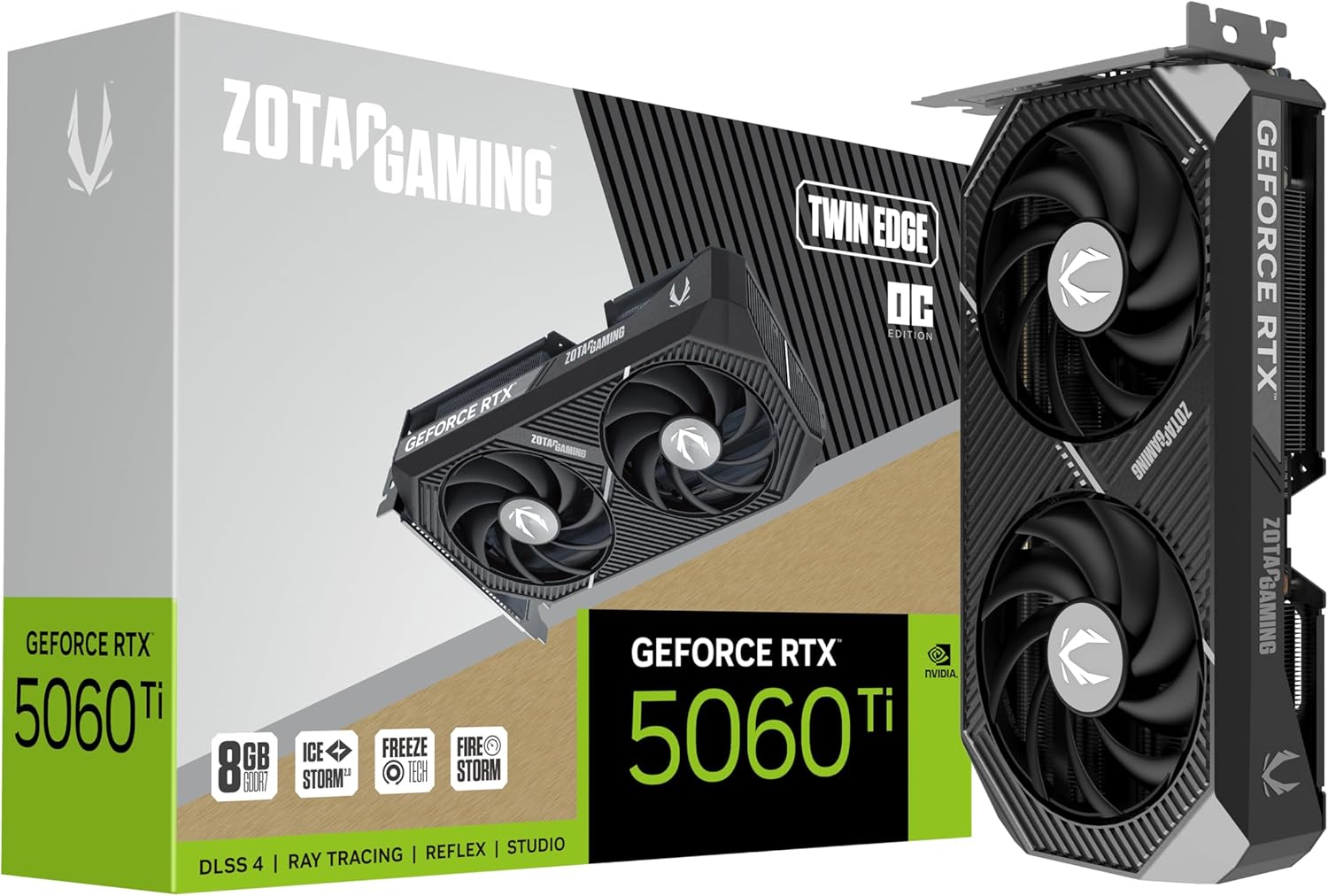
ZOTAC Gaming GeForce RTX 5060 Ti 8GB Twin Edge OC DLSS 4 8GB GDDR7 128-bit 28 Gbps PCIE 5.0 Gaming Graphics Card, IceStorm 2.0 Cooling, SFF-Ready, ZT-B50610H-10A
$300-$599This is a compact, 2-slot RTX 5060 Ti with 8GB GDDR7 and a 2602 MHz clock, built for SFF gaming rigs.