
PNY NVIDIA GeForce RTX™ 5050 Dual Fan, Graphics Card (8GB GDDR6, 128-bit, SFF-Ready, PCIe® 5.0, HDMI®/DP 2.1, 2-Slot, NVIDIA Blackwell Architecture, DLSS 4)
Want the best price and purchase timing?
Our AI advisor analyzes real-time pricing across all channels to find you the best deal.
AI Verdict
A 130W, 8GB GDDR6 (128-bit) Blackwell GPU designed for 1080p gaming with DLSS 4 support.
This PNY RTX 5050 is a situational fit, primarily for 1080p gamers on a budget who want access to NVIDIA's latest Blackwell architecture and DLSS 4 features. Its 8GB GDDR6 VRAM and 130W TDP make it suitable for efficient gaming in compact systems, but its performance and VRAM capacity might not satisfy those aiming for higher resolutions or long-term future-proofing.
If 1440p gaming or extended future-proofing is a priority, look for GPUs with at least 12GB of VRAM and a wider memory bus, potentially with GDDR7 memory.
Regret Score™
Medium RiskLower is better — measures purchase-regret risk from real buyer complaints, review credibility, and product maturity
Issues discovered after purchase
Critically weak dimension
Amazon rating vs actual quality
Chance this product isn't for you
Pros
- Features Blackwell architecture with 4th-gen Ray Tracing Cores and 5th-gen Tensor Cores for advanced AI capabilities.
- Supports DLSS 4 with Multi Frame Generation for boosted frame rates and improved image quality.
- Offers a solid 1080p gaming experience, handling modern titles at high settings.
- Operates with a low 130W TDP, contributing to minimal heat and noise output.
- Includes 3x DisplayPort 2.1 and 1x HDMI 2.1 outputs for modern display connectivity.
- Compact, SFF-Ready design makes it suitable for smaller PC builds.
Cons
- 8GB GDDR6 VRAM is considered underwhelming by some for 2025, potentially limiting longevity for future titles with higher texture demands.
- Utilizes a PCIe 5.0 x8 interface instead of x16, which might be a minor bottleneck in some scenarios.
- Performance is about 13% less than the RTX 4060 in compute performance.
- Some early opinions suggest pricing is too high compared to alternatives like the RTX 3060 or even some AMD cards.
- Requires an 8-pin power connector, which some users found surprising for its class.
Dimension Scores
Provides solid 1080p gaming at high settings and is significantly faster than the RTX 3050, but is slower than the RTX 4060 and not ideal for 1440p or 4K.
Early testing indicates the card never exceeded 67 Celsius and is described as extremely quiet, benefiting from its 130W TDP.
With a 130W TDP and a recommended 550W PSU, it's considered power-efficient for its performance class, leading to less heat and noise.
The 8GB GDDR6 VRAM is adequate for 1080p gaming currently but raises concerns about future-proofing and performance in upcoming titles with higher VRAM demands.
Best For
- Budget-conscious gamers targeting smooth 1080p gameplay at high settings.
- Small form factor (SFF) PC builds due to its compact design and 2-slot footprint.
- Users upgrading from older GPUs like the RTX 3050, seeking a significant performance uplift.
- Gamers who prioritize NVIDIA's AI features like DLSS 4 and Ray Tracing in supported titles.
Not Recommended For
- High-refresh rate 1440p or 4K gaming, where 8GB GDDR6 VRAM and overall performance may be insufficient.
- Users seeking best-in-class raw rasterization performance without relying on upscaling technologies.
- Those looking for a GPU with GDDR7 memory for future-proofing, as this card uses GDDR6.
Watch Out For
- The 8GB GDDR6 VRAM, while adequate for current 1080p gaming, is seen as a potential limitation for future games with increasing texture and asset demands, possibly shortening the card's relevance.
- Early discussions suggest the pricing might be too high, with some comparing its value unfavorably to older RTX 3060 cards or certain AMD alternatives.
- The PCIe 5.0 x8 interface, rather than x16, could theoretically limit bandwidth, though this is generally not a significant real-world issue for this performance tier.
- Despite its entry-level positioning, the card still requires an 8-pin power connector, which might be a consideration for some ultra-compact or pre-built systems.
Full Specifications
| ASIN | B0FRPFG6NW |
| Brand | PNY |
| Color | Black |
| Series | PNY GeForce RTX™ 5050 8GB Dual Fan GPU |
| Item Weight | 1.7 pounds |
| Manufacturer | PNY |
| Memory Speed | 2317 MHz |
| Chipset Brand | NVIDIA |
| GPU Clock Speed | 2317 MHz |
| Card Description | NVIDIA GeForce RTX 5050 with 8GB GDDR6, NVIDIA Blackwell architecture |
| Graphics Ram Size | 8 GB |
| Item model number | VCG50508DFXPB1 |
| Product Dimensions | 12.94 x 5.39 x 0.04 inches |
| Graphics Coprocessor | NVIDIA GeForce RTX 5050 |
| Max Screen Resolution | 7680x4320 |
| Graphics Card Ram Size | 8 GB |
| Item Dimensions LxWxH | 12.94 x 5.39 x 0.04 inches |
| Video Output Interface | DisplayPort, HDMI |
What Buyers Say
Early reviews and discussions around the PNY RTX 5050 highlight its role as an entry-level Blackwell card, bringing DLSS 4 and advanced AI features to a more accessible price point. While it's praised for efficient 1080p gaming and low power consumption, the 8GB GDDR6 VRAM is a recurring point of contention, with some questioning its longevity for future games. The card's performance is seen as a notable upgrade over the RTX 3050 but falls short of the RTX 4060.
“Look, if you're just trying to game at 1080p and want those new DLSS 4 features without breaking the bank, this PNY 5050 seems okay, but that 8GB VRAM is already making me nervous for next year's games.”
Common Praise
- Smooth 1080p gaming performance in modern titles.
- Inclusion of DLSS 4 with Multi Frame Generation for frame rate boosts.
- Low 130W power draw and efficient thermal performance, staying below 67 Celsius.
- Compact, SFF-Ready design for smaller PC cases.
- Support for modern display outputs like DisplayPort 2.1 and HDMI 2.1.
Common Complaints
- The 8GB GDDR6 VRAM is a concern for future game compatibility and high texture settings.
- Some early opinions suggest the price point is too high for the performance offered compared to alternatives.
- The PCIe 5.0 x8 interface is noted as a potential, albeit minor, limitation compared to x16.
- Performance is not a significant generational leap over some older, higher-tier cards.
Ownership Tips
- The 8GB GDDR6 VRAM might become a bottleneck sooner than expected in graphically demanding titles, especially at higher settings or resolutions.
- Its low 130W TDP means it should run cool and quiet even under load, making it a good fit for noise-sensitive setups.
- The compact, 2-slot design simplifies installation in a wide range of cases, including small form factor builds.
- Leveraging DLSS 4 with Frame Generation will be crucial for maintaining high frame rates in newer games, as raw rasterization performance might be limited.
Frequently Asked Questions
What kind of gaming performance can I expect from the RTX 5050?
The RTX 5050 is designed for smooth 1080p gaming, capable of running modern titles at high settings. It offers up to 60% better traditional raster performance compared to the RTX 3050.
Does the RTX 5050 support DLSS 4?
Yes, the RTX 5050 features DLSS 4 with Multi Frame Generation, which uses AI to boost frame rates and improve image quality in supported games.
Is 8GB of VRAM enough for modern games in 2025?
For 1080p gaming, 8GB GDDR6 VRAM is generally sufficient for many current titles. However, some early reviews express concern that it may limit the card's longevity as newer games demand more VRAM for higher texture settings.
What are the power requirements for the PNY RTX 5050?
The card has a Thermal Design Power (TDP) of 130W and an 8-pin power connector. A 550W power supply is recommended for a system using this GPU.
How does the RTX 5050 compare to the RTX 4060?
The RTX 5050 offers about 13% less compute performance than the RTX 4060. It's positioned as a more affordable entry point into the Blackwell architecture.
Buying Guide
When you're looking at a graphics card like this, you need to think about what resolution you play at. This card is built for 1080p. If you're trying to push 1440p or 4K, you're going to hit limits fast, especially with the VRAM. Also, consider if you're okay relying on upscaling tech like DLSS 4 to boost your frame rates, because that's where this card really shines for performance gains.
VRAM (Video RAM)
This is the memory on the graphics card that stores game textures and data. More VRAM means the card can handle higher resolution textures and more complex scenes without stuttering. 8GB is fine for 1080p now, but could be tight for future games.
TDP (Thermal Design Power)
This tells you how much heat the card generates and how much power it consumes. A lower TDP (like 130W here) means it runs cooler, quieter, and requires a less powerful (and often cheaper) power supply.
DLSS (Deep Learning Super Sampling)
NVIDIA's AI-powered upscaling technology. It renders games at a lower resolution and then uses AI to intelligently upscale them, giving you significantly higher frame rates with minimal visual quality loss. DLSS 4 is a key feature here for performance.
Alternatives
If this card doesn't quite fit, look for alternatives with at least 12GB of VRAM and a 192-bit or wider memory bus for better 1440p performance and improved longevity, or consider a GPU with GDDR7 memory if future-proofing is a major concern.
You Might Also Like

HP NVIDIA GeForce RTX 3070 8GB OEM Graphics Card (Renewed)
$150-$299This is a renewed HP OEM NVIDIA GeForce RTX 3070 with 8GB VRAM, a gamble for budget-conscious 1440p gamers who understand the risks of refurbished hardware.

ZOTAC Gaming GeForce RTX 5070 Twin Edge OC DLSS 4 12GB GDDR7 192-bit 28 Gbps PCIE 5.0 Gaming Graphics Card, IceStorm 2.0 Cooling, SFF-Ready, ZT-B50700H-10A
$600+This is a 2-slot, SFF-ready NVIDIA RTX 5070 with 12GB GDDR7 and a 2542 MHz boost clock, built for compact gaming rigs needing high 1440p performance.

ZOTAC Gaming GeForce RTX 5080 Solid CORE OC DLSS 4 16GB GDDR7 256-bit 30 Gbps PCIE 5.0 Gaming Graphics Card, IceStorm 3.0 Advanced Cooling, Spectra RGB Lighting, ZT-B50800J2-10A
$600+This ZOTAC RTX 5080 with 16GB GDDR7 and a 2640 GHz clock speed is built for high-end 4K gaming and content creation on the NVIDIA Blackwell architecture.
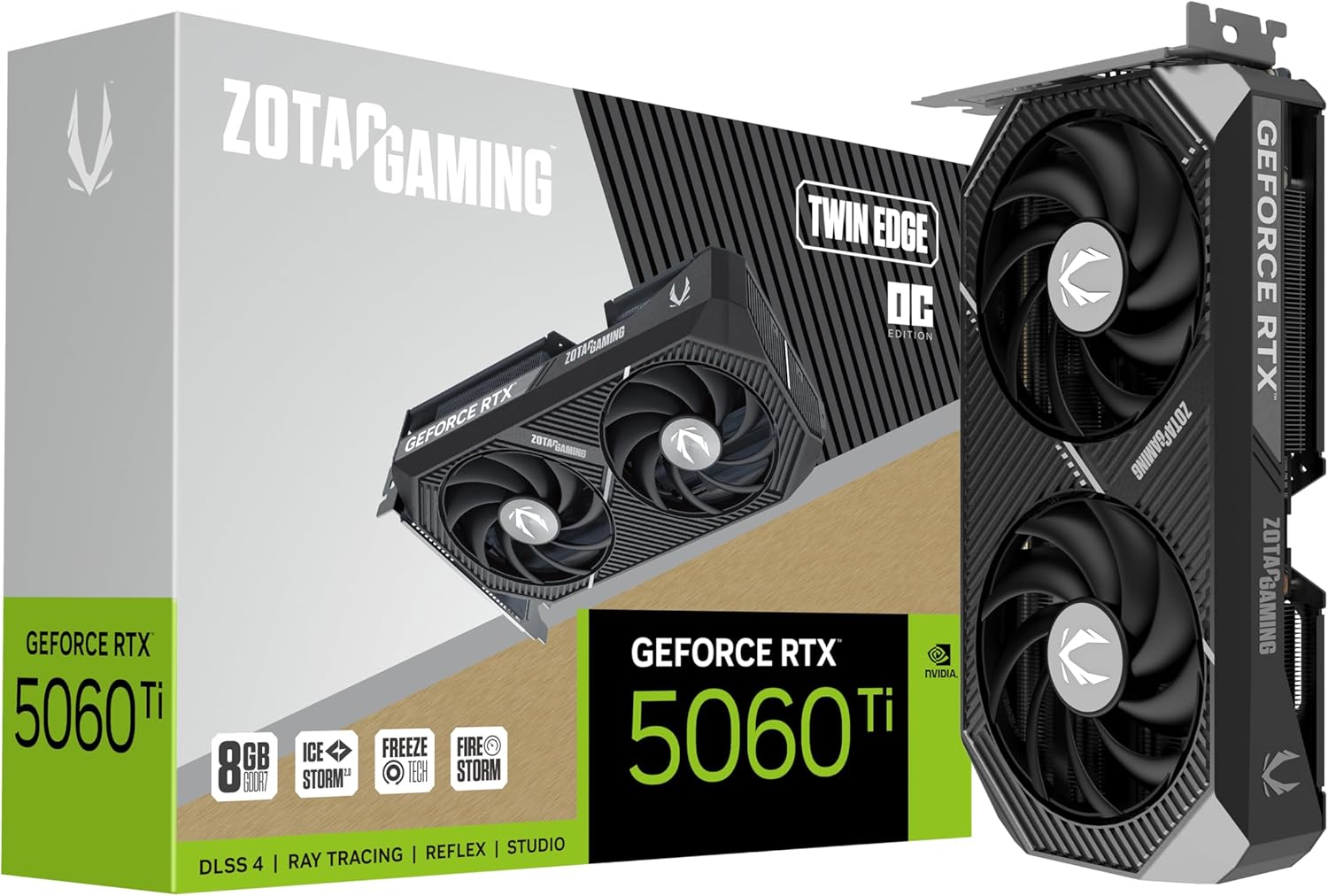
ZOTAC Gaming GeForce RTX 5060 Ti 8GB Twin Edge OC DLSS 4 8GB GDDR7 128-bit 28 Gbps PCIE 5.0 Gaming Graphics Card, IceStorm 2.0 Cooling, SFF-Ready, ZT-B50610H-10A
$300-$599This is a compact, 2-slot RTX 5060 Ti with 8GB GDDR7 and a 2602 MHz clock, built for SFF gaming rigs.