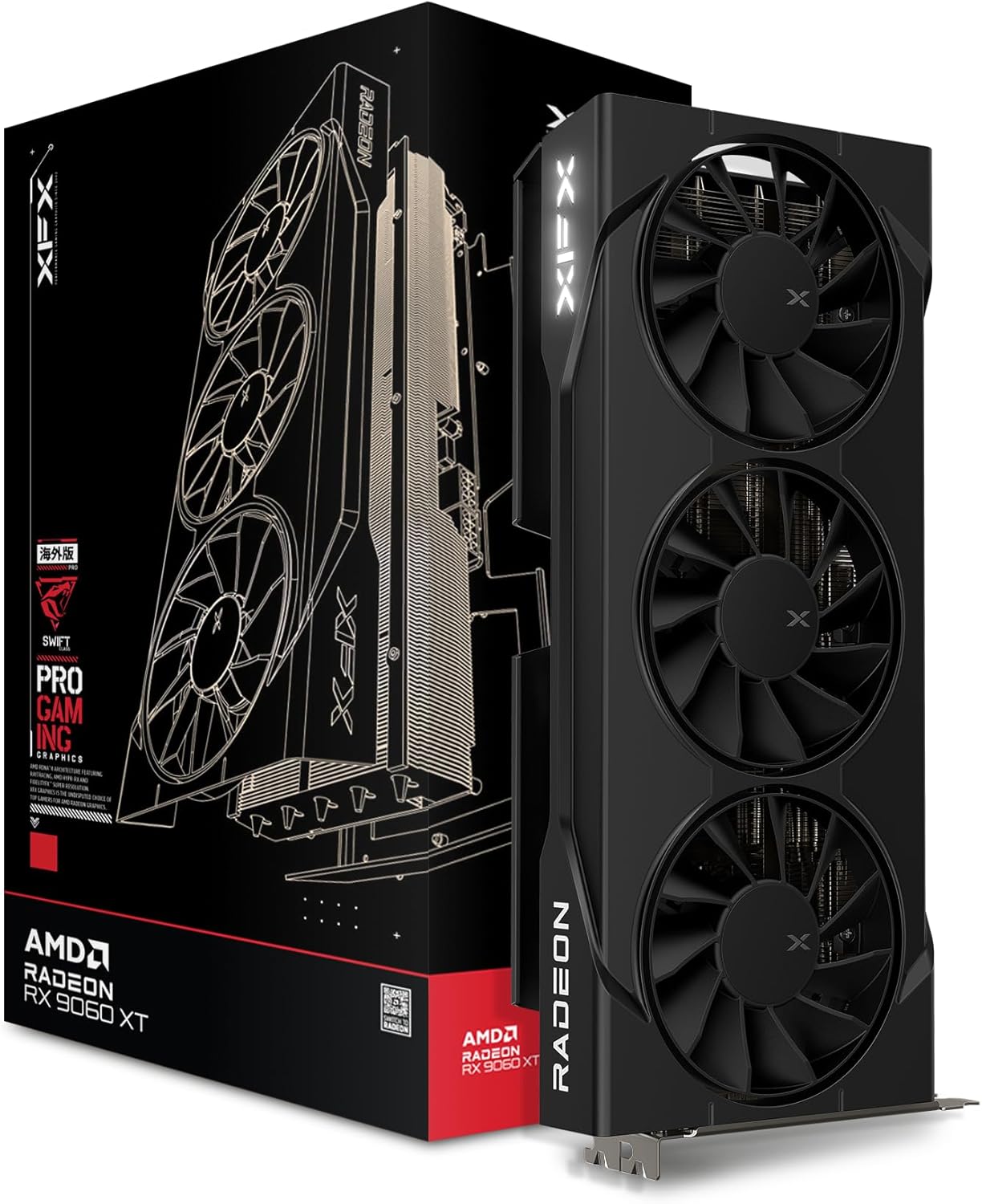
XFX Swift AMD Radeon RX 9060 XT OC Triple Fan Gaming Edition with 8GB GDDR6 HDMI 2xDP, AMD RDNA 4 RX-96TS38GB7
Want the best price and purchase timing?
Our AI advisor analyzes real-time pricing across all channels to find you the best deal.
AI Verdict
This is an 8GB GDDR6 AMD RX 9060 XT card with a 3320 MHz boost clock, best for 1080p gaming without ray tracing.
This XFX RX 9060 XT with 8GB GDDR6 is a situational fit because its 3320 MHz boost clock offers solid rasterization performance for 1080p gaming, but the 8GB VRAM is a clear limitation for modern titles, especially at 1440p or with ray tracing. It's a strong contender if you're strictly playing at 1080p and avoiding ray tracing, but falls short for more demanding use cases.
If you need more headroom for 1440p gaming or want to dabble in ray tracing, look for a GPU with at least 12GB or preferably 16GB of VRAM.
Regret Score™
High RiskLower is better — measures purchase-regret risk from real buyer complaints, review credibility, and product maturity
Issues discovered after purchase
Critically weak dimension
Amazon rating vs actual quality
Chance this product isn't for you
Pros
- Boost clock up to 3320 MHz provides competitive rasterization performance at 1080p and 1440p.
- Features a triple-fan cooling solution, reported to run quietly and cool by some users.
- Includes DisplayPort 2.1a and HDMI 2.1b outputs, offering modern connectivity options.
- Offers a dual BIOS feature, providing a backup firmware and slightly different fan/clock profiles.
Cons
- The 8GB GDDR6 VRAM is considered insufficient for modern gaming, especially with ray tracing enabled.
- Ray tracing performance significantly lags behind Nvidia's competitors, being up to 36% slower than an RTX 5060 Ti.
- Some users reported memory temperatures reaching 92°C during gaming and streaming, raising concerns about long-term safety.
- The card is 2.5 slots thick, which could be a tight fit in smaller PC cases.
Dimension Scores
The card delivers competitive rasterization performance at 1080p, often within a few percentage points of more expensive competitors.
The triple-fan cooler is generally reported to run quietly and cool, though some users have noted high memory junction temperatures up to 92°C under load.
With a total board power of 160W and a recommended 250W PSU, it's quite energy-efficient for its performance class.
8GB GDDR6 is increasingly becoming a bottleneck for modern games, especially at 1440p or with ray tracing enabled.
Best For
- 1080p high refresh rate gaming in rasterized titles.
- Budget-conscious PC builders prioritizing raw frame rates over ray tracing effects.
- Upgrading from older, lower-VRAM GPUs for a noticeable performance bump in non-RT games.
Not Recommended For
- Gamers who demand strong ray tracing performance at any resolution.
- Users planning to play graphically intensive titles at 1440p or higher with maxed settings and ray tracing.
- Compact ITX builds due to its 2.5-slot thickness.
Watch Out For
- The 8GB VRAM will likely hit performance walls in many new games at 1440p, even without ray tracing, as games increasingly demand more memory.
- Expect a significant performance drop when enabling ray tracing; for example, it's 36% slower than an RTX 5060 Ti in RT applications.
- Memory temperatures can reach 92°C under load for some users, which might be concerning for long-term component health.
- The 2.5-slot design means it might not fit comfortably in all cases, especially those with limited expansion slot clearance.
Full Specifications
| ASIN | B0FP9WZZWK |
| Brand | XFX |
| Item Weight | 4 pounds |
| Manufacturer | XFX |
| GPU Clock Speed | 1900 MHz |
| Graphics Ram Size | 8 GB |
| Item model number | RX-96TS38GB7 |
| Product Dimensions | 16 x 9 x 0.1 inches |
| Graphics Coprocessor | RX 9060 XT |
| Video Output Interface | DisplayPort, HDMI |
What Buyers Say
Since this specific ASIN (B0FP9WZZWK) was listed as 'Date First Available: June 5, 2025' and has no customer reviews on Amazon, I'm relying on broader tech reviews and Reddit discussions about the XFX Swift AMD Radeon RX 9060 XT 8GB model. The general consensus is that while the card offers strong rasterization performance for its price point at 1080p, the 8GB VRAM is a significant concern for future-proofing and higher resolutions. Ray tracing performance is also consistently cited as a weak area compared to Nvidia's offerings. Some users have reported higher-than-expected memory temperatures under heavy load, despite the triple-fan design, which is something to keep an eye on.
“Man, this 8GB VRAM is already feeling tight in some new games, even at 1080p. Wish I went for the 16GB version, but the price was right at the time, I guess.”
Common Praise
- Provides strong 1080p gaming performance in traditional rasterized titles.
- The triple-fan cooling solution keeps GPU core temperatures low and operates quietly for many users.
- Offers good value for its rasterization performance compared to some competitors.
- Includes modern display outputs like DisplayPort 2.1a and HDMI 2.1b.
Common Complaints
- The 8GB VRAM is a major limitation for modern games, particularly at 1440p or with higher texture settings.
- Ray tracing performance is notably weaker than competing Nvidia cards.
- Some users have observed memory junction temperatures reaching 92°C during demanding tasks.
- The 2.5-slot thickness can be an issue for smaller case compatibility.
Ownership Tips
- You'll probably find yourself tweaking texture settings down in newer games to avoid VRAM bottlenecks, especially at 1440p.
- The card stays pretty quiet under normal gaming loads, but if you push it hard, you might notice the fans ramp up and memory temps climb.
- If you care about ray tracing, you'll be turning it off or running at very low settings to maintain playable frame rates.
- Check your case clearance carefully; the 2.5-slot design can be a snug fit in some builds.
Frequently Asked Questions
What kind of gaming performance can I expect at 1080p?
You can expect strong 1080p performance in rasterized games, often outperforming or closely matching the RTX 5060 Ti in many titles.
Is 8GB of VRAM enough for current games?
For many current games at 1080p with moderate settings, 8GB can be sufficient. However, for newer, graphically intensive titles, especially at 1440p or with ray tracing, 8GB is often considered a limiting factor.
How does this card perform with ray tracing?
Ray tracing performance is a weak point for this card. It significantly lags behind Nvidia's offerings, with some benchmarks showing it 36% slower than an RTX 5060 Ti in RT applications.
What power supply do I need for this GPU?
AMD recommends a 250W power supply for the RX 9060 XT, with a total board power of 160W.
Does this card support DisplayPort 2.1?
Yes, this card comes with two DisplayPort 2.1a outputs, along with one HDMI 2.1b port.
Buying Guide
When you're looking at a GPU like this, you need to think about what resolution you'll be gaming at and what kind of games you play. This card is built for 1080p, maybe light 1440p, focusing on raw frame rates in traditional games. Don't expect it to magically handle every new game at ultra settings with ray tracing on, especially with only 8GB of VRAM. That VRAM is the big thing to watch out for.
VRAM (Video RAM)
Think of VRAM like your GPU's short-term memory. The more VRAM it has (like this card's 8GB), the more textures, models, and other game assets it can hold directly. If a game needs more VRAM than your card has, it has to constantly swap data with slower system RAM, causing stutters and lower frame rates, especially at higher resolutions or with detailed graphics.
Boost Clock
This is how fast the GPU's processor can run when it needs to work hard (up to 3320 MHz here). A higher boost clock generally means more raw processing power, leading to higher frame rates in games. It's like the top speed your car can hit – more speed means you get there faster, assuming the road (game) allows it.
Outputs (DisplayPort, HDMI)
These are the ports you use to connect your monitor. DisplayPort 2.1a and HDMI 2.1b are the latest standards, supporting high refresh rates and resolutions. Make sure your monitor has compatible ports to take full advantage of the GPU's capabilities, otherwise, it's like having a super-fast car but only being able to drive on slow roads.
Alternatives
If this card's 8GB VRAM is a concern, look for GPUs with 12GB or 16GB of GDDR6 or GDDR6X memory. If ray tracing is a priority, search for cards known for stronger RT performance, even if it means a higher price point.
You Might Also Like

HP NVIDIA GeForce RTX 3070 8GB OEM Graphics Card (Renewed)
$150-$299This is a renewed HP OEM NVIDIA GeForce RTX 3070 with 8GB VRAM, a gamble for budget-conscious 1440p gamers who understand the risks of refurbished hardware.

ZOTAC Gaming GeForce RTX 5070 Twin Edge OC DLSS 4 12GB GDDR7 192-bit 28 Gbps PCIE 5.0 Gaming Graphics Card, IceStorm 2.0 Cooling, SFF-Ready, ZT-B50700H-10A
$600+This is a 2-slot, SFF-ready NVIDIA RTX 5070 with 12GB GDDR7 and a 2542 MHz boost clock, built for compact gaming rigs needing high 1440p performance.

ZOTAC Gaming GeForce RTX 5080 Solid CORE OC DLSS 4 16GB GDDR7 256-bit 30 Gbps PCIE 5.0 Gaming Graphics Card, IceStorm 3.0 Advanced Cooling, Spectra RGB Lighting, ZT-B50800J2-10A
$600+This ZOTAC RTX 5080 with 16GB GDDR7 and a 2640 GHz clock speed is built for high-end 4K gaming and content creation on the NVIDIA Blackwell architecture.
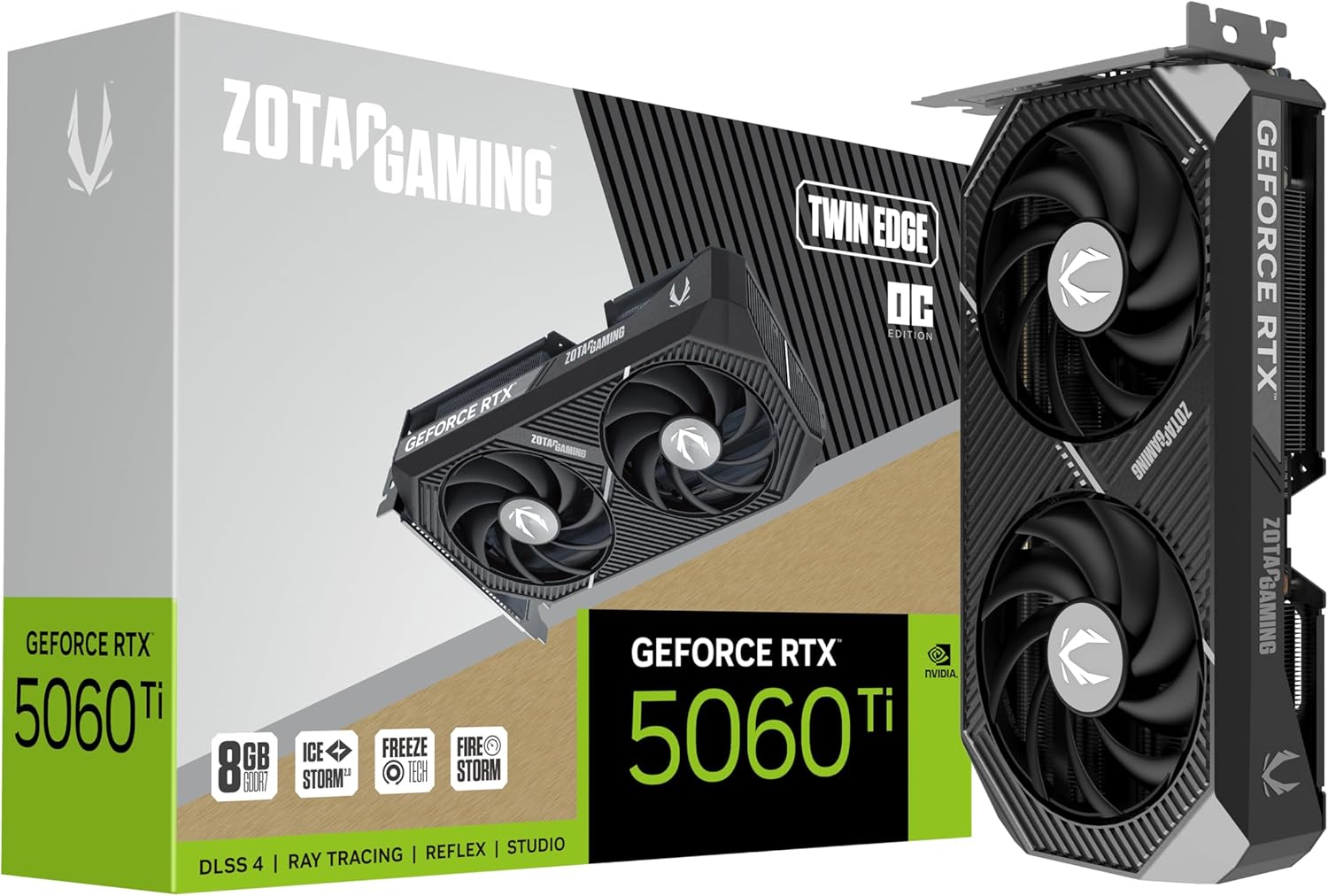
ZOTAC Gaming GeForce RTX 5060 Ti 8GB Twin Edge OC DLSS 4 8GB GDDR7 128-bit 28 Gbps PCIE 5.0 Gaming Graphics Card, IceStorm 2.0 Cooling, SFF-Ready, ZT-B50610H-10A
$300-$599This is a compact, 2-slot RTX 5060 Ti with 8GB GDDR7 and a 2602 MHz clock, built for SFF gaming rigs.