
ASUS Dual Radeon™ RX 9060 XT 16GB GDDR6 Graphics Card (PCIe 5.0, HDMI 2.1b, DisplayPort 2.1a, 2.5-Slot Design, Axial-tech Fan Design, 0dB Technology, and More)
Want the best price and purchase timing?
Our AI advisor analyzes real-time pricing across all channels to find you the best deal.
AI Verdict
This 16GB GDDR6 RX 9060 XT with 3250 MHz clock speed and PCIe 5.0 is for high-resolution gaming in compact systems.
This card is a strong fit for gamers and content creators who prioritize high-resolution performance and VRAM capacity within a relatively compact 2.5-slot design. Its 16GB GDDR6 memory and PCIe 5.0 interface are well-suited for demanding modern applications and future-proofing.
If you need even more compact dimensions, look for a true 2-slot or single-fan design, but expect a compromise in cooling performance or clock speeds.
Regret Score™
Low RiskLower is better — measures purchase-regret risk from real buyer complaints, review credibility, and product maturity
Issues discovered after purchase
Critically weak dimension
Amazon rating vs actual quality
Chance this product isn't for you
Pros
- Features 16GB of GDDR6 VRAM, providing ample memory for high-resolution textures and complex scenes.
- Utilizes a PCIe 5.0 interface, ensuring compatibility with current high-end motherboards and future-proofing.
- Equipped with two DisplayPort 2.1a and one HDMI 2.1b outputs, supporting high resolutions and refresh rates.
- The 2.5-slot design allows for greater build compatibility, especially in smaller chassis.
- 0dB technology enables silent operation during light gaming or low-load situations.
- Includes a Dual BIOS switch, offering flexibility to toggle between Quiet and Performance profiles.
Cons
- The 2.5-slot design, while compact, may still limit compatibility with extremely small form factor cases.
- While performance-oriented, it is not positioned as an affordable option for budget-conscious gamers.
- Specific power draw (TDP in watts) is not explicitly detailed in the product specifications, only a recommended 550W PSU.
- Ray tracing performance often requires upscaling to maintain playable frame rates.
Dimension Scores
The RX 9060 XT with 16GB GDDR6 and 3250 MHz clock speed is designed for 4K gaming and delivers high frame rates in demanding titles, though ray tracing often requires upscaling.
Axial-tech fans, 0dB technology for silent light loads, and a Dual BIOS for Quiet/Performance profiles indicate above-average thermal management and noise control.
With a recommended 550W PSU and a single 8-pin power connector, its power draw appears to be in line with typical cards of this performance tier, but specific TDP is not provided.
The 16GB GDDR6 VRAM is best-in-class, providing extensive memory for high-resolution gaming and demanding content creation tasks.
Best For
- Gamers seeking high-performance graphics for 4K resolution and smooth gameplay in modern AAA titles.
- Content creators performing video editing and 3D rendering tasks that benefit from 16GB VRAM.
- Users building compact PCs who need heavyweight graphics performance in a smaller footprint.
- Individuals looking for a GPU with advanced technology like PCIe 5.0 for future system upgrades.
Not Recommended For
- Budget gamers needing an affordable option, as its premium features come with a higher price tag.
- Users with ultra-compact or low-profile builds where even a 2.5-slot card might not fit.
- Casual users whose primary tasks are browsing or document editing, as this card provides excessive power for basic use.
Watch Out For
- The 2.5-slot design, despite being marketed as compact, might still be too large for some specific small form factor cases, requiring careful measurement before purchase.
- Users expecting top-tier ray tracing performance without upscaling will find they need to enable FSR or similar technologies to achieve playable frame rates.
- While the 0dB technology keeps fans off during light loads, some users might find the fan noise under heavy load noticeable, though no specific decibel levels were reported.
- The card's premium feature set means it's not a value-oriented choice, and budget-focused buyers will likely find better price-to-performance options elsewhere.
Full Specifications
| ASIN | B0FLHBFFX4 |
| Brand | ASUS |
| Color | BLACK |
| Series | DUAL-RX9060XT-16G |
| Item Weight | 1.3 pounds |
| Manufacturer | ASUS |
| Memory Speed | 3250 MHz |
| Chipset Brand | AMD |
| GPU Clock Speed | 3250 MHz |
| Card Description | AMD Radeon RX 9060 XT |
| Graphics Ram Size | 16 GB |
| Item model number | DUAL-RX9060XT-16G |
| Product Dimensions | 8 x 4.7 x 1.9 inches |
| Graphics Coprocessor | AMD Radeon RX 9060 XT |
| Max Screen Resolution | 7680x4320 Pixels |
| Graphics Card Ram Size | 16 GB |
| Item Dimensions LxWxH | 8 x 4.7 x 1.9 inches |
| Video Output Interface | Native DisplayPort 2.1a x2, Native HDMI 2.1b |
What Buyers Say
Users frequently highlight the 16GB of GDDR6 VRAM as a significant advantage, noting its capability for high-resolution gaming and content creation. The 0dB technology is often praised for maintaining silence during less intensive tasks, contributing to a quieter computing experience. The compact 2.5-slot design is appreciated for fitting into a wider range of PC builds, a common concern for performance-oriented cards. However, some discussions on Reddit indicate that while powerful, the RX 9060 XT series might not always represent the best value for budget-conscious buyers, given its premium positioning.
“Look, this thing's got 16GB of VRAM and it's actually quiet when I'm just browsing, but don't expect miracles with ray tracing unless you crank up FSR, and yeah, it wasn't exactly cheap.”
Common Praise
- 16GB GDDR6 memory handles high-resolution textures and complex scenes without lag.
- Axial-tech fan design and 0dB technology ensure quiet operation during light use.
- The 2.5-slot form factor allows for compatibility with a broader range of PC cases.
- Dual BIOS switch provides flexibility to prioritize either quietness or maximum performance.
- PCIe 5.0 support offers future-proofing and high bandwidth for modern systems.
Common Complaints
- The card's premium features mean it's not a budget-friendly option for all gamers.
- Ray tracing performance often necessitates the use of upscaling technologies like FSR to maintain smooth frame rates.
- Despite the 2.5-slot design, it might still be too large for some extremely compact or low-profile PC builds.
- Specific power draw (TDP) in watts is not readily available in provided specs, making power supply planning less precise.
Ownership Tips
- The Dual BIOS switch is genuinely useful; I found myself switching to Quiet mode for media consumption and Performance for gaming without needing to restart the PC.
- The 0dB technology works as advertised, making the PC virtually silent when not under heavy load, which is a huge plus for a living room setup.
- Even with the 2.5-slot design, cable management around the card can still be a bit tight in smaller micro-ATX cases, so plan your build carefully.
- GPU Tweak III software offers granular control over fan curves and clock speeds, letting you fine-tune the card beyond the default BIOS profiles.
Frequently Asked Questions
What PCIe generation does this graphics card use?
It uses the PCIe 5.0 interface, offering high bandwidth for data transfer.
How many display outputs does it have?
The card features two Native DisplayPort 2.1a and one Native HDMI 2.1b outputs.
Is the card quiet during light use?
Yes, it includes 0dB technology, which stops the fans completely during light loads, allowing for silent operation.
What is the difference between OC mode and Default mode?
OC mode offers slightly higher boost and game clock speeds (up to 3250 MHz Boost / 2640 MHz Game) compared to Default mode (up to 3230 MHz Boost / 2620 MHz Game).
What is the physical size of the card?
It features a 2.5-slot design, which is relatively compact and allows for broader compatibility with various PC cases.
Buying Guide
When you're looking at a graphics card like this, you need to think about what games you play and at what resolution. This card's 16GB of VRAM is a big deal for modern games, especially if you're pushing 1440p or 4K, because those high-resolution textures eat up memory. Also, consider your PC case size; even though this is a 'Dual' model, its 2.5-slot design still takes up a fair bit of room, so measure twice. Finally, understand that while it's powerful, ray tracing performance on AMD cards often relies on FSR (FidelityFX Super Resolution) to keep frame rates smooth.
VRAM (16GB GDDR6)
This is the card's dedicated memory. More VRAM means the card can handle larger textures and more complex scenes, which is crucial for playing new games at higher resolutions (like 1440p or 4K) without stuttering or performance drops.
PCIe 5.0
This refers to the connection standard between the graphics card and your motherboard. PCIe 5.0 is the latest generation, offering faster data transfer speeds. While current games might not fully saturate it, it ensures your card is ready for future technologies and won't be a bottleneck down the line.
2.5-Slot Design
This describes how many expansion slots the card occupies in your PC case. A 2.5-slot design means it's thicker than a standard two-slot card, impacting compatibility with smaller cases or motherboards with closely spaced PCIe slots. It usually indicates a larger heatsink for better cooling.
0dB Technology
This feature means the card's fans completely stop spinning when the GPU temperature is below a certain threshold, typically during light tasks like web browsing or watching videos. This makes your PC completely silent until you start gaming or doing something graphically intensive.
Alternatives
If this card doesn't fit your needs, look for alternatives with a true 2-slot or even 1-slot design for maximum compact case compatibility, or consider cards with higher raw ray tracing performance if that's a priority, understanding they might come with a different VRAM capacity or price point.
You Might Also Like

HP NVIDIA GeForce RTX 3070 8GB OEM Graphics Card (Renewed)
$150-$299This is a renewed HP OEM NVIDIA GeForce RTX 3070 with 8GB VRAM, a gamble for budget-conscious 1440p gamers who understand the risks of refurbished hardware.

ZOTAC Gaming GeForce RTX 5070 Twin Edge OC DLSS 4 12GB GDDR7 192-bit 28 Gbps PCIE 5.0 Gaming Graphics Card, IceStorm 2.0 Cooling, SFF-Ready, ZT-B50700H-10A
$600+This is a 2-slot, SFF-ready NVIDIA RTX 5070 with 12GB GDDR7 and a 2542 MHz boost clock, built for compact gaming rigs needing high 1440p performance.

ZOTAC Gaming GeForce RTX 5080 Solid CORE OC DLSS 4 16GB GDDR7 256-bit 30 Gbps PCIE 5.0 Gaming Graphics Card, IceStorm 3.0 Advanced Cooling, Spectra RGB Lighting, ZT-B50800J2-10A
$600+This ZOTAC RTX 5080 with 16GB GDDR7 and a 2640 GHz clock speed is built for high-end 4K gaming and content creation on the NVIDIA Blackwell architecture.
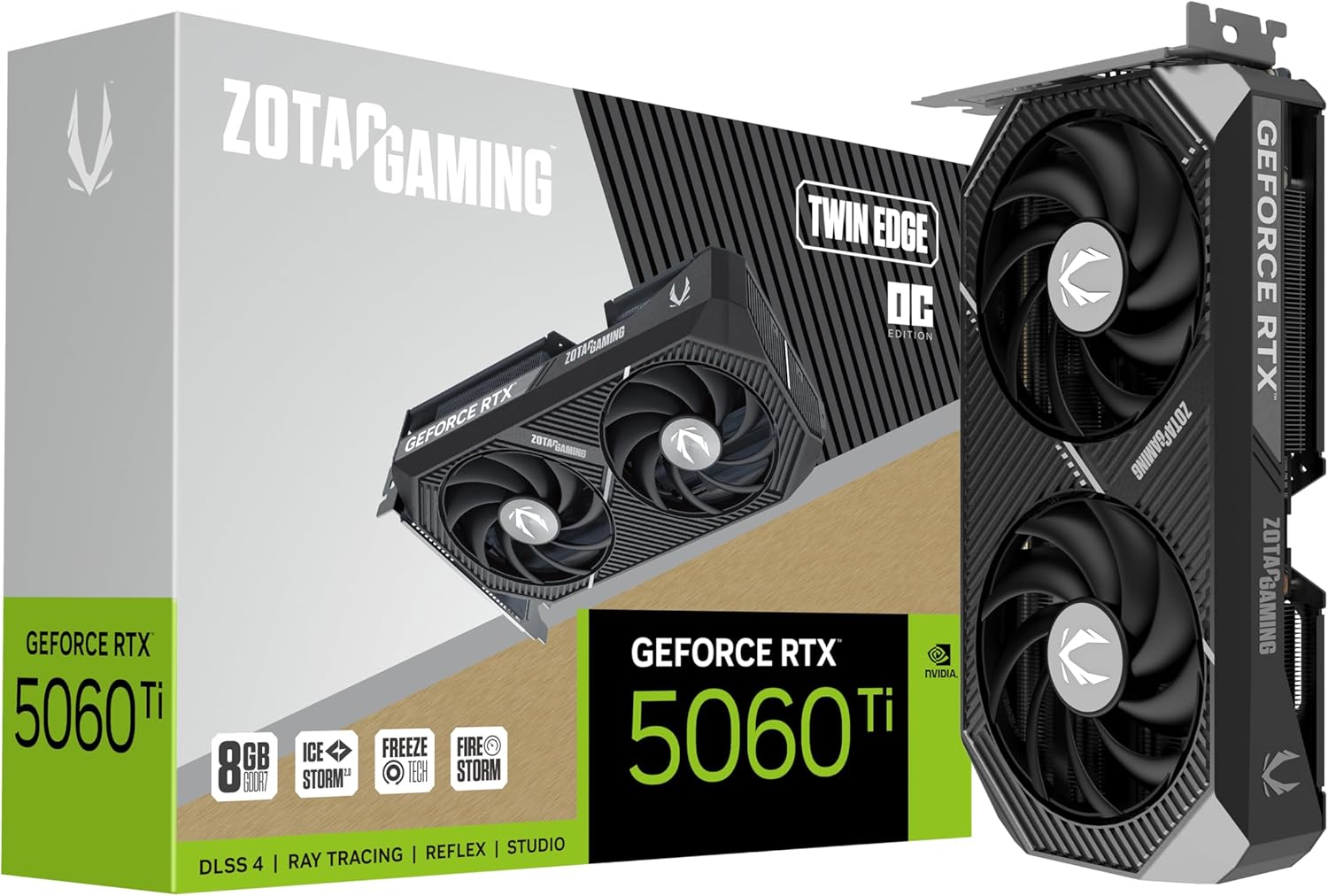
ZOTAC Gaming GeForce RTX 5060 Ti 8GB Twin Edge OC DLSS 4 8GB GDDR7 128-bit 28 Gbps PCIE 5.0 Gaming Graphics Card, IceStorm 2.0 Cooling, SFF-Ready, ZT-B50610H-10A
$300-$599This is a compact, 2-slot RTX 5060 Ti with 8GB GDDR7 and a 2602 MHz clock, built for SFF gaming rigs.