
XFX Radeon RX 480, 8GB GDDR5, Reference Graphics Card, PCI-Express
Want the best price and purchase timing?
Our AI advisor analyzes real-time pricing across all channels to find you the best deal.
AI Verdict
This is an older AMD Radeon RX 480 with 8GB VRAM and a single DisplayPort output, suitable only for 1080p gaming on a tight budget.
Regret Score™
Very High RiskLower is better — measures purchase-regret risk from real buyer complaints, review credibility, and product maturity
Issues discovered after purchase
Critically weak dimension
Amazon rating vs actual quality
Chance this product isn't for you
Pros
- Features 8GB of GDDR5 VRAM, which is helpful for 1080p gaming in some modern titles with adjusted settings.
- Capable of 1080p gaming, performing well in games like Doom at Ultra settings (140 FPS with Vulkan) and Overwatch (110 FPS) at its release.
- Some XFX models included a backplate, which can add to structural rigidity.
- Can be a significant upgrade from much older cards like a GTX 960 2GB.
- Supports DX12 and Vulkan APIs, which can improve performance in compatible games.
Cons
- The reference cooler design often runs warm under load and can be loud, with fans reaching around 2200 RPM to maintain 70°C.
- Limited output with only a single DisplayPort, restricting multi-monitor setups or older display compatibility.
- Overclocking headroom is minimal due to thermal and power limitations of the reference design.
- Some users reported crashing issues with the card.
- The listed 2 GHz clock speed is significantly higher than typical RX 480 boost clocks (around 1266-1288 MHz) and is likely a misrepresentation or typo, as user overclocks rarely exceeded 1370 MHz without thermal issues.
Dimension Scores
The RX 480 delivers entry-level 1080p performance in current games, often requiring medium settings or FSR for playable frame rates, a significant step down from its mid-range status at launch.
The reference cooler design is known to run warm under load, with fan speeds increasing to around 2200 RPM to maintain temperatures, resulting in noticeable noise.
The RX 480's power draw is average for its performance tier, typically requiring a single 6-pin power connector, though early reference cards had some PCIe slot power concerns that were addressed via drivers.
With 8GB of GDDR5 VRAM, this card offers a good capacity for 1080p gaming, allowing for higher texture settings in some titles compared to 4GB cards.
Best For
- 1080p gaming on a strict budget, willing to adjust settings.
- Upgrading from integrated graphics or a very old GPU (e.g., GTX 760/960 era) for basic gaming.
- Secondary PC builds where minimal cost is the priority.
- Systems with a single DisplayPort monitor.
Not Recommended For
- Competitive esports gaming requiring high frame rates at 1080p or higher resolutions.
- Users expecting quiet operation under gaming loads.
- Overclocking enthusiasts looking for performance gains.
- Multi-monitor setups requiring more than one DisplayPort output.
Watch Out For
- The listed 'Date First Available: July 22, 2025' is incorrect; the RX 480 was released in 2016, indicating this is likely a refurbished, re-listed, or very old stock item.
- The stated 2 GHz clock speed is highly improbable for a stock RX 480 core clock, which typically boosted around 1266-1288 MHz, suggesting a potential misrepresentation of performance.
- The single DisplayPort output severely limits connectivity options, making it incompatible with HDMI-only or DVI-only monitors without adapters.
- Reference design RX 480s are known to run warm and loud under load, with fan speeds reaching 2200 RPM to keep temperatures around 70°C.
- There are no specific user reviews for ASIN B0FK2XDB39, so actual product condition or seller support for this specific listing is unknown.
Full Specifications
| ASIN | B0FK2XDB39 |
| Brand | ReSpec.io |
| Manufacturer | Xfx |
| GPU Clock Speed | 2 GHz |
| Graphics Ram Size | 8 GB |
| Graphics Coprocessor | AMD Radeon RX 480 |
| Video Output Interface | DisplayPort |
What Buyers Say
This specific ASIN, B0FK2XDB39, lacks direct user reviews, which is a red flag, especially given the card's actual release date was 2016, not 2025. General feedback for the XFX RX 480 8GB reference model highlights its capability for 1080p gaming at the time of its release, but also points to its loud and warm operation under load due to the blower-style cooler. Users often found it to be a solid upgrade from older cards, but not a strong overclocker. The 8GB VRAM was a definite plus, helping it age better than 4GB variants.
“Look, I needed a cheap card for my old PC, and this RX 480 was 'available' for a decent price, but it's loud and I'm not sure about that 2GHz clock speed claim, feels like a refurbished gamble.”
Common Praise
- Handles 1080p gaming well for its price point, especially with settings adjusted.
- 8GB VRAM helps with texture quality in games.
- Noticeable performance improvement over older GPUs like the GTX 960.
- Some XFX models came with a backplate, improving aesthetics and rigidity.
Common Complaints
- Reference cooler gets loud under gaming load, with fans spinning up to 2200 RPM.
- Runs warm, often reaching 70°C or higher during extended gaming sessions.
- Limited overclocking potential due to thermal and power constraints.
- Some users experienced game crashes or instability.
- The bright blue LED on some XFX models was distracting and couldn't be turned off.
Ownership Tips
- Expect the fan to ramp up significantly during gaming, making it audible in a quiet room.
- You'll likely need to manually adjust fan curves or undervolt to manage temperatures and noise more effectively.
- Performance in newer titles will require lowering settings to medium or using FSR to maintain 60 FPS at 1080p.
- The single DisplayPort output means you're stuck with one monitor unless you use adapters, which can be finicky.
- Check the actual clock speeds with monitoring software; the listed 2 GHz is probably not what you'll get out of the box.
Frequently Asked Questions
Can this card run modern games at 1080p?
Yes, it can run many modern games at 1080p, but you'll likely need to lower graphics settings to medium or use upscaling technologies like FSR to achieve playable frame rates.
Is the 8GB VRAM enough for today's games?
The 8GB of GDDR5 VRAM is sufficient for 1080p gaming in many titles, especially when paired with appropriate graphics settings, preventing VRAM limitations that 4GB cards might face.
How loud is this graphics card?
The reference cooler design on the RX 480 is known to be audible under load, with fan speeds potentially reaching 2200 RPM to manage temperatures around 70°C.
What kind of power supply do I need for this card?
The RX 480 typically requires a single 6-pin power connector. A power supply of at least 500W is generally recommended for a system with this GPU, though specific system components will influence the exact requirement.
Can I overclock this XFX RX 480?
Overclocking headroom on the reference RX 480 is limited. Users report that pushing the core clock much beyond 1370 MHz can lead to high power draw and thermal throttling, making significant performance gains difficult.
Buying Guide
When you're looking at older GPUs like this RX 480, you need to set your expectations for 1080p gaming. It won't run everything on ultra settings, but it can still deliver playable frame rates if you're willing to tweak graphics options. Pay close attention to the seller and the 'Date First Available' because a card this old being listed as new in 2025 is a huge red flag for a refurbished or misleading product. Also, check the actual clock speeds reported by users or in detailed reviews, not just the headline number.
chipset (AMD Radeon RX 480)
This tells you the core processing power. The RX 480 was a mid-range card from 2016, so it's now considered entry-level. Think of it like an older car model; it still drives, but not as fast or with all the features of new ones.
vram (8 GB GDDR5)
VRAM is like the GPU's short-term memory for textures and game assets. 8GB is decent for 1080p gaming today, preventing stuttering in games that use a lot of texture data, even if the GPU itself isn't super fast.
clock_speed (2 GHz)
This is how fast the GPU's core processes data. A higher number usually means more performance. However, for this specific card, 2 GHz is unusually high for a stock RX 480 and should be viewed skeptically, as typical boost clocks were much lower (around 1.2-1.3 GHz).
output (DisplayPort)
These are the ports you use to connect your monitor. A single DisplayPort is very limited. Most modern setups use multiple monitors or need HDMI, so this restricts your display options significantly.
Alternatives
If this card doesn't fit, look for GPUs with a newer architecture for better 1080p performance, more video outputs (including HDMI 2.0/2.1), and a more efficient cooling solution for quieter operation.
You Might Also Like

HP NVIDIA GeForce RTX 3070 8GB OEM Graphics Card (Renewed)
$150-$299This is a renewed HP OEM NVIDIA GeForce RTX 3070 with 8GB VRAM, a gamble for budget-conscious 1440p gamers who understand the risks of refurbished hardware.

ZOTAC Gaming GeForce RTX 5070 Twin Edge OC DLSS 4 12GB GDDR7 192-bit 28 Gbps PCIE 5.0 Gaming Graphics Card, IceStorm 2.0 Cooling, SFF-Ready, ZT-B50700H-10A
$600+This is a 2-slot, SFF-ready NVIDIA RTX 5070 with 12GB GDDR7 and a 2542 MHz boost clock, built for compact gaming rigs needing high 1440p performance.

ZOTAC Gaming GeForce RTX 5080 Solid CORE OC DLSS 4 16GB GDDR7 256-bit 30 Gbps PCIE 5.0 Gaming Graphics Card, IceStorm 3.0 Advanced Cooling, Spectra RGB Lighting, ZT-B50800J2-10A
$600+This ZOTAC RTX 5080 with 16GB GDDR7 and a 2640 GHz clock speed is built for high-end 4K gaming and content creation on the NVIDIA Blackwell architecture.
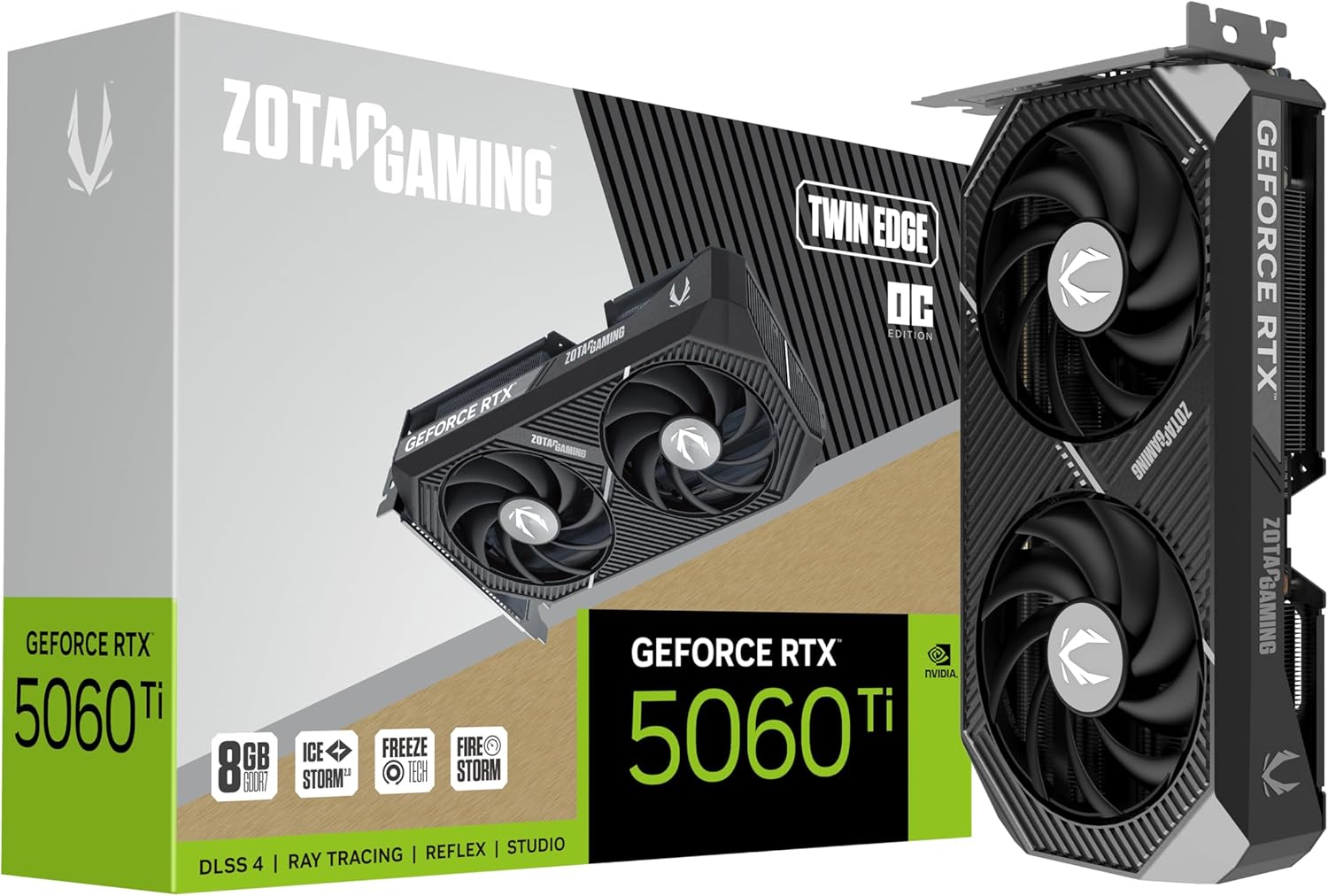
ZOTAC Gaming GeForce RTX 5060 Ti 8GB Twin Edge OC DLSS 4 8GB GDDR7 128-bit 28 Gbps PCIE 5.0 Gaming Graphics Card, IceStorm 2.0 Cooling, SFF-Ready, ZT-B50610H-10A
$300-$599This is a compact, 2-slot RTX 5060 Ti with 8GB GDDR7 and a 2602 MHz clock, built for SFF gaming rigs.