
XFX Mercury AMD Radeon RX 9060 XT OC Gaming Edition with 16GB GDDR6 HDMI 2xDP, AMD RDNA 4 RX-96TMERCB9
Want the best price and purchase timing?
Our AI advisor analyzes real-time pricing across all channels to find you the best deal.
AI Verdict
This XFX Mercury RX 9060 XT with 16GB GDDR6 is a 1080p gaming powerhouse, capable of 1440p with FSR, for gamers prioritizing VRAM capacity.
This GPU is a strong fit for 1080p and 1440p gaming, especially for those who value high VRAM capacity and efficient cooling. The 16GB GDDR6 memory and effective thermal design make it suitable for current and future demanding titles.
If you need stronger raw Ray Tracing performance or more mature upscaling technology, look for a card with a higher-tier chipset from the competing brand.
Regret Score™
Medium RiskLower is better — measures purchase-regret risk from real buyer complaints, review credibility, and product maturity
Issues discovered after purchase
Critically weak dimension
Amazon rating vs actual quality
Chance this product isn't for you
Pros
- Delivers high frame rates at 1080p resolution in most games.
- Features 16GB GDDR6 VRAM, which is beneficial for current and future games that demand more memory.
- Maintains low operating temperatures, often staying below 50°C during gameplay.
- Operates quietly, even under load, due to the Mercury edition's cooling focus.
- Achieves boost clock speeds up to 3320 MHz, with reported overclocking to over 3400 MHz.
- Offers DisplayPort and HDMI outputs for broad monitor compatibility.
Cons
- Ray Tracing performance is not as strong compared to competing cards in its class.
- FSR 4 support has been described as having poor implementation and widespread availability issues.
- The card's value proposition diminishes if its price approaches that of the RTX 5060 Ti.
- Some users in specific regions, like India, report potential after-sales and warranty challenges for XFX products.
Dimension Scores
It delivers amazing 1080p performance and handles 1440p well with FSR, with one user seeing 62 FPS in Cyberpunk at 1440p with FSR 4.
The Mercury edition focuses on cooling, resulting in the card rarely exceeding 50°C and operating quietly during gameplay.
Specific power draw figures are not available, so it's scored as category average based on typical RX 9060 XT expectations.
With 16GB GDDR6, this card offers substantial VRAM, which is a significant advantage for demanding games and future-proofing.
Best For
- Gamers targeting high refresh rate 1080p experiences.
- Players who want to game at 1440p using AMD's FSR and Frame Generation technologies.
- Users needing ample VRAM for demanding titles or content creation tasks that benefit from 16GB GDDR6.
- PC builders who prefer a quiet system, as the Mercury edition prioritizes thermal management.
Not Recommended For
- Users prioritizing top-tier Ray Tracing performance without relying heavily on upscaling.
- Those expecting seamless, universal FSR 4 integration across all games.
- Buyers in regions with limited XFX after-sales support.
Watch Out For
- The effectiveness of FSR 4 is inconsistent, with some users calling its support 'garbage'.
- While the card has 16GB VRAM, some 1080p games can still consume 9GB or more, pushing towards 12GB in certain scenarios.
- The card's competitive edge is reduced if its market price is close to the RTX 5060 Ti, which some perceive as a stronger alternative.
- Overclocking can push the boost clock over 3400 MHz, but this is not guaranteed for all units.
Full Specifications
| ASIN | B0FH2BTSTR |
| Brand | XFX |
| Item Weight | 3.91 pounds |
| Manufacturer | XFX |
| GPU Clock Speed | 1900 MHz |
| Graphics Ram Size | 16 GB |
| Item model number | RX-96TMERCB9 |
| Product Dimensions | 12.6 x 5 x 0.04 inches |
| Graphics Coprocessor | RX 9060 XT |
| Video Output Interface | DisplayPort, HDMI |
What Buyers Say
Users are consistently surprised by the card's ability to maintain low temperatures, often staying below 50°C even during extended gaming sessions. The 16GB of GDDR6 VRAM is frequently highlighted as a major benefit, especially for playing modern titles at 1080p and 1440p, with some games consuming up to 12GB. While 1080p performance is universally praised, its 1440p capabilities are also noted as strong, particularly when paired with FSR and Frame Generation. The card's quiet operation is another recurring positive, making it a good choice for noise-sensitive setups.
“Dude, this XFX Mercury 9060 XT is actually insane for 1080p, and even 1440p with FSR, plus it barely gets warm and is super quiet, totally worth it if you can snag it at a good price!”
Common Praise
- Achieves high frame rates at 1080p resolution.
- Handles 1440p gaming effectively with FSR and Frame Generation.
- Runs exceptionally cool, often below 50°C.
- Operates with minimal noise, even under heavy load.
- The 16GB GDDR6 VRAM provides ample memory for current and future games.
- Offers a noticeable performance upgrade over older generation cards like the RTX 2080.
Common Complaints
- Ray Tracing performance is not on par with competitors.
- FSR 4 implementation and support are inconsistent.
- Value proposition can be undermined if priced too close to the RTX 5060 Ti.
- Some users in certain regions face challenges with XFX after-sales support.
Ownership Tips
- The card's cooling solution is genuinely effective, keeping temperatures low even with a basic fan curve.
- The 16GB VRAM is not just marketing; games actually use a significant portion of it, especially at higher settings.
- AMD's software suite is preferred by some users over Nvidia's GeForce experience.
- Linux driver support is surprisingly robust, allowing many games to run well.
Frequently Asked Questions
What kind of performance can I expect at 1080p?
You can expect amazing performance at 1080p, with high frame rates in most games. One user reported a 20 FPS average increase over a 2080.
Is this card suitable for 1440p gaming?
Yes, it performs well at 1440p, especially when utilizing AMD's FSR and Frame Generation technologies. Cyberpunk on Ultra Ray Tracing with FSR 4 achieved 62 FPS.
How much VRAM does this card have?
The card comes with 16GB of GDDR6 VRAM, which is beneficial for modern games that are increasingly VRAM-hungry.
Does this GPU run hot or loud?
No, the XFX Mercury edition is designed with enhanced cooling and typically runs quietly, with reported temperatures rarely exceeding 50°C during gaming.
What display outputs does it have?
It includes both DisplayPort and HDMI outputs, offering flexibility for connecting to various monitors.
Buying Guide
When you're looking at a GPU like this, you're basically buying the engine for your gaming PC. It's what renders all the graphics, from simple menus to complex open worlds. The key is balancing its power with your monitor's resolution and refresh rate. Don't overspend on a card that's too powerful for your screen, or underspend and bottleneck your experience.
chipset (RX 9060 XT)
This is the core processor of the graphics card, like the CPU for your computer. A higher-tier chipset means more raw processing power for games and applications, directly impacting how many frames per second you'll see.
vram (16GB GDDR6)
VRAM is dedicated memory for graphics, similar to RAM for your system. More VRAM allows the GPU to store more textures, models, and other graphical data, which is crucial for higher resolutions, detailed graphics settings, and future-proofing your card for new games.
boost_clock (Up to 3320 MHz)
This is the maximum speed the GPU's core can reach under ideal conditions. A higher boost clock generally means faster performance, as the GPU can process more calculations per second, leading to smoother gameplay.
output (DisplayPort, HDMI)
These are the ports you'll use to connect your monitor. DisplayPort is generally preferred for high refresh rate and high-resolution gaming, while HDMI is more common for TVs and some monitors. Make sure the card's outputs match your monitor's inputs.
Alternatives
If this card doesn't quite hit the mark, consider looking for GPUs with a higher chipset number for better raw performance, or a competing brand's equivalent if Ray Tracing is a top priority.
You Might Also Like

HP NVIDIA GeForce RTX 3070 8GB OEM Graphics Card (Renewed)
$150-$299This is a renewed HP OEM NVIDIA GeForce RTX 3070 with 8GB VRAM, a gamble for budget-conscious 1440p gamers who understand the risks of refurbished hardware.

ZOTAC Gaming GeForce RTX 5070 Twin Edge OC DLSS 4 12GB GDDR7 192-bit 28 Gbps PCIE 5.0 Gaming Graphics Card, IceStorm 2.0 Cooling, SFF-Ready, ZT-B50700H-10A
$600+This is a 2-slot, SFF-ready NVIDIA RTX 5070 with 12GB GDDR7 and a 2542 MHz boost clock, built for compact gaming rigs needing high 1440p performance.

ZOTAC Gaming GeForce RTX 5080 Solid CORE OC DLSS 4 16GB GDDR7 256-bit 30 Gbps PCIE 5.0 Gaming Graphics Card, IceStorm 3.0 Advanced Cooling, Spectra RGB Lighting, ZT-B50800J2-10A
$600+This ZOTAC RTX 5080 with 16GB GDDR7 and a 2640 GHz clock speed is built for high-end 4K gaming and content creation on the NVIDIA Blackwell architecture.
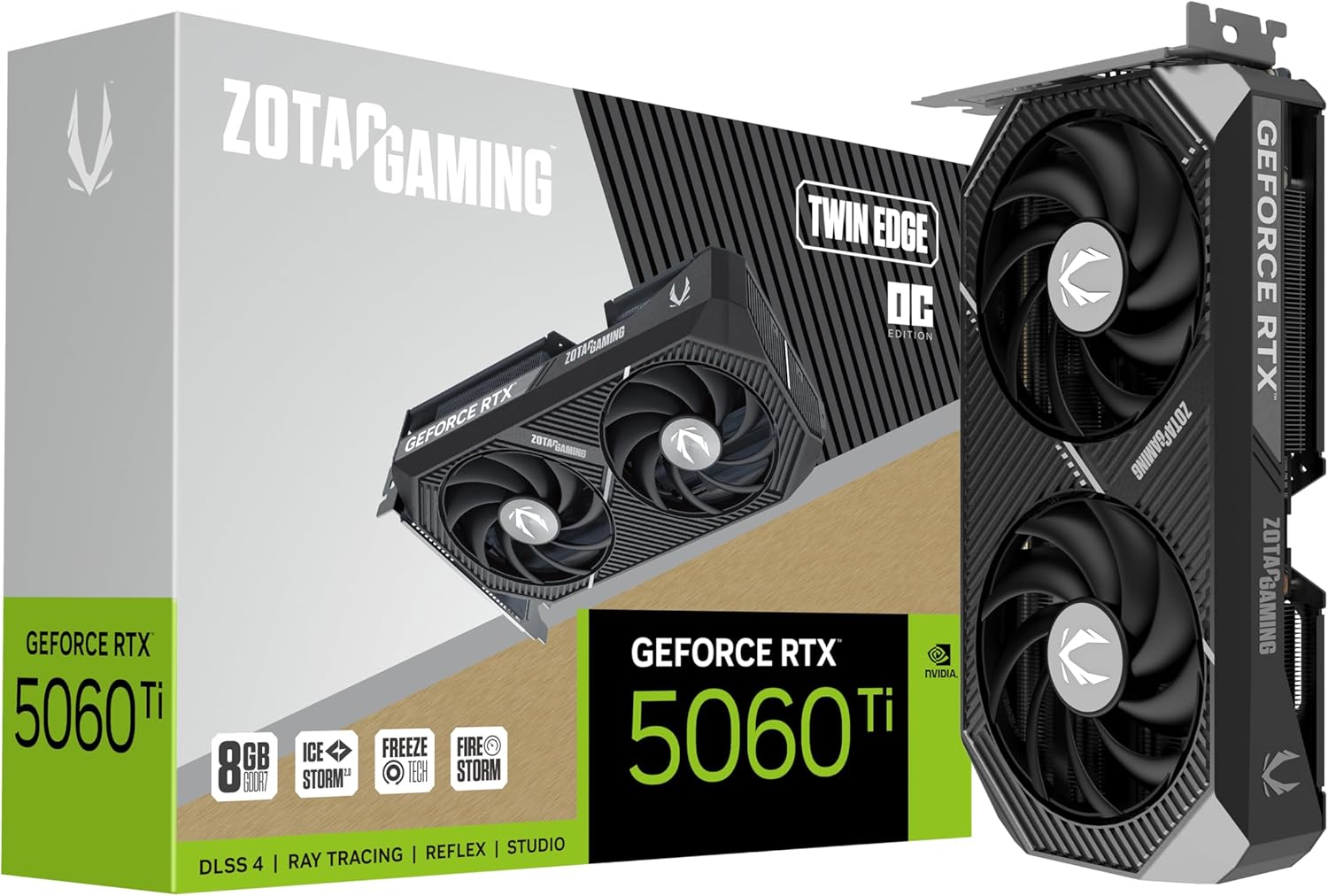
ZOTAC Gaming GeForce RTX 5060 Ti 8GB Twin Edge OC DLSS 4 8GB GDDR7 128-bit 28 Gbps PCIE 5.0 Gaming Graphics Card, IceStorm 2.0 Cooling, SFF-Ready, ZT-B50610H-10A
$300-$599This is a compact, 2-slot RTX 5060 Ti with 8GB GDDR7 and a 2602 MHz clock, built for SFF gaming rigs.