
ZOTAC Gaming GeForce RTX 5050 Solo DLSS 4 8GB GDDR6 128-bit 20 Gbps PCIE 5.0 Gaming Graphics Card, SFF-Ready Super Compact Card, ZT-B50500G-10L
Want the best price and purchase timing?
Our AI advisor analyzes real-time pricing across all channels to find you the best deal.
AI Verdict
This ZOTAC RTX 5050 Solo is an 8GB GDDR6, 128-bit, 2572 MHz boost clock, 164.5mm compact card for 1080p gaming in small form factor builds.
This ZOTAC RTX 5050 Solo is a situational fit, primarily due to its ultra-compact 164.5mm length and 2-slot design, making it one of the few options for extremely space-constrained Small Form Factor PCs. However, its 8GB VRAM and performance, which often only matches last-gen mid-range cards, mean it's not a strong performer for its price point.
If you have more case space and a slightly larger budget, look for a card with at least 12GB of VRAM and a higher CUDA core count for better longevity and performance in modern games.
Regret Score™
High RiskLower is better — measures purchase-regret risk from real buyer complaints, review credibility, and product maturity
Issues discovered after purchase
Critically weak dimension
Amazon rating vs actual quality
Chance this product isn't for you
Pros
- Its 164.5mm length and 2-slot width allow it to fit in 99% of PC builds, including SFF cases.
- Features NVIDIA's Blackwell architecture and DLSS 4 for modern rendering capabilities.
- Equipped with 3x DisplayPort 2.1b and 1x HDMI 2.1b, supporting up to 4 displays and 8K resolution.
- Requires only a single 8-pin PCIe power connector and a 550W recommended PSU, simplifying power requirements.
- Offers decent content creation performance for its price point.
Cons
- Gaming performance is often described as lackluster for its price, frequently trading blows with or being slightly behind the previous generation's RTX 4060 at 1080p.
- The 8GB GDDR6 VRAM can be a limitation in some modern games at 1080p, with titles like 'The Last of Us Part One' utilizing over 9GB.
- Has a higher power consumption for its performance level compared to some alternatives, with a 130W TDP.
- Utilizes a PCIe 5.0 x8 interface, which is half the bandwidth of a full x16 slot.
- The RTX 5060, for approximately $50 more, offers significantly better value with 50% more CUDA cores and other hardware.
Dimension Scores
Its 1080p gaming performance is often described as lackluster for its price, frequently matching or slightly trailing the previous generation's RTX 4060.
The single 90mm BladeLink fan and composite heatpipes are designed for a compact card, but professional reviews don't highlight exceptional thermal performance or quiet operation for its 130W TDP.
With a 130W TDP and an 8-pin connector, its power consumption is considered high relative to its performance output compared to some alternatives.
The 8GB GDDR6 VRAM is already proving insufficient for some modern 1080p games, which can utilize over 9GB, limiting its future-proofing.
Best For
- Small Form Factor (SFF) PC builds where space is extremely limited due to its 164.5mm length.
- Casual 1080p gaming in titles like Fortnite or Counter-Strike 2.
- Users prioritizing modern features like DLSS 4 and Blackwell architecture in a compact package.
- Budget-conscious content creation tasks that benefit from NVIDIA's ecosystem.
Not Recommended For
- Competitive 1440p or 4K gaming, where its 8GB VRAM and performance will be a bottleneck.
- Users seeking the best performance-per-dollar in the entry-level segment, as alternatives offer more power for a similar or slightly higher cost.
- Demanding AAA titles at high settings, especially those that are VRAM-intensive.
Watch Out For
- The 8GB GDDR6 VRAM is a significant limitation, with some 1080p games already exceeding this capacity, leading to performance issues.
- Performance-per-dollar is a concern, as the RTX 5060, costing only about $50 more, provides a 50% increase in core hardware.
- Despite being a new generation card, its 1080p gaming performance often only matches or slightly surpasses the previous generation's RTX 4060.
- The card has a 130W TDP, which is considered high for its performance tier, potentially impacting system thermals and power draw in SFF builds.
Full Specifications
| ASIN | B0FG9KQ9D7 |
| Brand | ZOTAC |
| Color | Gun Metal |
| Series | ZOTAC GAMING GeForce RTX 5050 SOLO |
| Item Weight | 1.46 pounds |
| Manufacturer | ZOTAC |
| Memory Speed | 20 GHz |
| Chipset Brand | NVIDIA |
| GPU Clock Speed | 2572 MHz |
| Card Description | Dedicated |
| Graphics Ram Size | 8 GB |
| Item model number | ZT-B50500G-10L |
| Product Dimensions | 6.5 x 1.4 x 0.1 inches |
| Graphics Coprocessor | GeForce RTX 5050 |
| Max Screen Resolution | 7680x4320 |
| Graphics Card Ram Size | 8 GB |
| Item Dimensions LxWxH | 6.5 x 1.4 x 0.1 inches |
| Video Output Interface | 3x DP 2.1b, HDMI 2.1b |
What Buyers Say
Actual user reviews for the ZOTAC Gaming GeForce RTX 5050 Solo are not widely available across major retail platforms or forums at this time. Professional reviews indicate that while the card is a marvel of compact engineering, its gaming performance often falls short of expectations for its price point. Many reviewers noted that for a slightly higher investment, the RTX 5060 offers a significantly better performance-per-dollar ratio. The 8GB VRAM is also a recurring concern, as it can be a bottleneck in newer, more demanding games even at 1080p.
“Man, I really wanted to love this little card for my tiny PC, but the games I actually play just chug on it, and for like fifty bucks more, I could've gotten way more frames. Kinda regretting not just saving up a bit longer.”
Common Praise
- Its extremely compact 164.5mm length and 2-slot design make it ideal for SFF builds.
- Includes modern features like NVIDIA's Blackwell architecture and DLSS 4.
- Requires only a single 8-pin power connector, simplifying PSU requirements.
- Offers decent performance for content creation tasks at its price.
Common Complaints
- Gaming performance is often considered lackluster for its price, frequently being outperformed by or only matching the previous generation's RTX 4060.
- The 8GB GDDR6 VRAM is a significant limitation, with some 1080p games already exceeding this capacity.
- The RTX 5060 offers a much better performance-to-price ratio for only about $50 more.
- High power consumption (130W TDP) for its performance tier.
Ownership Tips
- The card's small size genuinely opens up possibilities for builds that larger cards simply can't fit into.
- DLSS 4, when available and implemented well, can significantly boost frame rates, making some games more playable than native resolution would allow.
- Monitoring VRAM usage is crucial, as hitting the 8GB limit can cause noticeable stuttering and performance drops in certain titles.
- The single fan can get audible under load, especially in a compact case with limited airflow.
Frequently Asked Questions
What kind of gaming performance can I expect at 1080p?
You can expect playable frame rates in less demanding titles like Fortnite, but in more graphically intensive games, performance often only trades blows with or is slightly behind the RTX 4060, and 8GB VRAM can be a limiting factor.
Is this card suitable for Small Form Factor (SFF) PC builds?
Yes, its 'Solo' designation means it's specifically designed for SFF builds, with a super compact 164.5mm length and a 2-slot width, allowing it to fit in most compact cases.
Does this graphics card support ray tracing and DLSS?
Yes, it's powered by NVIDIA's Blackwell architecture and supports DLSS 4, including features like Multi Frame Generation, for enhanced visuals and performance in compatible games.
What power supply do I need for this card?
ZOTAC recommends a 550W power supply, and the card requires a single 8-pin PCIe power connector.
How many monitors can I connect to this graphics card?
The card features 3x DisplayPort 2.1b and 1x HDMI 2.1b, allowing you to connect up to four displays simultaneously.
Is the PCIe 5.0 x8 interface a bottleneck?
While it uses PCIe 5.0, it operates at x8 lanes, which is half the bandwidth of a full x16 slot. For this card's performance tier, it's unlikely to be a significant bottleneck in most scenarios, but it's a specification to note.
Buying Guide
When buying a graphics card, you're essentially choosing how many frames per second you want at a given resolution and graphics quality. For a card like this, you need to know if its compact size is a necessity for your PC case, because you're making a trade-off on raw performance for that small footprint. Don't expect to max out every game at 1080p, and definitely don't buy it for 1440p or 4K gaming.
VRAM (Video RAM)
Think of VRAM like the workspace for your graphics card. More VRAM means the card can handle more textures, models, and effects in games without having to constantly swap data, which can cause stuttering. 8GB is becoming a tight squeeze for many new games at 1080p.
Clock Speed (Boost Clock)
This is how fast the GPU's processor can run. A higher clock speed generally means more calculations per second, leading to better performance. However, it's just one piece of the puzzle; the underlying architecture and number of processing units are equally important.
Memory Bus (128-bit)
The memory bus is like the highway connecting the GPU to its VRAM. A wider bus (e.g., 256-bit vs. 128-bit) allows more data to travel simultaneously, which is crucial for high-resolution textures and fast frame rates. A narrower bus can limit the card's potential even with fast VRAM.
PCIe 5.0 x8
This refers to the connection speed between the graphics card and your motherboard. PCIe 5.0 is the latest standard, offering very high bandwidth. However, 'x8' means it uses half the lanes of a full 'x16' slot. For this card's performance level, the x8 bandwidth is generally sufficient and won't be a major bottleneck.
Alternatives
If this card doesn't fit your needs, look for alternatives with at least 12GB of VRAM and a wider memory bus (192-bit or 256-bit) if you have more case space and a slightly larger budget, especially for 1080p gaming longevity or entry-level 1440p.
You Might Also Like

HP NVIDIA GeForce RTX 3070 8GB OEM Graphics Card (Renewed)
$150-$299This is a renewed HP OEM NVIDIA GeForce RTX 3070 with 8GB VRAM, a gamble for budget-conscious 1440p gamers who understand the risks of refurbished hardware.

ZOTAC Gaming GeForce RTX 5070 Twin Edge OC DLSS 4 12GB GDDR7 192-bit 28 Gbps PCIE 5.0 Gaming Graphics Card, IceStorm 2.0 Cooling, SFF-Ready, ZT-B50700H-10A
$600+This is a 2-slot, SFF-ready NVIDIA RTX 5070 with 12GB GDDR7 and a 2542 MHz boost clock, built for compact gaming rigs needing high 1440p performance.

ZOTAC Gaming GeForce RTX 5080 Solid CORE OC DLSS 4 16GB GDDR7 256-bit 30 Gbps PCIE 5.0 Gaming Graphics Card, IceStorm 3.0 Advanced Cooling, Spectra RGB Lighting, ZT-B50800J2-10A
$600+This ZOTAC RTX 5080 with 16GB GDDR7 and a 2640 GHz clock speed is built for high-end 4K gaming and content creation on the NVIDIA Blackwell architecture.
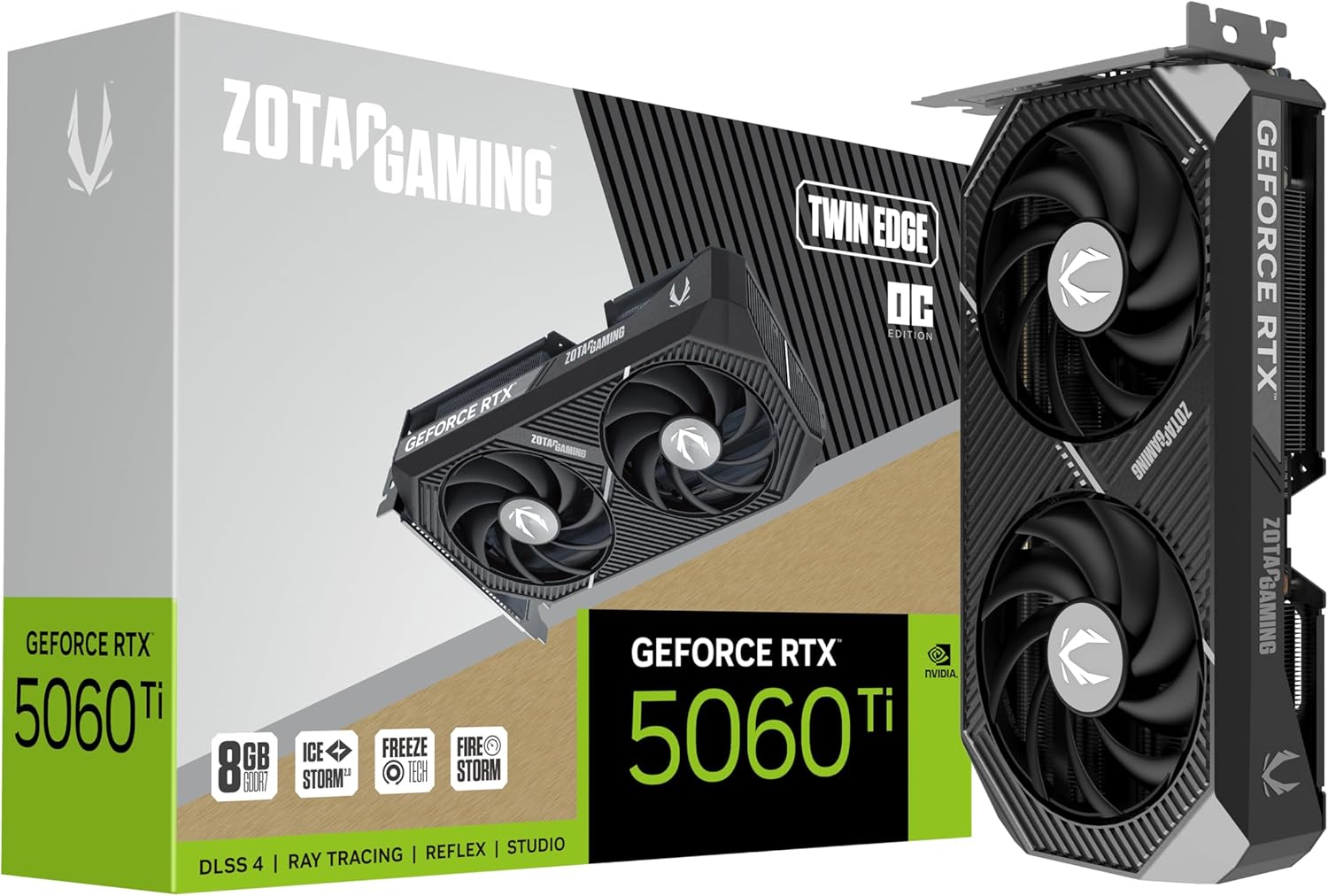
ZOTAC Gaming GeForce RTX 5060 Ti 8GB Twin Edge OC DLSS 4 8GB GDDR7 128-bit 28 Gbps PCIE 5.0 Gaming Graphics Card, IceStorm 2.0 Cooling, SFF-Ready, ZT-B50610H-10A
$300-$599This is a compact, 2-slot RTX 5060 Ti with 8GB GDDR7 and a 2602 MHz clock, built for SFF gaming rigs.