
msi Gaming RTX 5050 8G Shadow 2X OC Graphics Card (8GB GDDR6,128-bit, Extreme Performance: 2617 MHz, DisplayPort x3 2.1a, HDMI 2.1b, NVIDIA Blackwell Architecture)
Want the best price and purchase timing?
Our AI advisor analyzes real-time pricing across all channels to find you the best deal.
AI Verdict
A 8GB GDDR6 GPU with a 2617 MHz clock, built on NVIDIA Blackwell architecture for 1080p gaming with DLSS 4 support.
This GPU is a situational fit for gamers targeting solid 1080p performance with NVIDIA's latest architecture and DLSS 4. Its 8GB GDDR6 and 128-bit interface position it firmly in the mid-range, offering a 56% performance increase over the RTX 3050 for 1080p gaming.
If you need more headroom for 1440p gaming or future-proofing, look for GPUs with at least 12GB of VRAM and a wider memory bus (e.g., 192-bit or 256-bit).
Regret Score™
Medium RiskLower is better — measures purchase-regret risk from real buyer complaints, review credibility, and product maturity
Issues discovered after purchase
Critically weak dimension
Amazon rating vs actual quality
Chance this product isn't for you
Pros
- Powered by NVIDIA's Blackwell architecture and DLSS 4, enabling advanced graphics features and AI-enhanced performance.
- Features a 2617 MHz Extreme Performance clock speed for demanding gaming scenarios.
- Equipped with TORX Fan 5.0 and an efficient heat pipe design for maintaining high-pressure airflow and effective thermal energy transfer.
- Includes a reinforcing backplate with an airflow vent to enhance durability and cooling.
- Offers multiple display outputs with three DisplayPort 2.1a and one HDMI 2.1b for multi-monitor setups and high refresh rates.
- Draws 130W during gaming, making it compatible with a wider range of power supplies and older systems.
Cons
- The 128-bit memory interface might limit performance in future high-resolution or graphically intensive games.
- 8GB of GDDR6 VRAM could become a bottleneck for 1440p or 4K gaming in newer titles.
- Early community sentiment suggests the RTX 5050 series might offer questionable value compared to other options.
- The 'Shadow 2X OC' likely indicates a dual-fan cooler, which may not be as robust as triple-fan designs for sustained heavy loads, though likely adequate for this card's power target.
Dimension Scores
Provides solid 1080p gaming with a 56% performance increase over the RTX 3050, but is about 5% slower than Intel Arc B580 and AMD RX 7600 XT at stock.
Features TORX Fan 5.0, an efficient heat pipe design, and a reinforcing backplate with an airflow vent for effective cooling and quiet operation.
The 130W power consumption during gaming is efficient and accessible for a wide range of systems.
8GB GDDR6 is adequate for 1080p gaming but may become a limiting factor for future titles or higher resolutions.
Best For
- 1080p gaming with high refresh rates and NVIDIA's DLSS 4 technology.
- Upgrading an older system with a 130W power budget.
- Users who prioritize NVIDIA's ecosystem, including DLSS and ray tracing features, in a mid-range card.
- Content creation tasks that benefit from NVIDIA's GPU acceleration, like video editing or 3D rendering.
Not Recommended For
- Competitive 1440p or 4K gaming in demanding titles due to 8GB VRAM and 128-bit bus.
- Users seeking the absolute best price-to-performance ratio without considering NVIDIA-specific features.
- Compact PC builds, as the 'Shadow 2X OC' design may not fit mini-ITX cases.
Watch Out For
- No user reviews are available as of March 2026, so real-world performance and reliability are unconfirmed.
- The 8GB GDDR6 VRAM, while standard for this tier, might prove limiting for future game titles at higher settings or resolutions, potentially leading to stuttering.
- Speculative community discussions suggest the RTX 5050 series might be perceived as 'awfully expensive for what it is' or 'absolute garbage' in terms of value.
- While the 130W power consumption is efficient, it's crucial to ensure your power supply has adequate headroom and the necessary PCIe power connectors.
Full Specifications
| ASIN | B0FFVFD58L |
| Brand | msi |
| Item Weight | 1.75 pounds |
| Manufacturer | MSI |
| GPU Clock Speed | 2617 MHz |
| Graphics Ram Size | 8 GB |
| Item model number | RTX 5050 8G SHADOW 2X OC |
| Product Dimensions | 7.8 x 4.7 x 0.1 inches |
| Graphics Coprocessor | NVIDIA GeForce RTX 5050 |
| Video Output Interface | DisplayPort |
What Buyers Say
As of March 2026, there are no real user reviews available for the MSI Gaming RTX 5050 8G Shadow 2X OC Graphics Card, as its release date is June 27, 2025. Therefore, specific user experiences, common praise, complaints, or long-term ownership notes cannot be provided. Early speculative discussions on Reddit suggest mixed opinions on the RTX 5050 series' value proposition.
“Can't give a verdict yet, it's not even out! Gotta wait and see if this 5050 actually delivers or if it's just another 'budget' card that costs too much for what it does.”
Frequently Asked Questions
What kind of gaming performance can I expect from the RTX 5050?
The RTX 5050 is designed for solid 1080p gaming, offering a 56% performance increase over the RTX 3050. It leverages NVIDIA's Blackwell architecture and DLSS 4 for enhanced frame rates and visual quality.
Does this graphics card support ray tracing?
Yes, as part of the NVIDIA Blackwell architecture, the RTX 5050 supports ray tracing, allowing for more realistic lighting, shadows, and reflections in compatible games.
How much power does the MSI RTX 5050 consume?
The RTX 5050 has a power consumption of 130W during gaming, making it relatively efficient and suitable for systems with moderate power supplies.
Can I use this card for content creation or streaming?
Yes, the 8GB GDDR6 memory and NVIDIA's processing capabilities make it suitable for tasks like video editing, 3D rendering, and graphic design, accelerating rendering times and enhancing productivity. It's also suitable for streamers needing reliable graphics performance.
What are the display output options on this card?
The card features three DisplayPort 2.1a outputs and one HDMI 2.1b port, supporting multiple displays, 4K gaming, and high refresh rates.
Buying Guide
When looking at a GPU like this, you need to think about what games you play and at what resolution. This card is built for 1080p, so if you're rocking a 1080p monitor, you're probably in the sweet spot. Don't expect it to crush 4K, especially with only 8GB of VRAM. Also, consider your current power supply; while this card is efficient at 130W, you still need the right connectors.
8GB GDDR6 VRAM
This is the card's dedicated memory. More VRAM means the card can handle larger textures and more complex scenes without slowing down. 8GB is fine for most 1080p games today, but some newer, very demanding titles might start to push that limit, especially if you crank up texture quality.
128-bit Memory Interface
Think of this as the highway for data between the GPU and its VRAM. A wider highway (higher bit count) means more data can travel at once. A 128-bit interface is typical for mid-range cards, but it can be a bottleneck for raw bandwidth compared to cards with 192-bit or 256-bit interfaces, which affects performance in high-resolution gaming.
NVIDIA Blackwell Architecture & DLSS 4
Blackwell is the underlying design of the GPU, bringing improvements in efficiency and performance. DLSS 4 (Deep Learning Super Sampling) is an AI-powered upscaling technology that allows the card to render games at a lower resolution and then intelligently upscale them to your display's resolution, resulting in significantly higher frame rates with minimal visual quality loss in supported games.
2617 MHz Clock Speed
This is how fast the GPU's core processing unit operates. A higher clock speed generally means more calculations per second, leading to better performance. 2617 MHz is a factory overclocked speed, indicating it's tuned for higher performance out of the box compared to a reference design.
Alternatives
If this card doesn't fit, look for GPUs with at least 12GB of VRAM and a 192-bit or 256-bit memory bus for better 1440p performance, or consider cards with lower power consumption if your system has strict power limits.
You Might Also Like

HP NVIDIA GeForce RTX 3070 8GB OEM Graphics Card (Renewed)
$150-$299This is a renewed HP OEM NVIDIA GeForce RTX 3070 with 8GB VRAM, a gamble for budget-conscious 1440p gamers who understand the risks of refurbished hardware.

ZOTAC Gaming GeForce RTX 5070 Twin Edge OC DLSS 4 12GB GDDR7 192-bit 28 Gbps PCIE 5.0 Gaming Graphics Card, IceStorm 2.0 Cooling, SFF-Ready, ZT-B50700H-10A
$600+This is a 2-slot, SFF-ready NVIDIA RTX 5070 with 12GB GDDR7 and a 2542 MHz boost clock, built for compact gaming rigs needing high 1440p performance.

ZOTAC Gaming GeForce RTX 5080 Solid CORE OC DLSS 4 16GB GDDR7 256-bit 30 Gbps PCIE 5.0 Gaming Graphics Card, IceStorm 3.0 Advanced Cooling, Spectra RGB Lighting, ZT-B50800J2-10A
$600+This ZOTAC RTX 5080 with 16GB GDDR7 and a 2640 GHz clock speed is built for high-end 4K gaming and content creation on the NVIDIA Blackwell architecture.
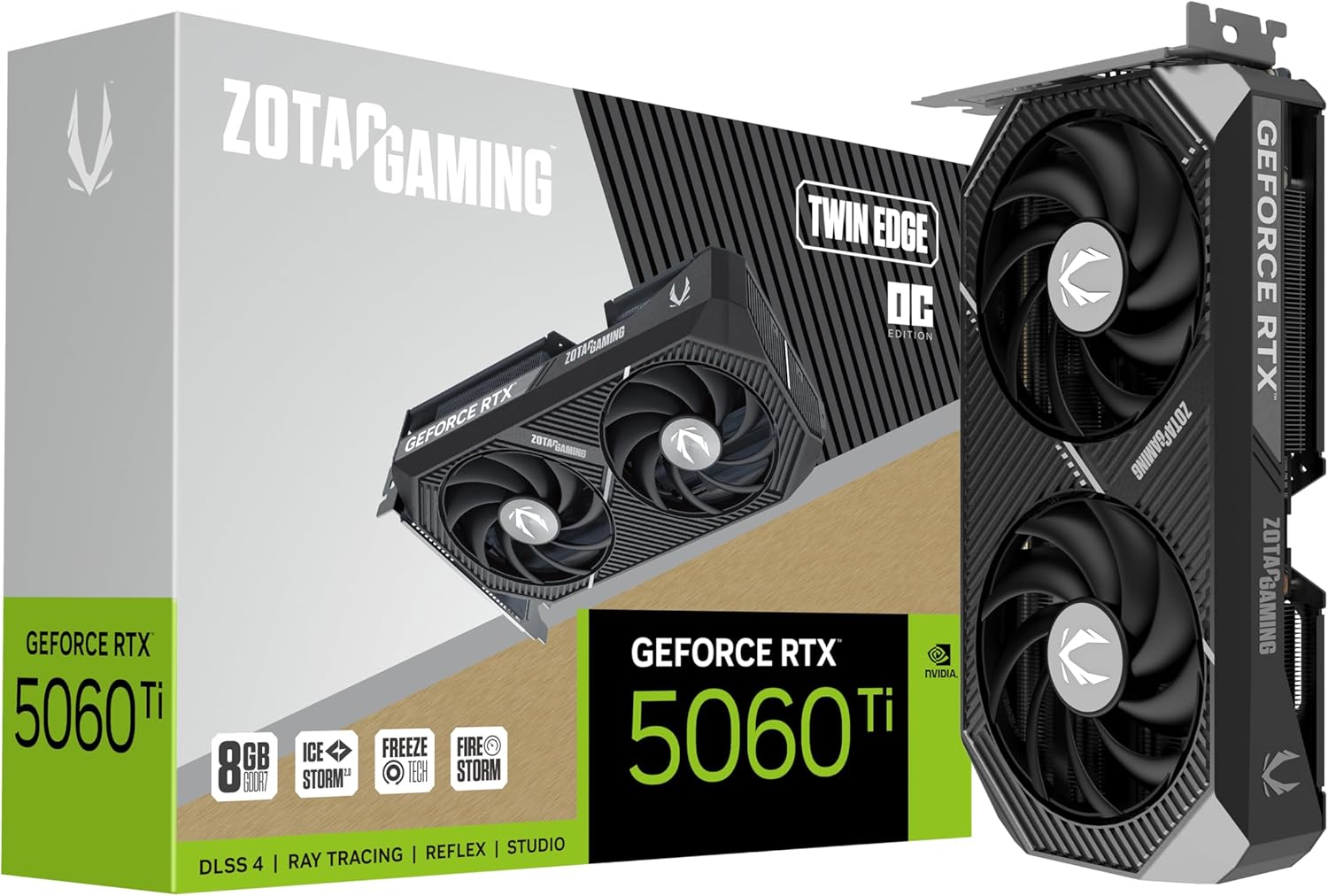
ZOTAC Gaming GeForce RTX 5060 Ti 8GB Twin Edge OC DLSS 4 8GB GDDR7 128-bit 28 Gbps PCIE 5.0 Gaming Graphics Card, IceStorm 2.0 Cooling, SFF-Ready, ZT-B50610H-10A
$300-$599This is a compact, 2-slot RTX 5060 Ti with 8GB GDDR7 and a 2602 MHz clock, built for SFF gaming rigs.