
GIGABYTE GeForce RTX 5060 Ti WINDFORCE MAX OC 8G Graphics Card, 8GB 128-bit GDDR7, PCIe 5.0, WINDFORCE Cooling System, GV-N506TWF2MAX OC-8GD Video Card
Want the best price and purchase timing?
Our AI advisor analyzes real-time pricing across all channels to find you the best deal.
AI Verdict
This is an 8GB GDDR7 GPU with a 2587 MHz clock and PCIe 5.0 x8 interface, primarily suited for 1080p gaming.
This card is a situational fit because its 8GB GDDR7 memory and PCIe 5.0 x8 interface offer strong 1080p performance, but these specifications become limiting for higher resolutions or demanding titles. It balances current-gen features with a constrained memory buffer.
If you need more headroom for 1440p gaming or future titles, look for a GPU with at least 12GB or 16GB of VRAM and a full PCIe x16 interface.
Regret Score™
Medium RiskLower is better — measures purchase-regret risk from real buyer complaints, review credibility, and product maturity
Issues discovered after purchase
Critically weak dimension
Amazon rating vs actual quality
Chance this product isn't for you
Pros
- Integrated with 8GB GDDR7 memory, offering 28000 MHz memory speed.
- Features the WINDFORCE cooling system with a Hawk fan.
- Utilizes the NVIDIA Blackwell architecture and DLSS 4 for enhanced rendering.
- Operates on a PCIe 5.0 x8 interface for modern motherboard compatibility.
- Often available at a lower price point compared to other RTX 5060 Ti models.
Cons
- The 8GB VRAM is a limiting factor for modern AAA titles, especially at 1440p, 4K, or with ray tracing enabled.
- The PCIe 5.0 x8 interface can lead to performance loss on PCIe 3.0 or PCIe 4.0 motherboards, particularly for the 8GB variant.
- The 8-pin power connector is located near the I/O bracket, which can complicate cable management.
- Some users have reported average thermal performance, reaching around 70°C at full load.
Dimension Scores
Delivers strong 1080p performance in most titles, but the 8GB VRAM limits its capabilities at higher resolutions or with demanding settings.
The WINDFORCE cooling system provides average thermal performance, with reported full load temperatures around 70°C.
As an 8GB 128-bit GDDR7 card in the upper-mid range, it's expected to be relatively power-efficient for its performance tier.
8GB of GDDR7 VRAM is a significant limitation for current and future AAA games, especially when playing at 1440p or 4K, or with ray tracing.
Best For
- 1080p gaming with high refresh rates in most titles.
- Budget-conscious PC builders looking for a current-gen NVIDIA card.
- Systems with PCIe 5.0 motherboards to minimize potential bandwidth bottlenecks.
Not Recommended For
- Consistent 1440p or 4K gaming, where 8GB VRAM becomes a significant bottleneck.
- Users prioritizing future-proofing, as 8GB VRAM is already constrained in some current games.
- Systems with older PCIe 3.0 or 4.0 motherboards, which may experience performance degradation due to the x8 interface.
Watch Out For
- 8GB VRAM capacity forces texture settings to be lowered in many modern games to avoid stuttering and pop-in, even at 1080p in some cases.
- The PCIe 5.0 x8 interface can cause a 1% performance loss on PCIe 4.0 systems and around 4% on PCIe 3.0 systems, impacting overall framerates.
- The power connector's position at the front of the card, near the I/O, makes for awkward cable routing and can affect aesthetics.
- Some Gigabyte Windforce cards have had historical issues with thermal gel leaking, though some users report this is less common with newer batches.
Full Specifications
| ASIN | B0FFQD3D9G |
| Brand | GIGABYTE |
| Color | Multicolor |
| Series | GV-N506TWF2MAX OC-8GD |
| Item Weight | 1.83 pounds |
| Manufacturer | GIGABYTE |
| Memory Speed | 28000 MHz |
| Chipset Brand | NVIDIA |
| GPU Clock Speed | 2587 MHz |
| Card Description | Dedicated |
| Graphics Ram Size | 8 GB |
| Item model number | GV-N506TWF2MAX OC-8GD |
| Product Dimensions | 8.19 x 4.72 x 1.57 inches |
| Graphics Coprocessor | NVIDIA GeForce RTX 5060Ti |
| Max Screen Resolution | 3840x2160 |
| Graphics Card Ram Size | 8 GB |
| Item Dimensions LxWxH | 8.19 x 4.72 x 1.57 inches |
| Video Output Interface | DisplayPort, HDMI |
What Buyers Say
The main discussion around this card centers on its 8GB VRAM, which users frequently point out as a bottleneck for modern games, even if it performs well at 1080p. Many buyers appreciate its price point, often finding it cheaper than comparable models. The PCIe 5.0 x8 interface is another point of contention, with concerns about performance on older motherboards. The awkward placement of the power connector is a minor but recurring complaint.
“Look, I got this for $250 and yeah, the 8GB VRAM is a total bummer for some games, but for 1080p it absolutely shreds, just don't expect to crank everything to ultra on Cyberpunk without some VRAM warnings popping up.”
Common Praise
- Handles 1080p gaming with high frame rates.
- Offers a competitive price compared to other RTX 5060 Ti cards.
- WINDFORCE cooling system keeps temperatures manageable, especially with undervolting.
- Noticeable performance upgrade from older generation cards like the GTX 1070.
Common Complaints
- 8GB VRAM is insufficient for many modern games, leading to texture pop-in and stuttering at higher settings or resolutions.
- PCIe 5.0 x8 interface can cause performance drops on PCIe 3.0 or 4.0 motherboards.
- The 8-pin power connector's location at the front of the card makes cable management difficult.
- Some users express concern about Gigabyte's past thermal gel leaking issues, even if it's less prevalent now.
Ownership Tips
- You'll probably spend time tweaking in-game settings to manage VRAM usage, especially in newer titles.
- Consider your motherboard's PCIe generation; a PCIe 3.0 board might noticeably limit this card's performance.
- Cable management might be a bit of a headache with the power connector's placement.
- Monitoring temperatures is a good idea, though the WINDFORCE cooling seems adequate for most users.
Frequently Asked Questions
Is 8GB VRAM enough for modern games?
For 1080p gaming, 8GB VRAM is generally sufficient for most titles, though you might need to lower texture settings in some demanding games to avoid performance issues. For 1440p or 4K, 8GB is often insufficient, leading to stuttering and reduced visual quality.
What does PCIe 5.0 x8 mean for performance?
The PCIe 5.0 x8 interface means the card uses 8 lanes of the PCIe bus. While PCIe 5.0 offers high bandwidth, using only 8 lanes can lead to minor performance losses on PCIe 4.0 motherboards and more noticeable drops on PCIe 3.0 systems, especially for the 8GB variant.
How effective is the WINDFORCE cooling system?
The WINDFORCE cooling system generally provides average thermal performance. Users have reported temperatures around 70°C under full load, which can be reduced to about 61°C with undervolting.
Is this card suitable for 1440p gaming?
While it can handle some 1440p gaming, especially with DLSS enabled, the 8GB VRAM will be a significant limitation in many modern titles. You'll likely need to compromise on texture quality and other settings to maintain playable frame rates.
Does this card support DLSS 4?
Yes, the GIGABYTE GeForce RTX 5060 Ti WINDFORCE MAX OC 8G is powered by the NVIDIA Blackwell architecture and supports DLSS 4, which can boost frame rates using AI-powered upscaling.
Buying Guide
When looking at a GPU like this, you need to understand that the amount of VRAM (video memory) and the PCIe interface are crucial. 8GB of VRAM means you'll hit limits quickly in demanding games, especially if you want to play at 1440p or higher, or use features like ray tracing. The PCIe 5.0 x8 interface means it uses half the lanes of a full x16 slot, so if your motherboard is older (PCIe 3.0 or 4.0), you might not get the card's full potential.
VRAM (8GB GDDR7)
Think of VRAM like a workbench for your GPU. The more VRAM, the bigger and more complex textures and game assets your card can load without having to constantly swap data, which causes stuttering. 8GB is like a small workbench; it's fine for smaller projects (1080p gaming) but gets crowded fast with bigger ones (1440p, 4K, or ray tracing).
PCIe 5.0 x8
PCIe is the highway your GPU uses to talk to the rest of your PC. PCIe 5.0 is a very fast highway, but 'x8' means it only has 8 lanes instead of the full 16. It's like having a super-fast car but only half the lanes available. For most tasks, it's fine, but if you're pushing a lot of data (like with an 8GB card trying to offload VRAM to system memory), those fewer lanes can become a bottleneck.
Clock Speed (2587 MHz)
This is how fast the GPU's processor core runs. A higher clock speed generally means more calculations per second, leading to higher frame rates. It's like the engine RPM of your car – higher RPM usually means more power, but it's only one part of the overall performance.
Alternatives
If this card doesn't quite fit, look for GPUs with 12GB or 16GB of VRAM for better longevity and 1440p performance. Also, consider cards with a full PCIe x16 interface if you have an older motherboard to avoid potential bandwidth limitations.
You Might Also Like

HP NVIDIA GeForce RTX 3070 8GB OEM Graphics Card (Renewed)
$150-$299This is a renewed HP OEM NVIDIA GeForce RTX 3070 with 8GB VRAM, a gamble for budget-conscious 1440p gamers who understand the risks of refurbished hardware.

ZOTAC Gaming GeForce RTX 5070 Twin Edge OC DLSS 4 12GB GDDR7 192-bit 28 Gbps PCIE 5.0 Gaming Graphics Card, IceStorm 2.0 Cooling, SFF-Ready, ZT-B50700H-10A
$600+This is a 2-slot, SFF-ready NVIDIA RTX 5070 with 12GB GDDR7 and a 2542 MHz boost clock, built for compact gaming rigs needing high 1440p performance.

ZOTAC Gaming GeForce RTX 5080 Solid CORE OC DLSS 4 16GB GDDR7 256-bit 30 Gbps PCIE 5.0 Gaming Graphics Card, IceStorm 3.0 Advanced Cooling, Spectra RGB Lighting, ZT-B50800J2-10A
$600+This ZOTAC RTX 5080 with 16GB GDDR7 and a 2640 GHz clock speed is built for high-end 4K gaming and content creation on the NVIDIA Blackwell architecture.
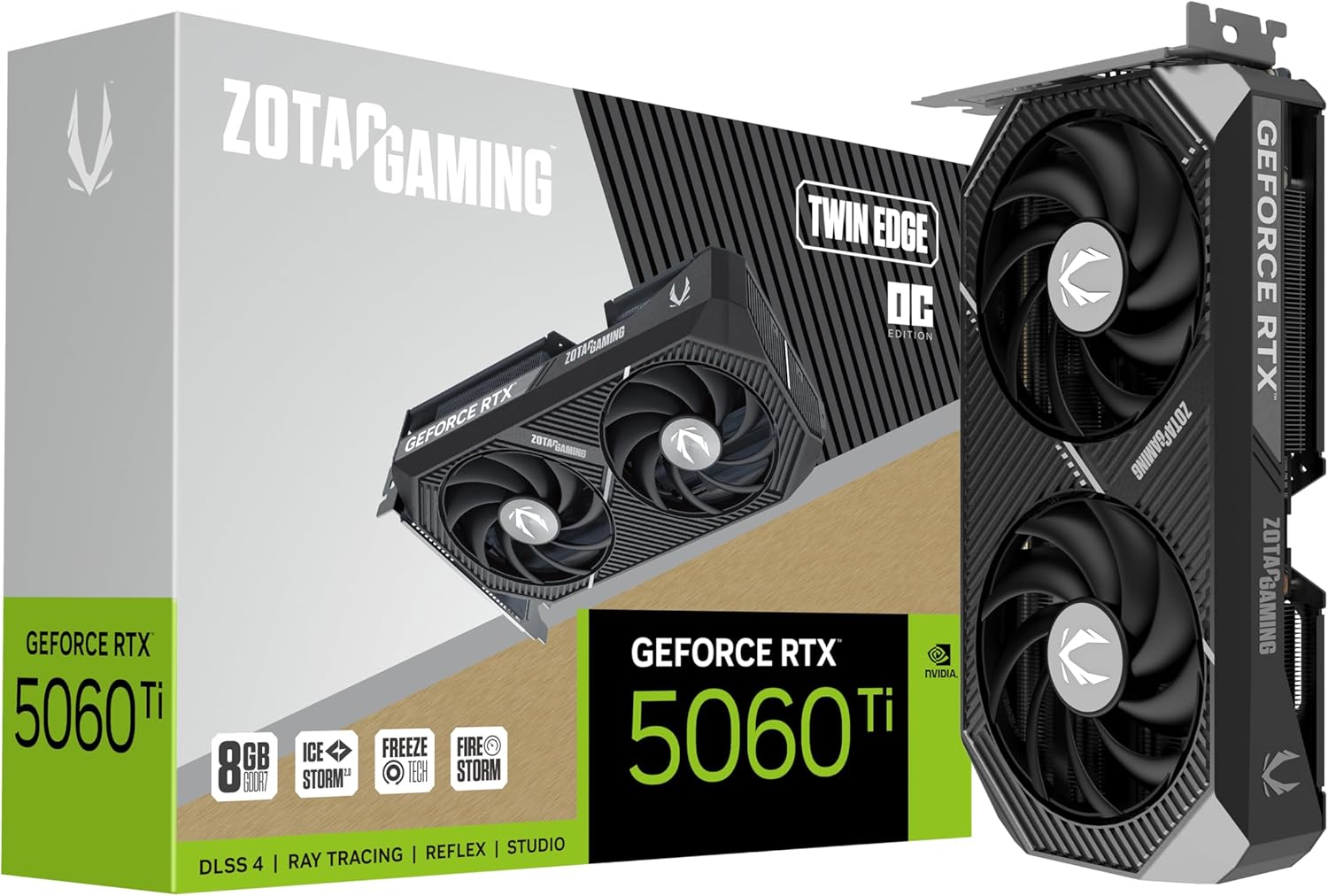
ZOTAC Gaming GeForce RTX 5060 Ti 8GB Twin Edge OC DLSS 4 8GB GDDR7 128-bit 28 Gbps PCIE 5.0 Gaming Graphics Card, IceStorm 2.0 Cooling, SFF-Ready, ZT-B50610H-10A
$300-$599This is a compact, 2-slot RTX 5060 Ti with 8GB GDDR7 and a 2602 MHz clock, built for SFF gaming rigs.