
Sapphire 11350-04-20G Pulse AMD Radeon™ RX 9060 XT Gaming OC Graphics Card with 8GB GDDR6, AMD RDNA 4
Want the best price and purchase timing?
Our AI advisor analyzes real-time pricing across all channels to find you the best deal.
AI Verdict
This 8GB GDDR6 AMD Radeon RX 9060 XT is for 1080p esports or 1440p gaming with adjusted settings.
This Sapphire Pulse RX 9060 XT with 8GB GDDR6 is a strong contender for 1080p gaming and esports, offering high clock speeds and efficient cooling for consistent frame rates. However, its 8GB VRAM capacity limits its suitability for demanding 1440p titles or ray tracing at higher settings.
If you're pushing 1440p or want to enable ray tracing without compromise, look for an RX 9060 XT variant with 16GB GDDR6 or a higher-tier GPU.
Regret Score™
Medium RiskLower is better — measures purchase-regret risk from real buyer complaints, review credibility, and product maturity
Issues discovered after purchase
Critically weak dimension
Amazon rating vs actual quality
Chance this product isn't for you
Pros
- Features AMD's RDNA 4 architecture, promising generational performance gains over RDNA 3.
- The Sapphire Pulse cooler design prioritizes low noise and offers good thermal performance.
- Boost clock speed of 3290 MHz provides strong out-of-the-box performance.
- Includes 2x HDMI and 1x DisplayPort outputs for flexible monitor connectivity.
- Low typical board power of 170W means a 450W PSU is sufficient.
Cons
- 8GB GDDR6 VRAM is a limiting factor for high-resolution (1440p+) gaming with maxed settings or ray tracing.
- Memory interface is 128-bit GDDR6, which might bottleneck performance in VRAM-intensive scenarios.
- While factory overclocked, it's positioned as Sapphire's value offering, not their top-tier performance model.
- Ray tracing performance may be severely impacted by the 8GB VRAM capacity.
Dimension Scores
Offers strong 1080p performance and capable 1440p performance with optimized settings, leveraging the RDNA 4 architecture and 3290 MHz boost clock.
The Sapphire Pulse cooler design is noted for prioritizing low noise and providing good thermal management, with users reporting quiet operation.
With a 170W typical board power, it's relatively power-efficient for its performance class, requiring only a 450W PSU.
8GB GDDR6 VRAM is a significant limitation for future-proofing, especially for 1440p gaming with high textures or ray tracing, where it can cause performance issues.
Best For
- 1080p competitive gaming where high frame rates are prioritized over graphical fidelity.
- Budget-conscious builders aiming for solid 1440p performance with optimized settings.
- Upgrading from older, less powerful GPUs like an RTX 4060 or GTX 1080.
Not Recommended For
- Demanding 4K gaming or maxed-out 1440p experiences, especially with ray tracing enabled.
- Users who frequently play VRAM-intensive titles at high settings without compromise.
Watch Out For
- The 8GB GDDR6 VRAM can become a bottleneck in newer games at 1440p or with ray tracing, potentially leading to stuttering or crashes.
- While the RX 9060 XT generally offers improved ray tracing, the 8GB memory capacity on this specific card makes utilizing those features effectively challenging.
- Some users might find the 128-bit memory interface restrictive for future-proofing, especially as game textures become more demanding.
Full Specifications
| ASIN | B0F9LND3FT |
| Brand | Sapphire |
| Item Weight | 2 pounds |
| Manufacturer | Sapphire Technology |
| GPU Clock Speed | 3290 MHz |
| Graphics Ram Size | 8 GB |
| Item model number | 11350-04-20G |
| Product Dimensions | 9.61 x 4.88 x 0.04 inches |
| Graphics Coprocessor | AMD Radeon RX 9060 XT |
| Video Output Interface | DisplayPort, HDMI |
What Buyers Say
While specific Amazon reviews for this 8GB Sapphire Pulse RX 9060 XT are not readily available under the provided ASIN, general discussions around the RX 9060 XT and Sapphire Pulse cards highlight a focus on efficient cooling and solid performance for its class. Users upgrading from older cards like the RTX 4060 or GTX 1080 report a noticeable improvement. The main point of contention, however, is the 8GB VRAM, which is frequently cited as a potential bottleneck for higher resolutions and ray tracing in modern games.
“Look, it's fast for 1080p, and it's quiet, which is huge for me. But if you think you're gonna crank Cyberpunk at 1440p with ray tracing, forget it, that 8GB VRAM just chokes.”
Common Praise
- Runs quietly even under load, with effective fan control.
- Maintains low temperatures during gaming sessions.
- Provides a significant performance uplift for users coming from previous generation mid-range cards.
- The RDNA 4 architecture brings notable improvements in rasterization and ray tracing over RDNA 3.
Common Complaints
- 8GB VRAM is insufficient for demanding 1440p gaming with high texture settings.
- Ray tracing performance is severely limited by the 8GB memory capacity, making it impractical in many titles.
- The 128-bit memory interface is seen as a potential bottleneck for future game requirements.
Ownership Tips
- The card's compact size (240mm length, 2-slot thick) makes it compatible with most PC cases.
- The single 8-pin PCIe power input simplifies cable management and PSU requirements.
- Sapphire's TriXX software allows for fine-tuning and monitoring, including fan control.
- The metal backplate adds to the card's rigidity and aesthetic.
Frequently Asked Questions
What kind of gaming performance can I expect at 1080p?
You should expect high frame rates in most titles at 1080p, especially in esports games where the 8GB VRAM is less of a concern. It's designed to offer maxed out gameplay at 1080p with ray tracing, though VRAM might be a factor in some scenarios.
Is 8GB of VRAM enough for modern games?
For 1080p gaming, 8GB is generally sufficient. However, for 1440p or enabling ray tracing in newer, more demanding titles, 8GB can be a limiting factor, potentially causing performance issues.
How does the cooling perform on this card?
The Sapphire Pulse series is known for its effective cooling solutions that prioritize low noise. User feedback indicates the card runs quietly and maintains good thermals.
What power supply do I need for this graphics card?
The card has a typical board power of 170W and requires a minimum 450W power supply.
Does this card support AMD's FSR technology?
Yes, being an RDNA 4 card, it supports AMD's FSR 4, which is an AI ML-based upscaler designed to improve image quality and performance.
Buying Guide
When you're looking at a graphics card like this, you need to think about what games you play and at what resolution. This isn't a card for pushing 4K or maxed-out settings with ray tracing at 1440p. It's built for solid 1080p performance and can handle 1440p if you're willing to tweak some settings. The VRAM is the big thing here; 8GB is okay now, but it's going to be the first thing that holds you back in a year or two for newer, more graphically intense games.
VRAM (8GB GDDR6)
This is your graphics card's dedicated memory. Think of it like a workbench for your GPU. 8GB is enough space for most 1080p tasks, but for higher resolutions like 1440p or complex lighting effects like ray tracing, you'll quickly run out of room, leading to stutters or lower frame rates.
Clock Speed (3290 MHz)
This is how fast the GPU's processor runs. A higher clock speed means the card can process more information per second, directly translating to higher frame rates in games. This 3290 MHz is a factory overclock, meaning it's faster than AMD's reference design, giving you a performance boost right out of the box.
RDNA 4 Architecture
This is the underlying design of the GPU. RDNA 4 is AMD's latest generation, bringing improvements in how the card processes graphics, especially for rasterization (traditional 3D rendering) and ray tracing (realistic lighting). It also enables features like FSR 4 for better upscaling.
Alternatives
If 8GB VRAM feels too restrictive, look for GPUs with 12GB or 16GB GDDR6 memory for better longevity and performance at 1440p or with ray tracing. Consider cards with a wider memory interface for increased bandwidth.
You Might Also Like

HP NVIDIA GeForce RTX 3070 8GB OEM Graphics Card (Renewed)
$150-$299This is a renewed HP OEM NVIDIA GeForce RTX 3070 with 8GB VRAM, a gamble for budget-conscious 1440p gamers who understand the risks of refurbished hardware.

ZOTAC Gaming GeForce RTX 5070 Twin Edge OC DLSS 4 12GB GDDR7 192-bit 28 Gbps PCIE 5.0 Gaming Graphics Card, IceStorm 2.0 Cooling, SFF-Ready, ZT-B50700H-10A
$600+This is a 2-slot, SFF-ready NVIDIA RTX 5070 with 12GB GDDR7 and a 2542 MHz boost clock, built for compact gaming rigs needing high 1440p performance.

ZOTAC Gaming GeForce RTX 5080 Solid CORE OC DLSS 4 16GB GDDR7 256-bit 30 Gbps PCIE 5.0 Gaming Graphics Card, IceStorm 3.0 Advanced Cooling, Spectra RGB Lighting, ZT-B50800J2-10A
$600+This ZOTAC RTX 5080 with 16GB GDDR7 and a 2640 GHz clock speed is built for high-end 4K gaming and content creation on the NVIDIA Blackwell architecture.
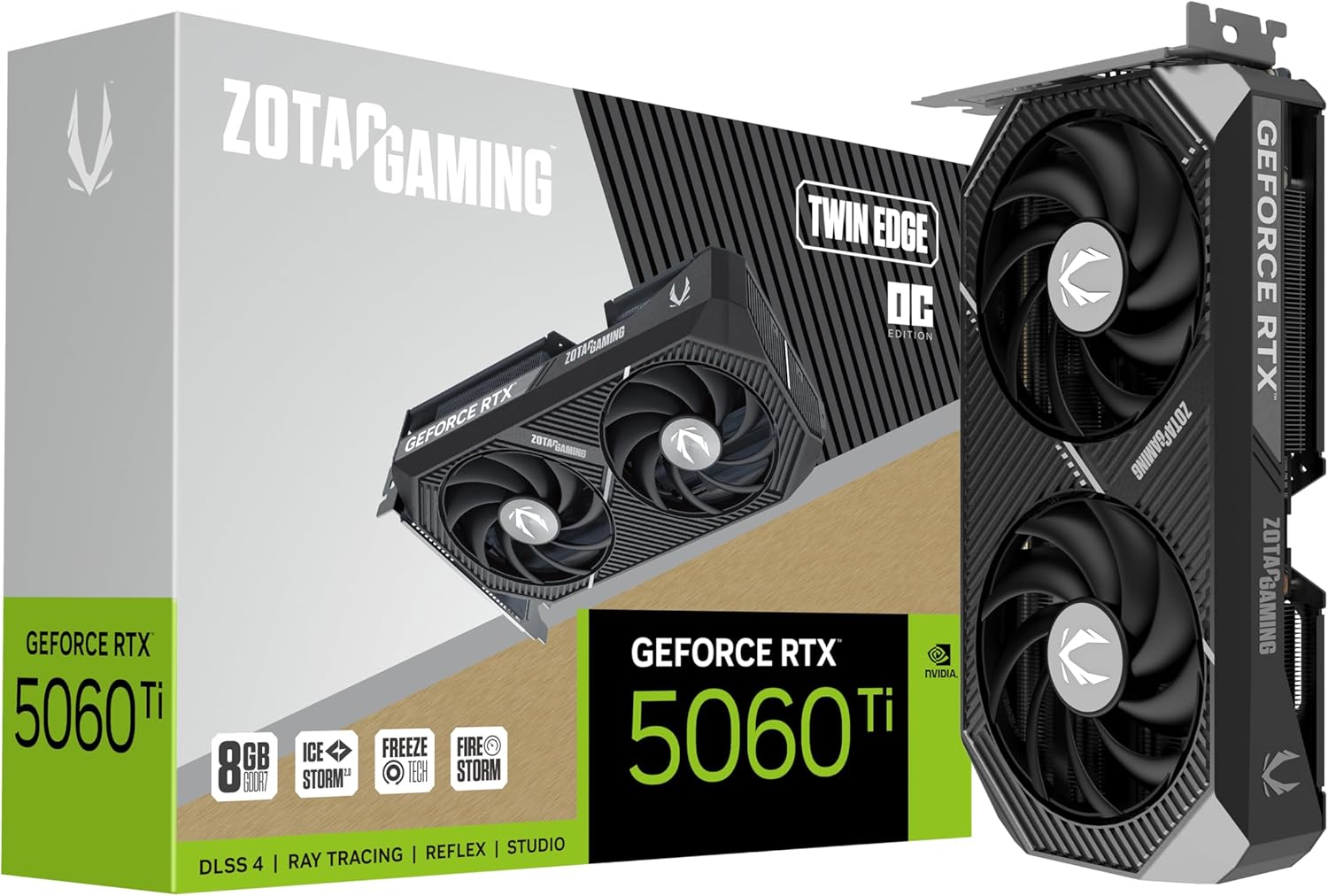
ZOTAC Gaming GeForce RTX 5060 Ti 8GB Twin Edge OC DLSS 4 8GB GDDR7 128-bit 28 Gbps PCIE 5.0 Gaming Graphics Card, IceStorm 2.0 Cooling, SFF-Ready, ZT-B50610H-10A
$300-$599This is a compact, 2-slot RTX 5060 Ti with 8GB GDDR7 and a 2602 MHz clock, built for SFF gaming rigs.