
ZOTAC Gaming GeForce RTX 5060 AMP DLSS 4 8GB GDDR7 128-bit 28 Gbps PCIE 5.0 Gaming Graphics Card, IceStorm 2.0 Cooling, ZT-B50600F-10M
Want the best price and purchase timing?
Our AI advisor analyzes real-time pricing across all channels to find you the best deal.
AI Verdict
This ZOTAC RTX 5060 AMP is a compact 8GB GDDR7 card with a 2550 MHz clock speed, built for 1080p gaming, but its 8GB VRAM is a significant limitation for modern titles.
This ZOTAC RTX 5060 AMP is a situational fit because its 8GB GDDR7 VRAM and 2550 MHz clock speed deliver solid 1080p performance, especially for its class, but this memory configuration is already proving insufficient for many modern games at higher settings. It's compact and efficient, which is a plus for specific builds.
If 8GB VRAM is a concern for your gaming habits, look for GPUs with 12GB or 16GB of GDDR7 memory to ensure better longevity and performance in future titles.
Regret Score™
Medium RiskLower is better — measures purchase-regret risk from real buyer complaints, review credibility, and product maturity
Issues discovered after purchase
Critically weak dimension
Amazon rating vs actual quality
Chance this product isn't for you
Pros
- Offers a 34% performance increase over the RTX 4060 at 1080p resolution.
- Features a compact, 2-slot SFF-ready design, making it suitable for smaller PC builds.
- Utilizes IceStorm 2.0 Cooling with two 90mm BladeLink fans and a Pass-thru Airflow Design for quiet operation.
- Includes modern technologies like DLSS 4 and Multi-Frame Generation for enhanced performance and visuals.
- Equipped with 3x DisplayPort 2.1b and 1x HDMI 2.1b, supporting up to 8K resolution and four displays.
- Comes with a metal backplate for added durability and heat dissipation.
Cons
- The 8GB GDDR7 VRAM increasingly limits its usability in newer titles, even at 1080p.
- Its long-term relevance for gaming is questionable due to the constrained 8GB memory configuration.
- Performance gains over the RTX 4060 are less pronounced at 1440p, showing only a 26% increase.
- Intel and AMD offer GPUs with more VRAM at similar or lower price points, making the 8GB a competitive disadvantage.
Dimension Scores
The card offers a 34% performance increase over the RTX 4060 at 1080p, but its 8GB VRAM limits its ability to handle modern titles at higher settings.
The IceStorm 2.0 Cooling system with 2x 90mm BladeLink fans, composite heatpipes, and FREEZE Fan Stop contributes to quiet operation.
It uses an 8-pin PCIe power connector and has increased power consumption compared to the RTX 4060, but is still considered efficient for its class.
The 8GB GDDR7 VRAM is a significant limitation, increasingly restricting performance in newer games even at 1080p.
Best For
- Budget-conscious gamers focused on 1080p resolution with modest expectations.
- Small Form Factor (SFF) PC builds due to its compact, 2-slot design.
- Users prioritizing efficiency and quiet operation in their gaming setup.
Not Recommended For
- Gamers aiming for consistent 1440p or 4K ultra settings in modern AAA titles.
- Users seeking a GPU with strong long-term relevance for future demanding games.
- Anyone expecting to play 7/8 modern titles at 1080p ultra without VRAM limitations.
Watch Out For
- The 8GB VRAM capacity is a significant bottleneck, with some reports indicating 7/8 modern titles are 'broken' at 1080p ultra due to insufficient memory.
- The card's long-term viability is questionable because 8GB VRAM is already limiting performance in new games, even at 1080p.
- While faster than the RTX 4060, the performance uplift is less significant at 1440p (26% faster) compared to 1080p (34% faster).
Full Specifications
| ASIN | B0F8THBBXH |
| Brand | ZOTAC |
| Color | Black |
| Series | ZOTAC GAMING GeForce RTX 5060 AMP |
| Item Weight | 2 pounds |
| Manufacturer | ZOTAC |
| Memory Speed | 28 GHz |
| Chipset Brand | NVIDIA |
| GPU Clock Speed | 2550 MHz |
| Card Description | Dedicated |
| Graphics Ram Size | 8 GB |
| Item model number | ZT-B50600F-10M |
| Product Dimensions | 8.7 x 1.6 x 0.1 inches |
| Graphics Coprocessor | GeForce RTX 5060 |
| Max Screen Resolution | 7680x4320 |
| Graphics Card Ram Size | 8 GB |
| Item Dimensions LxWxH | 8.7 x 1.6 x 0.1 inches |
| Video Output Interface | 3x DP 2.1b, HDMI 2.1b |
What Buyers Say
Community discussions and professional reviews highlight the ZOTAC RTX 5060 AMP as a compact and efficient card for 1080p gaming, showing a notable performance jump over the previous generation. However, the recurring concern is its 8GB VRAM, which is already proving insufficient for many modern games, even at 1080p ultra settings. This memory limitation raises questions about the card's long-term viability and value.
“Look, it's fast for 1080p, but this 8GB VRAM thing is a real problem. I'm already seeing games choke, and it's only going to get worse. Should have just waited for something with more memory.”
Common Praise
- The card's compact, 2-slot design is ideal for Small Form Factor (SFF) PC builds.
- It provides a noticeable performance improvement, being 34% faster than the RTX 4060 at 1080p.
- The IceStorm 2.0 cooling system keeps the card running quietly.
- It supports modern features like DLSS 4 and Multi-Frame Generation, enhancing visual quality and frame rates.
Common Complaints
- The 8GB GDDR7 VRAM is a major bottleneck, limiting performance in current and future demanding games.
- Concerns about the card's long-term relevance due to its constrained memory configuration.
- Some modern titles are reportedly 'broken' at 1080p ultra settings because of insufficient VRAM.
- Competitors from Intel and AMD offer more VRAM at similar or lower price points.
Ownership Tips
- You'll likely need to adjust game settings, particularly textures, to avoid VRAM limitations in newer titles, even at 1080p.
- The compact size makes it easy to fit into almost any case, which is a plus for SFF enthusiasts.
- The cooling system does a solid job keeping noise levels down, even under load.
- Expect to rely heavily on DLSS 4 and Multi-Frame Generation to maintain playable frame rates in demanding games.
Frequently Asked Questions
Is the ZOTAC Gaming GeForce RTX 5060 AMP suitable for 1440p gaming?
While it can run some games at 1440p, its 8GB VRAM and performance uplift over the RTX 4060 (26% at 1440p) suggest it's primarily designed for 1080p gaming, where it shows a 34% performance increase.
Does this card support multiple monitors?
Yes, it supports up to four displays with its 3x DisplayPort 2.1b and 1x HDMI 2.1b outputs.
What kind of power connector does this GPU use?
The ZOTAC Gaming GeForce RTX 5060 AMP uses a standard 8-pin PCIe power connector.
Is this graphics card good for Small Form Factor (SFF) builds?
Yes, it's designed as an SFF-ready compact card with a 2-slot form factor, making it suitable for smaller cases.
Does the card support NVIDIA's latest upscaling technology?
Yes, it's powered by the NVIDIA Blackwell architecture and supports DLSS 4 and Multi-Frame Generation.
Buying Guide
When buying a GPU like this, you need to think about what resolution you're playing at and how demanding your games are. This card is built for 1080p, but its memory capacity is the big catch. If you play a lot of new, graphically intense games, that 8GB of VRAM will become a bottleneck fast, forcing you to turn down settings. Don't just look at raw speed; VRAM is crucial for texture quality and overall stability in modern titles.
VRAM (Video RAM)
This is like the GPU's short-term memory. More VRAM means the card can handle larger textures and more complex scenes without stuttering, especially important for higher resolutions or graphically demanding games. 8GB is becoming a tight squeeze for new games, even at 1080p.
Clock Speed (2550 MHz)
This is how fast the GPU's processor runs. A higher clock speed generally means more raw processing power, leading to higher frame rates. This card's 2550 MHz is a factory overclock, giving it a bit more punch out of the box.
DLSS 4 (Deep Learning Super Sampling)
This is an NVIDIA technology that uses AI to render games at a lower resolution and then intelligently upscale them to a higher resolution. It can significantly boost frame rates without a huge hit to visual quality, acting like a 'free' performance upgrade, especially important for cards with limited VRAM.
PCIe 5.0
This refers to the interface the GPU uses to connect to your motherboard. PCIe 5.0 is the latest standard, offering faster data transfer speeds. While it's future-proof, most GPUs don't fully saturate a PCIe 4.0 slot yet, so it's more about future compatibility than immediate performance gains for this class of card.
Alternatives
If this card doesn't offer enough VRAM or performance for your needs, look for GPUs with 12GB or 16GB of GDDR7 memory and a higher memory interface (e.g., 192-bit or 256-bit) for better future-proofing and 1440p performance.
You Might Also Like

HP NVIDIA GeForce RTX 3070 8GB OEM Graphics Card (Renewed)
$150-$299This is a renewed HP OEM NVIDIA GeForce RTX 3070 with 8GB VRAM, a gamble for budget-conscious 1440p gamers who understand the risks of refurbished hardware.

ZOTAC Gaming GeForce RTX 5070 Twin Edge OC DLSS 4 12GB GDDR7 192-bit 28 Gbps PCIE 5.0 Gaming Graphics Card, IceStorm 2.0 Cooling, SFF-Ready, ZT-B50700H-10A
$600+This is a 2-slot, SFF-ready NVIDIA RTX 5070 with 12GB GDDR7 and a 2542 MHz boost clock, built for compact gaming rigs needing high 1440p performance.

ZOTAC Gaming GeForce RTX 5080 Solid CORE OC DLSS 4 16GB GDDR7 256-bit 30 Gbps PCIE 5.0 Gaming Graphics Card, IceStorm 3.0 Advanced Cooling, Spectra RGB Lighting, ZT-B50800J2-10A
$600+This ZOTAC RTX 5080 with 16GB GDDR7 and a 2640 GHz clock speed is built for high-end 4K gaming and content creation on the NVIDIA Blackwell architecture.
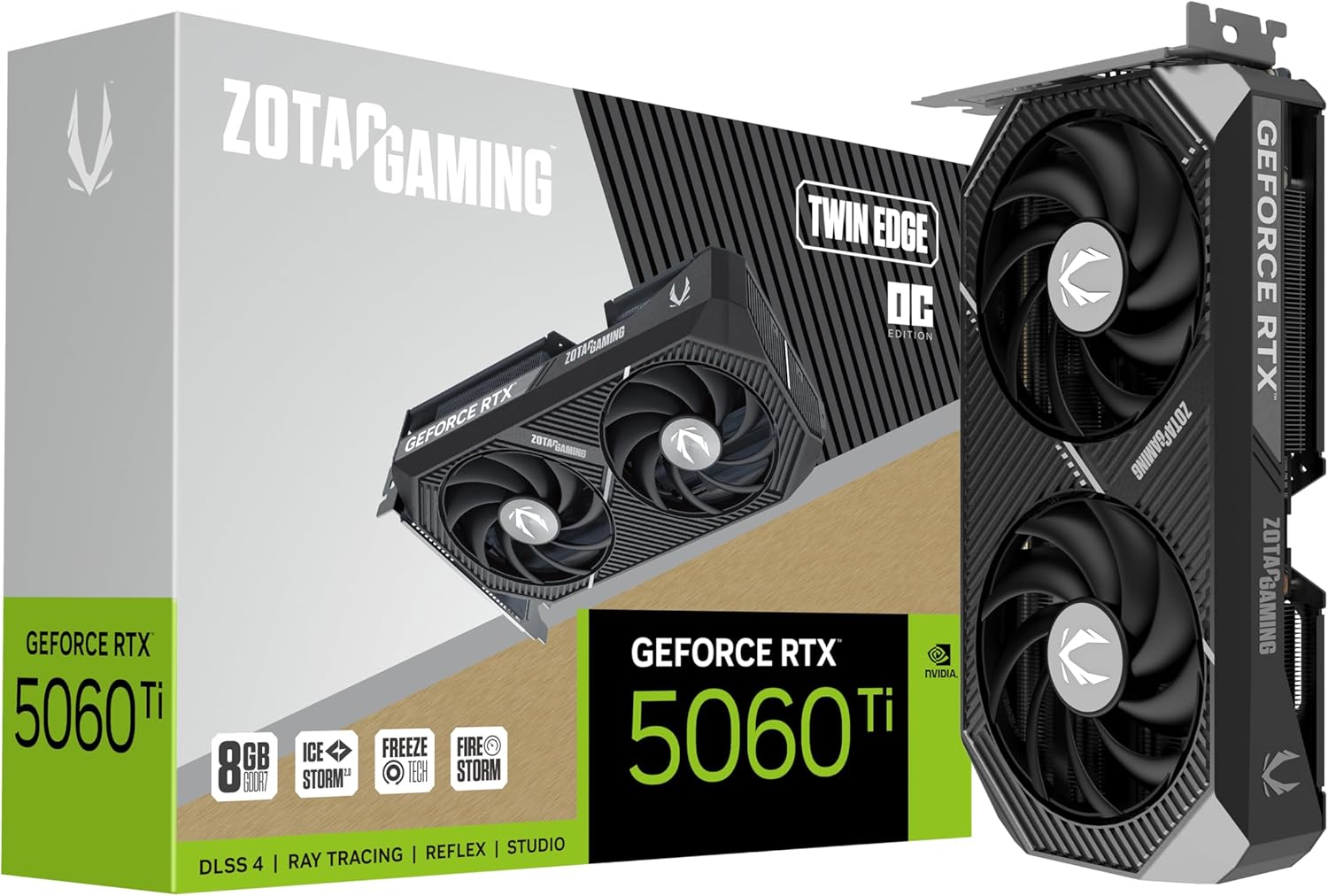
ZOTAC Gaming GeForce RTX 5060 Ti 8GB Twin Edge OC DLSS 4 8GB GDDR7 128-bit 28 Gbps PCIE 5.0 Gaming Graphics Card, IceStorm 2.0 Cooling, SFF-Ready, ZT-B50610H-10A
$300-$599This is a compact, 2-slot RTX 5060 Ti with 8GB GDDR7 and a 2602 MHz clock, built for SFF gaming rigs.