
ZOTAC Gaming GeForce RTX 5060 Twin Edge OC DLSS 4 8GB GDDR7 128-bit 28 Gbps PCIE 5.0 Gaming Graphics Card, SFF-Ready Compact Card, ZT-B50600H-10M
Want the best price and purchase timing?
Our AI advisor analyzes real-time pricing across all channels to find you the best deal.
AI Verdict
This is a compact, 2-slot GeForce RTX 5060 with 8GB GDDR7 and DLSS 4, designed for 1080p gaming in small form factor builds.
This ZOTAC RTX 5060 is a strong contender for small form factor builds due to its 2-slot, compact design and SFF-ready features. However, its 8GB GDDR7 VRAM limits its appeal for demanding 1440p or 4K gaming, making it primarily a 1080p card for current titles.
If you need more VRAM for higher resolutions or future-proofing, look for a GPU with at least 12GB or 16GB GDDR7.
Regret Score™
Medium RiskLower is better — measures purchase-regret risk from real buyer complaints, review credibility, and product maturity
Issues discovered after purchase
Critically weak dimension
Amazon rating vs actual quality
Chance this product isn't for you
Pros
- SFF-ready compact card with a 2-slot design fits into tight PC cases.
- Features NVIDIA Blackwell architecture and DLSS 4 for enhanced frame generation.
- Equipped with 8GB GDDR7 memory operating at 28 Gbps for fast data transfer.
- Cooling system includes 2x 90mm BladeLink fans, composite heatpipes, and pass-thru airflow design.
- Offers 3x DisplayPort 2.1b and 1x HDMI 2.1b for broad display compatibility and 8K readiness.
- Utilizes an 8-pin PCIe power connector, simplifying power delivery.
Cons
- 8GB GDDR7 VRAM may become a limitation for modern games at higher resolutions or settings.
- PCI Express 5.0 x8 interface, not a full x16, which could be a minor bandwidth consideration for some users.
- Specific user reviews and complaints for this exact model (ZT-B50600H-10M) are not readily available in search results.
Dimension Scores
The RTX 5060 chipset with DLSS 4 provides capable 1080p gaming performance, but it's an entry-level current-gen card for more demanding titles.
The Twin Edge OC cooling solution with 2x 90mm BladeLink fans and composite heatpipes is expected to manage temperatures effectively for a 60-series card.
Utilizing a single 8-pin PCIe power connector, the card's power consumption is efficient for its performance tier, drawing around 138-173 watts for a similar model.
8GB GDDR7 VRAM is becoming a limiting factor for modern games, especially at higher settings or resolutions beyond 1080p.
Best For
- Compact gaming PC builds where space is restricted.
- 1080p gaming with modern titles utilizing DLSS 4.
- Users prioritizing a smaller footprint without sacrificing current-generation features.
Not Recommended For
- High-refresh rate 1440p or 4K gaming without significant compromises.
- Users demanding extensive VRAM for future-proof gaming at ultra settings.
- Enthusiasts seeking maximum raw performance in the 50-series lineup.
Watch Out For
- The 8GB GDDR7 VRAM is a potential bottleneck; some newer games already push past 8GB at 1080p high settings, leading to texture pop-in or stuttering.
- Specific user feedback regarding coil whine or fan noise for this model is unavailable, so it's an unknown factor.
- The PCIe 5.0 x8 interface, while sufficient for the 5060's performance, is half the lanes of a full x16 slot, which might be a concern for some users with older motherboards or future upgrades.
Full Specifications
| ASIN | B0F8T73MZP |
| Brand | ZOTAC |
| Color | Black |
| Series | ZOTAC GAMING GeForce RTX 5060 Twin Edge OC |
| Item Weight | 1.57 pounds |
| Manufacturer | ZOTAC |
| Memory Speed | 2527 MHz |
| Chipset Brand | NVIDIA |
| Card Description | Dedicated |
| Graphics Ram Size | 8 GB |
| Item model number | ZT-B50600H-10M |
| Product Dimensions | 8.7 x 1.6 x 0.1 inches |
| Graphics Coprocessor | GeForce RTX 5060 |
| Max Screen Resolution | 7680x4320 |
| Graphics Card Ram Size | 8 GB |
| Item Dimensions LxWxH | 8.7 x 1.6 x 0.1 inches |
| Video Output Interface | 3x DP 2.1b, HDMI 2.1b |
| Graphics Processor Manufacturer | NVIDIA |
What Buyers Say
Specific user reviews for the ZOTAC Gaming GeForce RTX 5060 Twin Edge OC (ZT-B50600H-10M) are not widely available in search results. However, based on product specifications, this card is positioned as a compact solution for current-generation 1080p gaming, leveraging NVIDIA's Blackwell architecture and DLSS 4. Its SFF-ready design and efficient cooling are expected advantages, while the 8GB VRAM is a potential concern for future game demands.
“Look, if you need a new GPU for your tiny PC and only play at 1080p, this 5060 will probably do the job, but that 8GB VRAM is gonna sting later on.”
Common Praise
- Compact size allows for installation in small form factor PC cases.
- Inclusion of DLSS 4 technology for performance boosts in supported games.
- Fast 28 Gbps GDDR7 memory speed.
- Effective cooling design with dual BladeLink fans and heatpipes.
Common Complaints
- 8GB VRAM is increasingly insufficient for modern games at higher settings or resolutions.
- PCIe 5.0 x8 interface, not a full x16, which might raise questions about long-term bandwidth, though likely not a bottleneck for this GPU.
- Lack of specific user feedback makes it hard to gauge real-world noise levels or potential coil whine.
Ownership Tips
- The compact size means it should fit in almost any case, even older ones, but check your specific dimensions.
- Expect to use DLSS 4 frequently to maintain high frame rates in newer, graphically intensive games.
- Monitor VRAM usage in games, especially at 1440p, as 8GB can fill up quickly.
- The 8-pin power connector makes it compatible with most modern power supplies without needing adapter cables.
Frequently Asked Questions
Is this card suitable for 4K gaming?
While the card is 8K ready and supports 4 displays, its 8GB GDDR7 VRAM and RTX 5060 chipset are primarily designed for 1080p gaming, with some capability for 1440p in less demanding titles or with DLSS 4 enabled.
What kind of power supply do I need?
The card requires a single 8-pin PCIe power connector. A power supply of at least 550W is generally recommended for systems with a mid-range GPU like this, though specific system requirements may vary.
Does this card support ray tracing?
Yes, being an RTX 50-series GPU, it features Fourth-Gen Ray Tracing Cores and supports NVIDIA's ray tracing technology for more realistic lighting and reflections in compatible games.
Is this card good for small PC cases?
Absolutely. It's specifically marketed as an SFF-ready compact card with a 2-slot design, making it ideal for mini-ITX and other small form factor builds.
What is DLSS 4?
DLSS 4 (Deep Learning Super Sampling) is an NVIDIA technology that uses AI to render frames at a lower resolution and then upscales them to a higher resolution, boosting frame rates and image quality in supported games.
Buying Guide
When you're looking at a graphics card like this, you need to think about what games you play and at what resolution. This 5060 is built for 1080p gaming, especially if you want to crank up settings or use ray tracing. If you have a small PC case, its compact design is a huge plus. Don't expect it to crush 4K, but it will handle current games at its target resolution.
chipset (GeForce RTX 5060)
This tells you the core processing power. The RTX 5060 is NVIDIA's mid-range offering for the 50-series, meaning it's designed for solid performance in current games, typically at 1080p, and can leverage features like DLSS 4.
vram (8GB GDDR7)
VRAM is like the GPU's short-term memory for game textures and assets. 8GB is enough for most 1080p gaming today, but some newer titles are starting to demand more, so it could be a limitation for future games or higher resolutions.
SFF-ready compact card
This means the card is physically smaller and designed to fit into 'Small Form Factor' PC cases. If you have a mini-ITX build or a tight case, this is a critical feature to ensure compatibility.
DLSS 4
DLSS (Deep Learning Super Sampling) is an AI-powered technology that boosts frame rates by rendering games at a lower resolution and then intelligently upscaling them. DLSS 4 is the latest version, offering better performance and image quality, which is essential for getting smooth gameplay with ray tracing or high settings.
Alternatives
If 8GB VRAM feels too restrictive, look for GPUs with 12GB or 16GB of GDDR7 memory. If you need more raw performance for 1440p or higher, consider cards with a higher-tier chipset in the 50-series or previous generations.
You Might Also Like

HP NVIDIA GeForce RTX 3070 8GB OEM Graphics Card (Renewed)
$150-$299This is a renewed HP OEM NVIDIA GeForce RTX 3070 with 8GB VRAM, a gamble for budget-conscious 1440p gamers who understand the risks of refurbished hardware.

ZOTAC Gaming GeForce RTX 5070 Twin Edge OC DLSS 4 12GB GDDR7 192-bit 28 Gbps PCIE 5.0 Gaming Graphics Card, IceStorm 2.0 Cooling, SFF-Ready, ZT-B50700H-10A
$600+This is a 2-slot, SFF-ready NVIDIA RTX 5070 with 12GB GDDR7 and a 2542 MHz boost clock, built for compact gaming rigs needing high 1440p performance.

ZOTAC Gaming GeForce RTX 5080 Solid CORE OC DLSS 4 16GB GDDR7 256-bit 30 Gbps PCIE 5.0 Gaming Graphics Card, IceStorm 3.0 Advanced Cooling, Spectra RGB Lighting, ZT-B50800J2-10A
$600+This ZOTAC RTX 5080 with 16GB GDDR7 and a 2640 GHz clock speed is built for high-end 4K gaming and content creation on the NVIDIA Blackwell architecture.
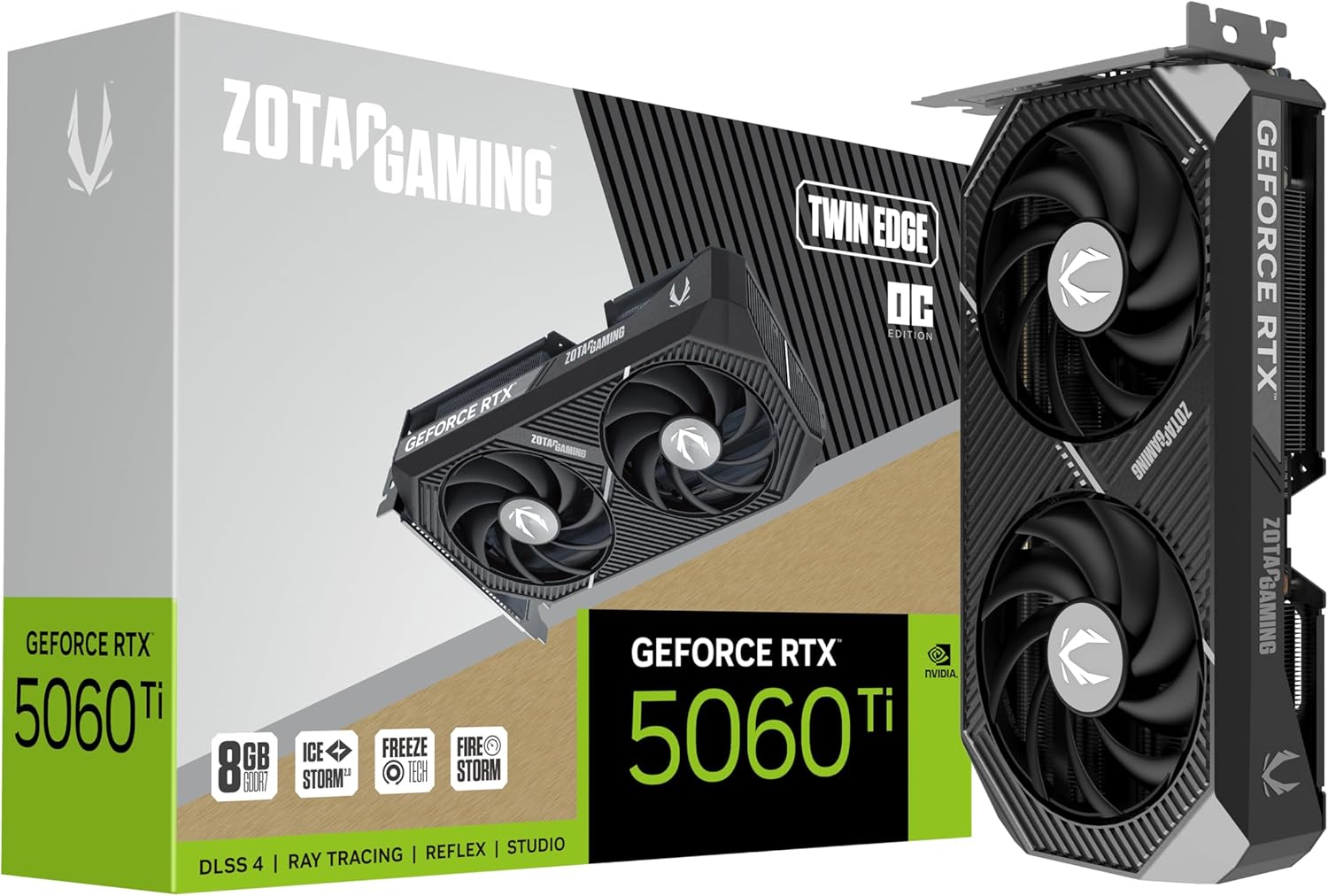
ZOTAC Gaming GeForce RTX 5060 Ti 8GB Twin Edge OC DLSS 4 8GB GDDR7 128-bit 28 Gbps PCIE 5.0 Gaming Graphics Card, IceStorm 2.0 Cooling, SFF-Ready, ZT-B50610H-10A
$300-$599This is a compact, 2-slot RTX 5060 Ti with 8GB GDDR7 and a 2602 MHz clock, built for SFF gaming rigs.