
PNY NVIDIA GeForce RTX™ 5060 Epic-X™ ARGB OC Triple Fan, Graphics Card (8GB GDDR7, 128-bit, SFF-Ready, PCIe® 5.0, HDMI®/DP 2.1, 2-Slot, NVIDIA Blackwell Architecture, DLSS 4)
Want the best price and purchase timing?
Our AI advisor analyzes real-time pricing across all channels to find you the best deal.
AI Verdict
This is a 2-slot, 8GB GDDR7 RTX 5060 on Blackwell architecture with a 2580 MHz boost clock, aimed at 1080p/1440p gaming with DLSS 4.
This PNY RTX 5060 is a situational fit, offering modern Blackwell architecture, 8GB GDDR7, and DLSS 4 for solid 1080p/1440p gaming. Its 2-slot, SFF-Ready design makes it suitable for compact builds, but the 128-bit memory bus and 8GB VRAM might limit its longevity at higher resolutions.
If you need more future-proofing for 1440p or entry-level 4K gaming, look for a GPU with a wider memory bus (e.g., 192-bit or 256-bit) and 12GB or 16GB of VRAM.
Regret Score™
Low RiskLower is better — measures purchase-regret risk from real buyer complaints, review credibility, and product maturity
Issues discovered after purchase
Critically weak dimension
Amazon rating vs actual quality
Chance this product isn't for you
Pros
- Features NVIDIA Blackwell Architecture with Fifth-Gen Tensor Cores and Fourth-Gen Ray Tracing Cores for advanced rendering capabilities.
- Includes DLSS 4 with Multi Frame Generation and NVIDIA Reflex 2 for AI-enhanced graphics and reduced latency in games.
- Equipped with 8GB GDDR7 memory operating at 28 Gbps effective on a 128-bit interface, providing 448 GB/s memory bandwidth.
- Offers triple fan cooling, suggesting effective thermal management for sustained performance.
- Supports PCIe 5.0 x8 interface, HDMI 2.1b, and three DisplayPort 2.1b outputs, allowing for up to four displays at 8K resolution.
- Designed with a 2-slot form factor and SFF-Ready designation, fitting into more compact PC builds.
Cons
- The 8GB GDDR7 VRAM, while fast, might become a limitation for future games at higher resolutions or with demanding texture packs.
- Utilizes a PCIe 5.0 x8 interface, which is half the lanes of a full x16 slot, potentially limiting bandwidth in some scenarios.
- Requires an 8-pin power connector and a recommended 550W power supply, which might necessitate a PSU upgrade for older systems.
- As a new product (Date First Available: June 17, 2025), there is no real-world user feedback on long-term performance, thermals, or potential issues.
Dimension Scores
The RTX 5060, with its Blackwell architecture, 2580 MHz boost clock, and DLSS 4, is positioned for above-average 1080p and 1440p gaming experiences.
The triple fan cooling solution suggests effective heat dissipation and potentially lower noise levels compared to dual-fan or single-fan designs for its 145W TDP.
With a 145W TDP and requiring a single 8-pin connector, its power draw is efficient for its expected performance, allowing for a recommended 550W PSU.
The 8GB GDDR7 VRAM is category average for a mid-range GPU, sufficient for most current games at 1080p/1440p, but could be a limiting factor for future high-fidelity titles.
Best For
- Gamers targeting 1080p or 1440p resolutions who want to leverage DLSS 4 and ray tracing.
- Users building SFF (Small Form Factor) PCs due to its 2-slot, SFF-Ready design.
- Content creators using NVIDIA Studio applications for AI-accelerated workflows in video editing or 3D rendering.
Not Recommended For
- Enthusiasts demanding uncompromised 4K gaming performance without DLSS.
- Users with power supplies under 550W who are unwilling to upgrade.
Watch Out For
- No user-reported pitfalls are available yet, as the product's official release date is June 17, 2025. Therefore, real-world issues like coil whine, driver stability, or specific thermal characteristics under load are unknown.
Full Specifications
| ASIN | B0F8P9RD4S |
| Brand | PNY |
| Color | Black |
| Series | RTX 5060 8GB |
| Item Weight | 2.22 pounds |
| Manufacturer | PNY |
| Memory Speed | 2280 MHz |
| Chipset Brand | NVIDIA |
| GPU Clock Speed | 2280 MHz |
| Card Description | Graphics card with NVIDIA GeForce RTX 5060 graphics chip with 8GB GDDR7 memory and NVIDIA Blackwell architecture |
| Graphics Ram Size | 8 GB |
| Item model number | VCG50608TFXXPB1-O |
| Package Dimensions | 14.53 x 7.52 x 2.91 inches |
| Graphics Coprocessor | NVIDIA GeForce RTX 5060 |
| Max Screen Resolution | 7680x4320 |
| Graphics Card Ram Size | 8 GB |
| Video Output Interface | DisplayPort, HDMI |
What Buyers Say
As of March 26, 2026, there are no real user reviews or feedback available for the PNY NVIDIA GeForce RTX 5060 Epic-X ARGB OC Triple Fan graphics card. The product's 'Date First Available' is listed as June 17, 2025, meaning it has not yet been released to the public for purchase and evaluation. Therefore, specific details regarding common praise, complaints, or long-term ownership experiences cannot be provided.
“Can't tell you anything yet, it's not even out! How am I supposed to know if it's good or not?”
Frequently Asked Questions
What kind of performance can I expect from the 8GB GDDR7 VRAM?
The 8GB GDDR7 VRAM, with its 28 Gbps effective speed and 448 GB/s bandwidth, is well-suited for 1080p and 1440p gaming, especially when leveraging DLSS 4. For some demanding titles at max settings or higher resolutions, 8GB might become a bottleneck in the future.
Is the PCIe 5.0 x8 interface a limitation?
The PCIe 5.0 x8 interface provides ample bandwidth for the RTX 5060's performance tier. While not a full x16, it's unlikely to be a significant bottleneck for this GPU, especially with current game loads.
What power supply do I need for this graphics card?
PNY recommends a 550W power supply for systems using this RTX 5060, which has a Total Graphics Power (TGP) of 145W and requires one 8-pin power connector.
Can this card fit in a small form factor (SFF) PC case?
Yes, this card is designed to be SFF-Ready with a 2-slot width and dimensions of 280 x 120 x 40mm, making it compatible with many compact PC builds.
Does this graphics card support ray tracing and DLSS?
Yes, it features NVIDIA's Blackwell architecture with Fourth-Gen Ray Tracing Cores and supports DLSS 4 with Multi Frame Generation, enabling advanced ray-traced visuals and AI-upscaling for higher frame rates.
Buying Guide
When looking at a graphics card, you need to think about what games you play and at what resolution. The GPU's chipset and architecture determine its raw power, while VRAM capacity and speed impact how well it handles textures and complex scenes. Pay attention to the power requirements and physical size to ensure it fits your PC case and power supply. Features like DLSS and ray tracing are important for modern gaming visuals and performance boosts.
VRAM (Video RAM)
This is the dedicated memory on the graphics card, like your computer's RAM but for graphics data. More VRAM means the card can handle larger textures and more complex scenes without stuttering, especially at higher resolutions or with ray tracing enabled. Think of it as the workspace for your games' visuals.
Memory Interface (e.g., 128-bit)
This refers to the width of the data path between the GPU and its VRAM. A wider interface allows more data to be transferred simultaneously, directly impacting memory bandwidth. Imagine it as the number of lanes on a highway – more lanes mean less traffic and faster data delivery.
Boost Clock Speed (e.g., 2580 MHz)
This is the maximum speed the GPU core can reach under optimal conditions, providing a burst of performance when needed. It's like the turbocharger in a car; it kicks in to give you extra power for demanding tasks, leading to higher frame rates in games.
TDP (Thermal Design Power)
TDP indicates the maximum amount of heat generated by the GPU that the cooling system needs to dissipate. It also gives you an idea of the card's power consumption. A higher TDP usually means more power draw and more heat, requiring a more robust cooling solution and a stronger power supply.
Alternatives
If this card doesn't meet your needs, consider GPUs with 12GB or 16GB of VRAM and a 192-bit or 256-bit memory interface for improved performance at 1440p and 4K resolutions, or look for cards with a lower TDP if power efficiency is a primary concern.
You Might Also Like

HP NVIDIA GeForce RTX 3070 8GB OEM Graphics Card (Renewed)
$150-$299This is a renewed HP OEM NVIDIA GeForce RTX 3070 with 8GB VRAM, a gamble for budget-conscious 1440p gamers who understand the risks of refurbished hardware.

ZOTAC Gaming GeForce RTX 5070 Twin Edge OC DLSS 4 12GB GDDR7 192-bit 28 Gbps PCIE 5.0 Gaming Graphics Card, IceStorm 2.0 Cooling, SFF-Ready, ZT-B50700H-10A
$600+This is a 2-slot, SFF-ready NVIDIA RTX 5070 with 12GB GDDR7 and a 2542 MHz boost clock, built for compact gaming rigs needing high 1440p performance.

ZOTAC Gaming GeForce RTX 5080 Solid CORE OC DLSS 4 16GB GDDR7 256-bit 30 Gbps PCIE 5.0 Gaming Graphics Card, IceStorm 3.0 Advanced Cooling, Spectra RGB Lighting, ZT-B50800J2-10A
$600+This ZOTAC RTX 5080 with 16GB GDDR7 and a 2640 GHz clock speed is built for high-end 4K gaming and content creation on the NVIDIA Blackwell architecture.
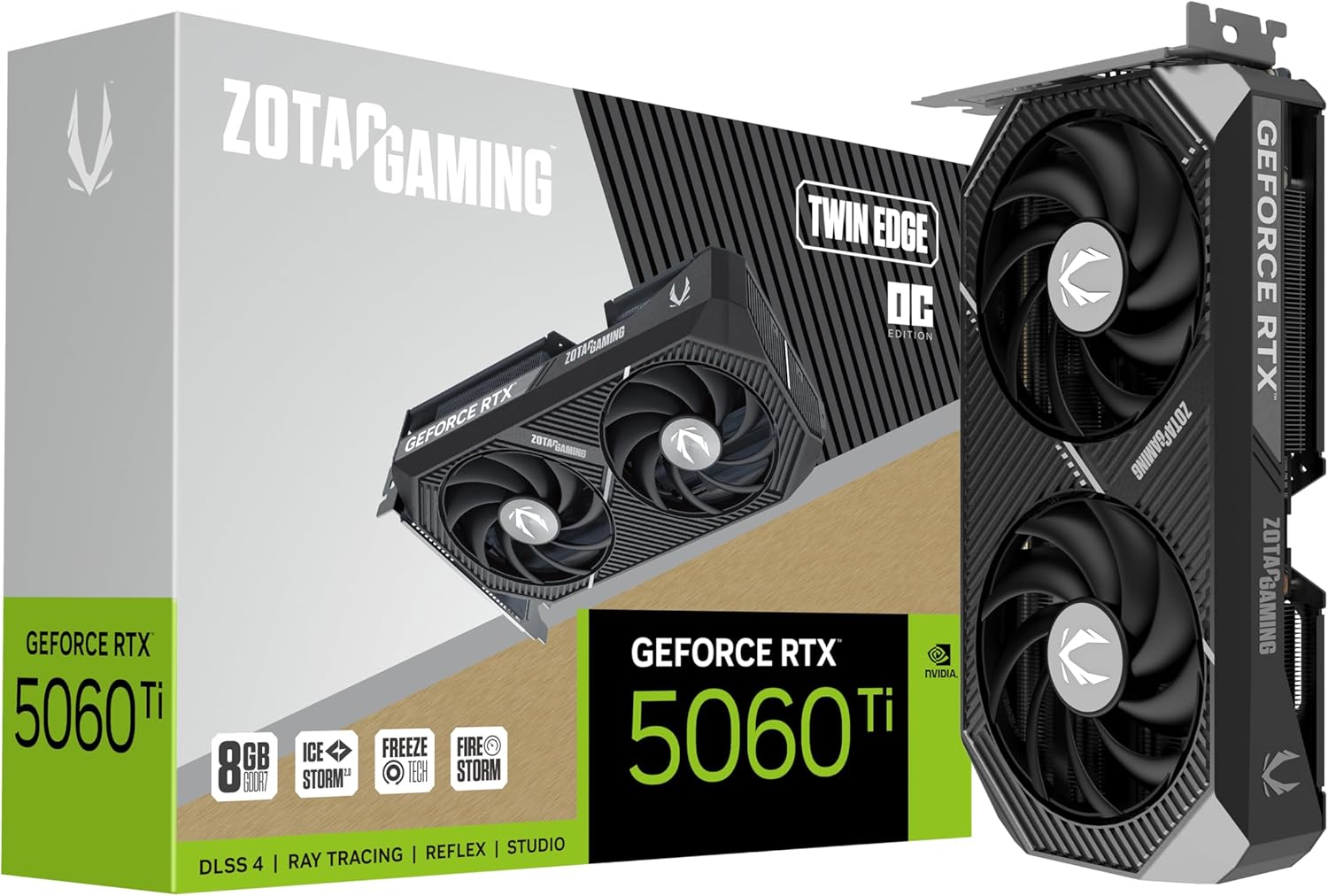
ZOTAC Gaming GeForce RTX 5060 Ti 8GB Twin Edge OC DLSS 4 8GB GDDR7 128-bit 28 Gbps PCIE 5.0 Gaming Graphics Card, IceStorm 2.0 Cooling, SFF-Ready, ZT-B50610H-10A
$300-$599This is a compact, 2-slot RTX 5060 Ti with 8GB GDDR7 and a 2602 MHz clock, built for SFF gaming rigs.