
GIGABYTE GeForce RTX 5060 AERO OC 8G Graphics Card, 8GB 128-bit GDDR7, PCIe 5.0, WINDFORCE Cooling System, Made by NVIDIA, DisplayPort & HDMI - Video Output Interface, GV-N5060AERO OC-8GD Video Card
Want the best price and purchase timing?
Our AI advisor analyzes real-time pricing across all channels to find you the best deal.
AI Verdict
This GIGABYTE RTX 5060 AERO OC with 8GB GDDR7 and a 2595 MHz boost clock is for 1080p gamers who prioritize a white aesthetic and efficient cooling over future-proof VRAM capacity.
This card is a situational fit because its NVIDIA GeForce RTX 5060 chipset and 2595 MHz boost clock provide solid 1080p gaming performance. However, the 8GB GDDR7 VRAM is a significant constraint for modern and future titles, especially at higher resolutions, leading to potential bottlenecks and instability in some games.
If 8GB VRAM is a concern, look for a GPU with 12GB or 16GB GDDR7 memory to ensure better longevity and performance in demanding applications.
Regret Score™
Medium RiskLower is better — measures purchase-regret risk from real buyer complaints, review credibility, and product maturity
Issues discovered after purchase
Critically weak dimension
Amazon rating vs actual quality
Chance this product isn't for you
Pros
- Features a WINDFORCE cooling system with Hawk fans, server-grade thermal conductive gel, copper base, and composite heat pipes for heat dissipation.
- Equipped with a dual BIOS (Performance / Silent) for flexible operation modes.
- Comes with a factory overclocked boost clock of 2595 MHz, higher than the reference 2497 MHz.
- Supports PCIe 5.0 interface, offering high bandwidth for modern systems.
- Includes RGB lighting with 16.7M customizable color options and various lighting effects.
- Offers multiple display outputs: three DisplayPort 2.1b and one HDMI 2.1b, supporting up to 8K resolution.
Cons
- The 8GB GDDR7 VRAM is a significant limitation for demanding games at 1440p or higher resolutions, and for future titles.
- Users report 8GB VRAM can cause performance issues and visual artifacts in specific demanding games like Rust.
- Despite the factory overclock, the 8GB VRAM can bottleneck performance in newer games, even compared to cards with more VRAM but similar core power.
- The card's 128-bit memory interface, while GDDR7, might restrict bandwidth compared to cards with wider interfaces, especially with the 8GB VRAM.
Dimension Scores
The card delivers strong 1080p performance, achieving 122 FPS in Far Cry 6 at high settings, but the 8GB VRAM limits its potential at 1440p and in future titles.
The WINDFORCE cooling system with Hawk fans, server-grade thermal gel, and copper heat pipes keeps GPU temperatures low, with a max GPU temp of 58°C and junction temp of 60°C under load.
The card has a recommended power supply of 550W and uses a single 8-pin power connector, indicating moderate power consumption for its class.
The 8GB GDDR7 VRAM is a significant drawback, frequently cited by users as insufficient for modern demanding games and future-proofing, especially at higher resolutions.
Best For
- 1080p gaming on high settings in current titles.
- Users building a white-themed PC due to its aesthetic.
- Esports titles and less graphically intensive games at high refresh rates.
- Creative applications that don't heavily rely on VRAM, leveraging DLSS 4 and Tensor Cores.
Not Recommended For
- Consistent 1440p or 4K gaming in graphically demanding, modern AAA titles.
- Users who want to future-proof their system for upcoming high-VRAM games.
- Heavy video editing or 3D rendering tasks that require more than 8GB of VRAM.
Watch Out For
- The 8GB VRAM is a recurring concern, with users noting it's 'not going to hold too well in the future' for graphically demanding games.
- Specific games like Rust reportedly 'kept freaking out every 20 minutes' with the 8GB version, requiring an upgrade to a 16GB variant for stable play.
- Performance can be 'bottlenecked' by the 8GB VRAM in new games, even if the GPU core is capable.
Full Specifications
| ASIN | B0F8MH9LG2 |
| Brand | GIGABYTE |
| Color | Information Not Available |
| Series | GV-N5060AERO OC-8GD |
| Item Weight | 2.5 pounds |
| Manufacturer | GIGABYTE |
| Memory Speed | 28000 MHz |
| Chipset Brand | NVIDIA |
| GPU Clock Speed | 2595 MHz |
| Card Description | Dedicated |
| Graphics Ram Size | 8 GB |
| Item model number | GV-N5060AERO OC-8GD |
| Product Dimensions | 11.06 x 4.61 x 1.57 inches |
| Graphics Coprocessor | NVIDIA GeForce RTX 5060 |
| Max Screen Resolution | 7680x4320 Pixels |
| Graphics Card Ram Size | 8 GB |
| Item Dimensions LxWxH | 11.06 x 4.61 x 1.57 inches |
| Video Output Interface | DisplayPort, HDMI |
What Buyers Say
The biggest takeaway from user feedback is the recurring concern about the 8GB VRAM; while the card handles 1080p gaming well, many users feel the VRAM is a bottleneck for 1440p and future titles. People upgrading from older cards like a GTX 1650 Super or RX 580 notice a substantial performance uplift. The card's white aesthetic is frequently praised, making it a popular choice for specific build themes. Despite the VRAM, it's seen as a viable option for those on a budget targeting 1080p, but with clear limitations for more demanding use cases.
“Look, it's fast for 1080p, but seriously, 8GB VRAM in 2026? My games are already pushing it, and I'm worried about next year. Should've just saved up for the 16GB version, Rust was a nightmare.”
Common Praise
- Runs most games at 1080p on high settings.
- Aesthetically pleasing white design.
- Significant performance upgrade from older generation cards like the 1650 Super or RX 580.
- Effective WINDFORCE cooling system keeps temperatures low, with a max GPU temp of 58°C under load.
- DLSS 4 provides strong lossless scaling performance.
Common Complaints
- 8GB of VRAM is not enough for graphically demanding games, especially at 1440p or higher.
- VRAM limitation causes instability and performance issues in certain titles like Rust.
- Concerns about the card's longevity and future-proofing due to the VRAM capacity.
- Users often wish for a 16GB variant for better performance in newer games.
Ownership Tips
- The white finish holds up well and doesn't yellow quickly, maintaining its aesthetic appeal.
- The dual BIOS switch is genuinely useful for quickly toggling between quieter operation and maximum performance without software tweaks.
- The card's physical size (281 x 117 x 40 mm) fits comfortably in most ATX cases without needing a support bracket.
- RGB lighting is easily controllable through GIGABYTE Control Center, allowing for seamless integration with other components.
Frequently Asked Questions
What kind of performance can I expect in games at 1080p?
You can expect to run most games at 1080p on high settings with smooth frame rates. For example, Far Cry 6 averaged 122 FPS at 1080p high, and Hogwarts Legacy averaged 134 FPS at 1440p quality settings with DLSS.
Is 8GB of VRAM enough for this card?
For 1080p gaming, 8GB of VRAM is generally sufficient for many current titles. However, for more graphically intensive games, especially at 1440p or if you plan to play new releases for several years, 8GB can be a limitation and cause performance issues.
Does this card have RGB lighting?
Yes, the GIGABYTE GeForce RTX 5060 AERO OC 8G features RGB lighting with 16.7 million customizable color options and various lighting effects, which can be synchronized with other GIGABYTE devices.
What kind of cooling system does it use?
It uses GIGABYTE's WINDFORCE cooling system, which includes Hawk fans with alternative spinning, server-grade thermal conductive gel, a copper base, composite heat pipes, and screen cooling.
What are the display output options?
The card comes with three DisplayPort 2.1b outputs and one HDMI 2.1b output, supporting a maximum resolution of 7680x4320 (8K) and up to four displays simultaneously.
Buying Guide
When you're looking at a graphics card like this, you need to think about what games you play and at what resolution. The '8GB' you see for VRAM is crucial; it's like the card's short-term memory, and if your games need more than that, performance will tank, even if the main chip is powerful. Also, check your power supply, as these cards need a certain amount of wattage and specific connectors.
VRAM (Video RAM)
This is the dedicated memory on the graphics card. Think of it as the canvas size for your games. 8GB is okay for 1080p, but if you want to paint bigger, more detailed pictures (higher resolutions or ultra settings), you'll need a larger canvas, like 12GB or 16GB, to avoid stuttering and texture pop-in.
Clock Speed (Boost Clock)
This is how fast the GPU's processor runs. A higher clock speed, like this card's 2595 MHz, means the card can process more information per second, leading to higher frame rates. It's like the engine size in a car – bigger usually means faster acceleration.
PCIe 5.0
This refers to the connection interface between the graphics card and your motherboard. PCIe 5.0 is the latest standard, offering double the bandwidth of PCIe 4.0. It's like having a wider highway for data to travel, which can be beneficial for very fast cards or specific workloads, though for most gaming, PCIe 4.0 is still plenty.
Alternatives
If 8GB VRAM is a dealbreaker, look for cards with 12GB or 16GB of GDDR7 memory, especially if you plan on 1440p gaming or want to play new AAA titles for several years.
You Might Also Like

HP NVIDIA GeForce RTX 3070 8GB OEM Graphics Card (Renewed)
$150-$299This is a renewed HP OEM NVIDIA GeForce RTX 3070 with 8GB VRAM, a gamble for budget-conscious 1440p gamers who understand the risks of refurbished hardware.

ZOTAC Gaming GeForce RTX 5070 Twin Edge OC DLSS 4 12GB GDDR7 192-bit 28 Gbps PCIE 5.0 Gaming Graphics Card, IceStorm 2.0 Cooling, SFF-Ready, ZT-B50700H-10A
$600+This is a 2-slot, SFF-ready NVIDIA RTX 5070 with 12GB GDDR7 and a 2542 MHz boost clock, built for compact gaming rigs needing high 1440p performance.

ZOTAC Gaming GeForce RTX 5080 Solid CORE OC DLSS 4 16GB GDDR7 256-bit 30 Gbps PCIE 5.0 Gaming Graphics Card, IceStorm 3.0 Advanced Cooling, Spectra RGB Lighting, ZT-B50800J2-10A
$600+This ZOTAC RTX 5080 with 16GB GDDR7 and a 2640 GHz clock speed is built for high-end 4K gaming and content creation on the NVIDIA Blackwell architecture.
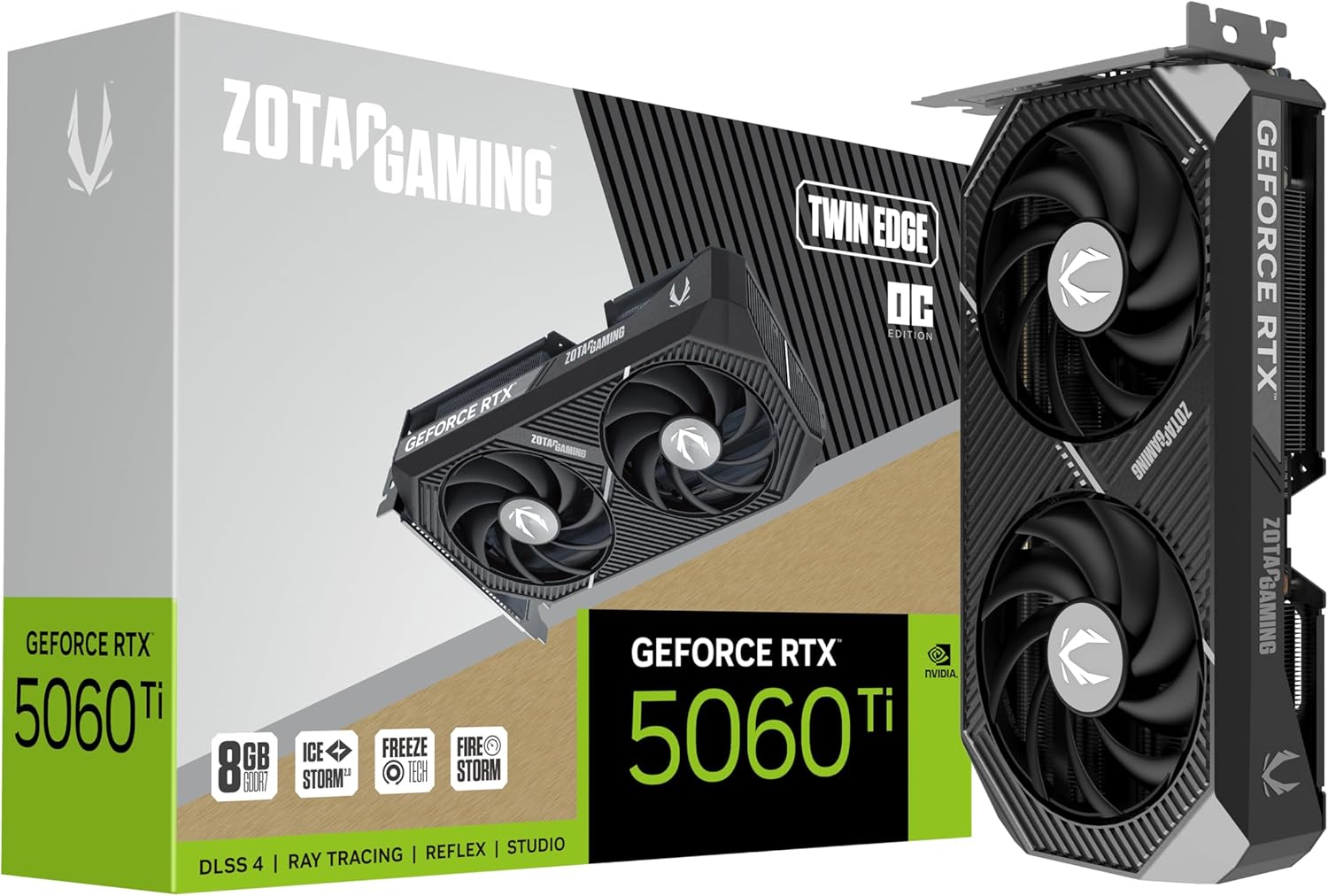
ZOTAC Gaming GeForce RTX 5060 Ti 8GB Twin Edge OC DLSS 4 8GB GDDR7 128-bit 28 Gbps PCIE 5.0 Gaming Graphics Card, IceStorm 2.0 Cooling, SFF-Ready, ZT-B50610H-10A
$300-$599This is a compact, 2-slot RTX 5060 Ti with 8GB GDDR7 and a 2602 MHz clock, built for SFF gaming rigs.