
GIGABYTE GeForce RTX 5060 OC Low Profile 8G Graphics Card, by NVIDIA, 8GB 128-bit GDDR7, PCIe 5.0, Supports up to 4 displays, DisplayPort & HDMI - Video Output Interface, GV-N5060OC-8GL Video Card
Want the best price and purchase timing?
Our AI advisor analyzes real-time pricing across all channels to find you the best deal.
AI Verdict
This 8GB GDDR7, PCIe 5.0 low-profile card is for compact builds needing 1080p gaming with DLSS 4.
This card is a situational fit because its low-profile design and PCIe 5.0 support are ideal for compact systems, but the 8GB GDDR7 VRAM is a clear limitation for modern gaming, especially at resolutions beyond 1080p. It leverages DLSS 4 to compensate for VRAM and raw performance, making it suitable for specific use cases rather than a general recommendation.
If you need more raw gaming power or plan to play at 1440p or higher resolutions, look for GPUs with at least 12GB or 16GB of VRAM and a full PCIe 5.0 x16 interface.
Regret Score™
Medium RiskLower is better — measures purchase-regret risk from real buyer complaints, review credibility, and product maturity
Issues discovered after purchase
Critically weak dimension
Amazon rating vs actual quality
Chance this product isn't for you
Pros
- Low profile design with a 182mm card length fits compact PC cases.
- Features NVIDIA's Blackwell architecture and DLSS 4 for upscaling and frame generation.
- Integrated with 8GB GDDR7 memory running at 28000 MHz for fast data access.
- Supports up to four displays with 1x HDMI 2.1b, 2x DisplayPort 2.1b, and 1x DisplayPort 1.4a outputs.
- Utilizes PCIe 5.0 for high-bandwidth connectivity.
- Includes a low-profile bracket for adaptable installation.
Cons
- 8GB of VRAM is frequently criticized as insufficient for modern games, especially at 1440p or higher settings, leading to performance issues.
- The PCIe 5.0 x8 interface might limit bandwidth compared to a full x16 slot, potentially impacting performance on some systems.
- Users report needing to rely heavily on DLSS to achieve playable frame rates at 1440p.
- Performance at 1080p, while acceptable, is not considered exceptional by some users.
Dimension Scores
The card delivers acceptable 1080p gaming, but its 8GB VRAM and reliance on DLSS 4 for 1440p prevent it from being a top performer.
While specific data for this exact model is limited, Gigabyte's use of server-grade thermal gel and graphene lubricant, combined with a low 145W TGP, suggests efficient cooling for a low-profile card.
With a Total Graphics Power (TGP) of 145 watts and a recommended 450W PSU, this card is relatively power-efficient for its class.
8GB of GDDR7 VRAM is a significant limitation for modern games, frequently leading to bottlenecks at 1440p and even some 1080p ultra settings.
Best For
- Small form factor PC builds where space is extremely limited.
- 1080p gaming, especially with DLSS 4 enabled for frame rate boosts.
- Workstations requiring multiple display outputs (up to four) in a compact design.
Not Recommended For
- Serious 1440p or 4K gaming without significant visual compromises.
- Users expecting to play demanding titles at ultra settings without VRAM limitations.
- Budget-conscious builders looking for the absolute best performance per dollar without needing a low-profile card.
Watch Out For
- 8GB VRAM is a significant bottleneck; some users report hitting VRAM limits even at 1080p ultra in games like Stalker 2 and Battlefield 6, leading to stuttering or requiring lower settings.
- The card's performance at 1440p often requires DLSS to maintain smooth gameplay, making native resolution gaming challenging.
- The PCIe 5.0 x8 bus interface could reduce throughput to 32 GB/s on PCIe 4.0 systems and 16 GB/s on PCIe 3.0 systems, potentially limiting the card's full potential.
Full Specifications
| ASIN | B0F8LNS15L |
| Brand | GIGABYTE |
| Color | Information Not Available |
| Series | GV-N5060OC-8GL |
| Item Weight | 1.3 pounds |
| Manufacturer | GIGABYTE |
| Memory Speed | 28000 MHz |
| Chipset Brand | NVIDIA |
| GPU Clock Speed | 2512 MHz |
| Card Description | Dedicated |
| Graphics Ram Size | 8 GB |
| Item model number | GV-N5060OC-8GL |
| Product Dimensions | 7.17 x 2.72 x 1.42 inches |
| Graphics Coprocessor | NVIDIA GeForce RTX 5060 |
| Max Screen Resolution | 7680x4320 Pixels |
| Graphics Card Ram Size | 8 GB |
| Item Dimensions LxWxH | 7.17 x 2.72 x 1.42 inches |
| Video Output Interface | DisplayPort, HDMI |
What Buyers Say
The most surprising feedback on this card, even before its official release, is the widespread concern over its 8GB VRAM, with many users anticipating it will be insufficient for modern gaming at higher resolutions or settings. While the low-profile design is a clear advantage for compact systems, the card's performance at 1440p is expected to heavily rely on DLSS 4, and some users even report VRAM limitations at 1080p ultra. The PCIe 5.0 x8 interface also draws criticism for potentially limiting bandwidth on older systems.
“Man, I really wanted to like this for my tiny build, but 8GB VRAM in 2025? Seriously? I'm already seeing people say it chokes at 1440p without DLSS, and even 1080p ultra is pushing it. Feels like a compromise right out of the box.”
Common Praise
- Compact low-profile design fits into small form factor cases.
- Includes an extra low-profile bracket for installation flexibility.
- Supports up to four displays, which is useful for productivity setups.
- Leverages NVIDIA's latest Blackwell architecture and DLSS 4 for advanced features.
Common Complaints
- 8GB VRAM is widely considered inadequate for future-proofing and demanding games, even at 1080p ultra settings.
- Performance at 1440p often necessitates the use of DLSS to achieve smooth frame rates.
- The PCIe 5.0 x8 interface is seen as a potential bottleneck, especially for users with older PCIe 3.0 or 4.0 motherboards.
- Some users feel the performance uplift over previous generations isn't enough to justify the cost, given the VRAM limitations.
Ownership Tips
- Expect to tweak game settings and rely on DLSS 4 heavily if playing at 1440p or aiming for high frame rates in newer titles.
- Verify your motherboard's PCIe slot configuration; the x8 interface might be a factor if you're not on PCIe 5.0.
- The low-profile bracket is a lifesaver for truly compact cases, but make sure your case has enough airflow for the cooling solution.
Frequently Asked Questions
What kind of performance can I expect for gaming?
You can expect playable frame rates at 1080p, especially with DLSS 4 enabled. For 1440p, you'll likely need to use DLSS and potentially lower settings to maintain smooth performance due to the 8GB VRAM limitation.
Will this card fit in my small PC case?
Yes, with a length of 182mm and a low-profile design, this card is specifically made for compact builds and includes an additional low-profile bracket for installation.
Does this graphics card support multiple monitors?
Yes, it supports up to four displays simultaneously, featuring one HDMI 2.1b port, two DisplayPort 2.1b ports, and one DisplayPort 1.4a port.
Is 8GB of VRAM enough for modern games?
For many modern games, especially at 1080p with optimized settings, 8GB can be sufficient. However, at higher resolutions like 1440p or with ultra settings, users frequently report hitting VRAM limits, leading to performance issues.
What power supply do I need for this card?
NVIDIA recommends a 450-watt power supply for this card, which has a total graphics power of 145 watts.
Buying Guide
When you're looking at a graphics card like this, you need to think about what games you play and on what kind of monitor. This card is built for smaller computers, so if you have a tiny case, that's a big plus. But the amount of video memory (VRAM) is super important for how well games run, especially newer ones with lots of detailed textures. Don't just look at the 'RTX' name; dig into the VRAM and how it performs at your desired resolution.
VRAM (8GB GDDR7)
This is like the graphics card's short-term memory. More VRAM means the card can handle more textures, models, and visual data in games without slowing down. 8GB is becoming a tight squeeze for modern games, especially if you want to play at 1440p or higher settings, often forcing you to lower visual quality.
PCIe 5.0
This is the connection speed between the graphics card and your computer's motherboard. PCIe 5.0 is the latest and fastest, but this card uses an x8 lane configuration instead of x16. Think of it like a highway: x16 is 16 lanes, x8 is 8 lanes. While still fast, it means less data can pass through simultaneously, which could be a bottleneck in some scenarios, especially if your motherboard only supports older PCIe versions.
Low Profile Design
This refers to the physical size of the card. A low-profile card is much shorter and thinner than standard cards, making it perfect for compact desktop PCs or home theater PCs where space is very limited. If you have a standard-sized PC case, this feature might not be as critical for you, but it's essential for small builds.
Alternatives
If you need more VRAM for demanding games or higher resolutions, look for cards with 12GB or 16GB GDDR7. If you don't need a low-profile form factor, you might find better performance-per-dollar in standard-sized cards with a full PCIe x16 interface.
You Might Also Like

HP NVIDIA GeForce RTX 3070 8GB OEM Graphics Card (Renewed)
$150-$299This is a renewed HP OEM NVIDIA GeForce RTX 3070 with 8GB VRAM, a gamble for budget-conscious 1440p gamers who understand the risks of refurbished hardware.

ZOTAC Gaming GeForce RTX 5070 Twin Edge OC DLSS 4 12GB GDDR7 192-bit 28 Gbps PCIE 5.0 Gaming Graphics Card, IceStorm 2.0 Cooling, SFF-Ready, ZT-B50700H-10A
$600+This is a 2-slot, SFF-ready NVIDIA RTX 5070 with 12GB GDDR7 and a 2542 MHz boost clock, built for compact gaming rigs needing high 1440p performance.

ZOTAC Gaming GeForce RTX 5080 Solid CORE OC DLSS 4 16GB GDDR7 256-bit 30 Gbps PCIE 5.0 Gaming Graphics Card, IceStorm 3.0 Advanced Cooling, Spectra RGB Lighting, ZT-B50800J2-10A
$600+This ZOTAC RTX 5080 with 16GB GDDR7 and a 2640 GHz clock speed is built for high-end 4K gaming and content creation on the NVIDIA Blackwell architecture.
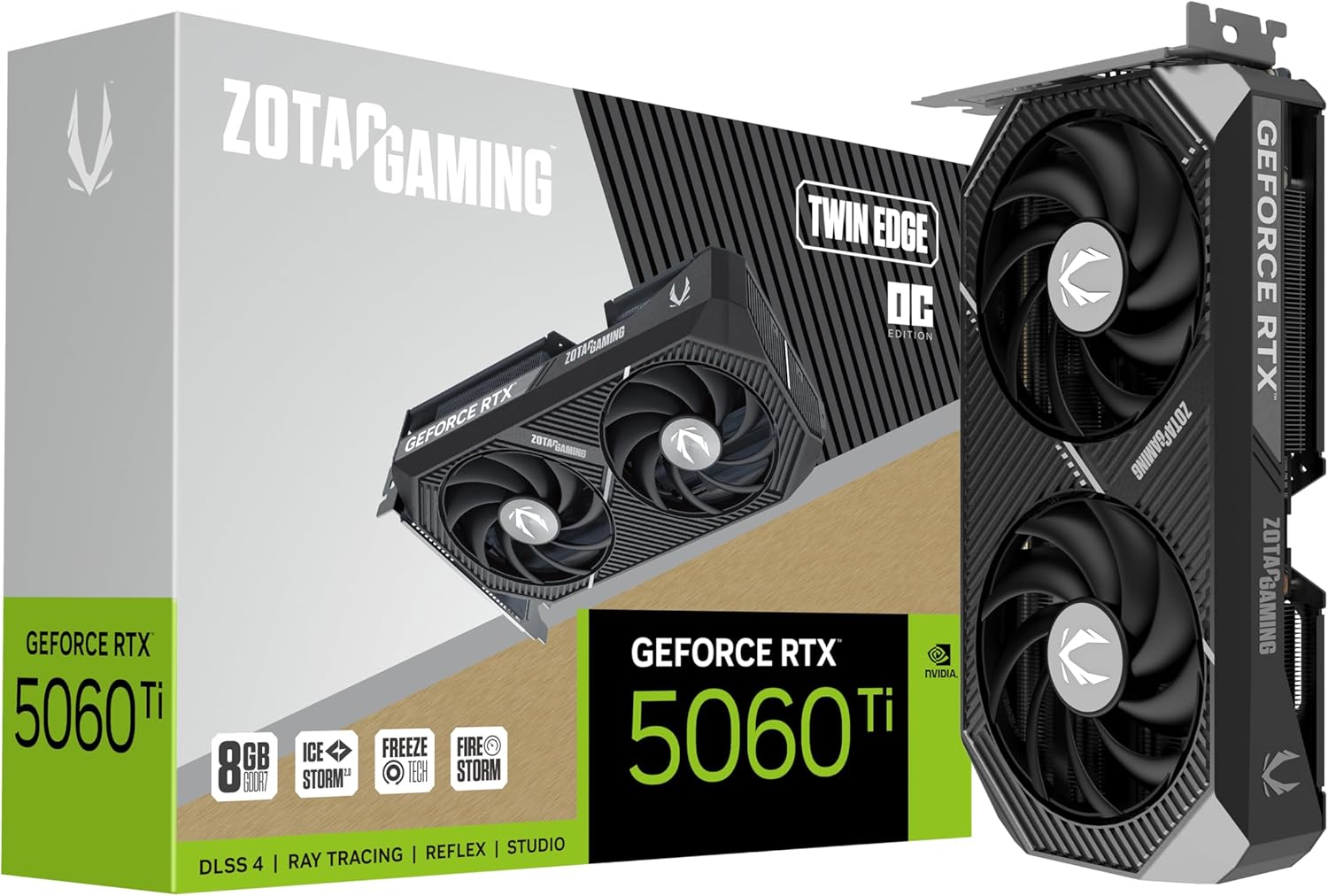
ZOTAC Gaming GeForce RTX 5060 Ti 8GB Twin Edge OC DLSS 4 8GB GDDR7 128-bit 28 Gbps PCIE 5.0 Gaming Graphics Card, IceStorm 2.0 Cooling, SFF-Ready, ZT-B50610H-10A
$300-$599This is a compact, 2-slot RTX 5060 Ti with 8GB GDDR7 and a 2602 MHz clock, built for SFF gaming rigs.