
GIGABYTE GeForce RTX 5060 WINDFORCE OC 8G Graphics Card, Cooling System, 8GB 128-bit GDDR7, PCIe 5.0, Manufactured by NVIDIA, DisplayPort & HDMI - Video Output Interface, GV-N5060WF2OC-8GD Video Card
Want the best price and purchase timing?
Our AI advisor analyzes real-time pricing across all channels to find you the best deal.
AI Verdict
This 8GB GDDR7, PCIe 5.0 x8 RTX 5060 is for 1080p gamers who need modern NVIDIA features on a budget.
This card is a strong contender if you're strictly a 1080p gamer aiming for high refresh rates in esports or playable frame rates in AAA games with DLSS 4. Its 8GB GDDR7 VRAM and PCIe 5.0 x8 interface are adequate for this specific use case, but become limiting quickly at higher resolutions or for future-proofing.
If you need more VRAM for 1440p gaming or better longevity, look for GPUs with 12GB or 16GB GDDR7 memory.
Regret Score™
Low RiskLower is better — measures purchase-regret risk from real buyer complaints, review credibility, and product maturity
Issues discovered after purchase
Critically weak dimension
Amazon rating vs actual quality
Chance this product isn't for you
Pros
- Delivers smooth 1080p gameplay, often above 144 FPS in competitive titles.
- Features NVIDIA's Blackwell architecture and DLSS 4 for enhanced performance and AI acceleration [cite: 6, Product Description].
- WINDFORCE cooling system keeps the GPU around 70°C under load, with quiet fan operation.
- Compact dual-fan design (199mm x 116mm x 40mm) fits well in various ATX and small form factor cases.
- Low power draw at 145 watts under load, requiring only a 450W PSU minimum.
Cons
- 8GB GDDR7 VRAM is a significant limiting factor for longevity in newer AAA games, especially at 1440p or higher resolutions.
- PCIe 5.0 x8 interface uses a short edge connector, potentially limiting throughput on older PCIe 3 systems and not fully utilizing PCIe 5.0 bandwidth.
- Some users report the build quality as 'better, not the best'.
Dimension Scores
Delivers strong 1080p performance, often exceeding 144 FPS in competitive games and 60 FPS in AAA titles with DLSS 4.
The WINDFORCE cooling system keeps the GPU around 70°C under load, peaking at 73°C, with quiet fan operation and semi-passive idle mode.
Draws a relatively low 145 watts under load, making it efficient and suitable for systems with a 450W PSU.
8GB GDDR7 VRAM is a significant limitation for current and future demanding games, especially at resolutions above 1080p.
Best For
- 1080p gaming with high refresh rates in esports and competitive titles
- Budget-conscious PC builds needing modern NVIDIA features like DLSS 4 and Frame Generation
- Compact PC builds due to its 199mm length and dual-fan cooler
Not Recommended For
- Gamers targeting 1440p or 4K resolutions for current and future AAA titles without significant VRAM compromises
- Users expecting maximum PCIe 5.0 bandwidth, as it uses an x8 interface with a short edge connector
- Those who plan to keep the same GPU for more than 2-3 years without upgrading, due to VRAM limitations
Watch Out For
- The 8GB VRAM can bottleneck performance in new games, especially at higher settings or resolutions, forcing compromises.
- The PCIe 5.0 x8 interface, despite being PCIe 5.0, is physically an 8x short edge connector, which can limit data throughput to 32 GB/s on PCIe 4/5 systems and 16 GB/s on PCIe 3, impacting performance.
- Some users feel the 8GB VRAM makes the card a tough sell for longevity, suggesting it won't hold up in the long run for demanding titles.
Full Specifications
| ASIN | B0F8LDHQ7Y |
| Brand | GIGABYTE |
| Color | Information Not Available |
| Series | GV-N5060WF2OC-8GD |
| Item Weight | 1.65 pounds |
| Manufacturer | GIGABYTE |
| Memory Speed | 28000 MHz |
| Chipset Brand | NVIDIA |
| GPU Clock Speed | 2512 MHz |
| Card Description | Dedicated |
| Graphics Ram Size | 8 GB |
| Item model number | GV-N5060WF2OC-8GD |
| Product Dimensions | 7.83 x 4.57 x 1.57 inches |
| Graphics Coprocessor | NVIDIA GeForce RTX 5060 |
| Max Screen Resolution | 7680x4320 Pixels |
| Graphics Card Ram Size | 8 GB |
| Item Dimensions LxWxH | 7.83 x 4.57 x 1.57 inches |
| Video Output Interface | DisplayPort, HDMI |
What Buyers Say
The biggest takeaway from early adopters is the concern around the 8GB VRAM, with many users questioning its longevity for future titles, especially at 1440p. Despite this, the card is frequently praised for its strong 1080p performance, often providing a significant upgrade from older GTX series cards. Its compact size and effective WINDFORCE cooling are also recurring positive points, keeping temperatures in check without excessive noise. The PCIe 5.0 x8 interface, while technically advanced, has drawn criticism for its physical implementation as a short edge connector, which some feel limits its potential throughput.
“Look, it's fast for 1080p, way better than my old 1650 Super, but that 8GB VRAM is gonna be a problem real soon if games keep getting crazier. I just hope it lasts me a couple years before I gotta upgrade again.”
Common Praise
- Provides a noticeable performance boost over older GTX 1650 Super or RX 580 cards.
- Runs quietly, with fans not needing to ramp excessively even under load.
- Compact design (199mm length) makes it easy to fit into smaller PC cases.
- Effective WINDFORCE cooling keeps GPU temperatures around 70°C during gaming.
- Offers smooth 1080p gameplay, often above 144 FPS in competitive titles.
Common Complaints
- 8GB VRAM is seen as insufficient for future-proofing and can bottleneck performance in new AAA games at higher settings.
- The PCIe 5.0 x8 interface uses a short edge connector, which some users feel is a cost-cutting measure that limits bandwidth.
- Some users report the build quality as 'better, not the best'.
Ownership Tips
- The card works well right out of the box, assuming compatible drivers are pre-installed.
- The compact size is a genuine benefit for builders with limited space.
- Even with 8GB VRAM, DLSS 4 and Frame Generation help maintain playable frame rates in demanding titles at 1080p.
- The card's low power consumption (145W) means it's not a huge drain on your PSU.
- While it's a PCIe 5.0 card, the x8 interface means you won't get full PCIe 5.0 x16 bandwidth, which might matter for some users.
Frequently Asked Questions
Is 8GB of VRAM enough for modern games?
For 1080p gaming, 8GB is generally sufficient for many current titles, especially with DLSS 4. However, for newer AAA games, particularly at 1440p or higher, 8GB can become a bottleneck, requiring lower texture settings.
What kind of performance can I expect at 1080p?
You can expect strong performance, often above 144 FPS in competitive games, and playable frame rates (comfortably above 60fps) in demanding AAA titles with settings adjusted and DLSS 4 enabled.
Will this card fit in a small PC case?
Yes, its compact dimensions of 199mm x 116mm x 40mm and dual-fan WINDFORCE cooler make it a good choice for small form factor builds.
What kind of power supply do I need?
GIGABYTE recommends a power supply of 450W or above, as the card draws around 145 watts under load and requires one 8-pin PCIe power connector.
Does this card support ray tracing and DLSS?
Yes, it's powered by NVIDIA's Blackwell architecture and supports DLSS 4, including Frame Generation, for enhanced visuals and performance in compatible games. [cite: 6, Product Description]
Buying Guide
When you're looking at a GPU like this, you need to think about what resolution you play at and for how long you expect to keep it. This card is built for 1080p gaming, where its 8GB of VRAM is generally okay for now. If you're trying to push 1440p or want to play every new game on 'Ultra' for years, you'll hit a VRAM wall fast. Also, consider your case size; this one is pretty compact, which is a plus for smaller builds.
vram (8GB GDDR7)
This is the card's dedicated memory for storing game textures and data. 8GB is currently sufficient for 1080p, but modern games are increasingly demanding more, so it's a potential bottleneck for future titles or higher resolutions, like trying to fit too many apps on a small phone's storage.
PCIe 5.0 (x8)
This is how the graphics card connects to your motherboard and communicates with the rest of your PC. PCIe 5.0 is the latest standard, offering fast data transfer. However, this card uses an x8 interface (half the lanes of a full x16 slot), which means it won't use the absolute maximum bandwidth of PCIe 5.0, though for a card of this tier, it's usually not a significant performance limiter. Think of it like a highway with 8 lanes instead of 16; still fast, but not the absolute widest.
WINDFORCE cooling system
This refers to the fans and heatsink designed to keep the GPU cool. A good cooling system prevents the card from overheating, which can lead to performance drops or even damage. GIGABYTE's WINDFORCE is known for being effective and relatively quiet, like a well-designed car engine that stays cool without making a racket.
Alternatives
If this card doesn't quite fit, look for GPUs with 12GB or 16GB of VRAM if you're aiming for 1440p or want more longevity. If you need even higher 1080p performance or better ray tracing, consider cards with a higher core count and wider memory bus.
You Might Also Like

HP NVIDIA GeForce RTX 3070 8GB OEM Graphics Card (Renewed)
$150-$299This is a renewed HP OEM NVIDIA GeForce RTX 3070 with 8GB VRAM, a gamble for budget-conscious 1440p gamers who understand the risks of refurbished hardware.

ZOTAC Gaming GeForce RTX 5070 Twin Edge OC DLSS 4 12GB GDDR7 192-bit 28 Gbps PCIE 5.0 Gaming Graphics Card, IceStorm 2.0 Cooling, SFF-Ready, ZT-B50700H-10A
$600+This is a 2-slot, SFF-ready NVIDIA RTX 5070 with 12GB GDDR7 and a 2542 MHz boost clock, built for compact gaming rigs needing high 1440p performance.

ZOTAC Gaming GeForce RTX 5080 Solid CORE OC DLSS 4 16GB GDDR7 256-bit 30 Gbps PCIE 5.0 Gaming Graphics Card, IceStorm 3.0 Advanced Cooling, Spectra RGB Lighting, ZT-B50800J2-10A
$600+This ZOTAC RTX 5080 with 16GB GDDR7 and a 2640 GHz clock speed is built for high-end 4K gaming and content creation on the NVIDIA Blackwell architecture.
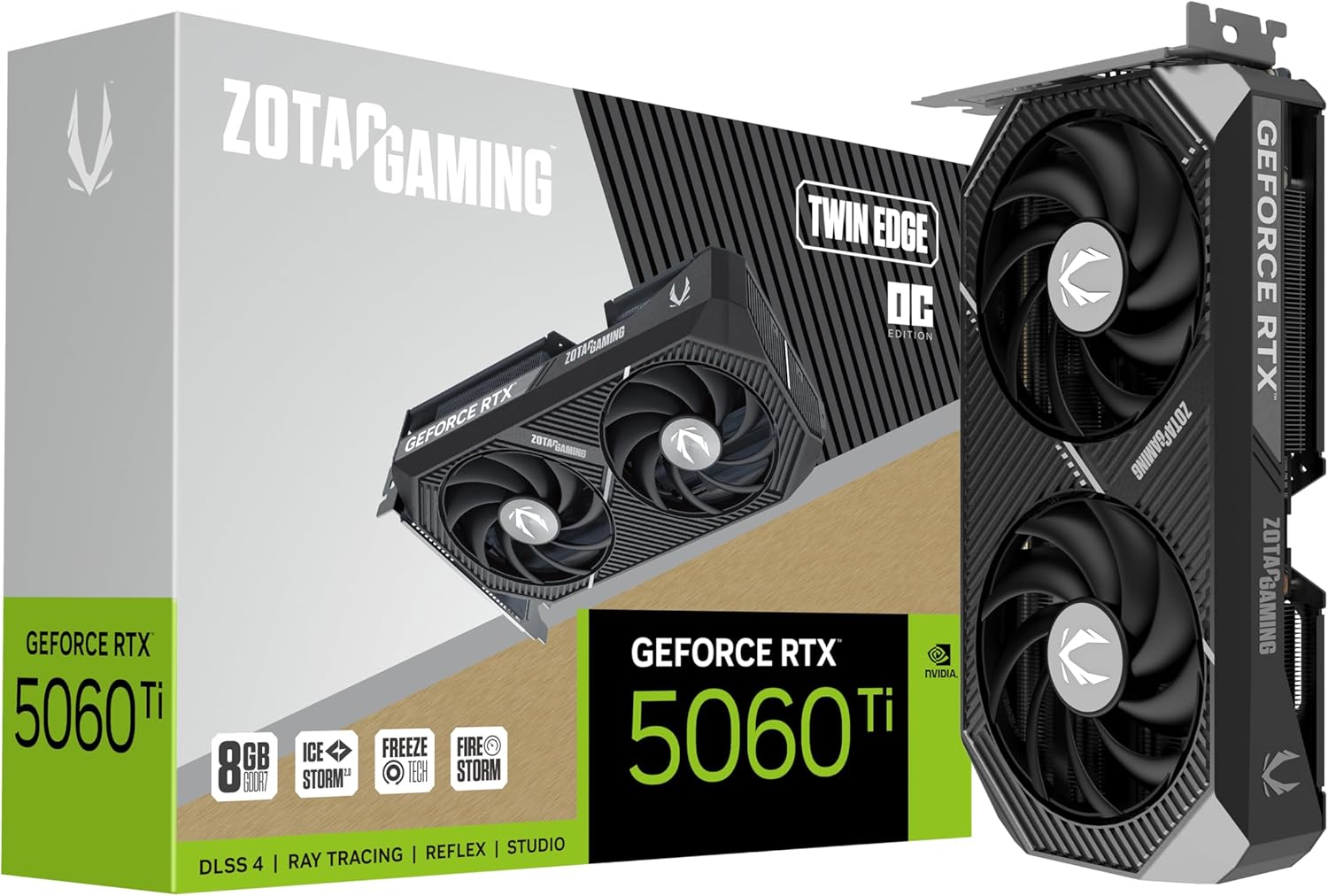
ZOTAC Gaming GeForce RTX 5060 Ti 8GB Twin Edge OC DLSS 4 8GB GDDR7 128-bit 28 Gbps PCIE 5.0 Gaming Graphics Card, IceStorm 2.0 Cooling, SFF-Ready, ZT-B50610H-10A
$300-$599This is a compact, 2-slot RTX 5060 Ti with 8GB GDDR7 and a 2602 MHz clock, built for SFF gaming rigs.