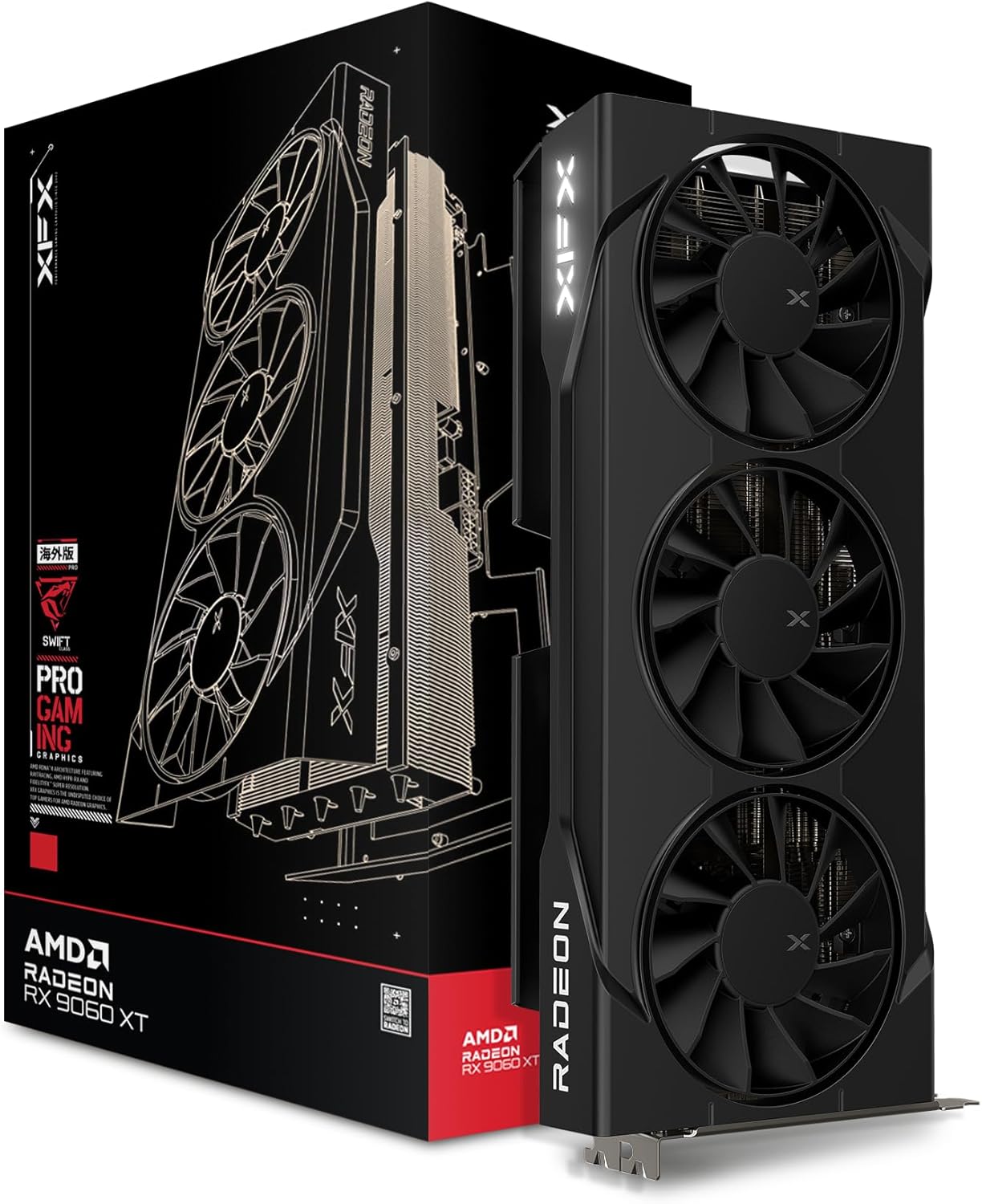
XFX Swift AMD Radeon RX 9060 XT OC Triple Fan Gaming Edition with 16GB GDDR6 HDMI 2xDP, AMD RDNA 4 RX 9060XT RX-96TS316BA
Want the best price and purchase timing?
Our AI advisor analyzes real-time pricing across all channels to find you the best deal.
AI Verdict
This XFX RX 9060 XT OC with 16GB GDDR6 and a 3320 MHz boost clock is for gamers prioritizing quiet 1440p performance and strong VRAM capacity without breaking the bank.
This GPU is a strong fit for 1440p gaming due to its 16GB GDDR6 VRAM and factory overclocked 3320 MHz boost clock. The XFX triple-fan cooling solution ensures low temperatures and quiet operation, making it ideal for users who value a serene gaming environment.
If 4K gaming with high settings is your primary goal, look for a GPU with a higher compute unit count and more robust ray tracing accelerators.
Regret Score™
Very Low RiskLower is better — measures purchase-regret risk from real buyer complaints, review credibility, and product maturity
Issues discovered after purchase
Critically weak dimension
Amazon rating vs actual quality
Chance this product isn't for you
Pros
- Features 16GB of GDDR6 VRAM, providing ample memory for current and future titles at higher resolutions.
- The triple-fan cooling solution keeps GPU temperatures low, with reported edge temps around 51°C and hotspot temps around 73°C for the dual-fan model, suggesting even better for triple-fan.
- Operates quietly, with fan speeds rarely exceeding 1100 RPM at stock, remaining barely audible even when overclocked.
- Offers a factory overclocked boost clock up to 3320 MHz, making it one of XFX's highest-clocked 9060 XT variants.
- Includes a dual BIOS switch, offering a backup firmware in case of failure or for experimenting with different fan curves.
- Supports PCIe 5.0 x16 connectivity, ensuring future-proof bandwidth for compatible motherboards.
Cons
- Ray tracing performance, while improved over RDNA3, still lags behind Nvidia's offerings in mathematically intensive scenarios.
- Some users noted a 'weird fan turbulence' sound on open-air test benches, though it's less noticeable in a closed case.
- The 180W Total Board Power (TBP) is higher than the 160W reference 16GB model, requiring a 450W PSU with an 8-pin connector.
- The card's physical dimensions, particularly its thickness (dual-fan is 2.5 slots), might be a tight fit in smaller form factor cases.
Dimension Scores
The RX 9060 XT with its 3320 MHz boost clock and 16GB VRAM delivers strong 1440p gaming performance, often rivaling the RTX 5060 Ti 16GB.
The XFX SWFT Triple Fan Cooling Solution provides impressively low GPU and memory temperatures while remaining whisper quiet, with fan speeds rarely exceeding 1100 RPM.
With a 180W TBP, it's efficient for its performance tier, requiring a modest 450W PSU, though it's slightly higher than the reference 16GB model's 160W.
The 16GB GDDR6 VRAM is excellent for its price point, providing ample memory for high-resolution textures and future-proofing against increasing game requirements.
Best For
- Gamers targeting high refresh rate 1440p gaming with modern titles.
- Users who prioritize quiet PC operation during gaming sessions.
- Anyone needing significant VRAM for texture-heavy games or creative applications.
- PC builders looking for a GPU with a clean, minimalistic aesthetic.
Not Recommended For
- Enthusiasts demanding top-tier ray tracing performance without compromise.
- Small form factor (SFF) PC builds with limited GPU clearance.
- Budget-conscious buyers seeking the absolute lowest price for a 9060 XT, as this OC model carries a slight premium.
Watch Out For
- The 180W TBP means you'll need at least a 450W power supply with a dedicated 8-pin PCIe power connector, so check your PSU before buying.
- While generally quiet, some users reported a 'weird fan turbulence' when the card is on an open test bench, which might be audible in very quiet cases.
- The triple-fan cooler, while effective, will make this card physically larger than dual-fan variants, potentially causing clearance issues in compact cases.
Full Specifications
| ASIN | B0F8128Y33 |
| Brand | XFX |
| Series | XFX SWIFT AMD Radeon™ RX 9060XT |
| Item Weight | 3.39 pounds |
| Manufacturer | XFX |
| Memory Speed | 20 GHz |
| Chipset Brand | AMD |
| GPU Clock Speed | 1900 MHz |
| Card Description | AMD Radeon RX 9060 XT with 16GB GDDR6, Boost Clock up to 3320 MHz, Base Clock 1900 MHz |
| Graphics Ram Size | 16 GB |
| Item model number | RX-96TS316BA |
| Product Dimensions | 11.42 x 4.92 x 0.04 inches |
| Graphics Coprocessor | RX 9060 XT |
| Max Screen Resolution | 3840x2160 |
| Graphics Card Ram Size | 16 GB |
| Item Dimensions LxWxH | 11.42 x 4.92 x 0.04 inches |
| Video Output Interface | DisplayPort, HDMI |
What Buyers Say
Users frequently highlight the XFX RX 9060 XT's quiet operation and effective cooling, even under load, making it a standout for thermal performance. Many appreciate the generous 16GB of VRAM, which is seen as a significant advantage for current and upcoming games. While the card offers a strong 1440p gaming experience, some discussions point out that its ray tracing capabilities, though improved, don't quite match Nvidia's top-tier offerings. The card's value proposition is often debated, with some finding the OC model's price slightly elevated compared to other 9060 XT variants.
“Dude, this card is seriously quiet, like, I can actually hear my game audio instead of fan whine, and 16 gigs of VRAM is just overkill in the best way for 1440p. Worth it.”
Common Praise
- Runs very cool, with GPU and memory temperatures staying low even during intense gaming.
- Fans are exceptionally quiet, often barely audible even when under load or overclocked.
- The 16GB GDDR6 VRAM is more than enough for demanding games at 1440p and beyond.
- Offers strong 1440p rasterization performance, often outperforming older, more expensive cards.
- The industrial design with a matte white finish (for the white variant) is visually appealing and clean.
Common Complaints
- Ray tracing performance, while present, isn't as strong as competing Nvidia cards.
- The OC model can be priced higher than other 9060 XT variants, making some question its value compared to base models.
- Physical size of the triple-fan cooler can be an issue for smaller PC cases.
- Some users on open test benches noticed a 'weird fan turbulence' sound.
Ownership Tips
- The dual BIOS switch is a handy feature for peace of mind, letting you experiment without fear.
- Even with the factory overclock, the card maintains low temperatures, suggesting good thermal headroom.
- The card's aesthetic is understated, which is a plus if you're not into flashy RGB.
- You'll definitely want to ensure your case has adequate clearance for this triple-fan beast.
Frequently Asked Questions
What kind of gaming performance can I expect from the RX 9060 XT?
You can expect strong performance for 1440p gaming, often comparable to an RX 7700 XT, and it can handle 4K with FSR enabled in graphically intensive titles.
Is this graphics card good for ray tracing?
The RDNA 4 architecture includes dedicated hardware for ray tracing, which is a significant improvement over previous AMD generations. However, Nvidia still holds an advantage in this area.
How much power does this GPU consume?
This XFX OC model has a Total Board Power (TBP) of 180W, which is slightly higher than the reference 16GB 9060 XT's 160W. A 450W power supply with an 8-pin PCIe connector is recommended.
Will this card fit in my PC case?
The triple-fan design means it's a larger card. While the dual-fan version is 2.5 slots thick, you should check your case's GPU clearance for length and thickness to ensure compatibility with this triple-fan model.
Does this GPU have a dual BIOS feature?
Yes, this XFX model includes a dual BIOS switch, which can be useful for switching between performance and silent modes or as a backup.
Buying Guide
When you're looking at a GPU like this, you're essentially buying the engine for your gaming PC. The 'chipset' (RX 9060 XT) tells you its core power, while 'VRAM' (16GB) is like the amount of memory it has to store game textures and data. More VRAM means smoother performance at higher resolutions and with more detailed graphics. The 'clock speed' is how fast the engine runs, directly impacting how many frames per second you'll see. Don't just chase the highest numbers; consider how these specs work together for the games you play and your monitor's resolution.
Chipset (RX 9060 XT)
This is the core processor of your graphics card, like the CPU for your whole computer. It dictates the raw processing power and what generation of features (like RDNA 4's ray tracing improvements) you're getting. A newer, more powerful chipset means better performance in games.
VRAM (16GB GDDR6)
Think of VRAM as the graphics card's short-term memory. Games load textures, models, and other assets into this memory. 16GB is a lot, meaning you can run games at higher resolutions (like 1440p or even 4K with FSR) with ultra-high texture settings without stuttering, especially in newer, more demanding titles.
Boost Clock (Up to 3320 MHz)
This is the maximum speed the GPU's core can reach under ideal conditions. A higher boost clock generally translates to more frames per second in games. This XFX model's high factory overclock means it's tuned for better performance right out of the box.
Cooling Solution (Triple Fan)
Just like a car engine needs cooling, your GPU needs it too, especially when running at high speeds. A triple-fan setup, like on this XFX card, is designed to dissipate heat more effectively, allowing the card to maintain higher clock speeds for longer and run quieter than cards with fewer or smaller fans.
Alternatives
If you need stronger ray tracing performance, look for GPUs from the competing brand with dedicated RT cores. If you're on a tighter budget and primarily play at 1080p, consider cards with less VRAM (e.g., 8GB or 12GB) and a slightly lower performance tier.
You Might Also Like

HP NVIDIA GeForce RTX 3070 8GB OEM Graphics Card (Renewed)
$150-$299This is a renewed HP OEM NVIDIA GeForce RTX 3070 with 8GB VRAM, a gamble for budget-conscious 1440p gamers who understand the risks of refurbished hardware.

ZOTAC Gaming GeForce RTX 5070 Twin Edge OC DLSS 4 12GB GDDR7 192-bit 28 Gbps PCIE 5.0 Gaming Graphics Card, IceStorm 2.0 Cooling, SFF-Ready, ZT-B50700H-10A
$600+This is a 2-slot, SFF-ready NVIDIA RTX 5070 with 12GB GDDR7 and a 2542 MHz boost clock, built for compact gaming rigs needing high 1440p performance.

ZOTAC Gaming GeForce RTX 5080 Solid CORE OC DLSS 4 16GB GDDR7 256-bit 30 Gbps PCIE 5.0 Gaming Graphics Card, IceStorm 3.0 Advanced Cooling, Spectra RGB Lighting, ZT-B50800J2-10A
$600+This ZOTAC RTX 5080 with 16GB GDDR7 and a 2640 GHz clock speed is built for high-end 4K gaming and content creation on the NVIDIA Blackwell architecture.
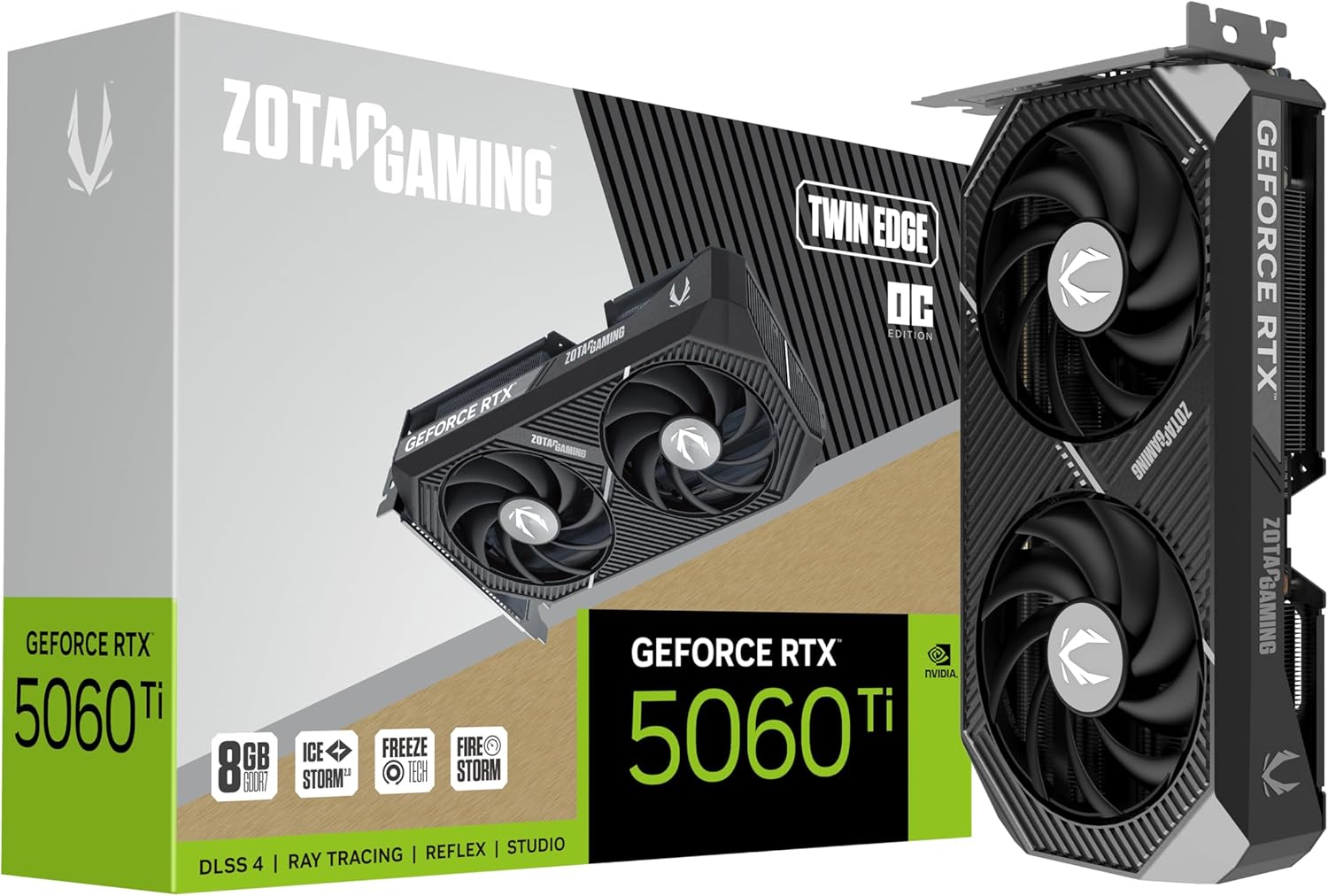
ZOTAC Gaming GeForce RTX 5060 Ti 8GB Twin Edge OC DLSS 4 8GB GDDR7 128-bit 28 Gbps PCIE 5.0 Gaming Graphics Card, IceStorm 2.0 Cooling, SFF-Ready, ZT-B50610H-10A
$300-$599This is a compact, 2-slot RTX 5060 Ti with 8GB GDDR7 and a 2602 MHz clock, built for SFF gaming rigs.