
GIGABYTE GeForce RTX 5060 Ti Gaming OC 16G Graphics Card, by NVIDIA,16GB 128-bit GDDR7, PCIe 5.0, WINDFORCE Cooling System,DisplayPort & HDMI - Video Output Interface,GV-N506TGAMING OC-16GD Video Card
Want the best price and purchase timing?
Our AI advisor analyzes real-time pricing across all channels to find you the best deal.
AI Verdict
This 16GB GDDR7 RTX 5060 Ti with a 2647 MHz boost clock targets 1080p/1440p gaming, offering a modest upgrade over the RTX 4060 Ti.
This GIGABYTE RTX 5060 Ti with 16GB GDDR7 and a 2647 MHz boost clock is a strong contender for 1080p and 1440p gaming, especially when leveraging DLSS 4. Its 16GB VRAM is a clear advantage for modern titles and creative tasks, but the modest generational performance increase and PCIe x8 interface make it a situational choice depending on upgrade path and budget.
If you need more raw performance for 4K gaming or higher frame rates at 1440p, look for a GPU with a higher tier chipset like the RTX 5070 or above.
Regret Score™
Medium RiskLower is better — measures purchase-regret risk from real buyer complaints, review credibility, and product maturity
Issues discovered after purchase
Critically weak dimension
Amazon rating vs actual quality
Chance this product isn't for you
Pros
- Integrated with 16GB GDDR7 memory, crucial for modern game asset loading and future-proofing at 1440p resolutions.
- Features a 2647 MHz boost clock, providing a slight performance edge over reference designs.
- Equipped with a WINDFORCE cooling system, contributing to quiet operation even under load.
- Supports NVIDIA Blackwell architecture and DLSS 4, enhancing frame rates and visual quality through AI acceleration.
- Includes 3 DisplayPort 2.1b and 1 HDMI 2.1b outputs, supporting 8K resolution.
- Utilizes a single 8-pin PCIe power connector, simplifying power supply requirements.
Cons
- The PCIe 5.0 x8 interface, rather than x16, has raised concerns about potential bandwidth limitations, though its impact is debated.
- Early reports mention potential issues with thermal gel application, with some users observing migration away from critical components.
- Performance gains over the previous generation (RTX 4060 Ti) are around 10-20%, which some users consider modest for a new architecture.
- The card's 'Performance BIOS' setting has been noted to run louder and hotter compared to other models.
Dimension Scores
The RTX 5060 Ti performs well at 1080p and 1440p, offering about a 10-20% improvement over the RTX 4060 Ti, especially with DLSS 4.
The WINDFORCE cooling system generally keeps the card quiet, but the 'Performance BIOS' can lead to higher temperatures (64.3 °C CPU core) and increased noise.
With a 180W TDP and requiring only a single 8-pin power connector, its power efficiency is above average for its performance tier.
The 16GB GDDR7 VRAM is excellent for its class, providing ample memory for current and future games at 1440p.
Best For
- Gamers targeting high refresh rate 1080p or solid 1440p performance with DLSS 4 enabled.
- Users upgrading from older 30-series or lower-end cards seeking significant performance and VRAM improvements.
- Creative professionals utilizing AI-accelerated applications for video editing, 3D rendering, and graphic design.
Not Recommended For
- Enthusiasts seeking top-tier 4K gaming performance without compromises, as the RTX 5070 offers significantly more power.
- Users with limited case space, as the card measures 281x 119x40 mm.
- Budget-conscious buyers who prioritize raw rasterization performance per dollar over NVIDIA's feature set, as alternatives might offer better value at certain price points.
Watch Out For
- Some early users have reported concerns about the thermal gel application, with observations of it possibly leaking or migrating from critical areas, potentially affecting long-term cooling efficiency.
- The card uses a PCIe 5.0 x8 interface, which, while generally sufficient, has led to discussions about whether it could be a bottleneck compared to a full x16 slot in specific scenarios.
- While 16GB VRAM is a plus, the performance uplift over the RTX 4060 Ti is around 10-20% in rasterization, which might not justify the price for some users expecting larger generational leaps.
- The 'Performance BIOS' mode on this specific model has been noted to result in higher operating temperatures (64.3 °C CPU core and 68 °C memory) and increased fan noise compared to its 'Quiet BIOS' or other models.
Full Specifications
| ASIN | B0F5BD1X83 |
| Brand | GIGABYTE |
| Color | Information Not Available |
| Series | GV-N506TGAMING OC-16GD |
| Item Weight | 2.57 pounds |
| Manufacturer | GIGABYTE |
| Memory Speed | 28000 MHz |
| Chipset Brand | NVIDIA |
| GPU Clock Speed | 2647 MHz |
| Card Description | Dedicated |
| Graphics Ram Size | 16 GB |
| Item model number | GV-N506TGAMING OC-16GD |
| Product Dimensions | 11.06 x 4.69 x 1.57 inches |
| Graphics Coprocessor | RTX 5060TI |
| Max Screen Resolution | 7680x4320 Pixels |
| Graphics Card Ram Size | 16 GB |
| Item Dimensions LxWxH | 11.06 x 4.69 x 1.57 inches |
| Video Output Interface | DisplayPort, HDMI |
What Buyers Say
Early impressions from tech reviews and user discussions highlight the 16GB VRAM as a significant advantage for modern gaming, especially compared to 8GB cards that are showing their age. While the card delivers solid 1080p and 1440p performance, some reviewers noted the generational leap over the RTX 4060 Ti was not as substantial as hoped, around 10-20% in rasterization. Concerns have surfaced regarding the PCIe 5.0 x8 interface and potential thermal gel issues, though long-term effects are still being observed. The WINDFORCE cooling system generally keeps things quiet, but the 'Performance BIOS' can make it run hotter and louder.
“Man, this 16GB VRAM is clutch for Cyberpunk at 1440p, but I'm kinda worried about that thermal paste thing I read about, hope it doesn't mess up later.”
Common Praise
- The 16GB GDDR7 VRAM is a game-changer for playing demanding titles at 1440p without hitting memory limits.
- DLSS 4 and Multi Frame Generation significantly boost frame rates, making high refresh rate gaming at 1440p achievable.
- The card runs quietly under typical gaming loads, thanks to the WINDFORCE cooling system.
- Installation is straightforward, and driver support is reported to be stable.
- The card's compact size (281x 119x40 mm) makes it compatible with a wider range of PC cases.
Common Complaints
- The PCIe 5.0 x8 interface has sparked debate about potential performance limitations compared to a full x16 slot, especially in future titles.
- Some early reports mention concerns about the thermal gel application, with observations of it potentially migrating.
- The performance increase over the previous generation (RTX 4060 Ti) is considered modest by some, making it a 'hard sell' unless priced competitively.
- The 'Performance BIOS' setting can lead to higher operating temperatures (64.3 °C CPU core) and increased fan noise.
Ownership Tips
- The dual BIOS switch is actually useful; the 'Silent' mode really does cut down on fan noise during less demanding tasks.
- Monitoring temperatures is a good idea, especially if you're pushing the card hard, due to the early thermal gel concerns.
- The card's physical size is manageable, fitting into most mid-tower cases without needing a GPU support bracket.
- DLSS 4 is a must-use feature; it genuinely makes a noticeable difference in frame rates without a huge hit to visual quality.
Frequently Asked Questions
Does this card support ray tracing?
Yes, the GIGABYTE GeForce RTX 5060 Ti Gaming OC 16G is powered by NVIDIA's Blackwell architecture with enhanced RT Cores, providing full ray tracing capabilities for realistic graphics.
What kind of power supply do I need for this graphics card?
NVIDIA recommends at least a 650W power supply for this GPU. The card itself uses a single 8-pin PCIe power connector.
Is 16GB of VRAM enough for modern games?
Yes, 16GB of GDDR7 VRAM is considered ample for modern games, especially at 1080p and 1440p resolutions, and helps prevent memory bottlenecks that 8GB cards can experience.
What is DLSS 4?
DLSS 4 is NVIDIA's latest neural rendering technology that uses AI to boost frame rates, reduce latency, and improve image quality through features like Multi Frame Generation and enhanced Ray Reconstruction.
Does this card have dual BIOS?
Yes, this GIGABYTE model includes a Dual BIOS feature, allowing you to switch between 'Performance' and 'Silent' modes.
Buying Guide
When you're looking at a graphics card like this, you're essentially buying the engine for your gaming PC. You need to think about what resolution you play at (1080p, 1440p, 4K) and how many frames per second (FPS) you want. This card is built for solid 1080p and 1440p gaming. Also, consider the features like DLSS, which uses AI to boost performance, and ray tracing for more realistic lighting.
VRAM (Video RAM)
Clock Speed (MHz)
PCIe 5.0
Alternatives
If you need more raw performance for 4K gaming or want a larger generational leap, look for cards with higher tier chipsets and potentially a full PCIe x16 interface. If budget is tighter, consider previous generation cards with similar VRAM capacity.
You Might Also Like

HP NVIDIA GeForce RTX 3070 8GB OEM Graphics Card (Renewed)
$150-$299This is a renewed HP OEM NVIDIA GeForce RTX 3070 with 8GB VRAM, a gamble for budget-conscious 1440p gamers who understand the risks of refurbished hardware.

ZOTAC Gaming GeForce RTX 5070 Twin Edge OC DLSS 4 12GB GDDR7 192-bit 28 Gbps PCIE 5.0 Gaming Graphics Card, IceStorm 2.0 Cooling, SFF-Ready, ZT-B50700H-10A
$600+This is a 2-slot, SFF-ready NVIDIA RTX 5070 with 12GB GDDR7 and a 2542 MHz boost clock, built for compact gaming rigs needing high 1440p performance.

ZOTAC Gaming GeForce RTX 5080 Solid CORE OC DLSS 4 16GB GDDR7 256-bit 30 Gbps PCIE 5.0 Gaming Graphics Card, IceStorm 3.0 Advanced Cooling, Spectra RGB Lighting, ZT-B50800J2-10A
$600+This ZOTAC RTX 5080 with 16GB GDDR7 and a 2640 GHz clock speed is built for high-end 4K gaming and content creation on the NVIDIA Blackwell architecture.
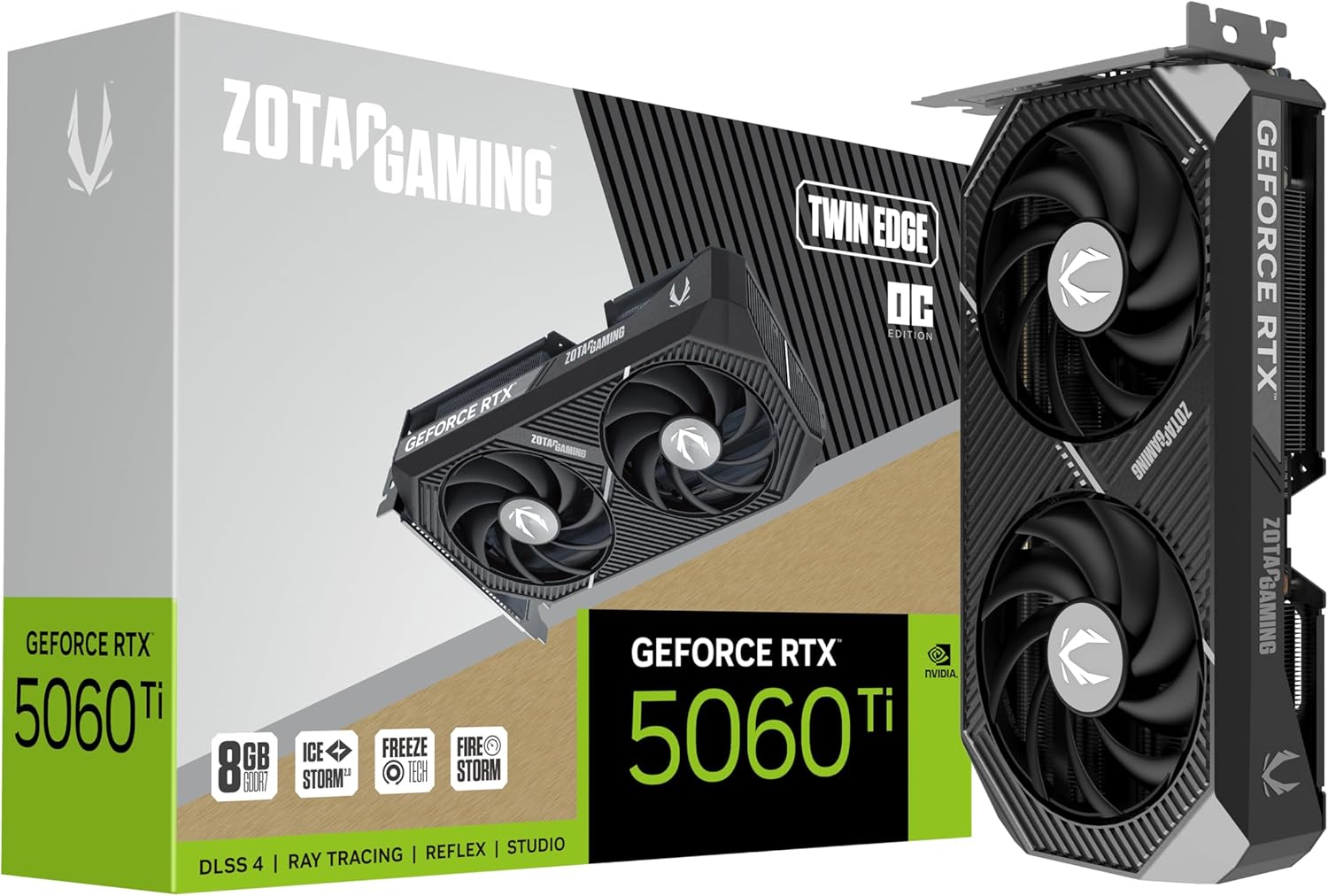
ZOTAC Gaming GeForce RTX 5060 Ti 8GB Twin Edge OC DLSS 4 8GB GDDR7 128-bit 28 Gbps PCIE 5.0 Gaming Graphics Card, IceStorm 2.0 Cooling, SFF-Ready, ZT-B50610H-10A
$300-$599This is a compact, 2-slot RTX 5060 Ti with 8GB GDDR7 and a 2602 MHz clock, built for SFF gaming rigs.