
ASUS The SFF-Ready Prime GeForce RTX™ 5060 Ti 8GB GDDR7 OC Edition Graphics Card (PCIe® 5.0, 8GB GDDR7, HDMI®/DP 2.1, 2.5-Slot, Axial-tech Fans, Dual BIOS)
Want the best price and purchase timing?
Our AI advisor analyzes real-time pricing across all channels to find you the best deal.
AI Verdict
This 2.5-slot, SFF-Ready GeForce RTX 5060 Ti with 8GB GDDR7 and a 2647 MHz OC clock is for compact builds needing current-gen NVIDIA features.
This card is a strong contender if you're building a small form factor PC and need current-gen NVIDIA features like DLSS 4 and Blackwell architecture. Its 2.5-slot design and SFF-Ready dimensions make it compatible with many compact cases. However, the 8GB VRAM is a significant bottleneck for high-end gaming with ray tracing or intensive AI workloads.
If 8GB VRAM feels too restrictive, look for a GPU with 12GB or 16GB GDDR7 to ensure better longevity and performance in VRAM-intensive scenarios.
Regret Score™
High RiskLower is better — measures purchase-regret risk from real buyer complaints, review credibility, and product maturity
Issues discovered after purchase
Critically weak dimension
Amazon rating vs actual quality
Chance this product isn't for you
Pros
- Designed for small form factor (SFF) cases with a 2.5-slot depth and NVIDIA's SFF-Ready dimensions (max 151mm height, 304mm length, 50mm depth).
- Features NVIDIA's Blackwell architecture and DLSS 4 for advanced rendering and upscaling technologies.
- Comes with a factory overclocked boost clock of 2647 MHz, offering higher performance out of the box compared to default mode's 2617 MHz.
- Equipped with a triple-fan cooling system utilizing Axial-tech fans for enhanced downward air pressure and cooling efficiency.
- Offers a comprehensive output selection with one HDMI 2.1b port and three DisplayPort 2.1b ports.
Cons
- The 8GB GDDR7 VRAM may be insufficient for demanding titles with ray tracing enabled or for intensive AI image generation tasks.
- The OC Edition's price premium might not be justified, as manual overclocking can achieve similar results on a non-OC version.
- Utilizes a PCIe 5.0 x8 interface, which, while still offering ample bandwidth, is half the lanes of a full x16 slot.
Dimension Scores
The RTX 5060 Ti with a 2647 MHz OC clock and DLSS 4 offers solid 1080p and 1440p gaming, but 8GB VRAM limits its potential in ray tracing and future demanding titles.
The triple-fan Axial-tech cooling system is designed for supreme airflow and cooling, suggesting effective heat dissipation for its 2.5-slot design.
While specific power draw isn't detailed, the 5060 Ti chipset is generally efficient for its performance tier, making it suitable for SFF builds where power delivery can be a concern.
With 8GB GDDR7, the card falls below the ideal for current high-fidelity gaming with ray tracing and is a significant concern for future titles and AI workloads.
Best For
- Compact gaming PC builds where physical card size is a primary constraint.
- Users prioritizing NVIDIA's latest features like DLSS 4 and Blackwell architecture in a smaller footprint.
- 1080p and 1440p gaming, especially with DLSS enabled for frame generation.
Not Recommended For
- Enthusiasts requiring high VRAM capacity for 4K gaming or future-proofed performance in VRAM-heavy applications.
- Budget-conscious buyers who can achieve similar performance by manually overclocking a non-OC variant.
Watch Out For
- 8GB of VRAM is a real limitation for some games, especially with ray tracing, where performance can be halved.
- The 'OC Edition' might not deliver a performance uplift significant enough to warrant the extra cost over a standard model, as manual overclocking is often straightforward.
- Despite being 'SFF-Ready,' its 2.5-slot design and triple-fan setup mean it's not a truly low-profile card, so double-check your case's specific GPU clearance.
Full Specifications
| ASIN | B0F4RXQS6M |
| Brand | ASUS |
| Color | BLACK |
| Series | PRIME-RTX5060TI-O8G |
| Item Weight | 2.65 pounds |
| Manufacturer | ASUS |
| Memory Speed | 2647 MHz |
| Chipset Brand | NVIDIA |
| GPU Clock Speed | 2647 MHz |
| Card Description | NVIDIA GeForce RTX 5060 Ti |
| Graphics Ram Size | 8 GB |
| Item model number | PRIME-RTX5060TI-O8G |
| Product Dimensions | 12 x 4.7 x 2 inches |
| Graphics Coprocessor | NVIDIA GeForce RTX5060TI |
| Max Screen Resolution | 7680x4320 Pixels |
| Graphics Card Ram Size | 8 GB |
| Item Dimensions LxWxH | 12 x 4.7 x 2 inches |
| Video Output Interface | DisplayPort, HDMI |
What Buyers Say
Given the product's 'Date First Available' is April 16, 2025, widespread user reviews are not yet available, and the 4.6/5 rating from 35 reviews likely reflects early impressions or pre-release marketing. Discussions on Reddit indicate concerns about the 8GB VRAM being a potential bottleneck for AI tasks and demanding games, especially with ray tracing enabled. Some users also question the value of the OC Edition, suggesting manual overclocking can bridge the performance gap with non-OC models. The 'SFF-Ready' designation is appreciated for compact builds, but users are still evaluating its real-world performance and value proposition against other cards.
“Man, 8GB VRAM on a 50-series card feels kinda tight for what I want to play, especially with ray tracing on. Should've just gotten the cheaper one and OC'd it myself.”
Common Praise
- Compact 2.5-slot design fits well in small form factor cases.
- Includes NVIDIA's latest Blackwell architecture and DLSS 4 features.
- Triple-fan Axial-tech cooling system promises effective thermal management.
- Offers a good selection of display outputs with one HDMI 2.1b and three DisplayPort 2.1b ports.
Common Complaints
- 8GB VRAM is seen as a limitation for modern games with ray tracing and AI applications.
- The OC Edition's price premium might not be justified over a standard model due to easy manual overclocking.
- PCIe 5.0 x8 interface, not a full x16, though likely sufficient for this card's performance tier.
Ownership Tips
- The 'SFF-Ready' dimensions are genuinely helpful for tight case clearances, but confirm your case's exact GPU length and height limits.
- You'll likely spend time tweaking settings in newer games to manage VRAM usage if you want to enable all the eye candy.
- The triple-fan setup is surprisingly quiet under load for a card this size, which is a win for SFF builds.
- Don't expect massive gains from the factory OC; it's a minor bump, so don't overpay for it if a non-OC version is cheaper.
Frequently Asked Questions
Is 8GB of VRAM enough for modern games?
For many 1080p and 1440p titles, 8GB is adequate, especially with DLSS 4. However, for games with demanding ray tracing or at higher resolutions, users have reported 8GB can be a limitation, significantly impacting frame rates.
What does 'SFF-Ready' mean for this card?
SFF-Ready indicates the card adheres to NVIDIA's guidelines for small form factor compatibility, specifically having a maximum height of 151mm, length of 304mm, and depth of 50mm (2.5 slots). This ensures it fits in many compact PC cases.
Is the OC Edition worth the extra cost?
Some users suggest the performance difference between the OC and non-OC versions might not justify the price difference, as the boost clock increase is minor (2647 MHz vs 2617 MHz) and manual overclocking can often achieve similar results.
Does this card support PCIe 5.0?
Yes, it supports PCI Express 5.0, but it utilizes an x8 interface rather than a full x16. This still provides ample bandwidth for the RTX 5060 Ti's performance level.
How many display outputs does it have?
The card comes with four display outputs: one HDMI 2.1b port and three DisplayPort 2.1b ports, allowing for multi-monitor setups.
Buying Guide
When you're looking at a graphics card like this, you need to think about what you actually play and what kind of PC you have. This isn't just about raw speed; it's about fitting into a small case and getting those new NVIDIA features. Don't just chase the highest numbers; consider if 8GB of VRAM will actually hold you back in your specific games or tasks, especially if you like ray tracing or dabble in AI stuff.
VRAM (Video RAM)
Think of VRAM like your GPU's short-term memory. The more VRAM it has (like 8GB here), the more textures, models, and effects it can load without having to constantly swap data, which can cause stuttering. For modern games, especially with high resolutions or ray tracing, more VRAM is better, and 8GB can be a pinch point.
Clock Speed (MHz)
This is how fast the GPU's core processing unit runs. Higher clock speeds generally mean more calculations per second, leading to better performance. The 'OC Edition' means it's factory-tuned for a slightly higher speed (2647 MHz) than the standard version.
SFF-Ready / 2.5-Slot Design
This tells you how physically big the card is. 'SFF-Ready' means it's designed to fit into smaller PC cases, which often have tight space constraints. A '2.5-slot' design means it takes up the space of two and a half expansion slots in your PC, so ensure your case has enough room for its thickness.
Alternatives
If this card doesn't quite hit the mark, consider looking for GPUs with 12GB or 16GB of VRAM for better future-proofing and performance in demanding titles, or a card with a full PCIe 5.0 x16 interface if you're building a top-tier system.
You Might Also Like

HP NVIDIA GeForce RTX 3070 8GB OEM Graphics Card (Renewed)
$150-$299This is a renewed HP OEM NVIDIA GeForce RTX 3070 with 8GB VRAM, a gamble for budget-conscious 1440p gamers who understand the risks of refurbished hardware.

ZOTAC Gaming GeForce RTX 5070 Twin Edge OC DLSS 4 12GB GDDR7 192-bit 28 Gbps PCIE 5.0 Gaming Graphics Card, IceStorm 2.0 Cooling, SFF-Ready, ZT-B50700H-10A
$600+This is a 2-slot, SFF-ready NVIDIA RTX 5070 with 12GB GDDR7 and a 2542 MHz boost clock, built for compact gaming rigs needing high 1440p performance.

ZOTAC Gaming GeForce RTX 5080 Solid CORE OC DLSS 4 16GB GDDR7 256-bit 30 Gbps PCIE 5.0 Gaming Graphics Card, IceStorm 3.0 Advanced Cooling, Spectra RGB Lighting, ZT-B50800J2-10A
$600+This ZOTAC RTX 5080 with 16GB GDDR7 and a 2640 GHz clock speed is built for high-end 4K gaming and content creation on the NVIDIA Blackwell architecture.
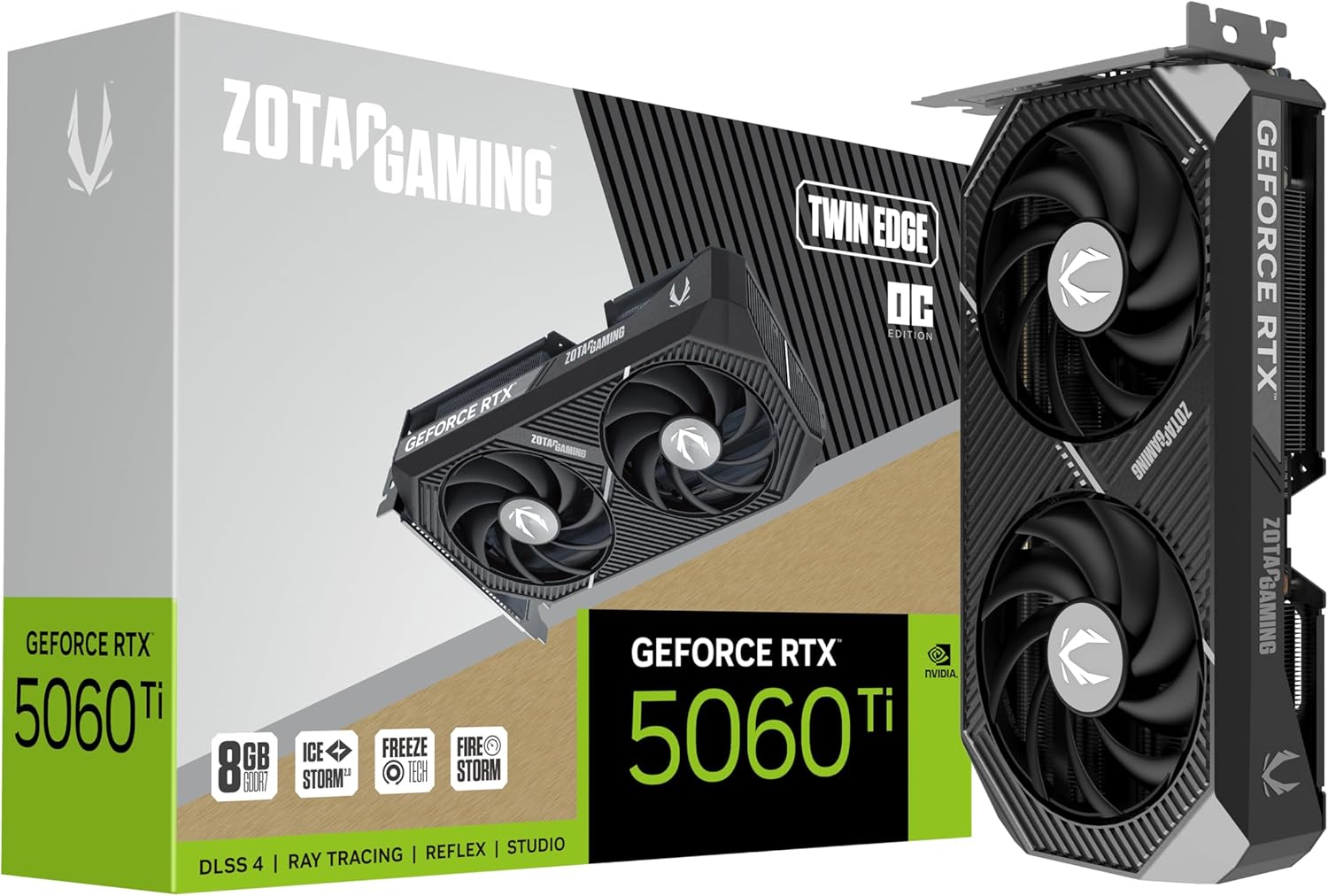
ZOTAC Gaming GeForce RTX 5060 Ti 8GB Twin Edge OC DLSS 4 8GB GDDR7 128-bit 28 Gbps PCIE 5.0 Gaming Graphics Card, IceStorm 2.0 Cooling, SFF-Ready, ZT-B50610H-10A
$300-$599This is a compact, 2-slot RTX 5060 Ti with 8GB GDDR7 and a 2602 MHz clock, built for SFF gaming rigs.