
ASUS TUF GeForce RTX™ 5060 Ti 16GB GDDR7 OC Edition Graphics Card, NVIDIA, Desktop (PCIe® 5.0, HDMI®/DP 2.1, 3.1-Slot, Military-Grade Components, Protective PCB Coating, Axial-tech Fans)
Want the best price and purchase timing?
Our AI advisor analyzes real-time pricing across all channels to find you the best deal.
AI Verdict
This is a 16GB GDDR7 GPU with a 2692 MHz OC clock and PCIe 5.0 x8 interface, designed for quiet 1440p gaming with DLSS 4.
This card, with its 16GB GDDR7 and 2692 MHz OC clock, is a strong contender for 1440p gaming with DLSS 4, but its 3.1-slot size and the 12VHPWR connector for a 180W TGP might not suit all build preferences or case limitations. It struggles with native 4K performance.
If native 4K gaming without heavy upscaling is a priority, consider a GPU with a higher CUDA core count and a wider memory interface.
Regret Score™
Low RiskLower is better — measures purchase-regret risk from real buyer complaints, review credibility, and product maturity
Issues discovered after purchase
Critically weak dimension
Amazon rating vs actual quality
Chance this product isn't for you
Pros
- Features 16GB GDDR7 VRAM, providing ample memory for current and near-future gaming at 1440p resolutions.
- Operates with an OC clock of 2692 MHz, offering a factory overclock higher than the Nvidia default spec of 2572 MHz.
- Equipped with DLSS 4 Frame Generation and Transformer Upscaling, significantly boosting frame rates in supported titles.
- Boasts an 'extremely quiet' cooling solution, with reported fan noise never exceeding 40 dB and GPU temperatures staying below 65°C.
- Built with military-grade components and a protective PCB coating for enhanced durability and a longer lifespan.
- Includes a Dual BIOS feature and a higher power limit compared to other ASUS models, allowing for greater overclocking headroom.
Cons
- Utilizes a PCI-Express 5.0 x8 interface, which is not the full x16 bandwidth.
- Features a 3.1-slot design, measuring 302mm long, 133mm wide, and 62mm thick, which can be challenging for smaller PC cases.
- Comes with a 16-pin 12VHPWR connector despite a relatively low 180W TGP, which some users find excessive.
- Offers only 'marginal' generation-over-generation raw performance improvements without relying on multi-frame generation.
- Memory overclocking is 'artificially limited by the driver', restricting potential performance gains.
Dimension Scores
The card performs 'quite well at 1440p tests' with DLSS 4, but 'struggle[s] a little bit at 4K' without heavy reliance on frame generation.
It features 'best thermals' among tested 5060 Ti models (57.3 °C CPU, 65.9 °C memory) and is 'extremely quiet', never exceeding 40 dB.
With a 180W TGP, the card is considered 'extremely energy-efficient' for its performance class.
The 16GB GDDR7 VRAM is 'enough for now' and a 'flawless investment' for 1080p and 1440p gaming.
Best For
- 1440p gaming with DLSS 4 and frame generation enabled, where it performs 'quite well'.
- High refresh rate 1080p gaming, considered a 'flawless investment' for this resolution.
- PC builds prioritizing quiet operation and low component temperatures under load.
- Users seeking a durable GPU with 'military-grade components' and protective features.
Not Recommended For
- Native 4K gaming without heavy reliance on DLSS 4 and frame generation, as it 'struggle[s] a little bit at 4K' and is 'out of the question' for native 4K.
- Compact PC builds or small form factor cases due to its 'largest card' and '3.1-slot' physical dimensions.
- Users expecting significant raw performance gains over previous generation cards without the aid of upscaling technologies.
Watch Out For
- One user reported 'audio issues with both my monitors and the audio ports on my PC tower' after installation, potentially requiring driver reinstallation.
- The 3.1-slot cooler, while effective, is considered 'absurd' by some for a GPU with a sub-200W power draw, potentially limiting case compatibility.
- The inclusion of a 16-pin 12VHPWR connector for a 180W TGP card is seen as 'kind of strange' and potentially unnecessary by some users.
Full Specifications
| ASIN | B0F4RVFBW7 |
| Brand | ASUS |
| Color | BLACK |
| Series | TUF-RTX5060TI-O16G-GAMING |
| Item Weight | 4 pounds |
| Manufacturer | ASUS |
| Memory Speed | 2692 MHz |
| Chipset Brand | NVIDIA |
| GPU Clock Speed | 2692 MHz |
| Card Description | NVIDIA GeForce RTX5060TI with 16GB GDDR6X, 2692 MHz core clock speed, AI performance of 785 AI TOPS, powered by NVIDIA Blackwell architecture and DLSS 4 |
| Graphics Ram Size | 16 GB |
| Item model number | TUF-RTX5060TI-O16G-GAMING |
| Product Dimensions | 11.9 x 5.3 x 2.4 inches |
| Graphics Coprocessor | NVIDIA GeForce RTX5060TI |
| Max Screen Resolution | 7680x4320 Pixels |
| Graphics Card Ram Size | 16 GB |
| Item Dimensions LxWxH | 11.9 x 5.3 x 2.4 inches |
| Video Output Interface | DisplayPort, HDMI |
What Buyers Say
Early user discussions highlight the ASUS TUF 5060 Ti's exceptional cooling and quiet operation, with GPU temperatures rarely exceeding 65°C even under load, making it a standout for thermal performance. While it handles 1440p gaming competently, especially with DLSS 4, some users note its limitations for native 4K experiences. The card's substantial 3.1-slot size and the use of a 12VHPWR connector for its 180W power draw are recurring points of discussion.
“Look, for 1440p this thing is a beast, especially with DLSS 4, but don't even think about native 4K unless you're cool with low settings, and seriously, this card is HUGE, make sure it fits your case!”
Common Praise
- The cooling solution keeps the GPU 'extremely quiet' and temperatures 'very low', often below 65°C.
- The 16GB GDDR7 VRAM is considered 'enough for now' for current gaming demands.
- DLSS 4 Frame Generation and Transformer Upscaling provide 'incredible' performance boosts.
- The card arrives 'overclocked out of the box' with a 2692 MHz boost clock.
- Its 'military-grade components' and protective PCB coating contribute to perceived durability.
- The inclusion of a Dual BIOS and higher power limit allows for 'incredible overclocking potential'.
Common Complaints
- The '3.1-slot' physical size is large and may pose compatibility issues for some PC cases.
- The PCI-Express 5.0 x8 interface is not the full x16, which is a point of contention for some users.
- The 16-pin 12VHPWR connector for a 180W TGP card is seen as 'absurd' or 'strange' by some.
- Raw performance improvements over the previous generation are 'marginal' without multi-frame generation.
- Memory overclocking capabilities are 'artificially limited by the driver'.
- 4K gaming is largely dependent on DLSS 4 and frame generation, as native performance 'struggle[s]'.
Ownership Tips
- Some users have encountered audio issues post-installation, which were often resolved by reinstalling Nvidia HDMI audio drivers or motherboard audio drivers.
- The physical size of the 3.1-slot cooler can be a tight fit in many standard ATX cases, requiring careful measurement before purchase.
- Despite its low 180W TGP, the card uses the 12VHPWR connector, which might necessitate PSU upgrades or specific cable management for some users.
- The 'quiet BIOS' setting truly delivers on noise reduction, making it almost inaudible even during gaming sessions.
- The card's ability to maintain low temperatures under load contributes to stable boost clocks without manual tweaking.
Frequently Asked Questions
What kind of performance can I expect at 1440p?
The card 'performs quite well at 1440p tests', though some high-end games might require DLSS 4 for optimal frame rates.
Is this card suitable for 4K gaming?
It 'struggle[s] a little bit at 4K', and is generally 'out of the question' for native 4K unless you are 'happy with sticking to lower game visuals and relying heavily on frame gen'.
How are the thermals and noise levels?
The card is reported to be 'extremely quiet' with its quiet BIOS, maintaining GPU temperatures below 65°C and memory temperatures around 65.9°C under load, with fan noise never exceeding 40 dB.
Does this card use the new 12VHPWR power connector?
Yes, it 'utilize[s] the 16-pin 12VHPWR connector', which some users find 'kind of strange' given its 180W TGP.
What are the physical dimensions of the card?
The card measures 302mm (11.8in) in length, 133mm (5.25in) in width, and 62mm (2.4in) in height, making it a '3.1-slot video card'.
Buying Guide
When looking at a graphics card like this, you're essentially buying the engine for your gaming PC. You need to consider how well it handles the resolution you play at, how much memory it has for textures and complex scenes, and if your power supply and case can actually accommodate it. Don't just chase the highest clock speed; think about the whole package.
VRAM (16GB GDDR7)
This is the card's dedicated memory, like RAM for your games. 16GB of GDDR7 is a lot, meaning it can handle high-resolution textures and complex game worlds without stuttering, especially important for 1440p gaming. Think of it as a large workspace for your games to operate in.
Clock Speed (2692 MHz OC)
This is how fast the GPU's processor runs. A higher clock speed means more calculations per second, leading to higher frame rates. The 'OC' means it's factory overclocked, so it's already running faster than the base model without you having to do anything.
PCIe 5.0 x8
This refers to the connection interface with your motherboard. PCIe 5.0 is the latest standard, offering fast data transfer. The 'x8' means it uses 8 lanes, which is half of the maximum 'x16'. While it's still very fast, it's worth noting it's not the full bandwidth, though for this card's performance tier, it's generally sufficient.
Cooling (Axial-tech fans, 3.1-Slot)
This is how the card stays cool under pressure. Axial-tech fans are designed for better airflow, and the '3.1-slot' refers to how thick the card is. A thicker card usually means a larger heatsink and better cooling, but it also means it takes up more space in your PC case, so measure your case carefully.
Alternatives
If this card doesn't fit your needs, look for a GPU with a higher native 4K performance profile, potentially a wider memory bus, or a smaller 2-slot design if case compatibility is a concern.
You Might Also Like

HP NVIDIA GeForce RTX 3070 8GB OEM Graphics Card (Renewed)
$150-$299This is a renewed HP OEM NVIDIA GeForce RTX 3070 with 8GB VRAM, a gamble for budget-conscious 1440p gamers who understand the risks of refurbished hardware.

ZOTAC Gaming GeForce RTX 5070 Twin Edge OC DLSS 4 12GB GDDR7 192-bit 28 Gbps PCIE 5.0 Gaming Graphics Card, IceStorm 2.0 Cooling, SFF-Ready, ZT-B50700H-10A
$600+This is a 2-slot, SFF-ready NVIDIA RTX 5070 with 12GB GDDR7 and a 2542 MHz boost clock, built for compact gaming rigs needing high 1440p performance.

ZOTAC Gaming GeForce RTX 5080 Solid CORE OC DLSS 4 16GB GDDR7 256-bit 30 Gbps PCIE 5.0 Gaming Graphics Card, IceStorm 3.0 Advanced Cooling, Spectra RGB Lighting, ZT-B50800J2-10A
$600+This ZOTAC RTX 5080 with 16GB GDDR7 and a 2640 GHz clock speed is built for high-end 4K gaming and content creation on the NVIDIA Blackwell architecture.
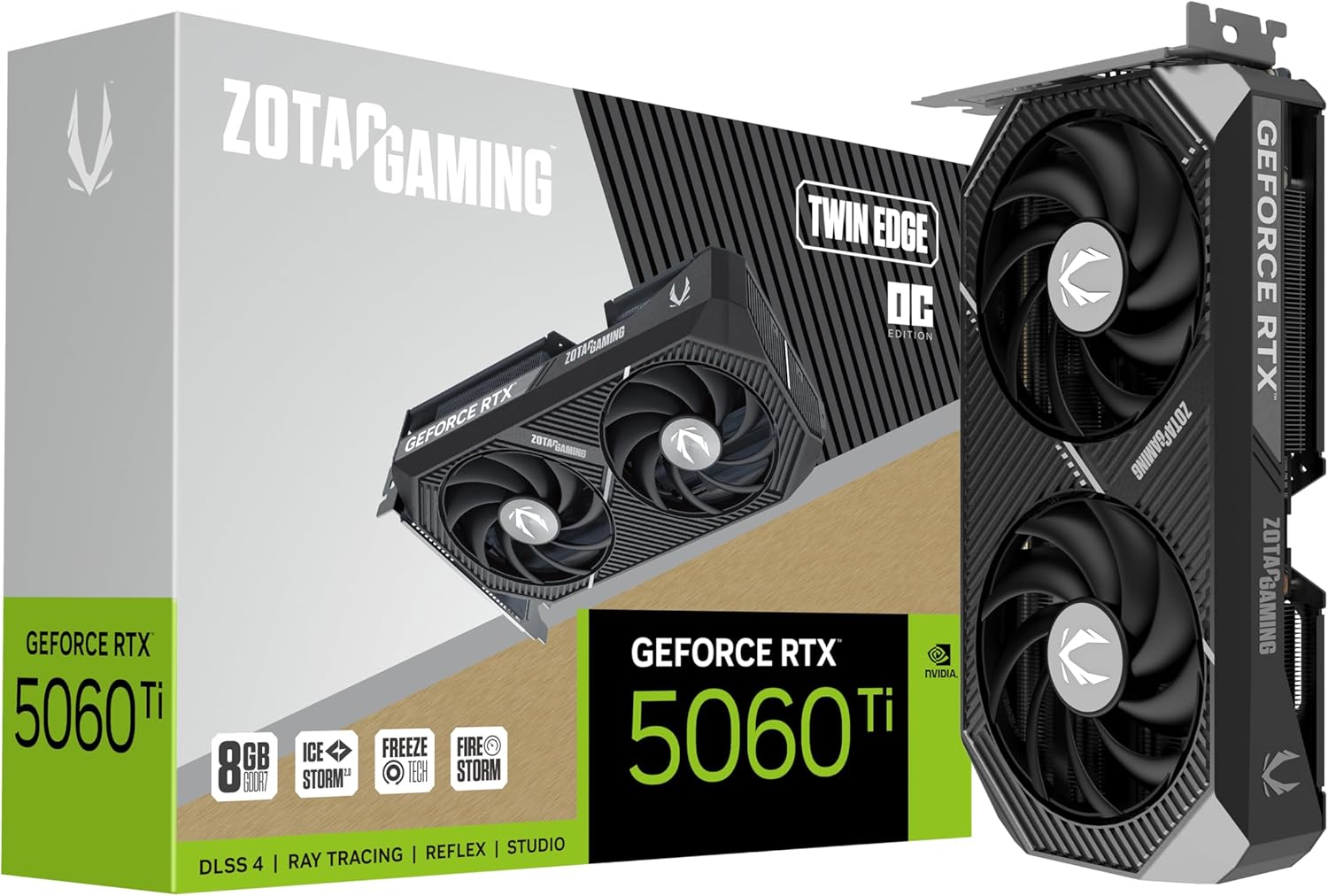
ZOTAC Gaming GeForce RTX 5060 Ti 8GB Twin Edge OC DLSS 4 8GB GDDR7 128-bit 28 Gbps PCIE 5.0 Gaming Graphics Card, IceStorm 2.0 Cooling, SFF-Ready, ZT-B50610H-10A
$300-$599This is a compact, 2-slot RTX 5060 Ti with 8GB GDDR7 and a 2602 MHz clock, built for SFF gaming rigs.