
msi Gaming RTX 5060 Ti 16G Ventus 2X OC Plus Graphics Card (16GB GDDR7, 128-bit, Extreme Performance: TBA MHz, DisplayPort x 3 2.1a, HDMI 2.1b, NVIDIA Blackwell Architecture)
Want the best price and purchase timing?
Our AI advisor analyzes real-time pricing across all channels to find you the best deal.
AI Verdict
This is a 16GB GDDR7, 128-bit NVIDIA Blackwell GPU for smooth 1080p and 1440p gaming, especially with DLSS 4.
This card is a situational fit because its 16GB GDDR7 VRAM and Blackwell architecture are strong for 1080p and 1440p gaming, especially with DLSS 4. However, the 128-bit memory interface and reported loud fan noise under load might be drawbacks for some users.
If you need quieter operation or a wider memory bus for higher resolutions, look for cards with larger cooling solutions or a 192-bit (or wider) memory interface.
Regret Score™
Medium RiskLower is better — measures purchase-regret risk from real buyer complaints, review credibility, and product maturity
Issues discovered after purchase
Critically weak dimension
Amazon rating vs actual quality
Chance this product isn't for you
Pros
- Features 16GB GDDR7 VRAM, providing ample memory for high-resolution textures and future games.
- Powered by NVIDIA's Blackwell architecture and DLSS 4, offering advanced rendering and upscaling capabilities.
- Designed for efficient thermal management with TORX Fan 5.0 and a nickel-plated copper baseplate.
- Includes a metal backplate for structural reinforcement and improved heat dissipation.
- Offers DisplayPort x 3 2.1a and HDMI 2.1b for broad display compatibility.
Cons
- The 128-bit memory interface might limit performance in some scenarios, despite GDDR7.
- Reported high fan noise levels under load, which could be distracting.
- Lacks RGB lighting and a VBIOS toggle, offering a very basic aesthetic and limited customization.
- PCIe Gen 5 speeds are limited to x8, though this is not expected to impact performance.
- The listed clock speed of 28 MHz in some specifications is a clear placeholder or error, with actual performance TBA.
Dimension Scores
The card delivers fast 1080p and smooth 1440p gaming, especially with DLSS 4 and its 4,608 CUDA cores.
While it has lower heat emissions, early reviews indicate a trade-off with loud fan noise under load.
The card shows welcome power efficiency gains with a TGP capped at 180W, drawing power through a single 8-pin connector.
With 16GB of GDDR7 VRAM, it offers a generous capacity for current and future games at 1080p and 1440p.
Best For
- Gamers targeting 1080p resolution with high refresh rates.
- Players seeking smooth 1440p gaming, especially utilizing DLSS 4.
- Users building a compact system, given its single-slot design and 22.5 x 10.5 x 4 cm dimensions.
- Enthusiasts prioritizing power efficiency, as it has welcome efficiency gains and a 180W TGP.
Not Recommended For
- Users who demand quiet operation under heavy gaming loads.
- Builders who prioritize extensive RGB lighting or advanced aesthetic customization.
- Gamers exclusively targeting 4K resolution without heavy reliance on upscaling technologies.
Watch Out For
- Expect high fan noise when the card is under heavy load, as noted in early reviews.
- The card's compact design and dual-fan cooler may lead to louder operation compared to larger, triple-fan alternatives.
- No VBIOS switch means you're stuck with the factory settings, limiting overclocking flexibility.
- The lack of RGB lighting might disappoint users looking for visual flair in their build.
Full Specifications
| ASIN | B0F45QRHQB |
| Brand | msi |
| Item Weight | 2.12 pounds |
| Manufacturer | MSI |
| GPU Clock Speed | 28 MHz |
| Graphics Ram Size | 16 GB |
| Item model number | G506T-16V2CP |
| Product Dimensions | 12 x 8 x 3.5 inches |
| Graphics Coprocessor | NVIDIA GeForce RTX 5060 Ti |
| Video Output Interface | DisplayPort |
What Buyers Say
Since this product is set to be released in April 2025, there are no general consumer reviews available yet. However, early professional reviews highlight its strong performance for 1080p and 1440p gaming, especially benefiting from DLSS 4 and the Blackwell architecture. Reviewers noted its power efficiency but also pointed out that the compact design leads to loud fan operation under load. The card's aesthetic is described as no-frills, lacking RGB or VBIOS switches.
“Look, I haven't actually gotten my hands on this yet since it's not out, but if those early reviews are right about the fan noise, I'm gonna be annoyed if it sounds like a jet engine when I'm trying to game.”
Common Praise
- Handles 1080p and 1440p gaming well, even with ray tracing and high settings.
- Benefits significantly from DLSS 4, enhancing its value proposition.
- Offers tangible power efficiency gains compared to previous generations.
- The 16GB GDDR7 VRAM is a welcome addition for modern gaming demands.
Common Complaints
- Fans become loud when the card is under heavy load.
- Lacks RGB lighting, which some users might expect for a gaming card.
- No VBIOS toggle, limiting advanced user customization.
- The 128-bit memory interface, while paired with GDDR7, could be a bottleneck in some scenarios.
Ownership Tips
- No general consumer ownership notes are available yet as the product has not been released to the public.
Frequently Asked Questions
What kind of gaming performance can I expect from this card?
You can expect fast 1080p and smooth 1440p gaming, even with high settings and ray tracing, especially when utilizing DLSS 4.
Does this graphics card have RGB lighting?
No, the MSI GeForce RTX 5060 Ti 16G Ventus 2X OC Plus does not feature any RGB lighting. It has a neutral aesthetic.
What are the physical dimensions of the card?
The card measures 22.5 x 10.5 x 4 cm and weighs approximately 590g, making it a single-slot design.
What power connector does this GPU use?
The card uses a single 8-pin power connector and has a maximum TGP (Total Graphics Power) capped at 180W.
Is the 28 MHz clock speed accurate?
No, the 28 MHz clock speed listed in some specifications is a placeholder or error. The actual clock speed for 'Extreme Performance' is currently 'TBA MHz' according to the product title.
Buying Guide
When buying a graphics card, you need to think about what resolution you play at and what games you want to run. More VRAM (like this card's 16GB) is good for higher resolutions and texture settings. The 'bit' number (128-bit here) refers to the memory interface width; a wider bus can move more data faster. Also, consider your power supply; this card needs an 8-pin connector.
VRAM (16GB GDDR7)
This is the card's dedicated memory. More VRAM means the card can handle larger textures and more complex scenes without slowing down, especially important for 1440p gaming and beyond. Think of it like RAM for your games, but directly on the GPU.
Memory Interface (128-bit)
This is how wide the 'road' is between the GPU and its VRAM. A wider interface (like 192-bit or 256-bit) generally allows for faster data transfer, which can be crucial for high frame rates at higher resolutions. While 128-bit is narrower, GDDR7 is very fast, helping to compensate.
NVIDIA Blackwell Architecture & DLSS 4
Blackwell is the underlying design of the GPU, bringing new efficiencies and performance. DLSS 4 is an AI-powered upscaling technology that renders games at a lower resolution and then intelligently reconstructs them to a higher one, giving you significantly more frames per second without a noticeable drop in visual quality.
Alternatives
If you need a quieter card, look for models with larger, multi-fan cooling solutions. For higher performance at 4K or in very demanding titles, consider cards with a wider memory bus (e.g., 192-bit or 256-bit) and potentially more CUDA cores.
You Might Also Like

HP NVIDIA GeForce RTX 3070 8GB OEM Graphics Card (Renewed)
$150-$299This is a renewed HP OEM NVIDIA GeForce RTX 3070 with 8GB VRAM, a gamble for budget-conscious 1440p gamers who understand the risks of refurbished hardware.

ZOTAC Gaming GeForce RTX 5070 Twin Edge OC DLSS 4 12GB GDDR7 192-bit 28 Gbps PCIE 5.0 Gaming Graphics Card, IceStorm 2.0 Cooling, SFF-Ready, ZT-B50700H-10A
$600+This is a 2-slot, SFF-ready NVIDIA RTX 5070 with 12GB GDDR7 and a 2542 MHz boost clock, built for compact gaming rigs needing high 1440p performance.

ZOTAC Gaming GeForce RTX 5080 Solid CORE OC DLSS 4 16GB GDDR7 256-bit 30 Gbps PCIE 5.0 Gaming Graphics Card, IceStorm 3.0 Advanced Cooling, Spectra RGB Lighting, ZT-B50800J2-10A
$600+This ZOTAC RTX 5080 with 16GB GDDR7 and a 2640 GHz clock speed is built for high-end 4K gaming and content creation on the NVIDIA Blackwell architecture.
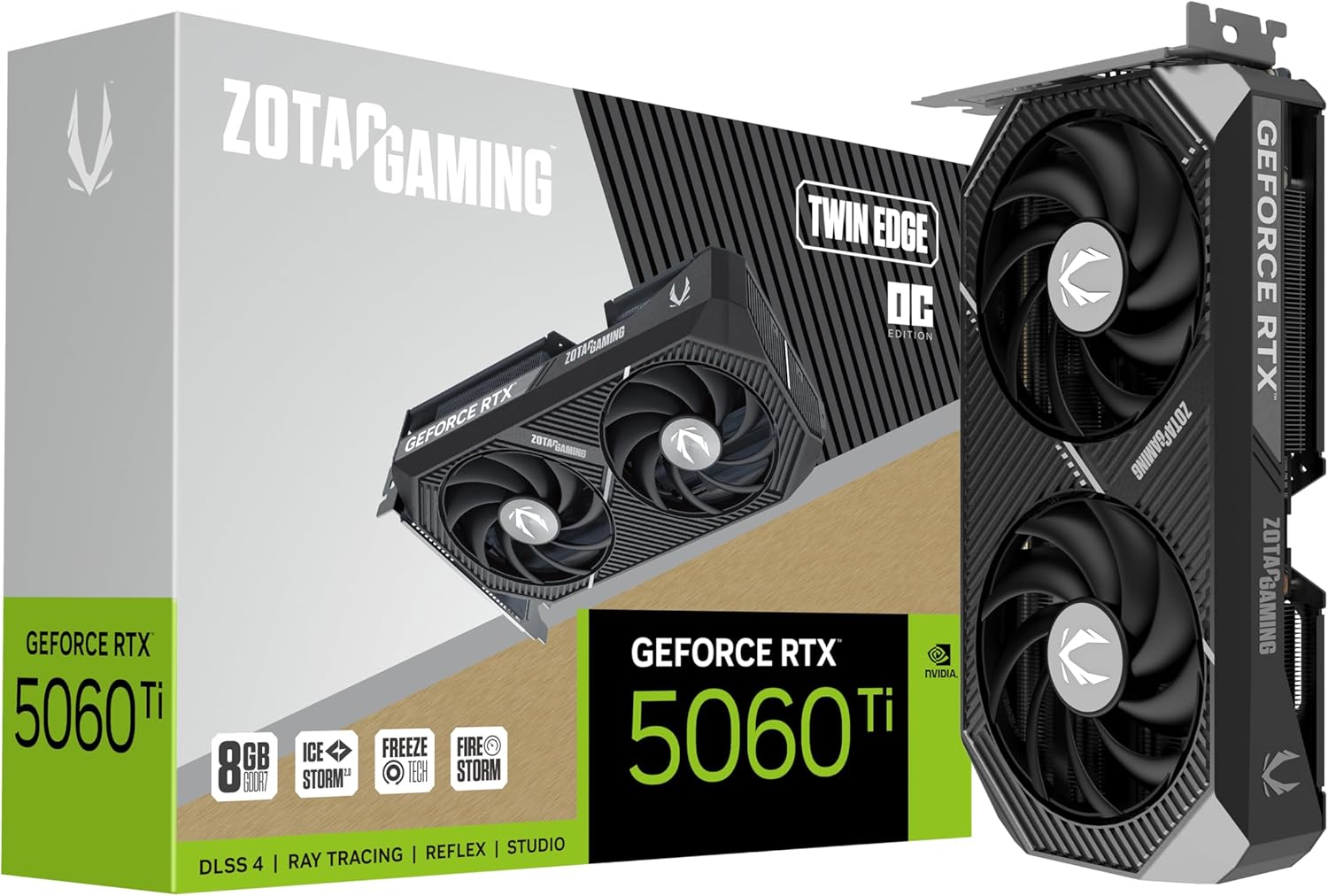
ZOTAC Gaming GeForce RTX 5060 Ti 8GB Twin Edge OC DLSS 4 8GB GDDR7 128-bit 28 Gbps PCIE 5.0 Gaming Graphics Card, IceStorm 2.0 Cooling, SFF-Ready, ZT-B50610H-10A
$300-$599This is a compact, 2-slot RTX 5060 Ti with 8GB GDDR7 and a 2602 MHz clock, built for SFF gaming rigs.