
msi Gaming RTX 5060 Ti 16G Shadow 2X OC Graphics Card (16GB GDDR7, 128-bit, Extreme Performance: TBA MHz, DisplayPort x 3 2.1a, HDMI 2.1b, NVIDIA Blackwell Architecture)
Want the best price and purchase timing?
Our AI advisor analyzes real-time pricing across all channels to find you the best deal.
AI Verdict
This 16GB GDDR7, 128-bit RTX 5060 Ti with a 2602 MHz boost clock is for gamers prioritizing 1080p and smooth 1440p performance with modern features.
This GPU is a situational fit because it brings the latest Blackwell architecture and 16GB GDDR7 memory, which is forward-looking for VRAM demands. However, the 128-bit memory interface might be a limiting factor for its 'Ti' designation, especially if you're pushing beyond 1440p, making its performance profile specific to certain resolution targets.
If you need more raw performance for 4K gaming or higher frame rates at 1440p without heavy reliance on DLSS, look for a GPU with a wider memory bus (e.g., 192-bit or 256-bit) and a higher TGP.
Regret Score™
Medium RiskLower is better — measures purchase-regret risk from real buyer complaints, review credibility, and product maturity
Issues discovered after purchase
Critically weak dimension
Amazon rating vs actual quality
Chance this product isn't for you
Pros
- Features 16GB of GDDR7 memory, providing substantial bandwidth for memory-intensive applications and high-resolution textures.
- Powered by the NVIDIA Blackwell architecture and DLSS 4, enabling advanced AI and ray tracing capabilities for enhanced visual fidelity.
- Includes three DisplayPort 2.1a and one HDMI 2.1b output, supporting multiple displays and high refresh rates up to 4K/480Hz and 8K/120Hz HDR.
- Equipped with TORX Fan 5.0, a nickel-plated copper baseplate, and Core Pipes for efficient thermal management, designed to maintain high-pressure airflow and maximize contact with the GPU baseplate.
- Offers a 2602 MHz boost clock, with potential for 2617 MHz via MSI Center extreme OC, indicating strong out-of-the-box performance.
Cons
- The 128-bit memory interface, while paired with GDDR7, could limit performance in some scenarios, especially at higher resolutions or with future demanding titles.
- The product's 'Date First Available' is April 16, 2025, meaning no real-world user reviews or long-term performance data are available yet.
- MSI does not allow increasing the power limits of the card, capping the max TGP at 180W, which might restrict overclocking potential beyond the advertised boost clock.
Dimension Scores
Expected to provide fast 1080p and smooth 1440p gaming, leveraging Blackwell architecture and DLSS 4, but the 128-bit bus might limit its top-tier performance in some games at higher resolutions.
Features TORX Fan 5.0, a nickel-plated copper baseplate, and Core Pipes designed for efficient heat transfer and high-pressure airflow, suggesting effective cooling.
With a max TGP capped at 180W, it's a relatively power-efficient card for its expected performance tier, though this also limits power limit adjustments.
Equipped with 16GB of GDDR7 memory, which is a generous amount for current and future games, especially at 1440p and even some 4K scenarios.
Best For
- Gamers targeting high refresh rate 1080p gaming with all settings maxed.
- Users seeking smooth 1440p gaming experiences, especially with DLSS 4 enabled.
- Builders looking for a compact, SFF-Ready GeForce card with modern display outputs.
- Enthusiasts wanting to experience NVIDIA's Blackwell architecture and DLSS 4 from a new generation GPU.
Not Recommended For
- Competitive 4K gamers who require consistently high frame rates without relying on upscaling.
- Users who prioritize extensive manual overclocking beyond factory settings due to power limit restrictions.
- Buyers who need immediate access to a product with established user feedback and real-world performance benchmarks.
Watch Out For
- No user-reported pitfalls are available as the product has not yet been released, making long-term reliability and specific quirks unknown.
- The 128-bit memory bus could become a bottleneck for future games at 1440p or 4K, potentially limiting the card's longevity at higher resolutions.
- The listed 4.9/5 rating and '50+ bought in past month' are likely pre-release indicators, as the card's availability date is in the future, so don't expect existing user reviews on launch.
Full Specifications
| ASIN | B0F45KGZPY |
| Brand | msi |
| Item Weight | 2.1 pounds |
| Manufacturer | MSI |
| GPU Clock Speed | 28.0 |
| Graphics Ram Size | 16 GB |
| Item model number | G506T-16S2CP |
| Product Dimensions | 12.1 x 8.2 x 0.04 inches |
| Graphics Coprocessor | NVIDIA GeForce RTX 5060 Ti |
| Video Output Interface | DisplayPort |
What Buyers Say
Since the MSI Gaming RTX 5060 Ti 16G Shadow 2X OC Graphics Card has a future release date of April 16, 2025, there are no actual user reviews or complaints available yet. Early discussions suggest some market uncertainty regarding the availability of 16GB 5060 Ti cards. However, pre-release information indicates strong performance for 1080p and 1440p gaming, with a focus on NVIDIA's Blackwell architecture and DLSS 4. The 128-bit memory bus is a recurring point of discussion, raising questions about its impact on higher resolution performance despite the ample 16GB GDDR7 VRAM.
“Man, I'm really hoping this 16GB GDDR7 card with Blackwell architecture crushes 1440p like they say, but that 128-bit bus has me a little nervous for future games, gotta see it in action!”
Common Praise
- No user feedback available yet.
Common Complaints
- No user feedback available yet.
Ownership Tips
- No user feedback available yet.
Frequently Asked Questions
What kind of gaming performance can I expect from the RTX 5060 Ti?
The RTX 5060 Ti is expected to deliver fast 1080p gaming and smooth 1440p gaming at high settings, with or without DLSS 4. It's designed for high refresh rates and minimal latency.
Does this card support ray tracing and DLSS?
Yes, it's powered by the NVIDIA Blackwell architecture, which includes 4th gen Ray Tracing Cores and supports DLSS 4 for enhanced visuals and frame rates.
What are the display output options?
It comes with three DisplayPort 2.1a (or 2.1b) and one HDMI 2.1b port, supporting multiple displays and high resolutions like 4K/480Hz and 8K/120Hz HDR.
Is the 128-bit memory bus a concern for performance?
While the 16GB GDDR7 memory provides ample capacity, the 128-bit memory interface could potentially limit the card's performance in some memory-bandwidth-intensive scenarios, especially at resolutions above 1440p.
What is the boost clock speed of this graphics card?
The card features a 2602 MHz boost clock, with the potential to reach 2617 MHz through MSI Center extreme OC.
Buying Guide
When you're looking at a new graphics card like this, you need to think about what resolution you play at most. A card's memory (VRAM) is important for high-resolution textures, and 16GB is a lot, which is good. But the 'memory interface' or 'bus width' (here, 128-bit) dictates how fast that memory can talk to the GPU, and a narrower bus can sometimes hold back a card, especially as you crank up the resolution or settings.
VRAM (16GB GDDR7)
Think of VRAM like a workbench for your games. 16GB is a huge workbench, letting the GPU handle lots of high-resolution textures and complex scenes without running out of space, which is crucial for modern games and higher resolutions.
Memory Interface (128-bit)
This is like the size of the highway connecting your GPU to its VRAM. A 128-bit highway is narrower than some other cards, meaning data might not flow as quickly, which can sometimes limit overall performance even with a lot of VRAM, especially at 1440p or 4K.
NVIDIA Blackwell Architecture & DLSS 4
This is the core technology inside the card. Blackwell is the latest generation, bringing improvements to how the card processes graphics, especially for ray tracing (realistic lighting) and DLSS 4 (AI-powered upscaling that boosts frame rates without sacrificing much visual quality).
Alternatives
If you're worried about the 128-bit memory bus for future-proofing at 1440p or for 4K gaming, look for cards with a 192-bit or 256-bit memory interface and a higher TGP for more raw power.
You Might Also Like

HP NVIDIA GeForce RTX 3070 8GB OEM Graphics Card (Renewed)
$150-$299This is a renewed HP OEM NVIDIA GeForce RTX 3070 with 8GB VRAM, a gamble for budget-conscious 1440p gamers who understand the risks of refurbished hardware.

ZOTAC Gaming GeForce RTX 5070 Twin Edge OC DLSS 4 12GB GDDR7 192-bit 28 Gbps PCIE 5.0 Gaming Graphics Card, IceStorm 2.0 Cooling, SFF-Ready, ZT-B50700H-10A
$600+This is a 2-slot, SFF-ready NVIDIA RTX 5070 with 12GB GDDR7 and a 2542 MHz boost clock, built for compact gaming rigs needing high 1440p performance.

ZOTAC Gaming GeForce RTX 5080 Solid CORE OC DLSS 4 16GB GDDR7 256-bit 30 Gbps PCIE 5.0 Gaming Graphics Card, IceStorm 3.0 Advanced Cooling, Spectra RGB Lighting, ZT-B50800J2-10A
$600+This ZOTAC RTX 5080 with 16GB GDDR7 and a 2640 GHz clock speed is built for high-end 4K gaming and content creation on the NVIDIA Blackwell architecture.
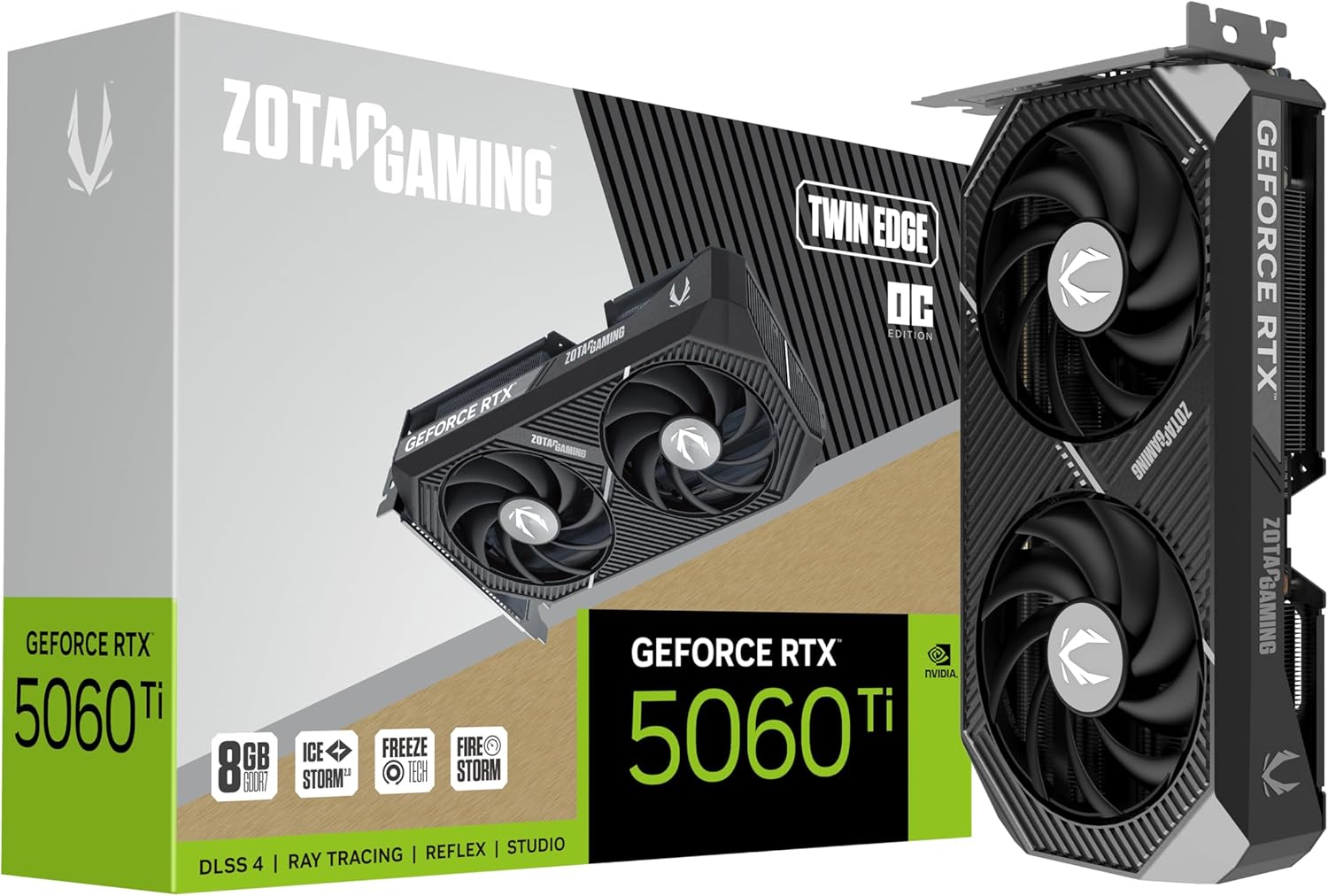
ZOTAC Gaming GeForce RTX 5060 Ti 8GB Twin Edge OC DLSS 4 8GB GDDR7 128-bit 28 Gbps PCIE 5.0 Gaming Graphics Card, IceStorm 2.0 Cooling, SFF-Ready, ZT-B50610H-10A
$300-$599This is a compact, 2-slot RTX 5060 Ti with 8GB GDDR7 and a 2602 MHz clock, built for SFF gaming rigs.