
NVIDIA GeForce RTX 5080 Founders Edition
Want the best price and purchase timing?
Our AI advisor analyzes real-time pricing across all channels to find you the best deal.
AI Verdict
This is a 16GB VRAM, 2806 MHz clock speed GPU for gamers prioritizing high rasterization at 4K and efficient thermals over raw VRAM capacity.
The RTX 5080 Founders Edition is a powerful card with a 2806 MHz clock speed and Blackwell architecture, making it suitable for high-resolution gaming and creative tasks. However, its 16 GB VRAM can be a bottleneck for demanding 4K ray tracing, pushing it into a niche where users must balance settings or rely heavily on DLSS 4.
If 4K ray tracing at max settings is a must-have, look for GPUs with 20GB or more VRAM.
Regret Score™
Medium RiskLower is better — measures purchase-regret risk from real buyer complaints, review credibility, and product maturity
Issues discovered after purchase
Critically weak dimension
Amazon rating vs actual quality
Chance this product isn't for you
Pros
- Achieves a 15% average 4K gaming performance boost over the RTX 4080 Super.
- Features NVIDIA Blackwell Architecture for advanced AI performance with FP4 and DLSS 4.
- Founders Edition cooler maintains extremely cool and quiet operation even under load.
- Offers world-class rasterization performance.
- Includes DisplayPort 2.1b with UHBR20 and HDMI 2.1a outputs.
- Smaller physical size compared to some previous generation high-end cards.
Cons
- 16 GB of VRAM is often insufficient for stable 4K gaming with ray tracing enabled, leading to frame pacing issues.
- Performance uplift over the RTX 4080 and 4080 Super is considered unimpressive, with only a 9% improvement at 1440p over the 4080.
- Reported DisplayPort 2.1 handshake issues can lead to unstable signals with certain monitors.
- The Founders Edition design blows hot air into the PC case, potentially increasing CPU temperatures.
- Can run very hot in small form factor cases, despite efficient cooling in larger builds.
Dimension Scores
It delivers a 15% average 4K gaming performance boost over the RTX 4080 Super in rasterization.
The Founders Edition cooler is noted for its impressive thermal efficiency and quiet operation even under intense loads.
With a 360W TGP, it requires an 850W PSU, which is a significant power draw, though manageable for high-end systems.
16 GB of VRAM is frequently cited as a limitation for 4K gaming with ray tracing, leading to performance issues.
Best For
- Gamers targeting 4K resolution with rasterization-heavy titles.
- Users who prioritize quiet operation and efficient thermal management in a GPU.
- Content creators leveraging NVIDIA's AI and encoding capabilities.
- Enthusiasts seeking the latest Blackwell architecture for future-proofing.
Not Recommended For
- Gamers who demand maxed-out 4K ray tracing settings without compromise due to 16GB VRAM limitations.
- Users with small form factor cases where heat dissipation from the Founders Edition design could be an issue.
- Budget-conscious buyers looking for a significant generational leap in performance per dollar over the 40-series.
Watch Out For
- The 16 GB VRAM capacity hits limits at 4K with ray tracing, causing frame pacing issues and requiring settings adjustments.
- DisplayPort 2.1 handshake issues have been reported, sometimes requiring specific fiber optic cables to maintain a stable signal.
- The 12VHPWR connector, while more stable than early iterations, still carries user concerns about melting, particularly in high-power draw scenarios.
- In small form factor cases, the card can run very hot, especially during intensive workloads like FurMark.
Full Specifications
| ASIN | B0DYVCGVK4 |
| Brand | NVIDIA |
| Item Weight | 2 pounds |
| Manufacturer | NVIDIA |
| GPU Clock Speed | 2806 MHz |
| Graphics Ram Size | 16 GB |
| Item model number | 900-1G144-2545-000 |
| Product Dimensions | 11.81 x 12.28 x 0.04 inches |
| Graphics Coprocessor | NVIDIA GeForce RTX 5080 |
| Video Output Interface | HDMI, DisplayPort |
What Buyers Say
The most surprising finding is how often users hit the 16 GB VRAM limit when trying to run 4K games with ray tracing, despite the card's high price point. Many expected more VRAM for a card positioned as the second-best in its generation. The Founders Edition design consistently receives praise for its quiet operation and effective cooling, a stark contrast to some previous generations. However, the performance uplift over the previous 4080 Super is often described as underwhelming, making it a questionable upgrade for some.
“Man, I dropped a grand on this thing and I'm already hitting VRAM limits in Cyberpunk with ray tracing, what gives? It's fast, yeah, but 16GB just ain't cutting it for true 4K maxed out.”
Common Praise
- The Founders Edition looks really clean and fits well in builds.
- It stays super quiet and cool, even when gaming hard.
- Rasterization performance is top-tier, making games look incredible without ray tracing.
- The card is surprisingly compact for its power.
- DLSS 4 and neural rendering offer significant performance boosts with minimal visual compromise.
Common Complaints
- 16 GB of VRAM isn't enough for 4K with ray tracing, forcing me to lower settings.
- The performance jump from my 4080 Super just wasn't worth the money.
- I had weird DisplayPort issues, had to buy expensive fiber optic cables to fix it.
- My CPU temps went up because the card blows hot air right into the case.
- The 12VHPWR connector still makes me nervous, even if it's mostly the 5090 that melts.
Ownership Tips
- You'll probably end up tweaking 4K ray tracing settings to avoid VRAM bottlenecks.
- The Founders Edition is surprisingly quiet, even quieter than some custom AIB cards.
- Be prepared for potential DisplayPort cable sensitivity, especially with high refresh rate 4K monitors.
- If you have a small case, monitor your internal temperatures, especially the CPU, due to the flow-through cooler design.
- The card's aesthetic is genuinely appealing in person, much more so than in pictures.
Frequently Asked Questions
Is the NVIDIA GeForce RTX 5080 Founders Edition good for 4K gaming?
Yes, it delivers a 15% average 4K gaming performance boost over the RTX 4080 Super in rasterization-heavy titles. However, its 16 GB VRAM can be a limitation for 4K gaming with ray tracing enabled.
How does the 5080 compare to the 4080 Super?
The RTX 5080 is approximately 13% faster than the 4080 Super. While it offers an uplift, some users find this generational improvement to be less significant than expected.
Does the Founders Edition run hot or loud?
The Founders Edition cooler is generally praised for its thermal efficiency and quiet operation, even under load. However, in small form factor cases, it can run very hot.
What kind of power supply do I need for the RTX 5080?
An 850W power supply is recommended for systems using the RTX 5080, which has a TGP of 360W.
Are there any issues with the DisplayPort on this card?
Some users have reported DisplayPort 2.1 handshake issues, leading to unstable signals with certain monitors.
Is 16 GB VRAM enough for future games?
For many current games, 16 GB VRAM is sufficient. However, for maxed-out 4K settings with ray tracing in newer titles, users have reported hitting VRAM limits, causing performance drops.
Buying Guide
When you're looking at a high-end GPU like this, you need to think about what games you play and at what resolution. If you're mostly into competitive shooters at 1440p, this card is overkill. But if you're chasing 4K frames in the latest single-player epics, especially with ray tracing, you need to understand the VRAM situation. Don't just look at raw FPS numbers; consider how much VRAM a game actually uses at your desired settings.
VRAM (Video RAM)
Think of VRAM as the GPU's short-term memory. The more VRAM you have, the more textures, models, and effects your graphics card can load at once, especially important for high resolutions like 4K and demanding features like ray tracing. If you run out, your card has to swap data to slower system RAM, causing stutters and frame drops.
Clock Speed (MHz)
This is how fast the GPU's core processing units operate. A higher clock speed means the GPU can perform more calculations per second, directly translating to higher frame rates in games. It's like the engine RPM in a car – higher RPM generally means more power.
Output (HDMI, DisplayPort)
These are the ports you use to connect your monitor. Ensure your GPU has the right ports for your display, especially if you have a high-refresh-rate 4K monitor. DisplayPort 2.1 is newer and can handle higher bandwidth than HDMI 2.1a, which is crucial for uncompressed high-resolution, high-refresh-rate signals.
Alternatives
If 16 GB VRAM is a concern for your 4K ray tracing ambitions, look for cards with 20GB or more VRAM. If the performance uplift isn't enough for the price, consider previous generation cards with similar rasterization performance but a lower cost.
You Might Also Like

HP NVIDIA GeForce RTX 3070 8GB OEM Graphics Card (Renewed)
$150-$299This is a renewed HP OEM NVIDIA GeForce RTX 3070 with 8GB VRAM, a gamble for budget-conscious 1440p gamers who understand the risks of refurbished hardware.

ZOTAC Gaming GeForce RTX 5070 Twin Edge OC DLSS 4 12GB GDDR7 192-bit 28 Gbps PCIE 5.0 Gaming Graphics Card, IceStorm 2.0 Cooling, SFF-Ready, ZT-B50700H-10A
$600+This is a 2-slot, SFF-ready NVIDIA RTX 5070 with 12GB GDDR7 and a 2542 MHz boost clock, built for compact gaming rigs needing high 1440p performance.

ZOTAC Gaming GeForce RTX 5080 Solid CORE OC DLSS 4 16GB GDDR7 256-bit 30 Gbps PCIE 5.0 Gaming Graphics Card, IceStorm 3.0 Advanced Cooling, Spectra RGB Lighting, ZT-B50800J2-10A
$600+This ZOTAC RTX 5080 with 16GB GDDR7 and a 2640 GHz clock speed is built for high-end 4K gaming and content creation on the NVIDIA Blackwell architecture.
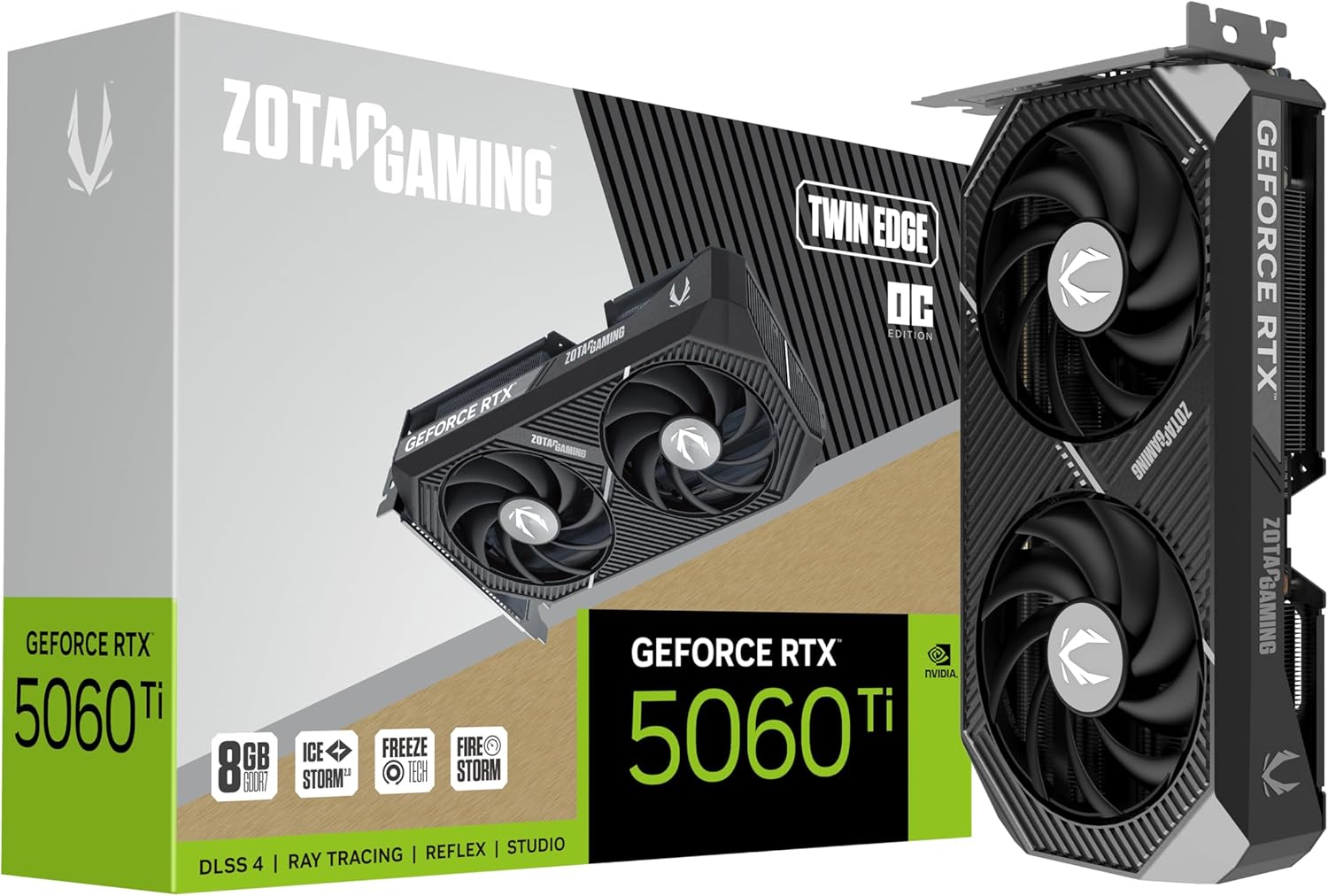
ZOTAC Gaming GeForce RTX 5060 Ti 8GB Twin Edge OC DLSS 4 8GB GDDR7 128-bit 28 Gbps PCIE 5.0 Gaming Graphics Card, IceStorm 2.0 Cooling, SFF-Ready, ZT-B50610H-10A
$300-$599This is a compact, 2-slot RTX 5060 Ti with 8GB GDDR7 and a 2602 MHz clock, built for SFF gaming rigs.