
PNY NVIDIA GeForce RTX™ 5070 Epic-X™ ARGB OC Triple Fan, Graphics Card (12GB GDDR7, 192-bit, Boost Speed: 2685 MHz, SFF-Ready, PCIe® 5.0, HDMI®/DP 2.1, 2.4-Slot, Blackwell Architecture, DLSS 4)
Want the best price and purchase timing?
Our AI advisor analyzes real-time pricing across all channels to find you the best deal.
AI Verdict
A 12GB GDDR7 Blackwell architecture GPU with 2685 MHz boost speed, optimized for 1440p gaming and AI acceleration.
This PNY RTX 5070 is a strong fit for 1440p gaming due to its 12GB GDDR7 VRAM, 2685 MHz boost clock, and Blackwell architecture with DLSS 4. It delivers smooth frame rates and advanced visual features at this resolution. For 4K gaming, it's a situational fit, as the 12GB VRAM might become a bottleneck in future titles, requiring settings adjustments.
If you consistently game at 4K with maximum settings and want more future-proofing, look for GPUs with 16GB or more VRAM.
Regret Score™
Very Low RiskLower is better — measures purchase-regret risk from real buyer complaints, review credibility, and product maturity
Issues discovered after purchase
Critically weak dimension
Amazon rating vs actual quality
Chance this product isn't for you
Pros
- Leverages NVIDIA Blackwell architecture with DLSS 4 for boosted frame rates and improved image quality.
- Features 6,144 CUDA Cores and 28 Gbps effective memory speed for demanding tasks.
- Equipped with Fifth-Gen Tensor Cores and Fourth-Gen Ray Tracing Cores for advanced AI and realistic lighting.
- Triple fan cooling design reportedly keeps the card running cool and quiet during use.
- PNY's VelocityX software provides integrated RGB, fan, and overclocking controls.
- PCIe 5.0 interface offers high bandwidth for current and future system compatibility.
Cons
- The 12GB GDDR7 VRAM capacity may become a limitation for future 4K gaming with ultra settings.
- The card's physical dimensions (11.80" length, 2.4-slot width) require significant case clearance.
- Requires a single 16-pin power connector, which often uses an adapter from two 8-pin PCIe cables, potentially adding cable bulk.
- While suitable for 1440p, consistent 4K high refresh rate performance might be challenging in newer, graphically intensive titles without significant DLSS utilization.
Dimension Scores
The RTX 5070 with Blackwell architecture and DLSS 4 delivers strong 1440p performance, often exceeding 60 FPS in demanding titles.
The triple fan design keeps the GPU cool, with users reporting quiet operation and temperatures around 65°C under load.
With a 250W TDP, the card offers efficient performance for its class, requiring a recommended 650W PSU.
The 12GB GDDR7 is sufficient for 1440p, but some users express concern about its longevity for future 4K gaming at high settings.
Best For
- High refresh rate 1440p gaming with ray tracing and DLSS 4 enabled.
- Creative professionals utilizing NVIDIA Studio for AI-accelerated workflows.
- Users upgrading from older generation GPUs (e.g., RTX 3060) seeking a substantial performance uplift.
- Enthusiasts looking to experiment with one-click or manual overclocking via PNY's software.
Not Recommended For
- Dedicated 4K high refresh rate gaming without compromises on settings or reliance on upscaling technologies.
- Small form factor (SFF) PC builds that have strict length or width restrictions (card is 11.80" long and 2.4-slot wide).
- Budget-conscious buyers seeking the absolute lowest price point in the 50-series lineup.
Watch Out For
- The 12GB GDDR7 VRAM, while fast, has been noted by users as a potential 'scary limit' for future 4K gaming, especially with demanding titles.
- The card's 11.80" (299.72 mm) length and 2.4-slot width means it won't fit in all PC cases, requiring users to verify internal clearance before purchase.
- Power input is a 16-pin connector, and while an adapter for two 8-pin PCIe cables is included, some users might find the cable management challenging or prefer a native 16-pin PSU cable.
Full Specifications
| ASIN | B0DYPGBX6J |
| Brand | PNY |
| Color | Black |
| Series | VCG507012TFXXPB1-O |
| Item Weight | 2.34 pounds |
| Manufacturer | PNY |
| Memory Speed | 2325 MHz |
| Chipset Brand | NVIDIA |
| Card Description | PNY NVIDIA GeForce RTX™ 5070 with 12GB GDDR7, Blackwell architecture, 6,144 CUDA cores, 2.16 GHz base clock, 250W TDP, 4 display support, 192-bit memory interface, up to 672 GB/s memory bandwidth, 28 Gbps memory speed, DisplayPort 2.1b (x3) and HDMI 2.1b outputs. |
| Graphics Ram Size | 12 GB |
| Item model number | VCG507012TFXXPB1-O |
| Graphics Coprocessor | NVIDIA GeForce RTX 5070 |
| Max Screen Resolution | 7680x4320 |
| Graphics Card Ram Size | 12 GB |
| Video Output Interface | DisplayPort, HDMI |
| Graphics Processor Manufacturer | NVIDIA |
What Buyers Say
Many users are debating the 12GB VRAM, with some calling it a 'scary limit' for future 4K gaming, even though it performs well at 1440p. The triple-fan design consistently receives praise for keeping the card cool and quiet, even under heavy loads. Owners frequently mention it's a significant upgrade from older cards like the RTX 3060, delivering noticeably higher frame rates. The PNY software for RGB and overclocking has also surprised users with its functionality and ease of use.
“Dude, this 5070 is crushing 1440p, but I'm kinda sweating the 12GB VRAM for 4K down the road, hope it holds up. Still, it's super quiet and fast, way better than my old 3060!”
Common Praise
- Runs games at 1440p 60fps+ with no issue.
- Stays cool and quiet, even during demanding gaming sessions.
- Provides a substantial performance upgrade from previous generation cards like the RTX 3060.
- DLSS 4 features are phenomenal, elevating performance at reasonable prices.
- PNY's VelocityX software offers effective RGB, fan, and overclocking controls.
Common Complaints
- 12GB VRAM is a 'scary limit' and a concern for future 4K gaming, potentially leading to VRAM issues.
- The card's physical size (11.80" length, 2.4-slot width) can be challenging for smaller cases.
- The 16-pin power connector, even with an adapter, can be bulky for cable management.
- Value is sometimes questioned when compared to other cards, even at MSRP.
Ownership Tips
- The triple-fan cooler effectively manages temperatures, keeping the GPU around 65°C under load.
- The PNY VelocityX software is surprisingly robust for managing RGB lighting and fan curves, and even offers a one-click OC scanner.
- The card's length of nearly 12 inches means you really need to double-check your case's GPU clearance before buying.
- The included 16-pin to dual 8-pin power adapter works, but a native 16-pin cable from your PSU can make for a cleaner build.
- While advertised as 'SFF-Ready', its 2.4-slot width and 11.80" length make it unsuitable for many true small form factor cases.
Frequently Asked Questions
Is 12GB GDDR7 VRAM enough for modern games?
For 1440p gaming, 12GB GDDR7 is sufficient for current titles and should remain capable for several years. For 4K gaming, especially with ultra settings and ray tracing, some users express concern that 12GB might become a limiting factor in future demanding games.
What kind of power supply do I need for this card?
NVIDIA recommends a 650W power supply for systems using this GPU, which has a 250W Thermal Design Power (TDP). The card requires one 16-pin power connector, and an adapter for two 8-pin PCIe connectors is included.
Will this graphics card fit in my PC case?
The card measures 11.80 inches (299.72 mm) in length and occupies 2.4 slots (48.26 mm). You should measure your PC case's available clearance for both length and width to ensure compatibility.
Does this card support DLSS 4 and ray tracing?
Yes, the PNY RTX 5070 is built on NVIDIA's Blackwell architecture and fully supports DLSS 4 and Fourth-Gen Ray Tracing Cores, enhancing performance and visual fidelity in compatible games.
How does the PNY software compare to other brands?
Users have found PNY's VelocityX software to be surprisingly capable, integrating RGB control, fan speed adjustments, and overclocking features effectively. Some even consider it on par with or slightly better than software from other major GPU brands.
Buying Guide
When you're looking at a graphics card like this PNY RTX 5070, you're essentially buying the engine for your gaming PC. It's what renders all the visuals, from simple web pages to complex game worlds. You need to think about what resolution you play at and how important features like ray tracing and AI upscaling (DLSS 4) are to you. This card is built for high performance, especially at 1440p, but its physical size and VRAM capacity are key considerations.
VRAM (Video RAM)
Think of VRAM like a workbench for your GPU. The more VRAM (12GB GDDR7 here), the more textures, models, and visual data the card can hold directly, which is crucial for higher resolutions like 4K and graphically intensive games. If your VRAM fills up, the card has to fetch data from slower system RAM, causing performance drops.
Boost Speed (2685 MHz)
This is how fast the GPU's processor can run under load. A higher boost speed means the card can process more information per second, directly translating to higher frame rates in games. The 'OC' in the name means it's factory overclocked for a bit more speed out of the box.
PCIe 5.0
This refers to the connection interface between the graphics card and your motherboard. PCIe 5.0 is the latest standard, offering double the bandwidth of PCIe 4.0. While current games might not fully saturate PCIe 4.0, having PCIe 5.0 ensures your card won't be bottlenecked by the interface in future titles or with faster storage.
DLSS 4 (Deep Learning Super Sampling)
This is NVIDIA's AI-powered upscaling technology. It renders games at a lower resolution and then uses AI to intelligently upscale them to a higher resolution, often looking nearly identical to native resolution but with significantly higher frame rates. It's like having a smart assistant that makes your games run faster without sacrificing visual quality.
Alternatives
If this card doesn't fit your needs, consider GPUs with 16GB or more VRAM for dedicated 4K gaming, or cards with a shorter length and dual-slot design for true small form factor builds.
You Might Also Like

HP NVIDIA GeForce RTX 3070 8GB OEM Graphics Card (Renewed)
$150-$299This is a renewed HP OEM NVIDIA GeForce RTX 3070 with 8GB VRAM, a gamble for budget-conscious 1440p gamers who understand the risks of refurbished hardware.

ZOTAC Gaming GeForce RTX 5070 Twin Edge OC DLSS 4 12GB GDDR7 192-bit 28 Gbps PCIE 5.0 Gaming Graphics Card, IceStorm 2.0 Cooling, SFF-Ready, ZT-B50700H-10A
$600+This is a 2-slot, SFF-ready NVIDIA RTX 5070 with 12GB GDDR7 and a 2542 MHz boost clock, built for compact gaming rigs needing high 1440p performance.

ZOTAC Gaming GeForce RTX 5080 Solid CORE OC DLSS 4 16GB GDDR7 256-bit 30 Gbps PCIE 5.0 Gaming Graphics Card, IceStorm 3.0 Advanced Cooling, Spectra RGB Lighting, ZT-B50800J2-10A
$600+This ZOTAC RTX 5080 with 16GB GDDR7 and a 2640 GHz clock speed is built for high-end 4K gaming and content creation on the NVIDIA Blackwell architecture.
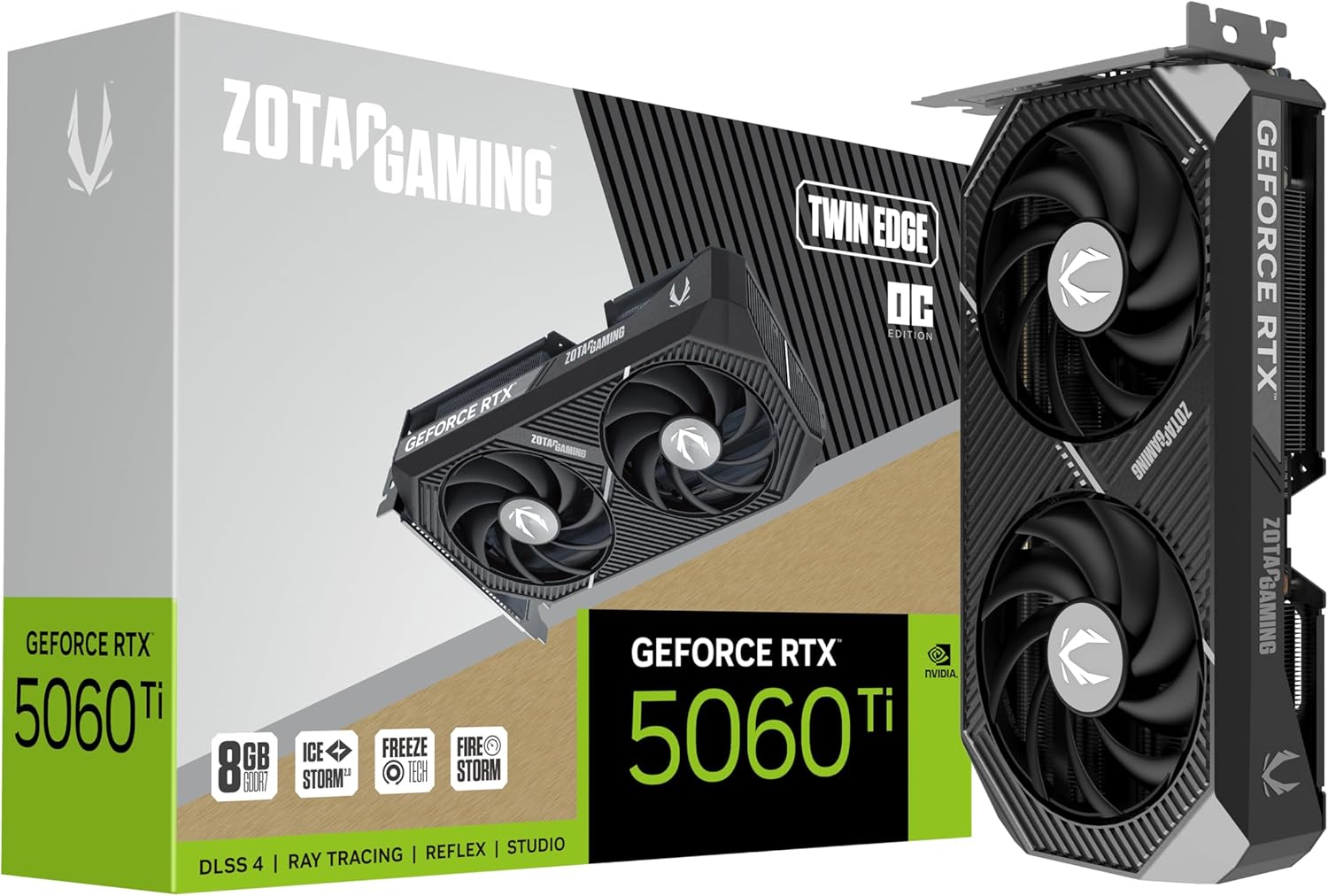
ZOTAC Gaming GeForce RTX 5060 Ti 8GB Twin Edge OC DLSS 4 8GB GDDR7 128-bit 28 Gbps PCIE 5.0 Gaming Graphics Card, IceStorm 2.0 Cooling, SFF-Ready, ZT-B50610H-10A
$300-$599This is a compact, 2-slot RTX 5060 Ti with 8GB GDDR7 and a 2602 MHz clock, built for SFF gaming rigs.