
PNY NVIDIA GeForce RTX™ 5070 Ti Epic-X™ ARGB OC Triple Fan, Graphics Card (16GB GDDR7, 256-bit, Boost Speed: 2640 MHz, PCIe® 5.0, HDMI®/DP 2.1, 2.98-Slot, NVIDIA Blackwell Architecture, DLSS 4)
Want the best price and purchase timing?
Our AI advisor analyzes real-time pricing across all channels to find you the best deal.
AI Verdict
This 16GB GDDR7, 2.98-slot RTX 5070 Ti with 8960 CUDA cores is for gamers and creators demanding high frame rates at 1440p and 4K, leveraging Blackwell architecture and DLSS 4.
This PNY RTX 5070 Ti is a strong fit for users prioritizing cutting-edge gaming performance and AI acceleration. Its 16GB GDDR7 VRAM and Blackwell architecture are designed for high-resolution gaming and demanding creative tasks. The triple-fan cooling system suggests it can handle its 300W TDP effectively.
If this card's performance isn't enough, look for a GPU with more CUDA cores and a wider memory bus, typically found in the higher-tier 50-series or previous generation 4090 models.
Regret Score™
Low RiskLower is better — measures purchase-regret risk from real buyer complaints, review credibility, and product maturity
Issues discovered after purchase
Critically weak dimension
Amazon rating vs actual quality
Chance this product isn't for you
Pros
- Features 16GB GDDR7 VRAM, providing ample memory for demanding games and creative applications.
- Utilizes NVIDIA's Blackwell architecture, including Fifth-Gen Tensor Cores and Fourth-Gen Ray Tracing Cores for advanced AI and rendering performance.
- Offers DisplayPort 2.1b and HDMI 2.1b outputs, supporting high refresh rates at 4K (480Hz) or 8K (165Hz) with DSC.
- Equipped with a triple fan cooling system and metal backplate, designed for efficient heat dissipation.
- Runs AAA games perfectly at 1440p with smooth performance, according to one user experience.
- Operates at around 42-43 dB under load, which is not considered loud for a high-performance graphics card.
Cons
- Requires a single 16-pin power connector and a recommended 750W power supply, which might necessitate a PSU upgrade for some systems.
- The 2.98-slot design (nearly 3 slots) and 300mm length may pose compatibility issues in smaller PC cases.
- Specific long-term user feedback and widespread complaint data are not yet widely available due to the product's relatively recent release.
Dimension Scores
The RTX 5070 Ti, powered by Blackwell architecture and DLSS 4, is reported to run AAA games perfectly at 1440p and smoothly at 4K, indicating top-tier performance.
The triple fan cooling system and metal backplate are designed for efficient heat dissipation, with reported noise levels around 42-43 dB under load, which is considered acceptable and not loud.
With a 300W TDP and a recommended 750W PSU, its power draw is typical for a high-performance GPU, but it requires a 16-pin connector which might be an upgrade for some users.
The 16GB of GDDR7 VRAM is a substantial amount, providing ample memory for current and future high-resolution gaming and demanding creative applications.
Best For
- High-refresh-rate 1440p gaming and smooth 4K gaming experiences.
- Content creators utilizing AI-accelerated workflows and NVIDIA Studio applications.
- Users building or upgrading a system with a robust power supply and ample case clearance for a large GPU.
Not Recommended For
- Compact form factor (SFF) PC builds due to its 2.98-slot width and 300mm length.
- Budget-conscious users, given its position as a high-end, next-generation graphics card.
- Users with older power supplies lacking a 16-pin connector or sufficient wattage.
Watch Out For
- The 2.98-slot width means it will occupy nearly three expansion slots, potentially crowding other PCIe cards or limiting airflow in some motherboards.
- Requires a single 16-pin power connector, which means older PSUs will need an adapter cable (often included) or an upgrade to a newer ATX 3.0 compatible unit.
- PNY recommends a 750W power supply, so users with lower wattage PSUs will need to factor in an upgrade cost.
- Limited public user reviews and complaint data are available, making it difficult to assess common long-term issues or specific quirks.
Full Specifications
| ASIN | B0DXL8NFLF |
| Brand | PNY |
| Color | Black |
| Series | VCG5070T16TFXXPB1-O |
| Item Weight | 3.61 pounds |
| Manufacturer | PNY |
| Memory Speed | 2295 MHz |
| Chipset Brand | NVIDIA |
| Card Description | NVIDIA GeForce RTX 5070 Ti, 16GB GDDR6, 2295 MHz core clock, DLSS 4, Tensor Cores, Ray Tracing Cores, Reflex technologies |
| Graphics Ram Size | 16 GB |
| Item model number | VCG5070T16TFXXPB1-O |
| Graphics Coprocessor | NVIDIA GeForce RTX 5070 Ti |
| Max Screen Resolution | 7680x4320 |
| Graphics Card Ram Size | 16 GB |
| Video Output Interface | DisplayPort, HDMI |
| Graphics Processor Manufacturer | NVIDIA |
What Buyers Say
Actual user feedback for the PNY RTX 5070 Ti is still emerging, but early impressions suggest strong performance. One user upgrading from an older card noted that it handles AAA games at 1440p with incredible smoothness. The triple-fan cooling system appears to keep noise levels in check, with measurements around 42-43 dB under full load, which isn't distracting. The card's substantial 2.98-slot design and 300mm length are important considerations for case compatibility and airflow.
“Dude, I swapped out my old card for this 5070 Ti and it just eats 1440p for breakfast, everything's so buttery smooth now, it's wild.”
Common Praise
- Handles AAA games at 1440p with perfect and smooth performance.
- Equipped with 16GB GDDR7 memory, suitable for future-proofing and demanding tasks.
- Features advanced Blackwell architecture for improved AI and ray tracing capabilities.
- Triple fan cooling system effectively manages heat output.
- Noise levels under load are not excessively loud, hovering around 42-43 dB.
Common Complaints
- Requires a 16-pin power connector, potentially needing a PSU upgrade or adapter.
- Its 2.98-slot design and 300mm length can be challenging for smaller PC cases.
- Limited widespread user reviews make it hard to identify common long-term issues.
Ownership Tips
- The 2.98-slot design means you really need to plan your motherboard layout and case airflow, especially if you have other PCIe cards.
- The 16-pin power connector is a chunky one; make sure your PSU cables are routed cleanly to avoid strain or an untidy build.
- Even with three fans, ensure your case has adequate ventilation to help the card breathe, especially during extended gaming sessions.
- The sheer size of the card might make it sag slightly over time; a GPU support bracket could be a wise investment.
Frequently Asked Questions
What kind of power supply do I need for this graphics card?
PNY recommends a 750W power supply for the RTX 5070 Ti. It connects via a single 16-pin power connector, so ensure your PSU has this connector or comes with the necessary adapter.
Will this graphics card fit in my PC case?
The card measures 300mm in length and is a 2.98-slot design (effectively 3 slots). You'll need to check your case's specifications for GPU clearance to ensure it fits both in length and width.
Does this card support ray tracing and DLSS?
Yes, it features Fourth-Gen Ray Tracing Cores and supports DLSS 4, which uses AI to boost frame rates and improve image quality in compatible games.
What kind of performance can I expect for gaming?
The RTX 5070 Ti is designed for high-end gaming, capable of running AAA titles perfectly at 1440p and providing smooth experiences at 4K resolutions.
Is this card good for content creation or AI tasks?
Absolutely. With NVIDIA's Blackwell architecture, Fifth-Gen Tensor Cores, and NVIDIA Studio drivers, it's built to accelerate creative applications and AI-powered workflows.
Buying Guide
When you're looking at a graphics card like this, you're buying into raw processing power for visuals. It's not just about how pretty games look, but how many frames per second (FPS) you get, which translates to how smooth and responsive your gameplay feels. For creative work, it means faster rendering and smoother previews. You need to consider your monitor's resolution and refresh rate – a powerful card like this is wasted on a low-end display. Also, don't forget your power supply and case size; this isn't a small component.
VRAM (16GB GDDR7)
Think of VRAM as the graphics card's short-term memory. More VRAM means the card can handle larger textures, more complex scenes, and higher resolutions without stuttering. 16GB is a generous amount, especially for 1440p and 4K gaming, and intensive creative applications.
CUDA Cores (8960)
These are the 'workers' inside the GPU that perform calculations. More CUDA cores generally mean more raw processing power, leading to better performance in games and accelerated tasks like video editing or 3D rendering. It's like having more hands to do the work.
DLSS 4 (Deep Learning Super Sampling)
This is NVIDIA's AI-powered upscaling technology. It renders games at a lower resolution and then uses AI to intelligently upscale them to your monitor's native resolution, often looking as good or better than native, but with significantly higher frame rates. It's like getting a performance boost for free.
PCIe 5.0
This refers to the interface that connects the graphics card to your motherboard. PCIe 5.0 offers double the bandwidth of PCIe 4.0, meaning faster data transfer between the GPU and the rest of your system. While not always fully utilized by games today, it provides future-proofing and ensures the card isn't bottlenecked by the interface.
Alternatives
If this card is too large or too powerful, look for GPUs with a 2-slot design and lower TDP, or if you need more performance, search for cards with a higher CUDA core count and a wider memory interface.
You Might Also Like

HP NVIDIA GeForce RTX 3070 8GB OEM Graphics Card (Renewed)
$150-$299This is a renewed HP OEM NVIDIA GeForce RTX 3070 with 8GB VRAM, a gamble for budget-conscious 1440p gamers who understand the risks of refurbished hardware.

ZOTAC Gaming GeForce RTX 5070 Twin Edge OC DLSS 4 12GB GDDR7 192-bit 28 Gbps PCIE 5.0 Gaming Graphics Card, IceStorm 2.0 Cooling, SFF-Ready, ZT-B50700H-10A
$600+This is a 2-slot, SFF-ready NVIDIA RTX 5070 with 12GB GDDR7 and a 2542 MHz boost clock, built for compact gaming rigs needing high 1440p performance.

ZOTAC Gaming GeForce RTX 5080 Solid CORE OC DLSS 4 16GB GDDR7 256-bit 30 Gbps PCIE 5.0 Gaming Graphics Card, IceStorm 3.0 Advanced Cooling, Spectra RGB Lighting, ZT-B50800J2-10A
$600+This ZOTAC RTX 5080 with 16GB GDDR7 and a 2640 GHz clock speed is built for high-end 4K gaming and content creation on the NVIDIA Blackwell architecture.
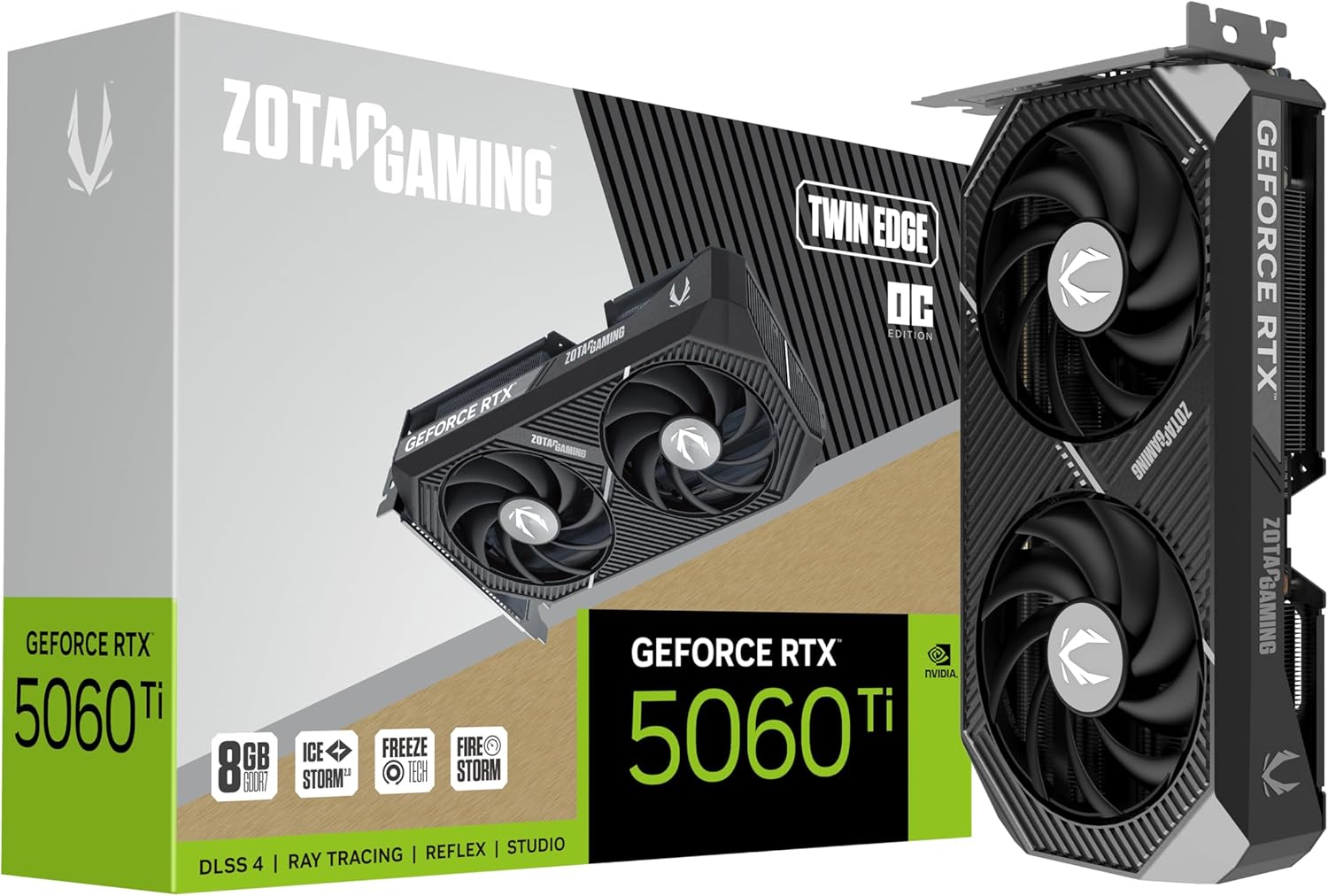
ZOTAC Gaming GeForce RTX 5060 Ti 8GB Twin Edge OC DLSS 4 8GB GDDR7 128-bit 28 Gbps PCIE 5.0 Gaming Graphics Card, IceStorm 2.0 Cooling, SFF-Ready, ZT-B50610H-10A
$300-$599This is a compact, 2-slot RTX 5060 Ti with 8GB GDDR7 and a 2602 MHz clock, built for SFF gaming rigs.