
Sapphire 11349-03-20G Pulse AMD Radeon™ RX 9070 Gaming Graphics Card with 16GB GDDR6, AMD RDNA 4
Want the best price and purchase timing?
Our AI advisor analyzes real-time pricing across all channels to find you the best deal.
AI Verdict
This 16GB GDDR6, 2520 MHz boost clock GPU delivers strong 1440p and 4K gaming performance.
This GPU is a strong fit for gamers targeting high frame rates at 1440p or smooth gameplay at 4K, thanks to its 16GB GDDR6 VRAM and 2520 MHz boost clock. It leverages the RDNA 4 architecture for improved efficiency and features like FSR 4. It's a compelling upgrade for many mid-range systems.
If you need a slight performance bump for more demanding 4K or ray tracing scenarios, look for the RX 9070 XT or a higher-tier RX 9000 series card.
Regret Score™
Low RiskLower is better — measures purchase-regret risk from real buyer complaints, review credibility, and product maturity
Issues discovered after purchase
Critically weak dimension
Amazon rating vs actual quality
Chance this product isn't for you
Pros
- Features 16GB GDDR6 VRAM, providing ample memory for high-resolution textures and future games.
- Achieves a 2520 MHz boost clock, contributing to high frame rates in demanding titles.
- Offers strong performance for 1440p and 4K gaming, often outperforming the RTX 5070.
- Supports AMD's new FSR 4 upscaling technology, exclusive to the RX 9000 series, for improved image quality and performance.
- Exhibits lower power consumption compared to some competitors, making it energy efficient.
- Sapphire Pulse cooling solutions are noted for being highly capable with a focus on low noise.
Cons
- The RX 9070 XT is frequently cited as offering better value for a slightly higher price point.
- Ray tracing performance, while improved, can still be inconsistent or lag behind Nvidia in certain titles.
- FSR 4, while promising, currently has limited game support.
- The card's price has been subject to scalping, making it difficult to acquire at MSRP.
Dimension Scores
The card delivers strong 1440p and 4K gaming performance, often outperforming the RTX 5070.
Sapphire Pulse cards are known for highly capable cooling solutions with a focus on low noise.
The RX 9070 has lower gaming power consumption and is considered more energy efficient than some competitors.
With 16GB GDDR6 VRAM, it provides a substantial memory buffer for current and future high-resolution gaming.
Best For
- High refresh rate 1440p gaming across a wide range of titles.
- 4K gaming at high settings in many modern games.
- Users upgrading from older AMD GPUs like the RX 6800 or RX 7800 XT seeking a significant performance uplift.
- PC builds where power efficiency is a consideration.
Not Recommended For
- Gamers who prioritize absolute best-in-class ray tracing performance in all scenarios.
- Budget-conscious buyers if the RX 9070 XT is available at a minimal price difference.
Watch Out For
- The RX 9070 XT often presents a better performance-per-dollar, making the non-XT version a questionable buy if the price difference is small.
- Availability at MSRP can be an issue, with some users reporting prices significantly above the $549-$600 suggested retail.
- While FSR 4 is a feature, the actual number of games supporting it at launch is limited, so don't expect immediate widespread use.
Full Specifications
| ASIN | B0DTHN37BP |
| Brand | Sapphire |
| Color | black |
| Series | RX 9070 |
| Item Weight | 2.98 pounds |
| Manufacturer | Sapphire Technology |
| Memory Speed | 20 GHz |
| Chipset Brand | AMD |
| GPU Clock Speed | 2520 MHz |
| Card Description | AMD Radeon RX 9070 with 16GB GDDR6, 2520 MHz GPU Clock, 20 GHz Memory Clock |
| Graphics Ram Size | 16 GB |
| Item model number | 11349-03-20G |
| Product Dimensions | 11.02 x 4.73 x 0.04 inches |
| Graphics Coprocessor | AMD Radeon RX 9070 |
| Max Screen Resolution | 3840x2160 |
| Graphics Card Ram Size | 16 GB |
| Item Dimensions LxWxH | 11.02 x 4.73 x 0.04 inches |
| Video Output Interface | DisplayPort, HDMI |
What Buyers Say
This Sapphire Pulse RX 9070 is a serious contender for 1440p and 4K gaming, often delivering higher frame rates than Nvidia's RTX 5070. Users are particularly keen on its 16GB VRAM, which handles demanding titles with ease. The inclusion of AMD's new FSR 4 upscaling technology is a big plus, even if game support is still building. However, the recurring sentiment is that the RX 9070 XT, for a small price increase, often offers a better performance-to-cost ratio, making the non-XT a slightly tougher sell if both are available.
“Dude, this 9070 is crushing 1440p, but seriously, if you can snag the XT for like fifty bucks more, just do it, you'll thank me later.”
Common Praise
- 16GB GDDR6 VRAM handles high-resolution textures without issue.
- Achieves high frame rates in 1440p and 4K gaming.
- FSR 4 upscaling technology improves image quality and performance.
- The Sapphire Pulse cooler keeps temperatures low and operates quietly.
- Power consumption is efficient compared to other cards in its class.
Common Complaints
- The RX 9070 XT often provides better value for a slightly higher cost.
- Ray tracing performance can sometimes fall behind Nvidia in specific games.
- Limited game support for the new FSR 4 technology at launch.
- Difficulty finding the card at its MSRP due to price fluctuations and scalping.
Ownership Tips
- The card maintains consistent performance even during extended gaming sessions.
- Its power efficiency means less heat dumped into your case and potentially lower electricity bills.
- The cooler design is effective, keeping noise levels down even under load.
- Installation is straightforward, fitting into standard ATX cases without issue.
Frequently Asked Questions
Is the Sapphire Pulse RX 9070 suitable for 1440p gaming?
Yes, it's designed to max out games at 1440p with high settings and even ray tracing enabled.
How does its ray tracing performance compare to competitors?
The RX 9070 shows improved ray tracing performance with the RDNA 4 architecture, but it can still be slightly slower than Nvidia's RTX 5070 in some ray-traced titles.
What is FSR 4 and is it available on this card?
FSR 4 is AMD's new AI ML-based upscaling algorithm that improves image quality and performance. It is exclusive to the Radeon RX 9000 series, including this card.
Is the Sapphire Pulse RX 9070 power efficient?
Yes, the RX 9070 is noted for being power efficient, with lower gaming power consumption compared to some competing cards.
How much VRAM does this graphics card have?
The Sapphire Pulse RX 9070 comes with 16GB of GDDR6 VRAM, which is a healthy buffer for modern games.
Buying Guide
When you're looking at a graphics card like this, you're essentially buying the engine for your gaming PC. The key is how well it can push pixels to your monitor, especially at higher resolutions like 1440p or 4K. You want enough VRAM so your games don't stutter when loading detailed textures, and a high clock speed means faster calculations for smoother gameplay. This card is built on AMD's RDNA 4 architecture, which means it's designed for efficiency and includes features like FSR 4 to boost your frame rates without sacrificing too much visual quality.
VRAM (16GB GDDR6)
Think of VRAM like the short-term memory for your graphics card. 16GB is a generous amount, especially for 1440p and 4K gaming, allowing the card to store more game assets and textures directly on the GPU, preventing slowdowns and ensuring smoother visuals, similar to how having more RAM in your computer lets you run more programs at once.
Clock Speed (2520 MHz)
The clock speed is how many cycles per second the GPU's processor can complete. A higher clock speed, like 2520 MHz, means the card can process more instructions and render frames faster, directly translating to higher frame rates in your games, much like a faster CPU processes tasks quicker.
AMD RDNA 4 Architecture
This is the underlying design of the graphics chip. RDNA 4 is AMD's latest generation, bringing improvements in performance per watt, better ray tracing capabilities, and new features like FSR 4. It's like getting a car with a brand new, more efficient engine design compared to an older model.
Alternatives
If this card doesn't quite hit the mark, consider looking for GPUs with higher clock speeds or more advanced ray tracing cores if that's a priority, or a step up in the RX 9000 series for more raw performance.
You Might Also Like

HP NVIDIA GeForce RTX 3070 8GB OEM Graphics Card (Renewed)
$150-$299This is a renewed HP OEM NVIDIA GeForce RTX 3070 with 8GB VRAM, a gamble for budget-conscious 1440p gamers who understand the risks of refurbished hardware.

ZOTAC Gaming GeForce RTX 5070 Twin Edge OC DLSS 4 12GB GDDR7 192-bit 28 Gbps PCIE 5.0 Gaming Graphics Card, IceStorm 2.0 Cooling, SFF-Ready, ZT-B50700H-10A
$600+This is a 2-slot, SFF-ready NVIDIA RTX 5070 with 12GB GDDR7 and a 2542 MHz boost clock, built for compact gaming rigs needing high 1440p performance.

ZOTAC Gaming GeForce RTX 5080 Solid CORE OC DLSS 4 16GB GDDR7 256-bit 30 Gbps PCIE 5.0 Gaming Graphics Card, IceStorm 3.0 Advanced Cooling, Spectra RGB Lighting, ZT-B50800J2-10A
$600+This ZOTAC RTX 5080 with 16GB GDDR7 and a 2640 GHz clock speed is built for high-end 4K gaming and content creation on the NVIDIA Blackwell architecture.
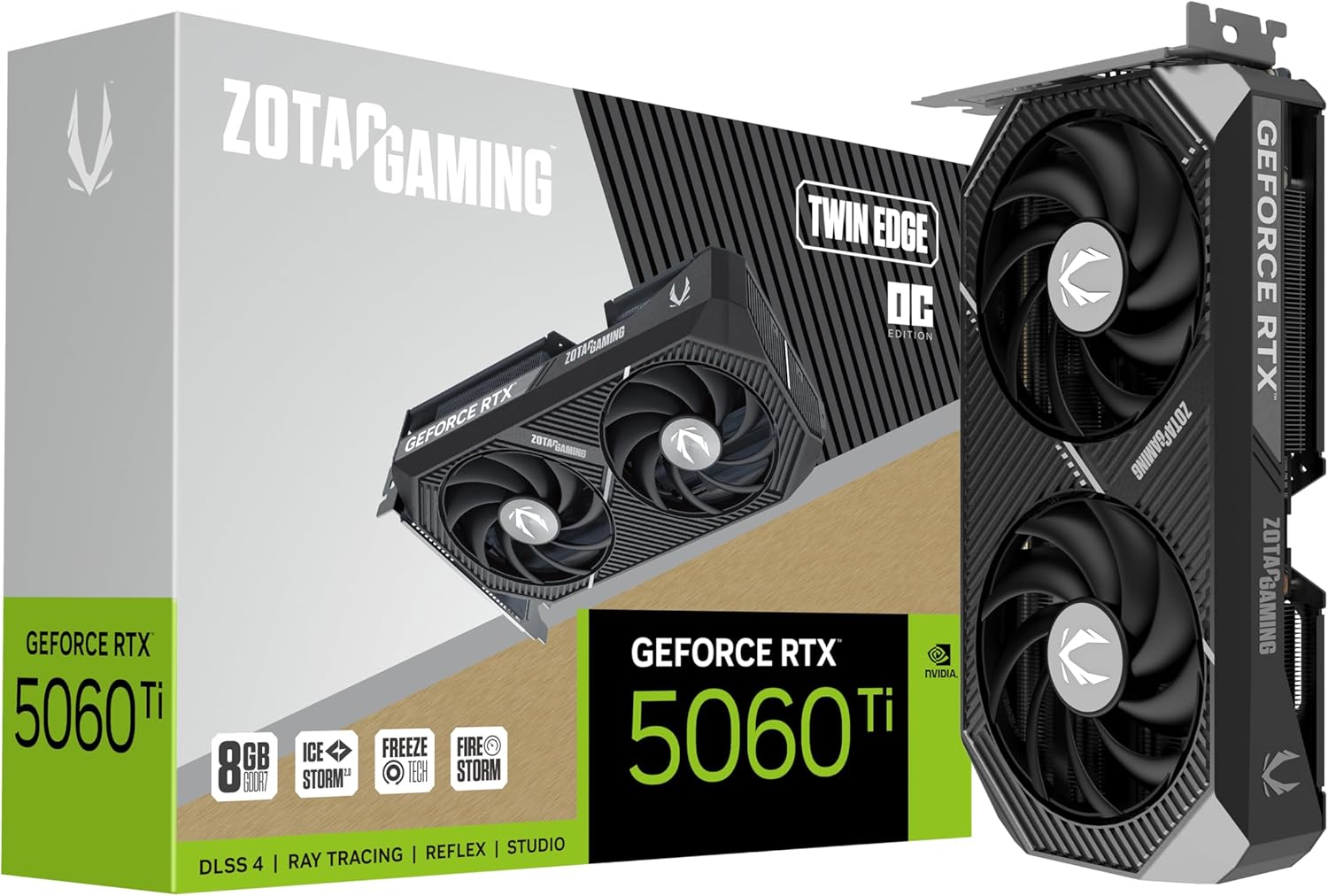
ZOTAC Gaming GeForce RTX 5060 Ti 8GB Twin Edge OC DLSS 4 8GB GDDR7 128-bit 28 Gbps PCIE 5.0 Gaming Graphics Card, IceStorm 2.0 Cooling, SFF-Ready, ZT-B50610H-10A
$300-$599This is a compact, 2-slot RTX 5060 Ti with 8GB GDDR7 and a 2602 MHz clock, built for SFF gaming rigs.