
GIGABYTE GeForce RTX 5090 Gaming OC 32G Graphics Card, WINDFORCE Cooling System, 32GB 512-bit GDDR7, by NVIDIA, DisplayPort & HDMI - Video Output Interface, GV-N5090GAMING OC-32GD Video Card
Want the best price and purchase timing?
Our AI advisor analyzes real-time pricing across all channels to find you the best deal.
AI Verdict
This is a 32GB GDDR7, PCIe 5.0, 2550MHz boost clock GPU for extreme 4K/8K gaming and AI acceleration.
This GPU is a strong fit for users demanding the absolute highest performance for 4K and 8K gaming, as well as intensive AI and creative workloads, due to its NVIDIA GeForce RTX 5090 chipset, 32GB GDDR7 memory, and 2550 MHz boost clock. Its advanced cooling system and dual BIOS offer flexibility for performance or acoustics.
If this card's size or power consumption is a concern, look for a dual-fan or smaller triple-fan RTX 5080 variant with a lower TGP and smaller form factor.
Regret Score™
Medium RiskLower is better — measures purchase-regret risk from real buyer complaints, review credibility, and product maturity
Issues discovered after purchase
Critically weak dimension
Amazon rating vs actual quality
Chance this product isn't for you
Pros
- Features 32GB GDDR7 memory with a 512-bit interface, providing 1.792 TB/s bandwidth for demanding applications and future-proofing.
- Boosts to 2550 MHz, exceeding the 2407 MHz reference clock for higher out-of-the-box performance.
- Equipped with DisplayPort 2.1b and HDMI 2.1b for broad display compatibility and high refresh rates.
- Includes a dual BIOS switch, offering a 'Quiet BIOS' mode for reduced fan noise under load.
- Users report zero coil whine in some units, even under heavy power draw.
- Supports DLSS 4 with Multi Frame Generation and NVIDIA Reflex 2 with Frame Warp for enhanced visuals and responsiveness.
Cons
- The card is physically large, measuring L34.2cm x W15cm x H6.5cm and occupying four slots, which can challenge case compatibility.
- Default BIOS can be loud under load, with some users reporting 'horrendous' fan noise.
- Total Graphics Power (TGP) is 600 watts, requiring a recommended 1000-watt power supply and potentially causing high heat output.
- The top shroud is made of plastic and can flex slightly during installation, which some users feel is cheap for a premium card.
- Memory overclocking is reportedly artificially limited by drivers, restricting enthusiast tweaking.
Dimension Scores
Powered by the RTX 5090 chipset with 21,760 CUDA cores and DLSS 4, it's designed to be the fastest GPU available for 4K and 8K gaming.
The WINDFORCE cooling system with a vapor chamber and three axial fans keeps GPU temperatures around 60-72°C under load, and a 'Quiet BIOS' option exists, though the default can be loud.
With a 600-watt TGP and a recommended 1000-watt PSU, its power consumption is very high, and it has high idle/multi-monitor power draw.
It features a staggering 32GB of GDDR7 memory with a 512-bit interface, offering 1.792 TB/s bandwidth, which is best-in-class for consumer cards.
Best For
- 4K and 8K gaming at high refresh rates with ray tracing enabled.
- AI acceleration and creative applications utilizing FP4-capable Tensor cores.
- Users with large PC cases and robust power supplies (1000W recommended).
- Enthusiasts seeking top-tier performance who are comfortable with undervolting for efficiency.
Not Recommended For
- Compact PC builds due to its quad-slot, 34.2cm length.
- Budget-conscious buyers, given its premium price point.
- Users sensitive to noise, especially if running the default Performance BIOS.
Watch Out For
- Some users report the top shroud is plastic and flexes during installation, feeling less premium for a high-end card.
- The card's 600W TGP can lead to high heat output, with some users calling it a 'space heater'.
- Memory overclocking is artificially limited by the driver, preventing users from maximizing memory performance.
- High idle, multi-monitor, and video playback power consumption has been noted.
- Thermal putty is used, which can make maintenance difficult for users.
Full Specifications
| ASIN | B0DT7GBNWQ |
| Brand | GIGABYTE |
| Color | Black |
| Series | GV-N5090GAMING OC-32GD |
| Item Weight | 4.91 pounds |
| Manufacturer | GIGABYTE |
| Memory Speed | 2209 MHz |
| Chipset Brand | NVIDIA |
| GPU Clock Speed | 2 GHz |
| Card Description | Dedicated |
| Graphics Ram Size | 32 GB |
| Item model number | GV-N5090GAMING OC-32GD |
| Product Dimensions | 13.46 x 5.98 x 2.76 inches |
| Graphics Coprocessor | NVIDIA GeForce RTX 5090 |
| Max Screen Resolution | 7680x4320 Pixels |
| Graphics Card Ram Size | 32 GB |
| Item Dimensions LxWxH | 13.46 x 5.98 x 2.76 inches |
| Video Output Interface | DisplayPort, HDMI |
What Buyers Say
Users are generally blown away by the sheer performance of this RTX 5090, especially for 4K and 8K gaming, with many noting its significant generational leap over the RTX 4090. However, the card's physical size and high power consumption are recurring themes, often requiring careful case selection and a robust power supply. While some units exhibit zero coil whine, others report it under heavy load, and the plastic shroud material is a minor point of contention for a premium product.
“Dude, this thing absolutely shreds 4K, but seriously, make sure your case is a monster and your PSU can handle the 600 watts, it's a beast but it's a hot beast.”
Common Praise
- Exceptional performance for 4K and 8K gaming, often exceeding expectations.
- Zero coil whine reported by some users, even when pushing the card hard.
- Effective WINDFORCE cooling system keeps GPU temperatures around 60-72°C under load.
- Strong undervolting capabilities allow for reduced power draw and improved efficiency.
- The 32GB GDDR7 VRAM is considered future-proof and beneficial for demanding applications.
Common Complaints
- The card's large, quad-slot design makes it difficult to fit into many cases.
- High power consumption (600W TGP) and associated heat output are significant concerns.
- Some users find the default BIOS fan noise loud under heavy load.
- The plastic top shroud feels less premium than expected for a card in this price range.
- Memory overclocking is artificially limited by drivers, frustrating enthusiasts.
Ownership Tips
- The dual BIOS switch is genuinely useful; the 'Quiet BIOS' makes a noticeable difference in fan acoustics.
- Undervolting is almost a must-do for managing power draw and heat, and it's surprisingly easy to implement for significant gains.
- The card's sheer weight might necessitate a GPU support bracket to prevent sag over time, even with its reinforced structure.
- The minimal RGB lighting (just the logo) is a plus for those who prefer a less flashy build.
- Expect your room temperature to increase significantly during intense gaming sessions due to the 600W power draw.
Frequently Asked Questions
What kind of power supply do I need for this graphics card?
GIGABYTE recommends a 1000-watt power supply to adequately power the card's 600-watt Total Graphics Power (TGP).
Does this card have coil whine?
User experiences vary; some report absolutely zero coil whine even under heavy load, while others notice it when the GPU draws 500 watts or more, though often not bothersome.
How big is this graphics card?
It's a large, quad-slot card, measuring approximately 34.2cm in length, 15cm in width, and 6.5cm in height. Ensure your PC case has sufficient clearance.
Can I undervolt this card for better efficiency?
Yes, users have reported success with undervolting, significantly reducing power draw (e.g., to ~250W average while gaming) while maintaining strong performance and lower temperatures.
What are the display output options?
The card features three DisplayPort 2.1b ports and one HDMI 2.1b port, supporting up to 8K resolution.
Buying Guide
When looking at a high-end GPU like this, you're primarily buying raw performance. Don't just look at the chipset; consider the specific board partner's cooling solution, as it directly impacts sustained performance and noise. Pay close attention to the physical dimensions and power requirements, as these cards are massive and power-hungry. Also, check for features like dual BIOS, which can offer a quieter experience at the expense of a tiny bit of performance.
vram (32GB GDDR7)
This is the card's dedicated memory. 32GB is an enormous amount, like having a massive workbench for your creative projects or games. It means you can run games at extreme resolutions (4K, 8K) with the highest texture settings and complex ray tracing without hitting memory bottlenecks, ensuring smooth performance even in future titles.
clock_speed (2550 MHz boost)
This is how fast the GPU's processor runs. A higher clock speed means the card can process more calculations per second, directly translating to higher frame rates in games and faster completion of demanding tasks. The 2550 MHz boost is a factory overclock, meaning it's faster than NVIDIA's baseline specification.
output (DisplayPort 2.1b, HDMI 2.1b)
These are the ports you connect your monitor to. DisplayPort 2.1b and HDMI 2.1b are the latest standards, capable of supporting incredibly high resolutions and refresh rates, like 4K at 240Hz or 8K at 120Hz. If your monitor has these, you'll get the best visual experience possible.
Alternatives
If this card is too large or expensive, search for GPUs with a lower TGP (e.g., 400-500W) and a 3-slot or smaller form factor. For slightly less extreme performance, look for cards with 24GB GDDR7 VRAM.
You Might Also Like

HP NVIDIA GeForce RTX 3070 8GB OEM Graphics Card (Renewed)
$150-$299This is a renewed HP OEM NVIDIA GeForce RTX 3070 with 8GB VRAM, a gamble for budget-conscious 1440p gamers who understand the risks of refurbished hardware.

ZOTAC Gaming GeForce RTX 5070 Twin Edge OC DLSS 4 12GB GDDR7 192-bit 28 Gbps PCIE 5.0 Gaming Graphics Card, IceStorm 2.0 Cooling, SFF-Ready, ZT-B50700H-10A
$600+This is a 2-slot, SFF-ready NVIDIA RTX 5070 with 12GB GDDR7 and a 2542 MHz boost clock, built for compact gaming rigs needing high 1440p performance.

ZOTAC Gaming GeForce RTX 5080 Solid CORE OC DLSS 4 16GB GDDR7 256-bit 30 Gbps PCIE 5.0 Gaming Graphics Card, IceStorm 3.0 Advanced Cooling, Spectra RGB Lighting, ZT-B50800J2-10A
$600+This ZOTAC RTX 5080 with 16GB GDDR7 and a 2640 GHz clock speed is built for high-end 4K gaming and content creation on the NVIDIA Blackwell architecture.
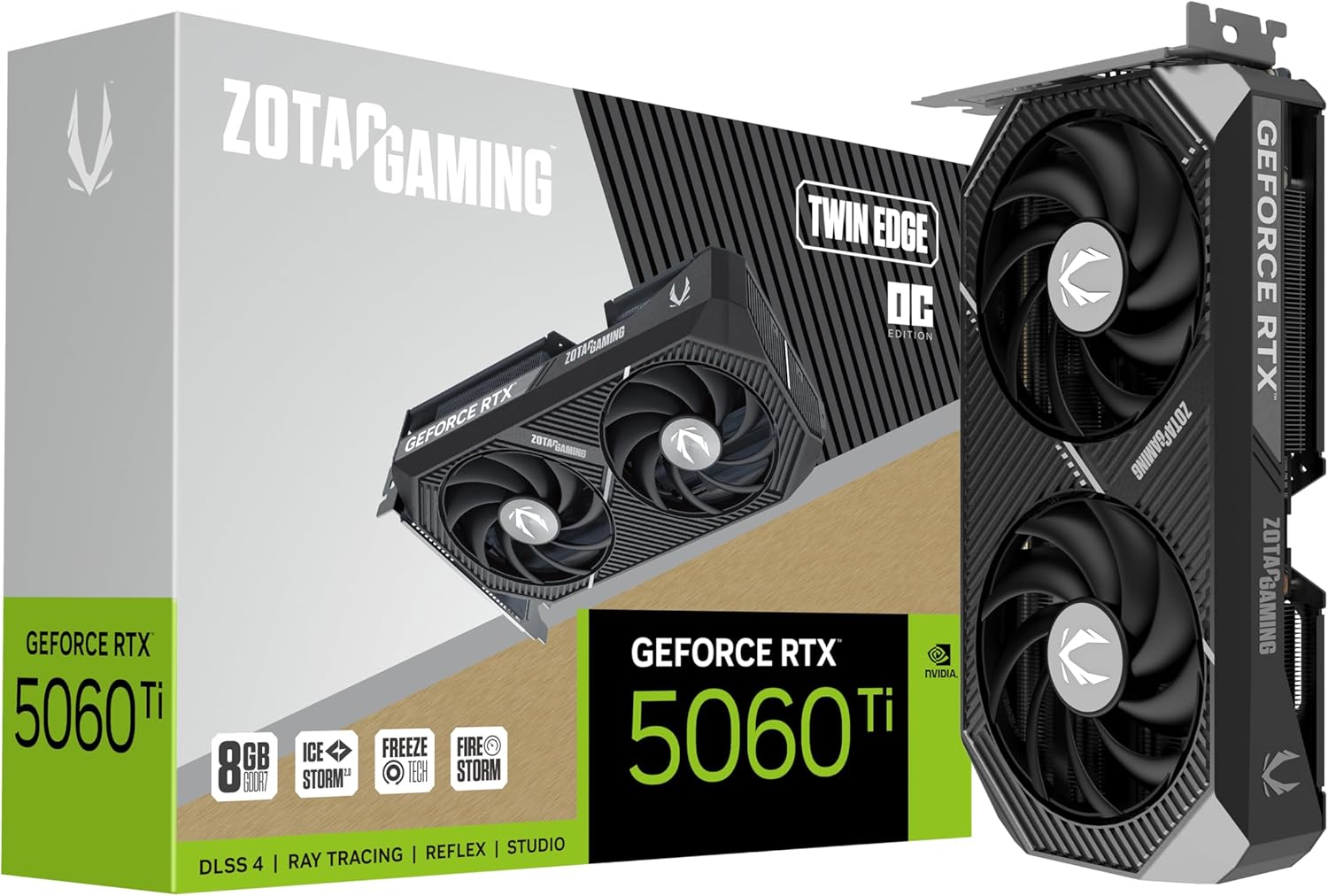
ZOTAC Gaming GeForce RTX 5060 Ti 8GB Twin Edge OC DLSS 4 8GB GDDR7 128-bit 28 Gbps PCIE 5.0 Gaming Graphics Card, IceStorm 2.0 Cooling, SFF-Ready, ZT-B50610H-10A
$300-$599This is a compact, 2-slot RTX 5060 Ti with 8GB GDDR7 and a 2602 MHz clock, built for SFF gaming rigs.