
Radeon RX560 2G Graphics Card, with 4 HDMI Monitor Graphics Card,Computer PC GPU GDDR5 128 Bit DirectX 12 PCI Express X16 3.0, 4 Port Video Cards (AMD RX560 2G 4HDMI)
Want the best price and purchase timing?
Our AI advisor analyzes real-time pricing across all channels to find you the best deal.
AI Verdict
This 2GB GDDR5 RX 560 with 4 HDMI outputs is for multi-monitor office setups, not demanding games.
This card is a situational fit because its 4 HDMI outputs and low 50W power draw are specific advantages for multi-monitor productivity setups or basic PC upgrades. However, its 2GB VRAM and entry-level RX 560 chipset severely limit its utility for anything beyond light gaming or non-demanding graphical tasks.
If you need better gaming performance or more VRAM for higher resolutions, look for cards with at least 4GB of GDDR5 or GDDR6 VRAM and a more modern chipset.
Regret Score™
Very High RiskLower is better — measures purchase-regret risk from real buyer complaints, review credibility, and product maturity
Issues discovered after purchase
Critically weak dimension
Amazon rating vs actual quality
Chance this product isn't for you
Pros
- Supports up to 4 HDMI monitors simultaneously, ideal for productivity setups.
- Draws a maximum of 50W directly from the PCI Express X16 slot, eliminating the need for an external power connector.
- Compact size (180*120*40mm) allows it to fit into smaller PC cases.
- Includes a cooling fan for heat dissipation, contributing to stable operation.
- Compatible with Windows 7, 10, and 11 (64-bit) operating systems.
Cons
- Only 2GB of GDDR5 VRAM significantly limits performance in modern games and higher resolutions.
- The AMD Radeon RX 560 chipset is an entry-level GPU with a 14nm process and Polaris 12 core, indicating older architecture.
- The 1176 MHz clock speed is low for current gaming performance expectations.
- Output is limited to HDMI ports, lacking DisplayPort or DVI options for broader monitor compatibility.
- Some RX 560 models from other brands historically required external power, which could lead to confusion for buyers expecting universal plug-and-play.
Dimension Scores
The 2GB VRAM and entry-level RX 560 chipset struggle with modern games, often requiring low settings for playable frame rates.
The card includes a cooling fan and has a low 50W power draw, suggesting it should run relatively cool and quiet for its performance tier.
With a maximum power consumption of 50W and no external power connector, it's highly efficient and compatible with most power supplies.
2GB of GDDR5 VRAM is a severe limitation for any modern gaming or graphically intensive tasks, even at 1080p.
Best For
- Multi-monitor office setups, especially for tasks like stock market monitoring that benefit from multiple screens.
- Light gaming, such as esports titles like League of Legends (LOL).
- Upgrading integrated graphics for basic desktop use and increasing display resolution in an office environment.
- Systems with limited power supply capacity due to its low 50W power draw.
Not Recommended For
- Playing demanding modern AAA games at high settings or resolutions, where 2GB VRAM is insufficient.
- Professional video editing, 3D rendering, or other GPU-intensive creative tasks.
- Users requiring DisplayPort or DVI connectivity for specific monitors or features like Freesync over DisplayPort.
Watch Out For
- The 2GB VRAM is a significant bottleneck for many games, even older ones at 1080p, with users reporting experiences that are 'painfull for my eyes' on low-medium settings.
- Performance of the RX 560 chipset is comparable to or slightly below an older GTX 1050, which itself is an entry-level card.
- Historically, some RX 560 cards from other manufacturers were '460 rebrands' with fewer stream processors, leading to confusion and underperformance in the market.
- The exclusive use of HDMI outputs means no native support for DisplayPort-only monitors or Freesync functionality that relies on DisplayPort.
Full Specifications
| ASIN | B0DSZL1MBV |
| Brand | Xynsviu |
| Item Weight | 14.1 ounces |
| Manufacturer | Xynsviu |
| GPU Clock Speed | 1176 MHz |
| Graphics Ram Size | 2 GB |
| Item model number | RX560 2G |
| Product Dimensions | 7.09 x 4.72 x 0.1 inches |
| Graphics Coprocessor | AMD Radeon RX 560 |
| Video Output Interface | HDMI |
What Buyers Say
While specific reviews for this Xynsviu model are unavailable, general sentiment around the 2GB RX 560 chipset highlights its limitations for gaming beyond esports titles. Users often find the 2GB VRAM insufficient for anything but the lowest settings in newer games, making it a 'painfull for my eyes' experience. Its strength lies in its ability to drive multiple displays for productivity, a feature often sought in office or stock trading setups. The low power draw is a consistent advantage, making it easy to integrate into systems without robust power supplies.
“Seriously, I just needed something to run my four work monitors and maybe play some old games, and this thing does that without needing a new power supply, but don't even *think* about Cyberpunk on this.”
Common Praise
- Supports 4 HDMI monitors for multi-display setups.
- Low power consumption (max 50W) without needing an external power connector.
- Adequate for light esports games like League of Legends.
- Compact form factor fits in smaller cases.
Common Complaints
- 2GB VRAM is a major bottleneck for modern games, even at 1080p.
- Performance is significantly behind more capable budget cards like the 4GB RX 570 or GTX 1050 Ti.
- The RX 560 chipset itself is an older, entry-level architecture.
- Lack of DisplayPort limits connectivity options and Freesync compatibility for some monitors.
Ownership Tips
- The 2GB VRAM fills up fast, even with basic applications open alongside a game, leading to stuttering.
- Drivers for older AMD cards can sometimes be finicky to install on newer Windows versions.
- The fan, while present, can get audible under load, even if the card isn't drawing much power.
- The 4 HDMI ports are genuinely useful for productivity, but ensure your monitors have HDMI inputs.
Frequently Asked Questions
Can it run AAA games?
No, the 2GB VRAM and entry-level RX 560 chipset are not sufficient for demanding modern AAA games at playable frame rates or settings.
Does it need external power?
No, this RX 560 card draws a maximum of 50W directly from the PCI Express X16 slot and does not require an external power connector.
What operating systems does it support?
It supports Windows 11-64 bit, Windows 10 64 bit, and Windows 7 64 bit.
What kind of ports does it have?
This card is equipped with 4 HDMI ports for display output.
Is it good for multiple monitors?
Yes, it is designed to support up to 4 monitors simultaneously via its 4 HDMI outputs, making it suitable for multi-display setups.
Is 2GB VRAM enough?
For basic desktop use, office applications, and very light esports titles, 2GB VRAM can be sufficient, but it is a significant limitation for most modern games and higher resolutions.
Buying Guide
When buying a graphics card like this, you need to understand its primary purpose. This isn't for gaming beyond very light titles; it's built for driving multiple displays in a productivity setting. The low power draw means you likely won't need to upgrade your power supply, which saves money and hassle. Don't expect it to magically transform your PC into a gaming powerhouse.
Chipset (AMD Radeon RX 560)
VRAM (2 GB)
Output (HDMI)
Alternatives
If you need better gaming performance, look for cards with at least 4GB of VRAM and a more powerful, newer generation chipset. If you need DisplayPort connectivity, ensure the alternative card explicitly lists it.
You Might Also Like

HP NVIDIA GeForce RTX 3070 8GB OEM Graphics Card (Renewed)
$150-$299This is a renewed HP OEM NVIDIA GeForce RTX 3070 with 8GB VRAM, a gamble for budget-conscious 1440p gamers who understand the risks of refurbished hardware.

ZOTAC Gaming GeForce RTX 5070 Twin Edge OC DLSS 4 12GB GDDR7 192-bit 28 Gbps PCIE 5.0 Gaming Graphics Card, IceStorm 2.0 Cooling, SFF-Ready, ZT-B50700H-10A
$600+This is a 2-slot, SFF-ready NVIDIA RTX 5070 with 12GB GDDR7 and a 2542 MHz boost clock, built for compact gaming rigs needing high 1440p performance.

ZOTAC Gaming GeForce RTX 5080 Solid CORE OC DLSS 4 16GB GDDR7 256-bit 30 Gbps PCIE 5.0 Gaming Graphics Card, IceStorm 3.0 Advanced Cooling, Spectra RGB Lighting, ZT-B50800J2-10A
$600+This ZOTAC RTX 5080 with 16GB GDDR7 and a 2640 GHz clock speed is built for high-end 4K gaming and content creation on the NVIDIA Blackwell architecture.
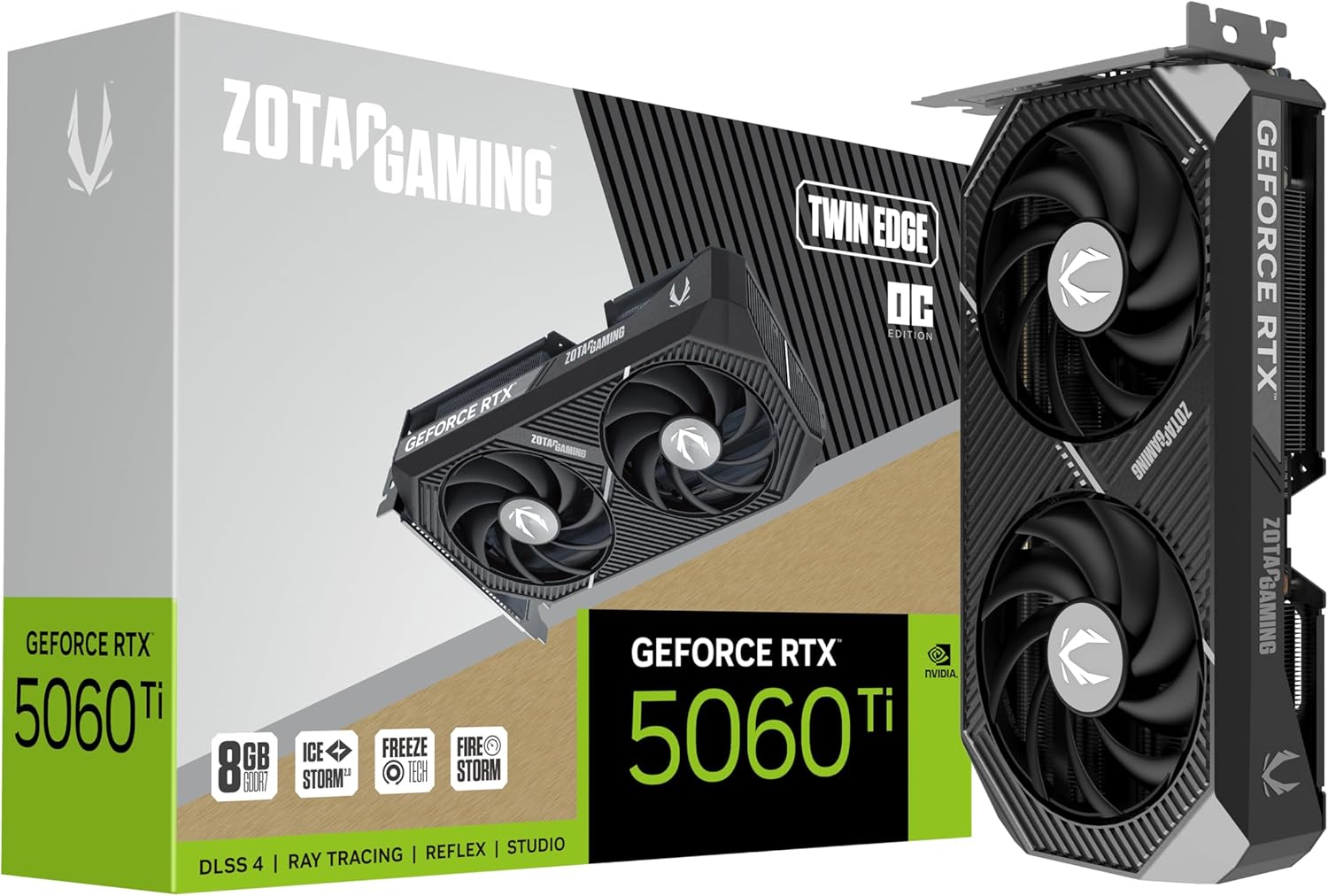
ZOTAC Gaming GeForce RTX 5060 Ti 8GB Twin Edge OC DLSS 4 8GB GDDR7 128-bit 28 Gbps PCIE 5.0 Gaming Graphics Card, IceStorm 2.0 Cooling, SFF-Ready, ZT-B50610H-10A
$300-$599This is a compact, 2-slot RTX 5060 Ti with 8GB GDDR7 and a 2602 MHz clock, built for SFF gaming rigs.