
ASUS The SFF-Ready Prime GeForce RTX™ 5070 Graphics Card, NVIDIA (PCIe® 5.0, 12GB GDDR7, HDMI®/DP 2.1, 2.5-Slot, Axial-tech Fans, Dual BIOS)
Want the best price and purchase timing?
Our AI advisor analyzes real-time pricing across all channels to find you the best deal.
AI Verdict
This 2.5-slot RTX 5070 with 12GB GDDR7 and 2542 MHz clock is for compact builds needing 1440p to light 4K gaming with DLSS 4.
This card is a strong contender if you're aiming for a compact build that can still push high frame rates at 1440p, thanks to its 2.5-slot design and efficient cooling. However, its 'SFF-Ready' claim needs careful case compatibility checks, as it won't fit the smallest enclosures.
If you need absolute minimal size for an SFF build, look for a true dual-slot or single-fan GPU, or if 4K gaming is your priority, consider cards with 16GB or more VRAM.
Regret Score™
Medium RiskLower is better — measures purchase-regret risk from real buyer complaints, review credibility, and product maturity
Issues discovered after purchase
Critically weak dimension
Amazon rating vs actual quality
Chance this product isn't for you
Pros
- The 2.5-slot design and three Axial-tech fans allow for better compatibility in smaller cases while maintaining cooling performance.
- Delivers 1440p and 4K gaming performance, with 1080p and 1440p averages over 90 FPS in some titles with DLSS enabled.
- Features a dual BIOS with performance and quiet modes, showing only a 1-2 decibel noise difference between them.
- Includes a full-sized aluminum backplate, contributing to a robust build quality.
- Utilizes a phase-change GPU thermal pad for optimal heat transfer, resulting in GPU temperatures around 70°C under load.
- Equipped with Native DisplayPort 2.1b x3 and Native HDMI 2.1b for future-proof connectivity.
Cons
- The 'SFF-Ready' designation is debated by users, as its 2.5-slot, three-fan design may still not fit true SFF cases not specifically designed for NVIDIA's standard.
- The 12GB GDDR7 VRAM might become a limitation for 4K gaming or future titles within 2-3 years, especially at ultra settings.
- The upward-facing 16-pin power connector can cause cable strain in cases with limited headroom above the GPU.
- Minimal performance difference between the dual BIOS's performance and quiet modes, with fan speeds only changing by a few percentage points.
Dimension Scores
The RTX 5070 delivers strong 1440p performance and can handle 4K gaming with DLSS 4, averaging over 90 FPS at 1440p in some titles.
Users report efficient cooling with GPU temperatures around 70°C under load and relatively low noise levels, even with the fans at 50% speed.
With a power consumption around 220W, which can be reduced with DLSS, it offers improved power efficiency compared to the Founders Edition.
The 12GB GDDR7 is sufficient for most 1440p gaming today, but some users express concerns about its longevity for future 4K titles at ultra settings.
Best For
- Gamers building a compact PC that needs high 1440p performance.
- Users upgrading from an RTX 3070 or 3060, seeking a noticeable performance uplift.
- Enthusiasts who prioritize efficient cooling and quiet operation in their system.
- Anyone wanting access to NVIDIA's Blackwell architecture and DLSS 4 for enhanced gaming.
Not Recommended For
- Builders of extremely small form factor (true SFF) cases that require single or dual-slot GPUs.
- Users who primarily game at 4K with maximum settings and ray tracing, due to potential 12GB VRAM limitations.
Watch Out For
- The 'SFF-Ready' label is misleading for many, as the 2.5-slot, three-fan design won't fit many traditional SFF cases.
- The 12GB VRAM, while currently adequate for 1440p, is a concern for future-proofing 4K gaming, with some users suggesting 16GB or 18GB would be better.
- The 16-pin power connector faces directly upwards, which can create clearance issues and cable bending in cases with tight top clearance.
- Despite having a dual BIOS, the performance difference between quiet and performance modes is negligible, often only 1-2 decibels.
Full Specifications
| ASIN | B0DS6V1YSY |
| Brand | ASUS |
| Color | BLACK |
| Series | PRIME-RTX5070-12G |
| Item Weight | 3.63 pounds |
| Manufacturer | ASUS |
| Memory Speed | 4000 MHz |
| Chipset Brand | NVIDIA |
| GPU Clock Speed | 2542 MHz |
| Card Description | Dedicated |
| Graphics Ram Size | 12 GB |
| Item model number | PRIME-RTX5070-12G |
| Product Dimensions | 12 x 5 x 2 inches |
| Graphics Coprocessor | NVIDIA GeForce RTX 5070 |
| Max Screen Resolution | 7680x4320 Pixels |
| Graphics Card Ram Size | 12 GB |
| Item Dimensions LxWxH | 12 x 5 x 2 inches |
| Video Output Interface | HDCP support, Native DisplayPort 2.1b x3, Native HDMI 2.1b |
What Buyers Say
The 'SFF-Ready' marketing for this 2.5-slot card is a recurring point of contention among users, as it often doesn't fit the smallest SFF cases despite its compact design. However, the card consistently receives praise for its quiet operation and effective cooling, keeping GPU temperatures around 70°C even under heavy loads. Performance-wise, it's a solid upgrade for 1440p gaming, often outperforming the Founders Edition due to its thermal design. The upward-facing 16-pin power connector is a minor but frequently mentioned design flaw, causing cable management headaches in tight builds.
“Man, this thing is fast for 1440p, but seriously, 'SFF-Ready' is a joke if you're not building in a shoebox-sized case, and that power plug is a pain to hide.”
Common Praise
- The card runs whisper quiet, with fan noise only becoming audible above 60% speed.
- GPU temperatures stay around 70°C under full load, indicating efficient cooling.
- Delivers strong 1440p performance, making games very playable with DLSS 4.
- The simple, blacked-out aesthetic with an aluminum backplate looks clean in most builds.
- Installation is straightforward, and it fits well in a variety of cases, especially larger SFF or mATX.
Common Complaints
- The 'SFF-Ready' claim is misleading; it's too thick for many true SFF cases.
- The 12GB VRAM is a worry for future 4K gaming, with some users wishing for more.
- The 16-pin power connector's upward orientation creates cable clearance issues in compact cases.
- The dual BIOS modes (performance/quiet) offer almost no practical difference in noise or frame rates.
Ownership Tips
- Even with the 'quiet' BIOS, the fan curve is only slightly less aggressive, not a huge difference.
- The card's thermal performance is consistently good, even in warmer room environments.
- Cable management around the 16-pin power connector requires planning, especially in smaller cases.
- The card's physical size, while 2.5-slot, still feels substantial and requires checking internal case dimensions.
Frequently Asked Questions
What power supply wattage does ASUS recommend for this card?
ASUS recommends a 750W power supply for the RTX 5070.
Is this card actually suitable for small form factor (SFF) builds?
While it's marketed as 'SFF-Ready' with a 2.5-slot design, many Reddit users point out that it might still be too large for traditional SFF cases not specifically designed for NVIDIA's new SFF standard. Always check your case's GPU clearance.
Does the dual BIOS offer a significant difference in performance or noise?
Reviews indicate there's very little difference between the performance and quiet modes, often just 1-2 decibels in noise and no perceivable performance change.
What kind of gaming performance can I expect?
You can expect strong 1440p gaming performance and playable frame rates at 4K, especially when utilizing DLSS 4. It shows significant improvement over RTX 30-series cards.
Does this card have RGB lighting?
No, the ASUS Prime RTX 5070 features a simple, blacked-out aesthetic with no RGB lighting.
Buying Guide
When you're looking at a graphics card like the RTX 5070, you need to think about what resolution you'll be gaming at and how much space you have in your PC case. This card is built for 1440p gaming, and it can even dabble in 4K with NVIDIA's DLSS 4. Don't just trust 'SFF-Ready' labels; measure your case's GPU clearance carefully, especially for length and width.
VRAM (12GB GDDR7)
This is the card's dedicated memory. More VRAM means the card can handle higher resolutions and more detailed textures without stuttering, especially crucial for 4K gaming or graphically intensive titles. 12GB is strong for 1440p, but 4K might push it in the future.
2.5-Slot Design
This refers to how many PCIe slots the card occupies in your motherboard. A 2.5-slot card is thicker than a standard dual-slot, impacting compatibility with smaller cases or other expansion cards. It's a compromise for better cooling.
Axial-tech Fans
These are the fans on the card. Axial-tech fans are designed to push air downwards more effectively, which helps keep the GPU cool. Better cooling means the card can maintain higher performance for longer without throttling.
Alternatives
If you need a card for a truly tiny SFF case, search for dual-slot or single-fan GPUs. For uncompromised 4K gaming, look for cards with 16GB or more VRAM.
You Might Also Like

HP NVIDIA GeForce RTX 3070 8GB OEM Graphics Card (Renewed)
$150-$299This is a renewed HP OEM NVIDIA GeForce RTX 3070 with 8GB VRAM, a gamble for budget-conscious 1440p gamers who understand the risks of refurbished hardware.

ZOTAC Gaming GeForce RTX 5070 Twin Edge OC DLSS 4 12GB GDDR7 192-bit 28 Gbps PCIE 5.0 Gaming Graphics Card, IceStorm 2.0 Cooling, SFF-Ready, ZT-B50700H-10A
$600+This is a 2-slot, SFF-ready NVIDIA RTX 5070 with 12GB GDDR7 and a 2542 MHz boost clock, built for compact gaming rigs needing high 1440p performance.

ZOTAC Gaming GeForce RTX 5080 Solid CORE OC DLSS 4 16GB GDDR7 256-bit 30 Gbps PCIE 5.0 Gaming Graphics Card, IceStorm 3.0 Advanced Cooling, Spectra RGB Lighting, ZT-B50800J2-10A
$600+This ZOTAC RTX 5080 with 16GB GDDR7 and a 2640 GHz clock speed is built for high-end 4K gaming and content creation on the NVIDIA Blackwell architecture.
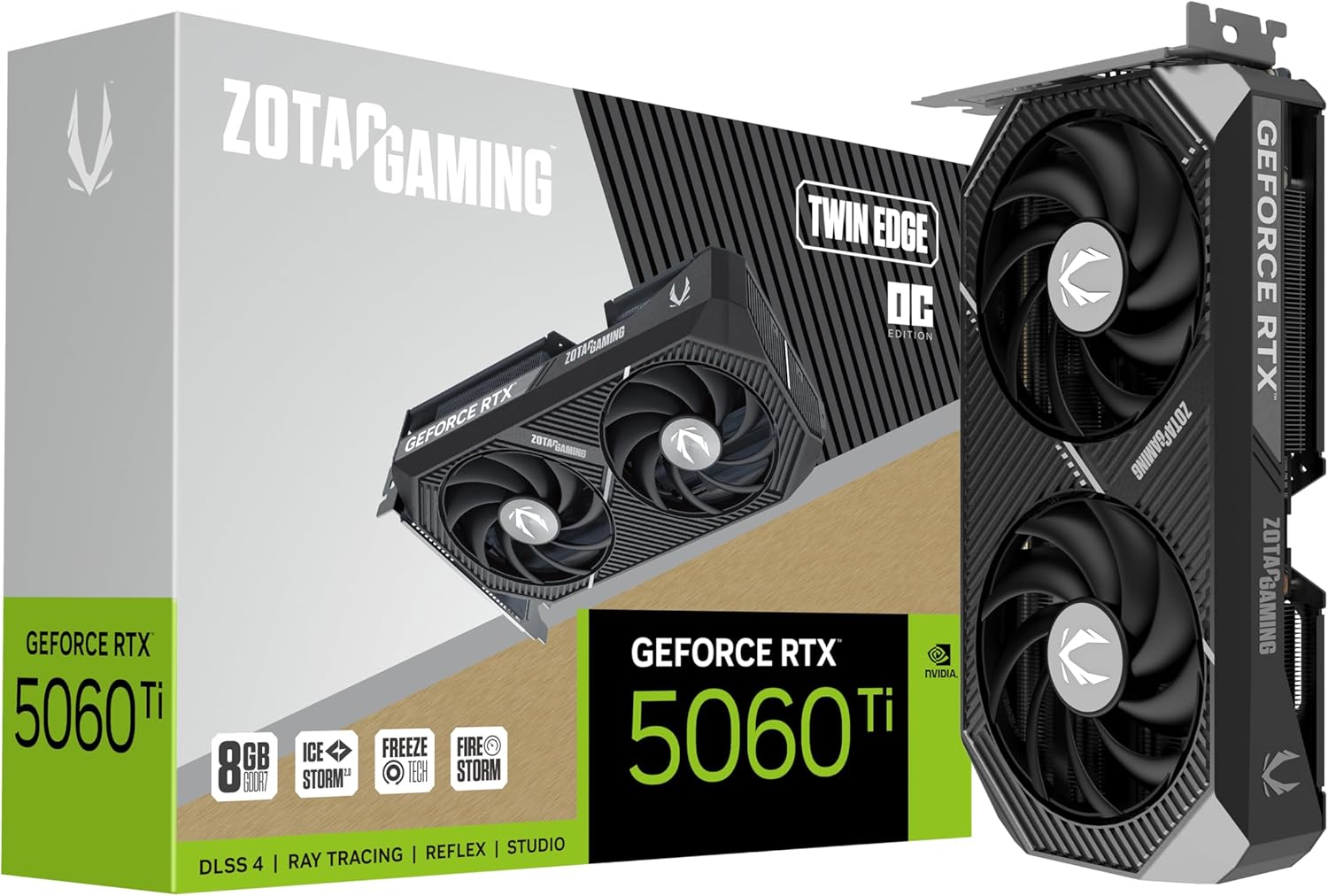
ZOTAC Gaming GeForce RTX 5060 Ti 8GB Twin Edge OC DLSS 4 8GB GDDR7 128-bit 28 Gbps PCIE 5.0 Gaming Graphics Card, IceStorm 2.0 Cooling, SFF-Ready, ZT-B50610H-10A
$300-$599This is a compact, 2-slot RTX 5060 Ti with 8GB GDDR7 and a 2602 MHz clock, built for SFF gaming rigs.