
GIGABYTE Radeon RX 9070 XT Gaming OC 16G Graphics Card, PCIe 5.0, 16GB GDDR6, GV-R9070XTGAMING OC-16GD Video Card
Want the best price and purchase timing?
Our AI advisor analyzes real-time pricing across all channels to find you the best deal.
AI Verdict
This is a 16GB GDDR6 Radeon RX 9070 XT GPU with a 3060 MHz clock, built for high-refresh 1440p gaming and capable 4K experiences.
This GIGABYTE Radeon RX 9070 XT is a strong performer for 1440p and 4K gaming, backed by its 16GB GDDR6 VRAM and 3060 MHz clock speed. However, it requires some user intervention for optimal thermal and acoustic performance due to reported high VRAM temperatures and aggressive stock fan curves. Its power draw is also higher than some competitors.
If you need a more power-efficient GPU with potentially better out-of-the-box driver stability, look for cards with a lower power rating and a proven track record for consistent software updates.
Regret Score™
Medium RiskLower is better — measures purchase-regret risk from real buyer complaints, review credibility, and product maturity
Issues discovered after purchase
Critically weak dimension
Amazon rating vs actual quality
Chance this product isn't for you
Pros
- Delivers 4K gaming at 50-60 FPS with max settings in many titles.
- Features 16GB of GDDR6 VRAM, providing ample memory for demanding games and applications.
- Equipped with a WINDFORCE Cooling System and Server-grade Thermal Conductive Gel, keeping the GPU at 57°C during long tests with tweaked fan curves.
- Ray tracing performance shows significant improvement over previous AMD generations, matching or exceeding the GeForce RTX 5070 in some 1440p scenarios.
- FSR 4 technology provides cleaner visuals and exceptional performance compared to FSR 3.
- Offers substantial overclocking headroom, allowing clock speeds into the mid-3000 MHz range.
Cons
- Users report VRAM temperatures reaching 92°C on stock settings.
- Out-of-the-box fan curves can be aggressive, with some users experiencing 100% fan speed at 50°C, leading to noticeable noise levels of around 48 dBA at 78% fan speed.
- Consumes more power than comparable Nvidia RTX 50 series cards, sometimes over 100W more.
- Some users have experienced driver stability issues, including black screens and crashes, with 'AMD software has detected a driver timeout' errors.
- Occasional coil whine has been reported by a few customers.
Dimension Scores
The card consistently delivers over 100 FPS at 1440p ultra settings and 50-60 FPS at 4K max settings, outperforming or matching several high-end competitors.
While the WINDFORCE cooling system can keep the GPU at 57°C with tweaked fan curves, stock VRAM temperatures can reach 92°C, and the default fan curve is often loud, requiring user adjustment.
The XT model has a power rating of 304W and can draw around 305W, which is noted as being sometimes over 100W more than comparable Nvidia RTX 50 series cards.
With 16GB of GDDR6 VRAM, this card offers excellent memory capacity, future-proofing it for demanding titles and high-resolution textures.
Best For
- High-refresh 1440p gaming on ultra settings, consistently achieving over 100 FPS.
- 4K gaming at 50-60 FPS with max settings, especially with FSR 4 enabled.
- Users willing to fine-tune fan curves and potentially undervolt for optimal thermal and acoustic performance.
- Workloads requiring 16GB of VRAM, such as 4K video editing.
Not Recommended For
- Users who prioritize absolute power efficiency without tweaking settings.
- Those sensitive to potential coil whine or who prefer silent operation out-of-the-box.
- Users expecting plug-and-play driver stability without any potential troubleshooting.
Watch Out For
- VRAM can run hot, reaching 92°C on stock settings, which might require manual adjustments like undervolting to maintain lower temperatures.
- The default fan curve can be overly aggressive, causing fans to spin at 100% at 50°C, resulting in a loud 'jet taking off' sound if not manually adjusted.
- Some users have encountered persistent driver timeouts, leading to black screens and game crashes, despite driver updates and registry fixes.
- The card requires three 8-pin power connectors, which might necessitate a PSU upgrade for systems with fewer available connectors.
Full Specifications
| ASIN | B0DS2QG2KW |
| Brand | GIGABYTE |
| Color | Black |
| Series | GV-R9070XTGAMING OC-16GD |
| Item Weight | 3.91 pounds |
| Manufacturer | GIGABYTE |
| Memory Speed | 2600 GHz |
| Chipset Brand | GIGABYTE |
| GPU Clock Speed | 3060 MHz |
| Card Description | Dedicated |
| Graphics Ram Size | 16 GB |
| Item model number | GV-R9070XTGAMING OC-16GD |
| Product Dimensions | 11.34 x 5.2 x 2.2 inches |
| Graphics Coprocessor | AMD Radeon RX 9070 XT |
| Max Screen Resolution | 7680x4320 Pixels |
| Graphics Card Ram Size | 16 GB |
| Item Dimensions LxWxH | 11.34 x 5.2 x 2.2 inches |
| Video Output Interface | DisplayPort |
What Buyers Say
What really stands out is how much this card punches above its weight in gaming, especially at 1440p and even 4K, often getting close to or surpassing more expensive Nvidia cards like the RTX 5070 Ti. People are pretty stoked about the FSR 4 tech, saying it cleans up visuals way better than FSR 3 and gives a big performance boost. The cooling system, with its fancy thermal gel, seems to keep the GPU core temps low, around 57°C, once you mess with the fan settings. But yeah, you'll probably need to mess with those fan settings because the out-of-the-box curve can be a bit much, and some folks are seeing VRAM temps hit 92°C if they don't undervolt. Driver stability has been a mixed bag for some, with black screens and timeouts popping up.
“Dude, this card absolutely rips at 1440p, everything on ultra, no sweat. But seriously, the fans out of the box sound like a jet taking off, and I had to spend an hour tweaking the curve and undervolting it to stop the VRAM from cooking. Still, for the frames, I guess it's worth the hassle.”
Common Praise
- Achieves over 100 FPS at 1440p on ultra settings in all tested games.
- Provides 50-60 FPS at 4K with max settings, especially with FSR 4 enabled.
- Ray tracing performance is a significant improvement over previous AMD generations.
- FSR 4 technology offers significantly cleaner visuals and exceptional performance compared to FSR 3.
- The cooling system effectively keeps GPU core temperatures low, around 57°C, after fan curve adjustments.
- Offers substantial overclocking potential, with users pushing clock speeds into the mid-3000 MHz range.
Common Complaints
- VRAM temperatures can reach 92°C on stock settings, requiring undervolting or fan curve adjustments.
- The default fan curve is often too aggressive, leading to loud fan noise at 100% speed if not manually configured.
- Some users experience driver timeouts, causing black screens and game crashes.
- Reports of coil whine from a minority of users.
- Higher power consumption compared to Nvidia's RTX 50 series cards.
Ownership Tips
- You'll likely need to spend some time in AMD Adrenalin software to fine-tune the fan curve and potentially undervolt the card to manage VRAM temperatures and noise levels.
- The card's physical size and the requirement for three 8-pin power connectors mean you need to ensure your case has adequate space and your power supply can handle the draw.
- Driver updates from AMD can significantly impact stability; keeping them current is important, especially if you encounter initial issues.
- The RGB lighting is customizable, but it's not a primary feature for performance, more for aesthetics.
- The Dual BIOS feature (Performance/Silent) can be useful for quickly switching between profiles if you don't want to manually adjust settings.
Frequently Asked Questions
What kind of gaming performance can I expect at 1440p?
You can expect to run all games at ultra settings at 1440p with frame rates exceeding 100 FPS. The card is considered a great 1440p GPU.
Is this card suitable for 4K gaming?
Yes, it's a capable 4K performer, delivering 50-60 FPS in 4K with max settings in many titles. Enabling FSR 4 can further boost performance at this resolution.
Does this graphics card have RGB lighting?
Yes, the GIGABYTE Radeon RX 9070 XT Gaming OC 16G features RGB Lighting as one of its highlights.
How many power connectors does this card need?
The card requires three 8-pin power connectors.
What is the VRAM capacity of this card?
It comes with 16GB of GDDR6 VRAM, which is sufficient for current and upcoming demanding games and applications.
Are there any known issues with fan noise?
Some users have reported that the stock fan curve can be very aggressive, leading to high fan speeds and noticeable noise. However, this can often be mitigated by adjusting the fan curve manually.
Buying Guide
When you're looking at a graphics card like this, you're essentially buying the engine for your gaming PC. The 'chipset' (AMD Radeon RX 9070 XT here) is the core processing unit, dictating raw power. 'VRAM' (16GB GDDR6) is like the card's own memory; more of it means it can handle higher resolutions and more detailed textures without stuttering. 'Clock speed' is how fast that engine runs. Don't just look at the raw numbers; think about what resolution you play at and what games you want to run.
chipset: AMD Radeon RX 9070 XT
This is the brain of your graphics card. A more powerful chipset means it can process more complex graphics faster, leading to higher frame rates and smoother gameplay in demanding titles.
vram: 16 GB GDDR6
Think of VRAM as the canvas size for your games. 16GB is a large canvas, allowing the card to load high-resolution textures and complex game worlds without running out of memory, which is crucial for 1440p and 4K gaming.
clock_speed: 3060 MHz
This is how many cycles per second the GPU's core can perform. A higher clock speed generally translates to more calculations per second, directly impacting your frame rates in games. It's like the RPMs of an engine.
output: DisplayPort
This is how the card connects to your monitor. DisplayPort is the standard for high-refresh-rate and high-resolution gaming, supporting features like Adaptive Sync for tear-free visuals.
Alternatives
If this card doesn't quite fit, look for GPUs with similar VRAM (16GB+) but potentially lower power draw for efficiency, or a different chipset if you prioritize specific features like ray tracing performance or driver stability out-of-the-box.
You Might Also Like

HP NVIDIA GeForce RTX 3070 8GB OEM Graphics Card (Renewed)
$150-$299This is a renewed HP OEM NVIDIA GeForce RTX 3070 with 8GB VRAM, a gamble for budget-conscious 1440p gamers who understand the risks of refurbished hardware.

ZOTAC Gaming GeForce RTX 5070 Twin Edge OC DLSS 4 12GB GDDR7 192-bit 28 Gbps PCIE 5.0 Gaming Graphics Card, IceStorm 2.0 Cooling, SFF-Ready, ZT-B50700H-10A
$600+This is a 2-slot, SFF-ready NVIDIA RTX 5070 with 12GB GDDR7 and a 2542 MHz boost clock, built for compact gaming rigs needing high 1440p performance.

ZOTAC Gaming GeForce RTX 5080 Solid CORE OC DLSS 4 16GB GDDR7 256-bit 30 Gbps PCIE 5.0 Gaming Graphics Card, IceStorm 3.0 Advanced Cooling, Spectra RGB Lighting, ZT-B50800J2-10A
$600+This ZOTAC RTX 5080 with 16GB GDDR7 and a 2640 GHz clock speed is built for high-end 4K gaming and content creation on the NVIDIA Blackwell architecture.
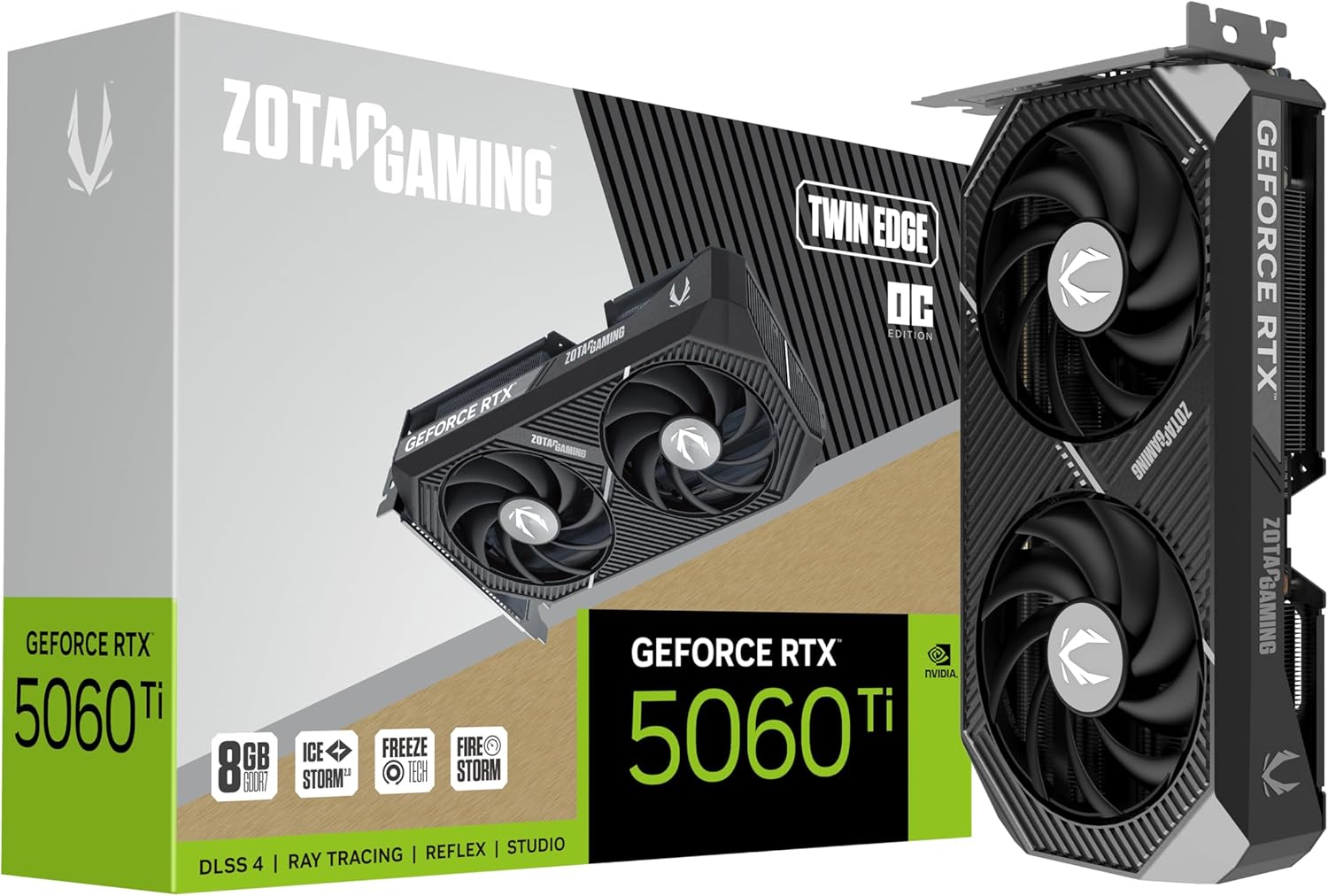
ZOTAC Gaming GeForce RTX 5060 Ti 8GB Twin Edge OC DLSS 4 8GB GDDR7 128-bit 28 Gbps PCIE 5.0 Gaming Graphics Card, IceStorm 2.0 Cooling, SFF-Ready, ZT-B50610H-10A
$300-$599This is a compact, 2-slot RTX 5060 Ti with 8GB GDDR7 and a 2602 MHz clock, built for SFF gaming rigs.