
Sapphire Pulse AMD Radeon™ RX 9070 XT Gaming 16GB Dual HDMI/Dual DP
Want the best price and purchase timing?
Our AI advisor analyzes real-time pricing across all channels to find you the best deal.
AI Verdict
This is a 16GB GDDR6 Navi 48 GPU with 64 Compute Units, optimized for 1440p gaming and capable of 4K with FSR 4.
This GPU is a strong fit for gamers targeting high-refresh-rate 1440p or entry-level 4K gaming, especially with its 16GB GDDR6 VRAM and RDNA 4 architecture. Its improved ray tracing capabilities and FSR 4 support make it relevant for modern titles. The effective cooling system also contributes to a quiet gaming experience.
If you need more raw performance for uncompromised 4K gaming without upscaling, look for GPUs with higher compute unit counts and faster memory bandwidth, potentially with GDDR7.
Regret Score™
Very Low RiskLower is better — measures purchase-regret risk from real buyer complaints, review credibility, and product maturity
Issues discovered after purchase
Critically weak dimension
Amazon rating vs actual quality
Chance this product isn't for you
Pros
- Features 16 GB of GDDR6 on a 256-bit Memory Bus, providing ample VRAM for high-resolution textures.
- Includes AMD FidelityFX Super Resolution 4 with AI Upscaling for enhanced performance in supported titles.
- Equipped with a triple-slot cooling solution featuring three AeroCurve axial airflow fans, five 6mm heat pipes, and a copper baseplate for effective heat dissipation.
- Users report quiet operation, with some experiencing temperatures around 55-60°C during gaming.
- Offers improved ray tracing performance compared to previous AMD GPU generations.
- Supports PCI-Express 5.0, providing high bandwidth for future compatibility.
Cons
- Some users have reported coil whine, which can be noticeable in quiet environments.
- Mediocre AI performance compared to some competing GPUs.
- Uses GDDR6 memory, while some newer competitor cards have moved to GDDR7, potentially limiting future memory bandwidth.
- Often sold above its $600 MSRP due to stock limitations and scalping.
Dimension Scores
The RX 9070 XT offers strong performance for 1440p gaming with ray tracing and is capable of 4K with FSR 4, often outperforming the RTX 5070.
Users report very low temperatures, around 55-60°C during gaming, and extremely quiet operation at 25.5 dBA, making it one of the quietest RX 9070 XT models tested.
The RX 9070 XT is more energy-efficient than some competitors like the RTX 5070 in gaming, though it can be more power-hungry in content creation tasks.
With 16 GB of GDDR6 VRAM on a 256-bit bus, this card provides ample memory for high-resolution textures and demanding modern games.
Best For
- 1440p gaming at high settings with ray tracing enabled.
- Light 4K gaming with FSR 4 or reduced settings.
- Users prioritizing quiet operation and effective cooling in their GPU.
- Building a system with PCI-Express 5.0 compatibility for future upgrades.
Not Recommended For
- Users requiring top-tier AI acceleration performance for professional workloads.
- Budget-conscious buyers who cannot find the card at its $600 MSRP.
Watch Out For
- Coil whine is a reported issue for some users, potentially audible even with open-back headphones.
- The card is frequently out of stock and sold by scalpers for prices up to $900, significantly above its $600 MSRP.
- While the cooling is effective, the triple-slot design might be a tight fit in smaller PC cases.
Full Specifications
| ASIN | B0DRPRZMK2 |
| Brand | Sapphire |
| Series | PULSE |
| Item Weight | 3.3 pounds |
| Manufacturer | Sapphire |
| Memory Speed | 2500 MHz |
| Chipset Brand | AMD |
| Card Description | Dedicated |
| Graphics Ram Size | 16 GB |
| Item model number | 11348-03-20G |
| Product Dimensions | 11.81 x 11.81 x 0.04 inches |
| Graphics Coprocessor | AMD Radeon VII |
| Max Screen Resolution | 3840x2160 |
| Graphics Card Ram Size | 16 GB |
| Item Dimensions LxWxH | 11.81 x 11.81 x 0.04 inches |
| Video Output Interface | DisplayPort, HDMI |
| Graphics Processor Manufacturer | AMD |
What Buyers Say
What's really standing out is how quiet this card runs, even under load; people are consistently reporting low fan noise and temperatures around 55-60°C during gaming. The improved ray tracing performance over older AMD cards is a big win, making modern titles feel much better. However, the card's availability is a real problem, with many users unable to find it at its $600 MSRP and resorting to scalped prices up to $900. Some folks are also hitting coil whine, which can be annoying if you're sensitive to that kind of noise.
“Man, this 9070 XT Pulse is a beast for 1440p, runs super quiet and cool, but finding one at the actual price is a nightmare, scalpers are everywhere and the coil whine is kinda annoying sometimes.”
Common Praise
- Runs very quietly, with some users reporting virtually inaudible operation at full load.
- Maintains low temperatures, often around 55-60°C during gaming sessions.
- Provides strong performance for 1440p gaming, even with ray tracing enabled.
- The dual-fan Pulse design is appreciated for its compact size and effective cooling.
- Offers 16 GB of GDDR6 VRAM, which is plenty for current and upcoming games.
Common Complaints
- Some users experience noticeable coil whine, which can be distracting.
- The card is frequently out of stock and sold at inflated prices above MSRP.
- AI performance is not as competitive as some other GPUs on the market.
- The triple-slot cooler design can be bulky for smaller PC cases.
Ownership Tips
- Undervolting the card can help reduce potential coil whine and further improve power efficiency.
- The fans are designed to be easily removable for cleaning, which is a huge plus for long-term maintenance.
- Despite being a dual-fan design, the cooling solution is quite robust and keeps temperatures in check.
- You'll want to check your case dimensions carefully, as the triple-slot cooler can be a tight fit.
Frequently Asked Questions
Does this card have noticeable coil whine?
User experiences vary; some report no coil whine, while others find it audible. It might be influenced by your power supply or can be reduced by undervolting the card.
What kind of gaming performance can I expect at 1440p?
The RX 9070 XT is designed to max out games at 1440p, even with ray tracing enabled, offering strong performance in many titles.
Is this GPU suitable for 4K gaming?
Yes, it can handle 4K Ultra HD gameplay at fairly high settings, especially with ray tracing enabled and utilizing FSR 4 for performance enhancement.
How are the temperatures and noise levels?
The Sapphire Pulse RX 9070 XT is reported to run very cool and quiet. Users have noted temperatures around 55-60°C during gaming, and noise levels as low as 25.5 dBA, making it virtually inaudible at full load in a quiet room.
Does this card support the latest PCI-Express standard?
Yes, it supports PCI-Express 5.0, offering high bandwidth for current and future system configurations.
Buying Guide
When you're looking at a GPU like this, you're essentially buying the engine for your gaming PC. The 'chipset' (Navi 48) tells you which generation and performance tier it belongs to, while 'VRAM' (16GB GDDR6) is like the card's own memory, crucial for handling high-resolution textures and complex scenes. 'Memory speed' (20 Gbps GDDR6) dictates how fast that VRAM can be accessed, impacting overall performance. Finally, the 'output' ports (HDMI, DisplayPort) determine what monitors you can connect and at what resolutions and refresh rates.
Chipset (Navi 48, RDNA 4)
This is the core processor of the graphics card, like the CPU for your whole computer. RDNA 4 is AMD's latest architecture, meaning it has the newest features and performance improvements, especially for things like ray tracing and upscaling technologies.
VRAM (16 GB GDDR6)
Think of VRAM as the GPU's short-term memory. More VRAM means the card can store more game assets, like high-resolution textures, directly on the card. This is critical for smooth performance at higher resolutions (like 1440p and 4K) and with demanding game settings.
Memory Speed (20 Gbps GDDR6)
This is how fast the VRAM can transfer data. A higher memory speed allows the GPU to access textures and game data more quickly, which directly translates to better frame rates and smoother gameplay, especially in fast-paced or graphically intensive games.
Output (Dual HDMI / Dual DisplayPort)
These are the physical ports you'll use to connect your monitor(s). Having multiple HDMI and DisplayPort options gives you flexibility for connecting different displays, including high-refresh-rate gaming monitors or multiple monitors for a wider field of view.
Alternatives
If this card doesn't quite fit your needs, consider looking for GPUs with higher effective memory bandwidth if you're pushing extreme 4K resolutions, or cards with dedicated AI accelerators if your primary use case involves heavy AI workloads.
You Might Also Like

HP NVIDIA GeForce RTX 3070 8GB OEM Graphics Card (Renewed)
$150-$299This is a renewed HP OEM NVIDIA GeForce RTX 3070 with 8GB VRAM, a gamble for budget-conscious 1440p gamers who understand the risks of refurbished hardware.

ZOTAC Gaming GeForce RTX 5070 Twin Edge OC DLSS 4 12GB GDDR7 192-bit 28 Gbps PCIE 5.0 Gaming Graphics Card, IceStorm 2.0 Cooling, SFF-Ready, ZT-B50700H-10A
$600+This is a 2-slot, SFF-ready NVIDIA RTX 5070 with 12GB GDDR7 and a 2542 MHz boost clock, built for compact gaming rigs needing high 1440p performance.

ZOTAC Gaming GeForce RTX 5080 Solid CORE OC DLSS 4 16GB GDDR7 256-bit 30 Gbps PCIE 5.0 Gaming Graphics Card, IceStorm 3.0 Advanced Cooling, Spectra RGB Lighting, ZT-B50800J2-10A
$600+This ZOTAC RTX 5080 with 16GB GDDR7 and a 2640 GHz clock speed is built for high-end 4K gaming and content creation on the NVIDIA Blackwell architecture.
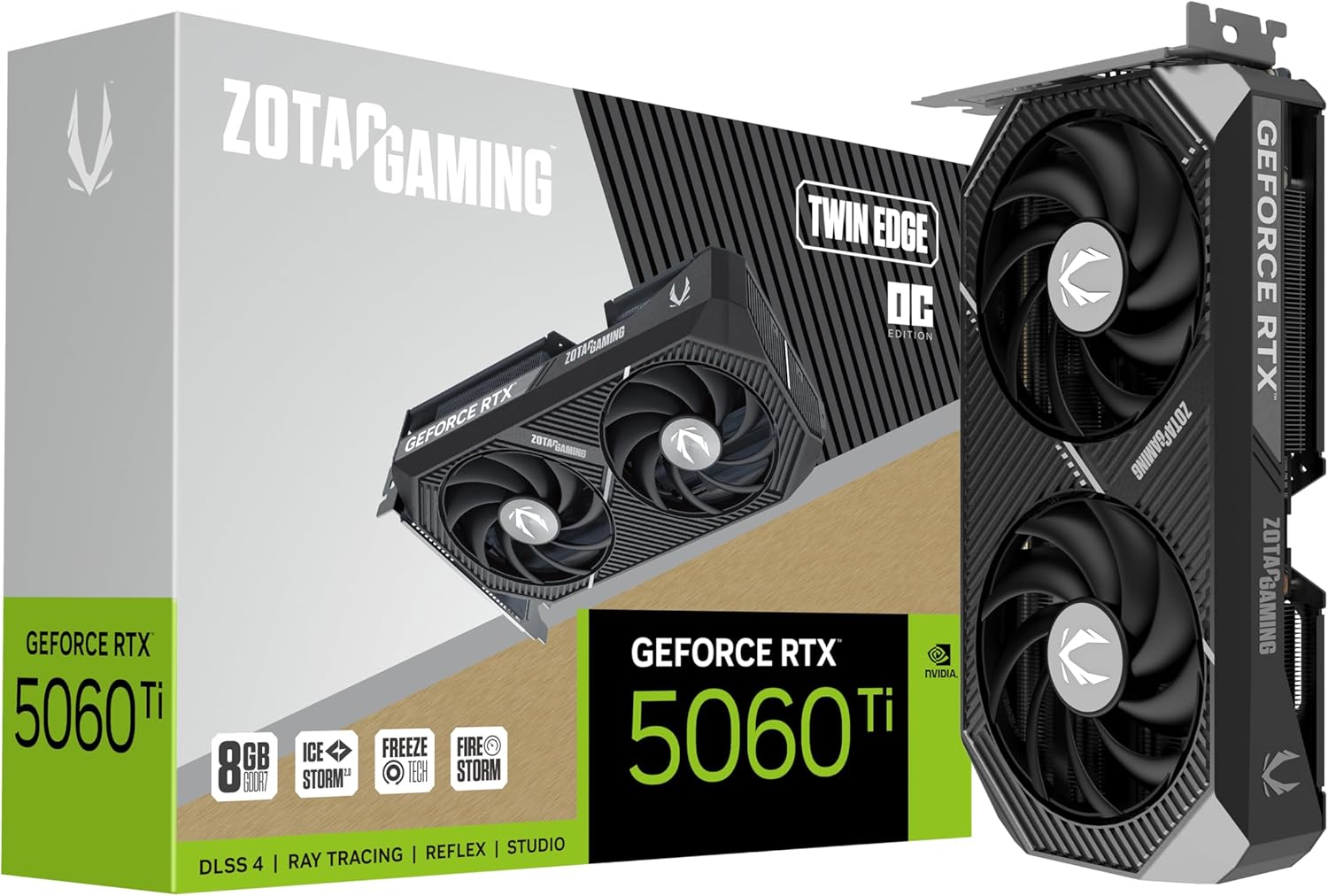
ZOTAC Gaming GeForce RTX 5060 Ti 8GB Twin Edge OC DLSS 4 8GB GDDR7 128-bit 28 Gbps PCIE 5.0 Gaming Graphics Card, IceStorm 2.0 Cooling, SFF-Ready, ZT-B50610H-10A
$300-$599This is a compact, 2-slot RTX 5060 Ti with 8GB GDDR7 and a 2602 MHz clock, built for SFF gaming rigs.