
ASUS TUF GeForce RTX™ 5080 16GB GDDR7 OC Edition Graphics Card, NVIDIA, Desktop (PCIe® 5.0, HDMI®/DP 2.1, 3.6-Slot, Military-Grade Components, Protective PCB Coating, Axial-tech Fans, Vapor Chamber)
Want the best price and purchase timing?
Our AI advisor analyzes real-time pricing across all channels to find you the best deal.
AI Verdict
This is a 16GB GDDR7 NVIDIA GeForce RTX 5080 with a 2640 MHz OC clock, built for demanding 4K gaming and heavy creative workloads.
This card is a strong fit for anyone building a high-end gaming or workstation PC focused on 4K performance and demanding applications. Its 16GB GDDR7 VRAM and 2640 MHz OC clock speed are designed for top-tier performance, and the robust cooling system handles heavy loads effectively.
If 16GB VRAM isn't enough for your specific creative tasks, consider a GPU with 24GB or more for future-proofing in extremely VRAM-intensive applications.
Regret Score™
Very Low RiskLower is better — measures purchase-regret risk from real buyer complaints, review credibility, and product maturity
Issues discovered after purchase
Critically weak dimension
Amazon rating vs actual quality
Chance this product isn't for you
Pros
- Delivers exceptional performance in 4K gaming, providing a significant upgrade over older cards.
- Cooling system keeps the GPU at a maximum of 65°C under stress, even with overclocking, and operates quietly.
- Features military-grade components and a protective PCB coating for enhanced durability and a longer lifespan.
- Equipped with three DisplayPort 2.1a and two HDMI 2.1b outputs, supporting up to four displays simultaneously.
- Offers substantial performance without excessive power consumption, drawing 360W Total Graphics Power.
- Generally runs without coil whine, contributing to a quieter system.
Cons
- The 3.6-slot design and dimensions of 348mm (L) x 146mm (W) x 72mm (H) make it too large for smaller PC cases.
- Requires a minimum 850W power supply, with 1000W recommended for overclocking with high-end CPUs.
- Some early reports indicate pricing can be significantly higher than the Founders Edition, up to 49% more.
Dimension Scores
The NVIDIA GeForce RTX 5080 with DLSS 4.0 and a 2640 MHz OC clock delivers exceptional 4K gaming performance.
The 3.6-slot design with Axial-tech fans and a phase-change thermal pad keeps the GPU at a maximum of 65°C under stress and operates quietly.
With a Total Graphics Power of 360W, it offers substantial performance without being excessively power-hungry for its class.
16GB of GDDR7 VRAM is ample for most current 4K gaming and many professional creative applications.
Best For
- Gamers targeting high refresh rate 4K resolution with ray tracing and DLSS 4.0.
- Content creators needing accelerated performance for video editing, 3D rendering, and AI-assisted workflows.
- Users upgrading from previous generation GPUs seeking a substantial performance leap.
Not Recommended For
- Compact PC builds due to its 3.6-slot, 348mm length.
- Budget-conscious users, given its premium price band and potential for higher retail markups.
Watch Out For
- The card's 3.6-slot width and 348mm length mean it won't fit in many smaller cases, requiring careful measurement before purchase.
- While the card itself draws 360W, a recommended 850W PSU is needed, and 1000W is suggested if you're pushing a high-end CPU and overclocking.
- Some early pricing observations showed this OC Edition costing up to 49% more than the Founders Edition, which is a big jump for the performance gain.
Full Specifications
| ASIN | B0DQSMMCSH |
| Brand | ASUS |
| Color | BLACK |
| Series | TUF-RTX5080-O16G-GAMING |
| Item Weight | 5 pounds |
| Manufacturer | ASUS |
| Memory Speed | 2730 MHz |
| Chipset Brand | NVIDA |
| GPU Clock Speed | 2730 MHz |
| Card Description | NVIDIA GeForce RTX™ 5080 |
| Graphics Ram Size | 16 GB |
| Item model number | TUF-RTX5080-O16G-GAMING |
| Product Dimensions | 13.7 x 5.7 x 2.8 inches |
| Graphics Coprocessor | NVIDIA GeForce RTX 5080 |
| Max Screen Resolution | 7680x4320 Pixels |
| Graphics Card Ram Size | 16 GB |
| Item Dimensions LxWxH | 13.7 x 5.7 x 2.8 inches |
| Video Output Interface | Native DisplayPort 2.1a x3, Native HDMI 2.1b x 2 |
What Buyers Say
Early feedback highlights this card's ability to maintain low temperatures, hitting only 65°C under maximum stress even when overclocked, which is pretty wild. Users are consistently pointing out its exceptional performance for 4K gaming, calling it a significant upgrade. The build quality gets a lot of shout-outs for feeling sturdy and durable, which makes sense with the military-grade components. It generally runs without coil whine, which is a relief for anyone sensitive to noise. The main catch seems to be its sheer size, which demands a roomy case.
“Dude, this 5080 is a beast, my 4K frames are insane and it barely breaks a sweat, but seriously, measure your case first, this thing is HUGE.”
Common Praise
- Delivers exceptional performance in 4K gaming.
- Cooling efficiency is remarkable, keeping the card cool even under load.
- Build quality is sturdy and appreciated by users.
- Operates quietly, enhancing the gaming experience.
- DLSS 4.0 performance is excellent, enhancing gaming visuals.
- Generally runs without coil whine.
Common Complaints
- The large size and weight can be an issue for smaller PC cases.
- Requires a powerful PSU, with 850W recommended and 1000W for overclocking.
- Some retailers are listing it at a much higher price than the Founders Edition.
Ownership Tips
- The card's 3.6-slot design means it will likely block adjacent PCIe slots on your motherboard.
- The 'minimal yet effective RGB lighting' is subtle, not over-the-top, if you're into that.
- The dual BIOS switch lets you toggle between a performance mode and a quieter mode, which is handy for different use cases.
- The included GPU Tweak III software allows for further overclocking and monitoring, giving you more control over performance.
- The card comes with a TUF Graphics Card Holder, which is actually useful given its weight and size to prevent sag.
Frequently Asked Questions
What kind of power supply do I need for this graphics card?
ASUS recommends an 850W power supply for this card. If you plan on overclocking or have a high-end CPU, a 1000W unit might be a better choice.
Will this card fit in my PC case?
This card has a 3.6-slot design and measures 348mm in length, 146mm in width, and 72mm in thickness. You should measure your case carefully to ensure it has enough clearance.
Does this graphics card support multiple monitors?
Yes, it supports up to four displays simultaneously, with three Native DisplayPort 2.1a and two Native HDMI 2.1b outputs.
How well does it cool under heavy use?
Feedback indicates the cooling is very effective, keeping the card at around 65°C even under maximum stress conditions with overclocking.
Does this card have RGB lighting?
Yes, it features minimal yet effective ARGB lighting.
Buying Guide
When you're looking at a high-end GPU like this, you need to think about more than just raw speed. You're investing in the whole ecosystem: how well it cools, how much power it needs, and if it'll actually fit in your rig. Don't just chase the highest clock speed; consider the thermal design and your case's airflow. This isn't a 'plug and play' for every system.
VRAM (Video Random Access Memory)
Think of VRAM as the GPU's short-term memory. More VRAM, like the 16GB here, means the card can handle larger textures, more complex scenes, and higher resolutions (like 4K) without stuttering, similar to how more RAM helps your computer multitask efficiently.
Clock Speed (MHz)
This is how fast the GPU's core processing unit operates. A higher clock speed, like the 2640 MHz OC mode, generally means more calculations per second, leading to higher frame rates in games and faster processing in creative applications. It's like the engine's RPMs in a car.
Slot Design (e.g., 3.6-slot)
This refers to how many PCIe slots the card physically occupies in your motherboard. A 3.6-slot card is chunky and takes up a lot of space, so you need to make sure your case has enough room and that it won't block other essential components or airflow. It's like trying to fit a big SUV into a compact parking spot.
Alternatives
If this card's size is a dealbreaker, look for GPUs with a 2-slot or 2.5-slot design. If you need more VRAM for specific professional tasks, search for cards offering 24GB or 32GB of GDDR7 memory.
You Might Also Like

HP NVIDIA GeForce RTX 3070 8GB OEM Graphics Card (Renewed)
$150-$299This is a renewed HP OEM NVIDIA GeForce RTX 3070 with 8GB VRAM, a gamble for budget-conscious 1440p gamers who understand the risks of refurbished hardware.

ZOTAC Gaming GeForce RTX 5070 Twin Edge OC DLSS 4 12GB GDDR7 192-bit 28 Gbps PCIE 5.0 Gaming Graphics Card, IceStorm 2.0 Cooling, SFF-Ready, ZT-B50700H-10A
$600+This is a 2-slot, SFF-ready NVIDIA RTX 5070 with 12GB GDDR7 and a 2542 MHz boost clock, built for compact gaming rigs needing high 1440p performance.

ZOTAC Gaming GeForce RTX 5080 Solid CORE OC DLSS 4 16GB GDDR7 256-bit 30 Gbps PCIE 5.0 Gaming Graphics Card, IceStorm 3.0 Advanced Cooling, Spectra RGB Lighting, ZT-B50800J2-10A
$600+This ZOTAC RTX 5080 with 16GB GDDR7 and a 2640 GHz clock speed is built for high-end 4K gaming and content creation on the NVIDIA Blackwell architecture.
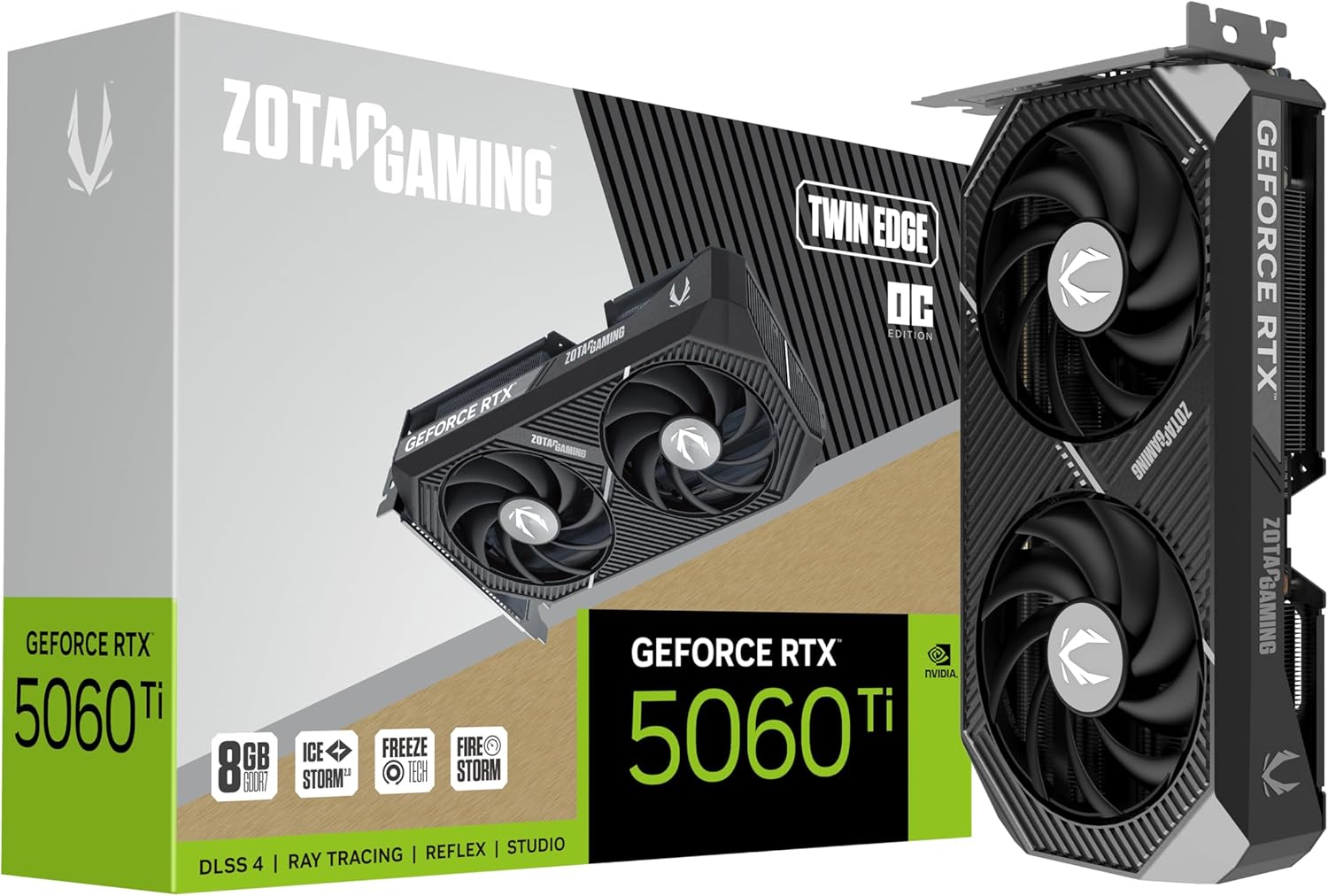
ZOTAC Gaming GeForce RTX 5060 Ti 8GB Twin Edge OC DLSS 4 8GB GDDR7 128-bit 28 Gbps PCIE 5.0 Gaming Graphics Card, IceStorm 2.0 Cooling, SFF-Ready, ZT-B50610H-10A
$300-$599This is a compact, 2-slot RTX 5060 Ti with 8GB GDDR7 and a 2602 MHz clock, built for SFF gaming rigs.