
ASUS ROG Astral GeForce RTX™ 5080 OC Edition Graphics Card, NVIDIA (PCIe® 5.0, 16GB GDDR7, HDMI®/DP 2.1, 3.8-Slot, 4-Fan Design, Axial-tech Fans, Patented Vapor Chamber, Phase-Change GPU Thermal Pad)
Want the best price and purchase timing?
Our AI advisor analyzes real-time pricing across all channels to find you the best deal.
AI Verdict
This is a 3.8-slot, quad-fan NVIDIA RTX 5080 with 16GB GDDR7, designed for extreme 4K gaming and AI tasks, pushing 2790 MHz clock speeds.
This card is a strong fit for users demanding top-tier 4K gaming and AI performance, backed by its 16GB GDDR7 VRAM and high clock speeds. Its advanced cooling system with a quad-fan design and vapor chamber aims to keep temperatures low even under heavy loads, which is crucial for sustained performance.
If this card's performance isn't enough, look for a GPU with a higher tier chipset like the RTX 5090 for a more substantial performance jump, though expect an even higher price and potentially larger physical dimensions.
Regret Score™
Low RiskLower is better — measures purchase-regret risk from real buyer complaints, review credibility, and product maturity
Issues discovered after purchase
Critically weak dimension
Amazon rating vs actual quality
Chance this product isn't for you
Pros
- Features a quad-fan design and patented vapor chamber, boosting airflow by up to 20% for lower GPU temperatures.
- Equipped with 16GB GDDR7 VRAM, delivering high bandwidth for 4K and 8K textures.
- Achieves a 6% performance uplift over baseline RTX 5080 due to factory overclock and increased power limit.
- Includes Native DisplayPort 2.1a x3 and Native HDMI 2.1b x2 outputs, supporting high-resolution, high-refresh rate displays.
- Built with a full metal diecast shroud, frame backplate, and protective PCB coating for structural rigidity and durability.
- Maintains low temperatures, averaging 56°C under load, with fans often described as quiet or barely audible by users.
Cons
- Its 3.8-slot design, measuring 350mm long and over 2.5kg, makes it physically large and heavy, potentially causing fitment issues in smaller cases.
- Professional reviews indicate it's not the quietest card, with the extra fan potentially increasing noise output compared to some competitors.
- Priced significantly higher than NVIDIA's MSRP, with one review noting a $500 or 50% increase.
- Performance uplift over the previous generation RTX 4080 Super is 16% at 4K rasterization, which some found less than expected.
- Requires a 12VHPWR connector, which might necessitate a PSU upgrade for older systems.
Dimension Scores
The card delivers 16% more performance than the RTX 4080 Super at 4K rasterization and runs 1440p 120 fps with max ray tracing in demanding titles.
Its quad-fan, 3.8-slot design with a vapor chamber keeps GPU temperatures around 56-60°C under load, but some professional reviews indicate it's not the quietest card compared to competitors.
It draws 14.9% more power than the NVIDIA RTX 5080 FE, indicating higher power consumption, though it features powerful 50-amp MOSFETs for stability.
Equipped with 16GB of GDDR7 VRAM, it offers ample memory for high-resolution textures and demanding modern games, a significant upgrade from previous GDDR6 generations.
Best For
- Extreme 4K gaming at high refresh rates with ray tracing and DLSS 4.
- Users with large PC cases and robust power supplies capable of accommodating its size and power requirements.
- Content creators and professionals leveraging AI performance with 1801 AI TOPS and DLSS 4.
- Enthusiasts seeking a factory-overclocked RTX 5080 with advanced cooling for maximum performance.
Not Recommended For
- Compact PC builds or small form factor cases due to its 3.8-slot, 350mm length.
- Budget-conscious buyers, given its premium price point significantly above MSRP.
- Users sensitive to fan noise, as some professional tests indicate it can be louder than competing models.
Watch Out For
- The 3.8-slot design and 350mm length means it won't fit in many standard cases, so measure your chassis before buying.
- Expect to pay a significant 'Asus tax,' with one review noting a $500 premium over the NVIDIA MSRP.
- While some users report quiet operation, professional testing suggests it's not the quietest card, potentially being 'too damn loud' under load compared to some rivals.
- The 16% performance gain over the RTX 4080 Super at 4K rasterization might not justify the upgrade for some users expecting larger generational leaps.
Full Specifications
| ASIN | B0DQSD7YQC |
| Brand | ASUS |
| Color | BLACK |
| Series | ROG-ASTRAL-RTX5080-O16G-GAMING |
| Item Weight | 5 pounds |
| Manufacturer | ASUS |
| Memory Speed | 2790 MHz |
| Chipset Brand | NVIDA |
| GPU Clock Speed | 2790 MHz |
| Card Description | NVIDIA GeForce RTX 5080, 16GB GDDR7 |
| Graphics Ram Size | 16 GB |
| Item model number | ROG-ASTRAL-RTX5080-O16G-GAMING |
| Product Dimensions | 14.1 x 5.9 x 3 inches |
| Graphics Coprocessor | NVIDIA GeForce RTX 5080 |
| Max Screen Resolution | 7680x4320 Pixels |
| Graphics Card Ram Size | 16 GB |
| Item Dimensions LxWxH | 14.1 x 5.9 x 3 inches |
| Video Output Interface | Native DisplayPort 2.1a x3, Native HDMI 2.1b x 2 |
What Buyers Say
This card is a beast, literally. Users are consistently blown away by its ability to crush 4K gaming, even with ray tracing on, and many report surprisingly low temperatures and quiet operation despite its massive cooling setup. However, professional reviews sometimes contradict the noise claims, finding it louder than some rivals. The sheer size and weight are frequently mentioned, requiring careful case selection, and the price tag is definitely a talking point.
“Dude, this thing is a monster, literally! My old 4070 feels like a toy now. Cyberpunk at max settings, 1440p, 120fps, no sweat, and it's actually quiet, unlike some reviews said. But seriously, measure your case, this thing is HUGE. And yeah, my wallet cried a little, but totally worth it for this performance.”
Common Praise
- Games run extremely smooth at high and ultra settings with excellent frame rates in 1440p and 4K.
- Cooling system works effectively, keeping temperatures low (around 60°C max) even during long gaming sessions.
- Fans are often described as quiet or barely audible by users, sometimes quieter than case fans.
- Build quality feels premium and robust, with a full metal shroud and backplate.
- PCIe 5.0 support provides crazy-fast data throughput, improving load times and responsiveness.
- DLSS 4 and multi-frame generation are fantastic in games like Cyberpunk 2077 and Monster Hunter Wilds.
Common Complaints
- The card is 'stupid big' and 'massive,' making it difficult to fit into many PC cases.
- The price is significantly higher than the NVIDIA MSRP, leading to comments about an 'Asus tax'.
- Some professional tests indicate it's not the quietest card, with the quad-fan design potentially generating more noise than competitors.
- Performance uplift over the RTX 4080 Super was less than expected by some, at 16% for 4K rasterization.
- Requires a 12VHPWR connector, which might be an inconvenience for older power supplies.
Ownership Tips
- The card's physical size (3.8 slots, 350mm length) is a constant consideration for case compatibility and airflow around it.
- Despite its size and power, many users report surprisingly low operating temperatures and minimal fan noise during extended gaming sessions.
- The premium price point is a recurring theme, but owners generally feel the performance justifies the investment for high-end gaming.
- The 12VHPWR connector requires a compatible PSU or adapter, which is an important pre-purchase check.
- The aesthetic design, with its die-cast frame and metal bracket, contributes to a premium feel that users appreciate.
Frequently Asked Questions
What kind of power supply do I need for this graphics card?
You'll need a power supply with a 12VHPWR connector. ASUS also recommends pairing it with ROG Thor III or ROG Strix Platinum Series PSUs for enhanced voltage stability and power efficiency.
Will this card fit in my PC case?
This card features a 3.8-slot design and measures 350mm in length, so you'll need a spacious case. It's considered 'stupid big' by some users, so measure your case's available clearance carefully.
How does the cooling system perform?
It uses a quad-fan design, patented vapor chamber, and phase-change GPU thermal pad to boost airflow by up to 20% and keep GPU temperatures low. Users report temperatures around 60°C max at full load.
Is this graphics card good for 8K gaming?
With 16GB GDDR7 VRAM and its powerful NVIDIA Blackwell architecture, it's designed to handle 4K and even 8K textures, providing smooth gameplay at ultra-high resolutions. The maximum digital resolution supported is 7680 x 4320.
What kind of performance uplift can I expect over previous generations?
You can expect a 16% performance uplift over the RTX 4080 Super and an 82% increase over the RTX 3080 in 4K rasterization. However, it is 9% slower than the RTX 4090 and 48% slower than the RTX 5090.
Buying Guide
When you're looking at a high-end GPU like this, you're not just buying raw power; you're investing in an entire ecosystem. You need to consider your case size, your power supply's wattage and connectors, and your monitor's resolution and refresh rate to truly take advantage of what this card offers. Don't just look at benchmarks; think about how it integrates into your current or planned PC build.
16GB GDDR7 VRAM
This is the card's dedicated memory. 16GB of the new GDDR7 type means it can handle incredibly detailed textures and complex scenes in games, especially at 4K and 8K resolutions, without stuttering or slowdowns. Think of it like a massive, super-fast workspace for your GPU.
3.8-Slot, Quad-Fan Design
This describes the physical size and cooling system. '3.8-Slot' means it's thick, taking up almost four expansion slots in your PC. The 'Quad-Fan' design means it has four fans dedicated to cooling. This massive cooling solution is designed to keep the powerful GPU from overheating, allowing it to maintain high performance, but it also means the card is physically very large and heavy.
PCIe® 5.0
This is the interface that connects the graphics card to your motherboard. PCIe 5.0 is the latest standard, offering double the bandwidth of PCIe 4.0. While current games might not fully saturate this bandwidth, it ensures future-proofing and faster data transfer for other applications, like AI workloads.
Native DisplayPort 2.1a x3, Native HDMI 2.1b x2
These are the ports you'll use to connect your monitors. DisplayPort 2.1 and HDMI 2.1 are the latest standards, capable of supporting extremely high resolutions (like 4K at 240Hz or 8K at 120Hz) and refresh rates. Having multiple of each means you can connect several high-end monitors simultaneously.
Alternatives
If this card is too big or expensive, look for a 5080 model with a 3-slot or dual-fan cooler, or consider a previous generation high-end card for better value. If you need more raw power for professional tasks or extreme 8K gaming, search for the next tier GPU with more VRAM and a higher core count.
You Might Also Like

HP NVIDIA GeForce RTX 3070 8GB OEM Graphics Card (Renewed)
$150-$299This is a renewed HP OEM NVIDIA GeForce RTX 3070 with 8GB VRAM, a gamble for budget-conscious 1440p gamers who understand the risks of refurbished hardware.

ZOTAC Gaming GeForce RTX 5070 Twin Edge OC DLSS 4 12GB GDDR7 192-bit 28 Gbps PCIE 5.0 Gaming Graphics Card, IceStorm 2.0 Cooling, SFF-Ready, ZT-B50700H-10A
$600+This is a 2-slot, SFF-ready NVIDIA RTX 5070 with 12GB GDDR7 and a 2542 MHz boost clock, built for compact gaming rigs needing high 1440p performance.

ZOTAC Gaming GeForce RTX 5080 Solid CORE OC DLSS 4 16GB GDDR7 256-bit 30 Gbps PCIE 5.0 Gaming Graphics Card, IceStorm 3.0 Advanced Cooling, Spectra RGB Lighting, ZT-B50800J2-10A
$600+This ZOTAC RTX 5080 with 16GB GDDR7 and a 2640 GHz clock speed is built for high-end 4K gaming and content creation on the NVIDIA Blackwell architecture.
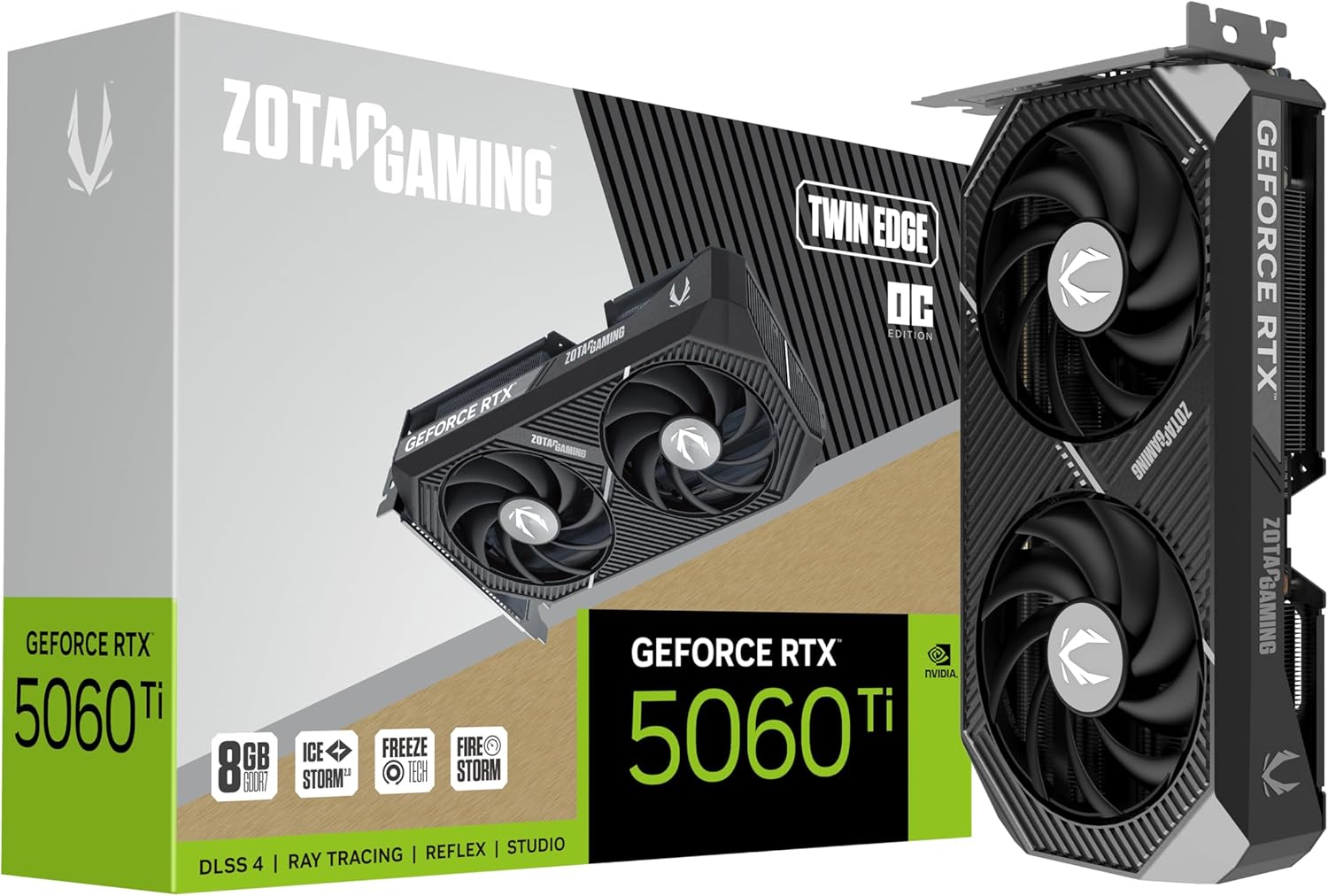
ZOTAC Gaming GeForce RTX 5060 Ti 8GB Twin Edge OC DLSS 4 8GB GDDR7 128-bit 28 Gbps PCIE 5.0 Gaming Graphics Card, IceStorm 2.0 Cooling, SFF-Ready, ZT-B50610H-10A
$300-$599This is a compact, 2-slot RTX 5060 Ti with 8GB GDDR7 and a 2602 MHz clock, built for SFF gaming rigs.