
msi RTX 3050 Gaming X 6G Graphics Card (NVIDIA, 96-Bit, Boost Clock: 1507 MHz, 6GB GDDR6 14 Gbps, HDMI/DP, Ampere Architecture), Desktop Compatible
Want the best price and purchase timing?
Our AI advisor analyzes real-time pricing across all channels to find you the best deal.
AI Verdict
This 6GB GDDR6, 96-bit RTX 3050 is for upgrading pre-built PCs with weak power supplies or for 1080p esports on a strict power budget.
This card is a situational fit because its 75W power draw and lack of external power connectors make it uniquely suited for upgrading pre-built systems or compact SFF PCs. However, its 6GB VRAM and 96-bit memory interface mean it struggles with demanding 1080p AAA gaming, often requiring settings adjustments and DLSS for playable frame rates.
If you need more gaming horsepower for 1080p or want to play AAA titles at higher settings, look for a GPU with at least 8GB of VRAM and a 128-bit or wider memory bus.
Regret Score™
Medium RiskLower is better — measures purchase-regret risk from real buyer complaints, review credibility, and product maturity
Issues discovered after purchase
Critically weak dimension
Amazon rating vs actual quality
Chance this product isn't for you
Pros
- Operates without an external power connector, drawing only 75W, making it compatible with many OEM systems.
- Maintains low temperatures, with reported highs around 59 degrees, and runs quietly due to its dual-fan cooler.
- Capable of delivering 144+ FPS in esports titles like WoW, League of Legends, and Overwatch at 1080p.
- Features NVIDIA's Ampere architecture with Ray Tracing Cores and AI Tensor Cores for DLSS support.
- Its compact size allows it to fit into virtually any mid-tower or mini-tower case.
Cons
- Its 96-bit memory interface and 6GB GDDR6 VRAM limit performance significantly compared to the 8GB RTX 3050 and other cards in its price range.
- Performance in modern AAA titles at 1080p often requires medium settings and DLSS upscaling to achieve smooth frame rates.
- Ray tracing causes a substantial performance drop, even with DLSS enabled, making it less ideal for experiencing RTX features.
- Offers poor price-to-performance compared to alternatives like the RX 6600, which can be 28% faster for only $20-$30 more.
Dimension Scores
While capable of high FPS in esports at 1080p, it struggles with modern AAA titles, often requiring medium settings and DLSS for playable frame rates.
Users consistently report low operating temperatures, with highs around 59 degrees, and quiet operation thanks to its dual-fan cooler and MSI's Twin Frozr design.
Its 75W power draw and ability to operate without an external power connector are exceptional, making it ideal for systems with limited power supplies.
The 6GB GDDR6 VRAM is adequate for 1080p esports and some modern titles, but the 96-bit memory interface can be a bottleneck for more demanding games.
Best For
- Upgrading older OEM desktop PCs with limited power supplies (e.g., 200W stock PSUs) that lack external GPU power connectors.
- Small form factor (SFF) PC builds where power efficiency and physical size are critical constraints.
- Dedicated 1080p esports gaming, achieving high frame rates in less demanding titles.
- Users who specifically require NVIDIA features like DLSS or CUDA for productivity applications on a budget.
Not Recommended For
- Gamers expecting high frame rates in modern AAA titles at 1080p on high or ultra settings without significant compromises.
- Users seeking the best performance-per-dollar for gaming, as several alternatives offer better value.
- Anyone prioritizing a full ray tracing experience, as its performance hit is too severe.
Watch Out For
- Performance for gaming is often described as only 30% faster than a GTX 1650, making it a questionable upgrade for some.
- Many users report that the 6GB RTX 3050 is 'as slow as a decade old midrange GPUs' for general gaming, despite its modern architecture.
- You'll find that the RX 6600, often only $20-$30 more, delivers 28% better performance across a range of games, making the 3050 6GB a less efficient purchase for raw gaming power.
- Despite having Ray Tracing Cores, enabling ray tracing can drop average FPS by around 31% in games like Doom Eternal, even with DLSS.
Full Specifications
| ASIN | B0CV1F6439 |
| Brand | msi |
| Color | Black |
| Series | GeForce RTX 3050 GAMING X 6G Graphic Card |
| Item Weight | 1.53 pounds |
| Manufacturer | MSI |
| Memory Speed | 1507 MHz |
| Chipset Brand | NVIDIA |
| GPU Clock Speed | 1507 GHz |
| Card Description | Discrete - NVIDIA GeForce RTX 3050 |
| Graphics Ram Size | 6 GB |
| Item model number | GeForce RTX 3050 GAMING X 6G |
| Product Dimensions | 8.1 x 4.3 x 0.1 inches |
| Graphics Coprocessor | NVIDIA GeForce RTX 3050 |
| Max Screen Resolution | 7680x4320 |
| Graphics Card Ram Size | 6 GB |
| Item Dimensions LxWxH | 8.1 x 4.3 x 0.1 inches |
| Video Output Interface | DisplayPort |
What Buyers Say
This MSI RTX 3050 Gaming X 6G often gets a mixed reception, primarily due to its performance-to-price ratio compared to alternatives. Many users highlight its unique advantage of not needing an external power connector, making it a go-to for upgrading older OEM systems with weak power supplies. It consistently runs cool and quiet, even under load, which is a big plus for those sensitive to noise. However, for pure gaming performance, especially in modern AAA titles, it frequently falls short, often requiring settings to be dialed down and DLSS to be enabled for smooth 1080p gameplay.
“Honestly, I just needed something for my old Dell Optiplex that wouldn't blow up the power supply, and this 3050 6G actually works for 1080p Fortnite and League, but don't even think about Cyberpunk on high, seriously.”
Common Praise
- Runs very quietly, with fans that are super quiet even during long gaming sessions.
- Does not require an external power connector, making it easy to install in systems with limited power supply options.
- Maintains low operating temperatures, with reported highs of only 59 degrees.
- Handles esports titles like Fortnite, Valorant, and Marvel Rivals smoothly at 1080p.
- The build quality feels premium, and installation is simple.
Common Complaints
- Offers poor price-to-performance, with many users suggesting better value can be found in competing AMD cards like the RX 6600.
- Struggles with modern AAA games at 1080p on high settings, often necessitating medium settings and DLSS.
- The 6GB VRAM and 96-bit memory bus are seen as limiting factors for future-proofing and demanding titles.
- Some users feel it's 'garbage' for serious gaming, only suitable for niche use cases.
Ownership Tips
- After a few weeks, you'll notice how consistently quiet the fans are, even during extended gaming sessions, which is a relief if you're coming from a louder card.
- You'll appreciate not having to upgrade your power supply, especially if you're slotting this into an older pre-built system.
- You'll quickly learn which games benefit most from DLSS; for many modern titles, it's almost a requirement to hit playable frame rates at 1080p.
- If you try to push beyond 1080p or max out settings in demanding games, you'll see the performance ceiling pretty fast, reminding you this isn't a high-end card.
Frequently Asked Questions
Does this graphics card require an external power connector?
No, the MSI RTX 3050 Gaming X 6G is a 75W card and draws all its power directly from the PCIe slot, so it does not need any additional 6-pin or 8-pin power cables.
Can this card run modern games at 1080p?
Yes, it can run modern games at 1080p, but you'll likely need to play on medium settings and enable DLSS to achieve smooth frame rates. It performs very well in esports titles at 1080p.
How does the 6GB version compare to the 8GB RTX 3050?
The 6GB version is a downclocked model with less VRAM and a narrower 96-bit memory bus compared to the 8GB RTX 3050, resulting in lower overall performance.
Is this card suitable for small form factor (SFF) PCs?
Yes, its low 75W power consumption and compact size make it a strong candidate for ultra-small SFF PCs, especially those using power supplies without dedicated GPU connectors.
Does this card support ray tracing and DLSS?
Yes, it supports both ray tracing and DLSS due to its Ampere architecture. However, ray tracing significantly impacts performance, so DLSS is often necessary to maintain playable frame rates when ray tracing is enabled.
Buying Guide
When you're looking at a graphics card like this, you need to think about what you actually play and what kind of PC you have. This isn't a card for pushing the limits of graphical fidelity or high refresh rates in every new game. Instead, it's a specialist. You're buying it because it sips power and doesn't need extra cables, which is a huge deal if you're upgrading a pre-built desktop that has a weak power supply or a tiny case. If your main goal is 1080p esports or light gaming, and you're stuck with an older system, this card makes sense.
VRAM (Video Random Access Memory)
Think of VRAM like your GPU's short-term memory. The 6GB on this card is enough for 1080p gaming, especially for esports, but modern games with high-resolution textures can quickly fill it up, leading to stuttering or requiring lower settings. More VRAM means your card can handle more visual data without breaking a sweat.
Memory Interface (96-bit)
This is like the number of lanes on a highway for data to travel between the GPU and its VRAM. A 96-bit interface is narrower than what you'd find on higher-performing cards (like 128-bit or 192-bit), meaning less data can pass through at once. This can limit how fast your GPU can process information, even if it has enough VRAM, impacting overall frame rates.
Power Draw (75W, no external power)
This tells you how much electricity the card needs. At 75W and drawing power only from the motherboard's PCIe slot, this card is a dream for older or budget PCs with low-wattage power supplies (e.g., 200-300W) that don't have extra power cables for a GPU. Most gaming cards need more power and dedicated cables, so this is a key differentiator.
Boost Clock (1507 MHz)
This is the maximum speed your GPU's core can reach under load. While higher numbers generally mean more performance, it's just one piece of the puzzle. A lower boost clock combined with a narrower memory interface (like on this 6GB 3050) means it won't be as fast as cards with higher clocks and wider memory buses, even if they're from the same generation.
Alternatives
If this card doesn't quite cut it, look for GPUs with at least 8GB of VRAM and a 128-bit memory interface for better 1080p performance, or consider cards that require an external power connector if your power supply can handle it, as they often offer significantly more power for your money.
You Might Also Like

HP NVIDIA GeForce RTX 3070 8GB OEM Graphics Card (Renewed)
$150-$299This is a renewed HP OEM NVIDIA GeForce RTX 3070 with 8GB VRAM, a gamble for budget-conscious 1440p gamers who understand the risks of refurbished hardware.

ZOTAC Gaming GeForce RTX 5070 Twin Edge OC DLSS 4 12GB GDDR7 192-bit 28 Gbps PCIE 5.0 Gaming Graphics Card, IceStorm 2.0 Cooling, SFF-Ready, ZT-B50700H-10A
$600+This is a 2-slot, SFF-ready NVIDIA RTX 5070 with 12GB GDDR7 and a 2542 MHz boost clock, built for compact gaming rigs needing high 1440p performance.

ZOTAC Gaming GeForce RTX 5080 Solid CORE OC DLSS 4 16GB GDDR7 256-bit 30 Gbps PCIE 5.0 Gaming Graphics Card, IceStorm 3.0 Advanced Cooling, Spectra RGB Lighting, ZT-B50800J2-10A
$600+This ZOTAC RTX 5080 with 16GB GDDR7 and a 2640 GHz clock speed is built for high-end 4K gaming and content creation on the NVIDIA Blackwell architecture.
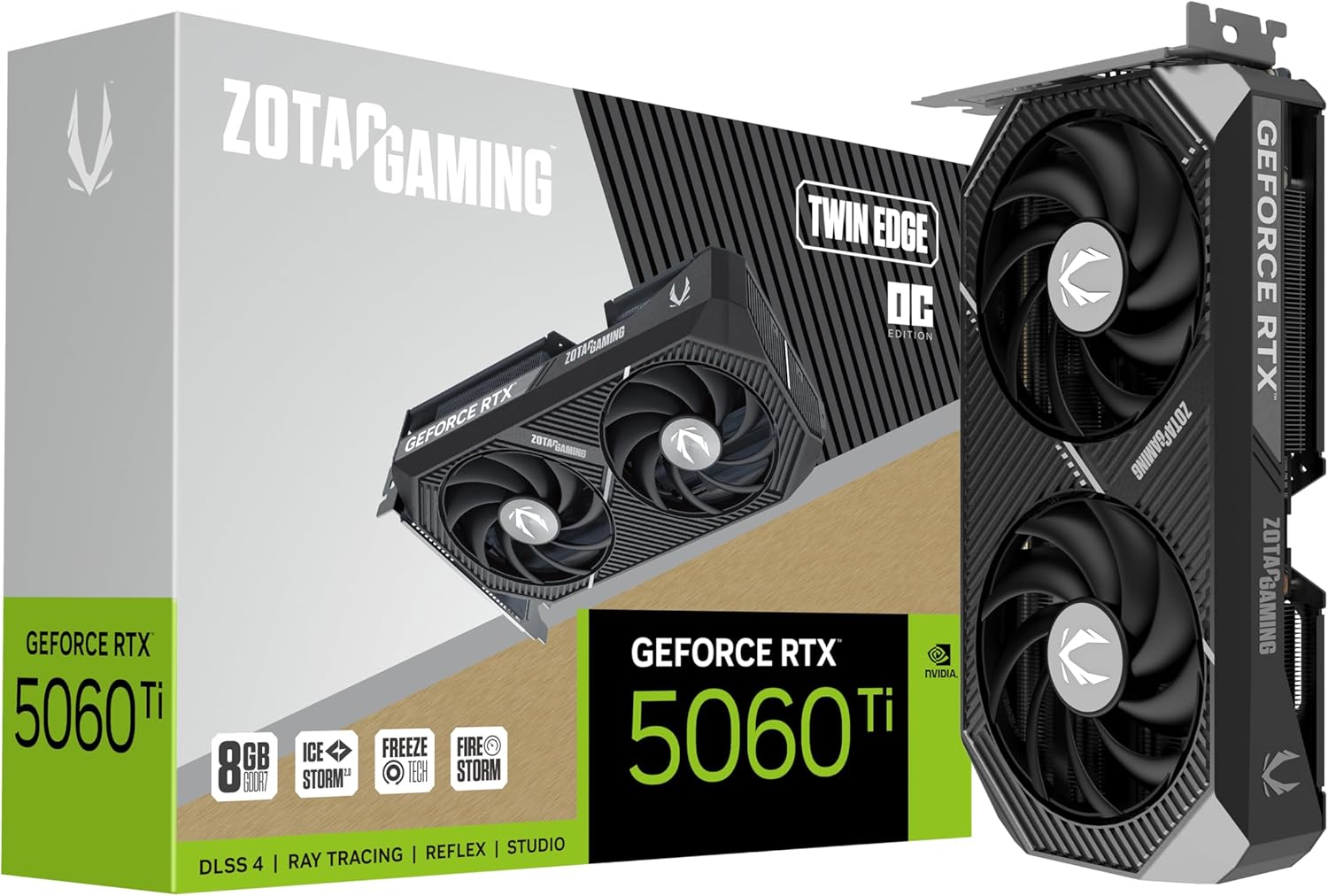
ZOTAC Gaming GeForce RTX 5060 Ti 8GB Twin Edge OC DLSS 4 8GB GDDR7 128-bit 28 Gbps PCIE 5.0 Gaming Graphics Card, IceStorm 2.0 Cooling, SFF-Ready, ZT-B50610H-10A
$300-$599This is a compact, 2-slot RTX 5060 Ti with 8GB GDDR7 and a 2602 MHz clock, built for SFF gaming rigs.