
msi Gaming RTX 3050 Ventus 2X 6G OC Graphics Card (NVIDIA RTX 3050, 96-Bit, Boost Clock: 1492 MHz, 6GB GDDR6 14 Gbps, HDMI/DP, Ampere Architecture)
Want the best price and purchase timing?
Our AI advisor analyzes real-time pricing across all channels to find you the best deal.
AI Verdict
This is a 6GB GDDR6 RTX 3050 with a 1492 MHz boost clock, ideal for 1080p esports and light gaming on a 70W power budget.
This 6GB RTX 3050 is a situational fit, primarily because its 70W power draw and compact size make it suitable for specific budget or small form factor builds. Its 1492 MHz boost clock and 6GB GDDR6 are adequate for 1080p esports, but the 96-bit memory interface restricts its performance in more demanding games.
If you need more horsepower for modern AAA games or higher resolutions, look for a GPU with at least 8GB of VRAM and a wider memory bus (e.g., 128-bit or higher).
Regret Score™
Medium RiskLower is better — measures purchase-regret risk from real buyer complaints, review credibility, and product maturity
Issues discovered after purchase
Critically weak dimension
Amazon rating vs actual quality
Chance this product isn't for you
Pros
- Consumes only 70W, eliminating the need for an external power connector.
- Maintains low temperatures, with one user reporting a maximum of 59 degrees Celsius.
- Compact 189x109x42 mm dimensions allow it to fit in smaller PC cases.
- Features two HDMI 2.1a ports and one DisplayPort 1.4a for multi-monitor setups.
- Delivers 144+ FPS in esports titles like Apex Legends and 200-250 FPS in CS2 at Full HD.
- Supports NVIDIA's DLSS and Ray Tracing for enhanced visuals in compatible games.
Cons
- The 6GB VRAM and 96-bit memory interface limit performance in demanding AAA titles, especially at higher resolutions.
- Lacks automatic fan shutdown, meaning fans run constantly even at idle.
- Does not include a backplate, leaving the PCB exposed.
- No RGB lighting, which might disappoint users looking for aesthetic customization.
- Performance in synthetic benchmarks can be comparable to or only slightly better than older GTX 1650 Super in some tests.
Dimension Scores
The 6GB GDDR6 and 96-bit memory interface provide adequate performance for 1080p esports and older titles, but struggles with newer AAA games at higher settings.
Users report low operating temperatures, with one user noting a maximum of 59 degrees Celsius, indicating effective cooling from the dual-fan design.
With a 70W power consumption and no need for an external power connector, it's highly efficient and compatible with lower-wattage power supplies.
6GB of GDDR6 VRAM is becoming a limiting factor for modern games, especially when aiming for higher textures or resolutions, and is less than the 8GB version of the 3050.
Best For
- 1080p competitive esports gaming where high frame rates are prioritized.
- Upgrading older systems with limited power supply capacity (requires only 70W).
- Compact PC builds where space for a graphics card is restricted.
- Content creation tasks that can leverage NVIDIA's Tensor Cores for AI acceleration (e.g., Blender).
Not Recommended For
- Playing new AAA games at 1440p or 4K resolutions with high settings.
- Users expecting top-tier performance for graphically intensive titles without DLSS.
- Enthusiasts seeking extensive overclocking headroom or advanced cooling features.
Watch Out For
- The 6GB version of the RTX 3050 is notably slower than the 8GB version, with some comparisons suggesting it's only about 30% faster than a GTX 1650/some iGPUs.
- Users report no automatic fan shutdown, meaning the dual fans operate continuously, potentially adding to system noise.
- The card's plastic casing and lack of a backplate might feel less premium compared to other models.
- Despite being an RTX card, its ray tracing performance is limited due to the 2304 CUDA Cores and 96-bit memory interface, requiring DLSS for playable frame rates in many scenarios.
Full Specifications
| ASIN | B0CTK1SFVD |
| Brand | msi |
| Color | Black |
| Series | VENTUS 2X |
| Item Weight | 1.28 pounds |
| Manufacturer | MSI |
| Memory Speed | 1492 MHz |
| Chipset Brand | NVIDIA |
| GPU Clock Speed | 1492 MHz |
| Card Description | NVIDIA GeForce RTX 3050 |
| Graphics Ram Size | 6 GB |
| Item model number | GeForce RTX 3050 VENTUS 2X 6G OC |
| Product Dimensions | 7.4 x 4.3 x 0.1 inches |
| Graphics Coprocessor | NVIDIA GeForce RTX 3050 |
| Max Screen Resolution | 7680x4320 |
| Graphics Card Ram Size | 6 GB |
| Item Dimensions LxWxH | 7.4 x 4.3 x 0.1 inches |
| Video Output Interface | DisplayPort |
What Buyers Say
Many users picked up this 6GB RTX 3050 for budget builds or as a temporary card, finding it surprisingly capable for 1080p gaming, especially in esports titles. Its low 70W power draw and compact size are frequently highlighted as major advantages, allowing it to fit into systems with limited power or space. However, the card's performance limitations in newer, graphically demanding games at higher settings are a recurring theme, with users often needing to adjust settings or rely on DLSS. The lack of a backplate and automatic fan stop are minor but present drawbacks.
“Look, I just needed something cheap that would actually fit in my old PC and not blow up my power supply, and this little 3050 does the job for my 1080p esports games, but don't expect to play Cyberpunk on ultra.”
Common Praise
- Runs games like WoW, LoL, Overwatch, Sea of Thieves, and Lost Ark at 120-144 FPS in 1080p.
- Temperatures stay low, with one user reporting a maximum of 59 degrees Celsius.
- Does not require an external power connector, simplifying installation.
- Compact form factor (189x109x42 mm) fits well in smaller cases.
- Supports multiple monitors with two HDMI 2.1a and one DisplayPort 1.4a.
Common Complaints
- The 6GB VRAM and 96-bit bus are insufficient for playing new AAA games at max settings or 1440p.
- Fans run continuously as there's no automatic fan shutdown feature.
- Lacks a backplate, leaving the circuit board exposed.
- Some users feel it was overpriced at launch for its performance tier.
- Not as powerful as the 8GB RTX 3050 variant, which some users mistakenly compare it to.
Ownership Tips
- The card is surprisingly quiet even with fans running constantly, as the 70W TDP doesn't generate much heat.
- Its small size makes it a hassle-free install, especially in cramped cases where larger cards are a nightmare.
- DLSS really helps stretch its capabilities in games that support it, making some otherwise unplayable settings viable.
- The lack of a backplate is purely aesthetic; it doesn't seem to affect thermal performance.
Frequently Asked Questions
Does this graphics card require an external power connector?
No, the MSI RTX 3050 Ventus 2X 6G OC has a low power consumption of 70W and does not require any external power connectors.
Can this card run modern AAA games?
It can run modern AAA games, but you'll likely need to play at 1080p resolution with medium settings and utilize DLSS for playable frame rates. It's not designed for max settings or higher resolutions in demanding titles.
Does this graphics card have RGB lighting?
No, the MSI RTX 3050 Ventus 2X 6G OC does not feature any RGB lighting.
What kind of cooling system does it use?
This card uses a dual-fan Ventus 2X cooling system, which users report keeps temperatures low, with one user seeing a maximum of 59 degrees Celsius.
Is this the 8GB version of the RTX 3050?
No, this specific model is the 6GB GDDR6 version of the RTX 3050, which has a 96-bit memory interface.
What is the recommended power supply for this graphics card?
MSI recommends a power supply unit of 300W or higher for systems using this graphics card.
Buying Guide
When you're looking at a graphics card like this, you need to think about what games you actually play and at what resolution. This isn't a card for pushing 4K or even 1440p in the latest blockbusters. It's built for efficiency and 1080p gaming, especially if you're into competitive titles where high frame rates matter more than ultra-realistic graphics. Pay close attention to its power requirements and physical size to ensure it fits your current PC.
VRAM (Video RAM)
Boost Clock
Memory Interface (Bit)
Power Consumption (TDP)
Alternatives
If this card doesn't quite cut it, look for GPUs with at least 8GB of VRAM, a 128-bit or wider memory interface, and a higher CUDA core count for better performance in demanding games. Be prepared for increased power draw and potentially larger physical dimensions.
You Might Also Like

HP NVIDIA GeForce RTX 3070 8GB OEM Graphics Card (Renewed)
$150-$299This is a renewed HP OEM NVIDIA GeForce RTX 3070 with 8GB VRAM, a gamble for budget-conscious 1440p gamers who understand the risks of refurbished hardware.

ZOTAC Gaming GeForce RTX 5070 Twin Edge OC DLSS 4 12GB GDDR7 192-bit 28 Gbps PCIE 5.0 Gaming Graphics Card, IceStorm 2.0 Cooling, SFF-Ready, ZT-B50700H-10A
$600+This is a 2-slot, SFF-ready NVIDIA RTX 5070 with 12GB GDDR7 and a 2542 MHz boost clock, built for compact gaming rigs needing high 1440p performance.

ZOTAC Gaming GeForce RTX 5080 Solid CORE OC DLSS 4 16GB GDDR7 256-bit 30 Gbps PCIE 5.0 Gaming Graphics Card, IceStorm 3.0 Advanced Cooling, Spectra RGB Lighting, ZT-B50800J2-10A
$600+This ZOTAC RTX 5080 with 16GB GDDR7 and a 2640 GHz clock speed is built for high-end 4K gaming and content creation on the NVIDIA Blackwell architecture.
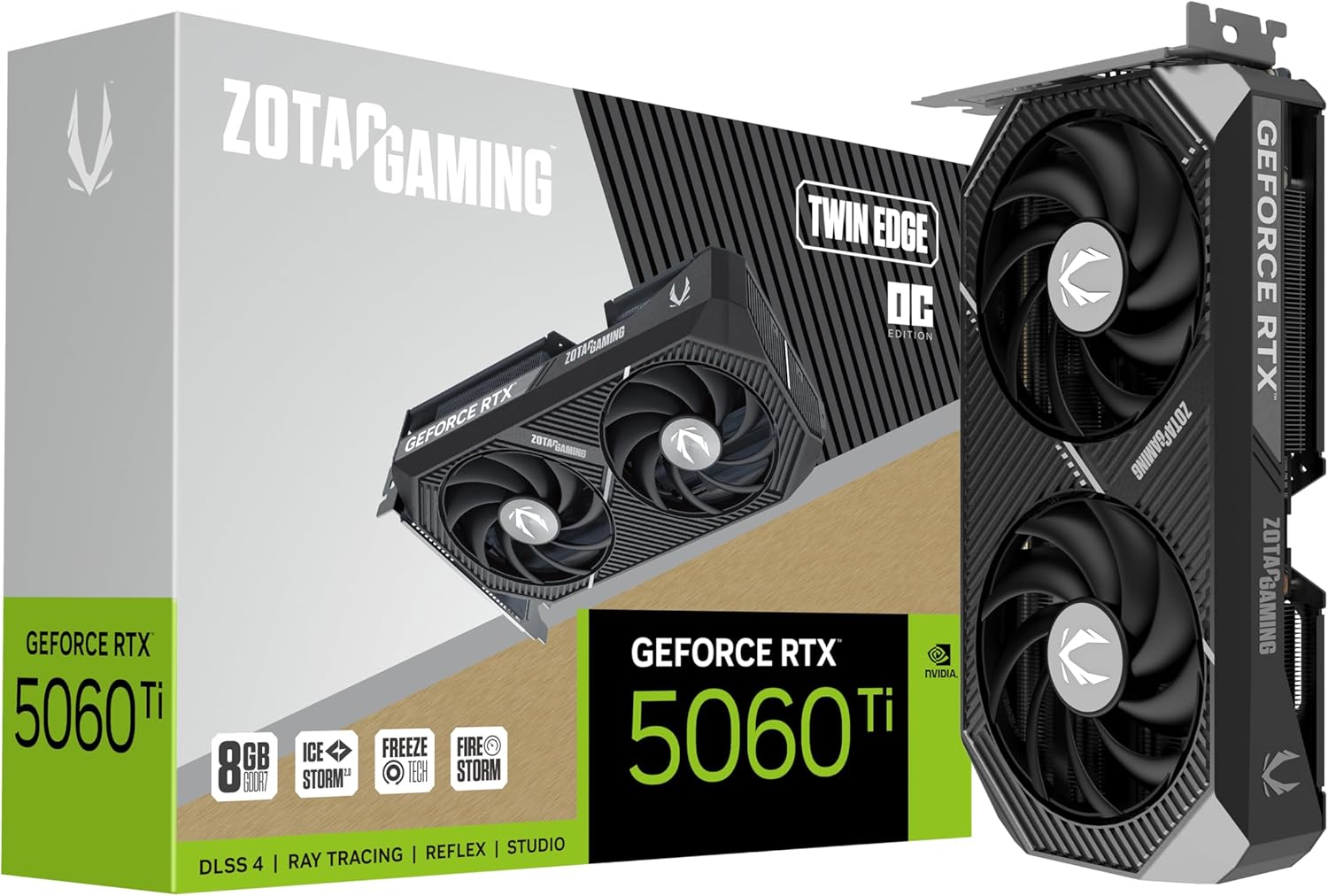
ZOTAC Gaming GeForce RTX 5060 Ti 8GB Twin Edge OC DLSS 4 8GB GDDR7 128-bit 28 Gbps PCIE 5.0 Gaming Graphics Card, IceStorm 2.0 Cooling, SFF-Ready, ZT-B50610H-10A
$300-$599This is a compact, 2-slot RTX 5060 Ti with 8GB GDDR7 and a 2602 MHz clock, built for SFF gaming rigs.