
Sapphire 11339-04-20G Pulse AMD Radeon RX 7600 XT Gaming Graphics Card with 16GB GDDR6, AMD RDNA 3
Want the best price and purchase timing?
Our AI advisor analyzes real-time pricing across all channels to find you the best deal.
AI Verdict
This is a 1080p graphics card that brute-forces texture limits with 16GB of VRAM, built for gamers who want max visual settings without upgrading their case.
This card solves exactly one problem: running out of VRAM at 1080p. The 16GB capacity handles massive texture packs, but the 128-bit bus and PCIe x8 interface severely limit its raw compute power for anything beyond 1080p gaming.
If you play at 1440p, look for a card with a 192-bit or 256-bit memory bus to prevent bandwidth bottlenecks.
Regret Score™
Medium RiskLower is better — measures purchase-regret risk from real buyer complaints, review credibility, and product maturity
Issues discovered after purchase
Critically weak dimension
Amazon rating vs actual quality
Chance this product isn't for you
Pros
- 16GB of GDDR6 memory completely eliminates texture pop-in at 1080p in VRAM-heavy games like Far Cry 6.
- Dual-fan cooler keeps the GPU core around 72°C while spinning at a whisper-quiet 1270 RPM.
- Compact 2.2-slot thickness fits easily into older OEM cases and micro-ATX builds.
- Features two HDMI 2.1 and two DisplayPort 2.1 outputs, giving you modern multi-monitor flexibility.
Cons
- The narrow 128-bit memory bus chokes the 16GB VRAM at 1440p resolutions.
- Requires two 8-pin PCIe power cables, which is surprisingly demanding for a 190W card.
- Uses a PCIe 4.0 x8 interface, causing a 3-5% frame rate drop if installed in an older PCIe 3.0 motherboard.
- Hotspot temperatures can reach 91°C under heavy load with the stock fan curve.
Dimension Scores
Handles 1080p ultra settings easily, but the 128-bit bus kills 1440p scaling.
The Dual-X cooler keeps noise down to 38 dBA at 25% fan speed.
Pulls up to 190W and requires two 8-pin connectors, which is high for this performance tier.
16GB is massive for a 1080p-focused GPU and completely eliminates texture bottlenecks.
Best For
- 1080p gamers who refuse to lower texture quality settings in modern AAA titles.
- Small form factor PC builders needing a compact 2.2-slot card that stays under 40 dBA.
- Budget video editors working with 4K timelines who need the 16GB VRAM buffer.
Not Recommended For
- 1440p or 4K gamers, as the 128-bit bus physically cannot move data fast enough for higher resolutions.
- Upgraders with older 500W power supplies that only have a single 8-pin PCIe cable.
Watch Out For
- PCIe 4.0 x8 interface — if you plug this into a PCIe 3.0 motherboard, you lose bandwidth and drop frames in stutter-heavy games.
- Two 8-pin power connectors required — many older 500W power supplies only have one, forcing you to buy adapters or a new PSU.
- 128-bit memory bus bottleneck — the 16GB VRAM looks great on the box, but the narrow bus means the GPU struggles to actually use it all at 1440p.
- Aggressive zero-RPM fan mode — the fans stay completely off until 50°C, which makes the backplate uncomfortably hot to the touch during light desktop use.
Full Specifications
| ASIN | B0CTD21LW1 |
| Brand | Sapphire |
| Color | black |
| Series | PULSE Radeon RX 7600 XT |
| Item Weight | 2.4 pounds |
| Manufacturer | Sapphire Technology |
| Memory Speed | 18 GHz |
| Chipset Brand | AMD |
| Card Description | AMD |
| Graphics Ram Size | 16 GB |
| Item model number | 11339-04-20G |
| Package Dimensions | 12.56 x 6.5 x 3.35 inches |
| Graphics Coprocessor | AMD Radeon RX 7600 XT |
| Max Screen Resolution | 3840x2160 |
| Graphics Card Ram Size | 16 GB |
| Video Output Interface | DisplayPort, HDMI |
| Graphics Processor Manufacturer | AMD |
What Buyers Say
The 16GB VRAM capacity dominates user discussions, with buyers thrilled they can finally max out textures in modern ports without crashing. The Sapphire Pulse cooler gets consistent praise for staying under 40 dBA during heavy gaming sessions. Many upgraders get caught off guard by the dual 8-pin power requirement on a card in this tier. The 128-bit memory bus frustrates users who try to push the card to 1440p and watch their frame rates tank.
“Upgraded from an 8gb card because last of us kept crashing, this 16gb beast fixed the stuttering completely but I had to dig through my closet to find a second 8 pin power cable for it.”
Common Praise
- 16GB VRAM completely stops the stuttering in Hogwarts Legacy at 1080p Ultra.
- Fans are practically silent at 1270 RPM during heavy Cyberpunk 2077 sessions.
- Compact 2.2-slot thickness leaves plenty of breathing room in micro-ATX cases.
- Dual HDMI 2.1 ports make it easy to connect a monitor and an OLED TV at the same time.
Common Complaints
- Needs two 8-pin PCIe power cables for a GPU that only pulls 190 watts.
- Frame rates drop off a cliff the second you switch the resolution to 1440p.
- Hotspot temperatures routinely hit 90°C because the stock fan curve prioritizes silence over cooling.
- Stutters on older motherboards because it only uses 8 PCIe lanes instead of 16.
Ownership Tips
- The zero-RPM fan mode keeps the card dead silent during web browsing, but the metal backplate gets extremely hot to the touch.
- You have to manually undervolt the GPU in AMD Adrenalin to get the power draw down from 190W to a more reasonable 160W.
- The 128-bit bus means overclocking the memory past 18 Gbps yields almost zero actual frame rate improvement.
Frequently Asked Questions
Does this card need a support bracket to prevent sagging?
No. The 2.2-slot design and aluminum backplate keep it rigid, and it's light enough that it won't stress your PCIe slot.
Will this work on my older PCIe 3.0 motherboard?
Yes, it is backwards compatible. You will lose about 3-5% of your frame rate because the card only uses 8 PCIe lanes instead of the full 16.
Why does a 1080p card need 16GB of VRAM?
Modern games load massive uncompressed textures even at 1080p. The 16GB prevents the stuttering and texture pop-in that 8GB cards suffer from in titles like The Last of Us Part 1.
Are the fans loud under full load?
At the stock fan curve, they spin at around 1270 RPM and hit just 38 dBA, which is barely audible over standard case fans.
Can I run three monitors with this?
Yes. It has two HDMI 2.1 ports and two DisplayPort 2.1 ports, supporting up to four displays simultaneously.
Buying Guide
You are buying this card for exactly one reason: the 16GB of VRAM. Modern games use massive textures that overflow 8GB cards, causing massive stutters. This card brute-forces that problem at 1080p. Do not buy this expecting to play at 1440p or 4K, because the internal memory bus is too narrow to handle those resolutions.
16GB GDDR6 VRAM
Think of VRAM as the desk space your GPU uses to hold game textures. 16GB is a massive desk, meaning the GPU never has to wait to fetch new textures from your hard drive.
128-bit Memory Bus
This is the doorway between the VRAM and the GPU core. A 128-bit doorway is narrow, so even though you have a massive 16GB desk, you can only move data through the door slowly.
PCIe 4.0 x8 Interface
This card only has half the physical connection pins of a standard GPU. On modern motherboards, this is fine, but on older ones, it limits how fast your CPU can talk to the graphics card.
Alternatives
If you want to play games at 1440p, search for a GPU with a 192-bit or 256-bit memory bus to ensure enough bandwidth.
You Might Also Like

HP NVIDIA GeForce RTX 3070 8GB OEM Graphics Card (Renewed)
$150-$299This is a renewed HP OEM NVIDIA GeForce RTX 3070 with 8GB VRAM, a gamble for budget-conscious 1440p gamers who understand the risks of refurbished hardware.

ZOTAC Gaming GeForce RTX 5070 Twin Edge OC DLSS 4 12GB GDDR7 192-bit 28 Gbps PCIE 5.0 Gaming Graphics Card, IceStorm 2.0 Cooling, SFF-Ready, ZT-B50700H-10A
$600+This is a 2-slot, SFF-ready NVIDIA RTX 5070 with 12GB GDDR7 and a 2542 MHz boost clock, built for compact gaming rigs needing high 1440p performance.

ZOTAC Gaming GeForce RTX 5080 Solid CORE OC DLSS 4 16GB GDDR7 256-bit 30 Gbps PCIE 5.0 Gaming Graphics Card, IceStorm 3.0 Advanced Cooling, Spectra RGB Lighting, ZT-B50800J2-10A
$600+This ZOTAC RTX 5080 with 16GB GDDR7 and a 2640 GHz clock speed is built for high-end 4K gaming and content creation on the NVIDIA Blackwell architecture.
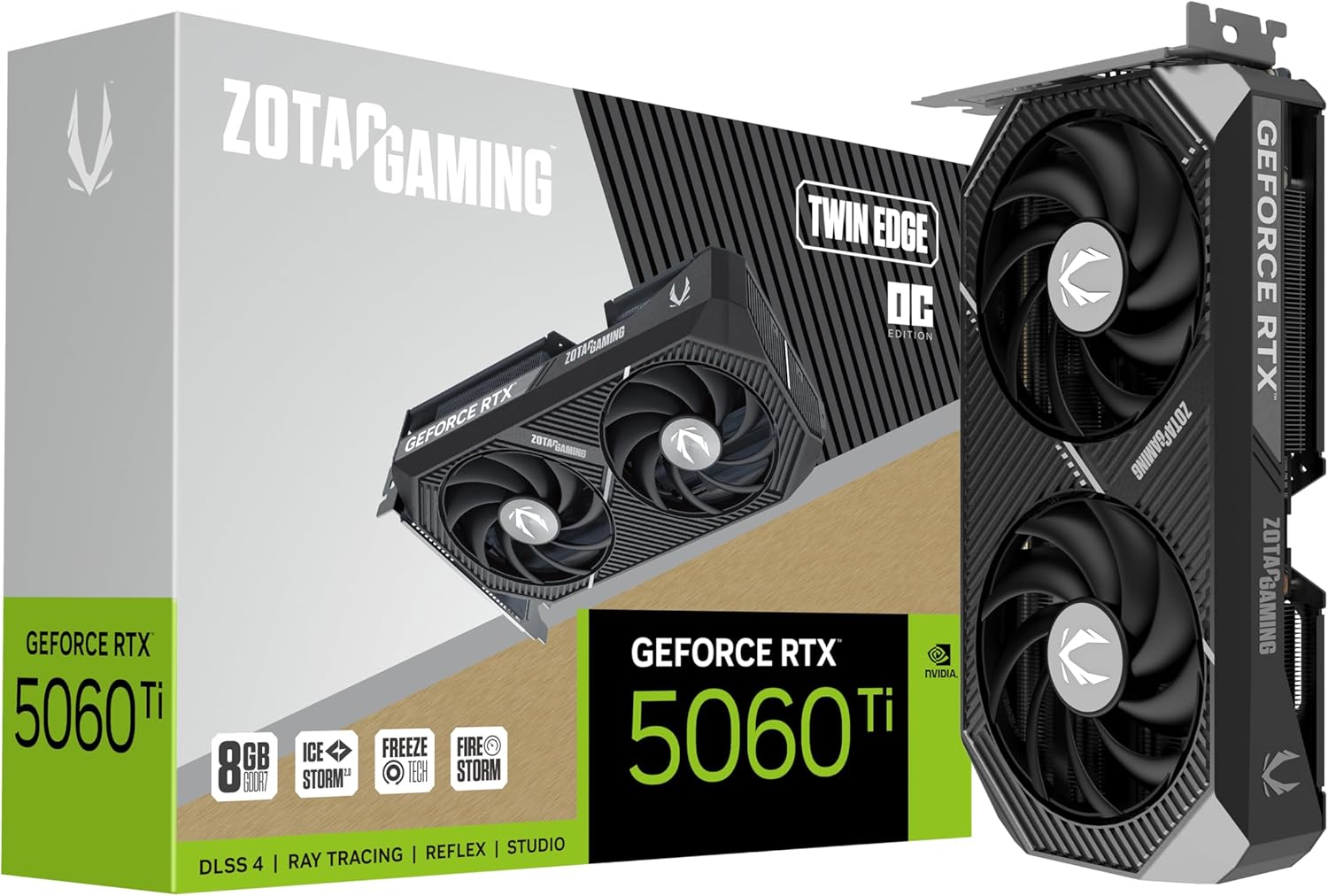
ZOTAC Gaming GeForce RTX 5060 Ti 8GB Twin Edge OC DLSS 4 8GB GDDR7 128-bit 28 Gbps PCIE 5.0 Gaming Graphics Card, IceStorm 2.0 Cooling, SFF-Ready, ZT-B50610H-10A
$300-$599This is a compact, 2-slot RTX 5060 Ti with 8GB GDDR7 and a 2602 MHz clock, built for SFF gaming rigs.