
Gigabyte Radeon RX 7600 XT Gaming OC 16GB Graphics Card - 2810 MHz Core, 16GB GDDR6 18000MHz 128-bit Memory, PCI-E 4.0, 2X DP 1.4, 2X HDMI 2.1a, RDNA Architecture, RGB Fusion, GV-R76XTGAMING OC-16GD
Want the best price and purchase timing?
Our AI advisor analyzes real-time pricing across all channels to find you the best deal.
AI Verdict
A 1080p powerhouse with a massive 16GB VRAM buffer bottlenecked by a 128-bit bus, making it ideal for modders and entry-level AI creators but overkill for casual gamers.
This card pairs a 1080p-class Navi 33 GPU and 128-bit bus with a massive 16GB VRAM pool. It makes sense if you specifically need massive memory capacity for non-gaming tasks like AI generation or video editing on a strict budget. Pure gamers will hit bandwidth bottlenecks long before they fill the 16GB buffer.
If you just want high-FPS 1080p gaming, save your money and buy the standard 8GB RX 7600; if you want true 1440p performance, step up to the RX 7700 XT with its 192-bit bus.
Regret Score™
Medium RiskLower is better — measures purchase-regret risk from real buyer complaints, review credibility, and product maturity
Issues discovered after purchase
Critically weak dimension
Amazon rating vs actual quality
Chance this product isn't for you
Pros
- 16GB of GDDR6 VRAM provides massive headroom for high-res texture mods and local AI generation
- Factory overclock pushes boost speeds to 2810 MHz, a 55 MHz bump over AMD's reference spec
- Triple 80mm Windforce fans keep average GPU temperatures remarkably low, often hovering around 54°C to 61°C under load
- Includes dual HDMI 2.1a and dual DisplayPort 2.1 outputs, offering better multi-monitor flexibility than standard 3x DP / 1x HDMI layouts
Cons
- The narrow 128-bit memory bus restricts bandwidth to 288 GB/s, bottlenecking the 16GB VRAM at 1440p and 4K resolutions
- The three 80mm fans become noticeably high-pitched and whiny when they ramp past 50% speed to cool hotspot temperatures
- At 281mm long, this triple-fan cooler is unnecessarily large for a 190W Navi 33 chip and blocks drive cages in smaller cases
Dimension Scores
Solid 1080p ultra performance, but struggles at 1440p due to the 128-bit bus limitation.
Average GPU temps are excellent at 54-61°C, but the 80mm fans get whiny and loud when hotspot temps spike.
At 190W TBP, it is relatively efficient and runs easily on a standard 600W power supply.
16GB is massive for this price bracket, providing excellent headroom for texture packs and AI workloads.
Best For
- 1080p gamers who heavily mod titles like Skyrim or Fallout 4 with massive texture packs
- Budget-conscious creators running local AI image generation (Stable Diffusion) that requires 12GB+ of VRAM
- Multi-monitor setups requiring dual HDMI 2.1a ports for modern TVs or high-refresh displays
Not Recommended For
- Native 4K gaming, as the 128-bit memory bus chokes on high-resolution rendering
- Small form factor (Mini-ITX) builds due to the 281mm length and triple-fan shroud
Watch Out For
- The 16GB VRAM pool is bottlenecked by the 128-bit memory bus, meaning the card physically cannot move data fast enough to fully utilize that memory in 1440p or 4K gaming.
- Gigabyte Control Center software frequently fails to recognize the card for performance tuning, forcing you to rely entirely on AMD's Adrenalin software for overclocks.
- Hotspot temperatures spike significantly higher than the average GPU temp, causing the 80mm fans to aggressively ramp up and produce a high-pitched whine.
Full Specifications
| ASIN | B0CSSZCZZP |
| Brand | GIGABYTE |
| Color | Black |
| Series | GIGABYTE Radeon RX 7600 XT Gaming OC |
| Item Weight | 2.64 pounds |
| Manufacturer | Gigabyte |
| Memory Speed | 18000 MHz |
| Chipset Brand | AMD |
| Card Description | Dedicated |
| Graphics Ram Size | 16 GB |
| Item model number | GV-R76XTGAMING OC-16GD |
| Product Dimensions | 11.06 x 4.61 x 0.04 inches |
| Graphics Coprocessor | AMD Radeon RX 7600 XT |
| Max Screen Resolution | 8K |
| Graphics Card Ram Size | 16 GB |
| Item Dimensions LxWxH | 11.06 x 4.61 x 0.04 inches |
| Video Output Interface | DisplayPort, HDMI |
| Graphics Processor Manufacturer | AMD |
What Buyers Say
The Gigabyte RX 7600 XT Gaming OC pairs a massive 16GB VRAM pool with a restrictive 128-bit memory bus, creating a polarizing experience. Real-world testing shows it handles VRAM-heavy tasks like Stable Diffusion and heavily modded 1080p games without crashing. The triple-fan cooler keeps average GPU temperatures impressively low, often hovering around 60°C under load. The small 80mm fans emit a noticeable high-pitched whine when hotspot temperatures force them to spin past 50%. The Gigabyte Control Center software is a frequent source of frustration, often failing to recognize the GPU for tuning. It serves as a great utility card for creators on a budget, but pure gamers hit bandwidth limits quickly.
“Bought this for Stable diffusion and 1080p gaming. The 16gb vram is a lifesaver but my god these tiny fans get whiny when the hotspot hits 80c. Good card if you tweak the fan curve in Adrenalin!”
Common Praise
- 16GB VRAM completely eliminates stuttering in VRAM-heavy titles like The Last of Us Part 1 at 1080p
- Dual HDMI 2.1a ports make it incredibly easy to hook up a gaming monitor and a modern TV simultaneously
- Average GPU core temperatures rarely exceed 61°C even after hours of benchmarking
- Handles local AI image generation and video editing timelines far better than 8GB cards in the same price tier
Common Complaints
- The 80mm fans sound like a tiny jet engine when they cross the 50% speed threshold
- Gigabyte Control Center software frequently fails to load the performance tuning tab
- 1440p performance is severely held back by the 288 GB/s memory bandwidth
- At 281mm, the plastic fan shroud feels unnecessarily long for a 190W graphics chip
Ownership Tips
- You absolutely need to set a custom fan curve in AMD Adrenalin to prevent the 80mm fans from aggressively ramping up and down.
- Gigabyte's RGB Fusion lighting is limited to just the side logo, making it very subtle in a glass case.
- Driver timeouts can occasionally happen if you push the memory overclock past 2500MHz.
- The metal backplate has a cutout at the end that actually helps exhaust heat up toward the CPU cooler.
Frequently Asked Questions
Does the 16GB of VRAM actually improve gaming performance over the 8GB RX 7600?
Barely. Because both cards share the same 128-bit memory bus and Navi 33 chip, the 16GB model only offers a 5-10% frame rate bump in most games, mostly due to its higher 2810 MHz clock speed.
Will this card fit in a micro-ATX case?
It depends on your exact case clearances. At 281mm (11.1 inches) long, this triple-fan model is surprisingly bulky for a mid-range GPU and will block drive cages in smaller ITX or mATX cases.
How loud are the fans under heavy gaming load?
Average temperatures stay cool, but hotspot temps cause the three 80mm fans to spin up past 50%. When they do, users report a distinct, high-pitched whine.
What power supply do I need for this card?
Gigabyte recommends a 600W to 700W PSU. The card itself draws a maximum of 190W under full load, which is about 25W more than the non-XT version.
Can I use this for PCVR gaming?
Yes, the 16GB of VRAM is very beneficial for VR titles like VRChat or Half-Life: Alyx. You may need to dial back the rendering resolution to maintain 90 FPS due to the GPU core limits.
Buying Guide
When looking at the RX 7600 XT, you need to understand that VRAM capacity isn't everything. This card has 16GB of memory, which sounds like a massive upgrade over 8GB cards, but it uses a narrow 128-bit memory bus. Think of it like having a massive water tank but a very skinny hose—you can hold a lot of data, but you cannot move it fast enough for 4K gaming. You are buying this card specifically for 1080p gaming with ultra textures, or for productivity tasks like video editing and AI generation where capacity matters more than raw speed.
16GB GDDR6 VRAM
This is the card's short-term memory. 16GB is huge, allowing you to load massive 4K texture mods in games or run complex AI models without the program crashing.
128-bit Memory Bus
This is the highway connecting the VRAM to the graphics processor. A 128-bit bus is relatively narrow, meaning it struggles to pump data fast enough for smooth 1440p or 4K gaming.
2810 MHz Boost Clock
This is how fast the graphics chip processes instructions. Gigabyte factory-overclocked this model to run slightly faster than AMD's base design, giving you a couple of extra frames per second out of the box.
Alternatives
If you want better 1440p gaming performance, look for a card with a 192-bit or 256-bit memory bus. If you only play at 1080p and don't care about AI or mods, search for standard 8GB cards to save money.
You Might Also Like

HP NVIDIA GeForce RTX 3070 8GB OEM Graphics Card (Renewed)
$150-$299This is a renewed HP OEM NVIDIA GeForce RTX 3070 with 8GB VRAM, a gamble for budget-conscious 1440p gamers who understand the risks of refurbished hardware.

ZOTAC Gaming GeForce RTX 5070 Twin Edge OC DLSS 4 12GB GDDR7 192-bit 28 Gbps PCIE 5.0 Gaming Graphics Card, IceStorm 2.0 Cooling, SFF-Ready, ZT-B50700H-10A
$600+This is a 2-slot, SFF-ready NVIDIA RTX 5070 with 12GB GDDR7 and a 2542 MHz boost clock, built for compact gaming rigs needing high 1440p performance.

ZOTAC Gaming GeForce RTX 5080 Solid CORE OC DLSS 4 16GB GDDR7 256-bit 30 Gbps PCIE 5.0 Gaming Graphics Card, IceStorm 3.0 Advanced Cooling, Spectra RGB Lighting, ZT-B50800J2-10A
$600+This ZOTAC RTX 5080 with 16GB GDDR7 and a 2640 GHz clock speed is built for high-end 4K gaming and content creation on the NVIDIA Blackwell architecture.
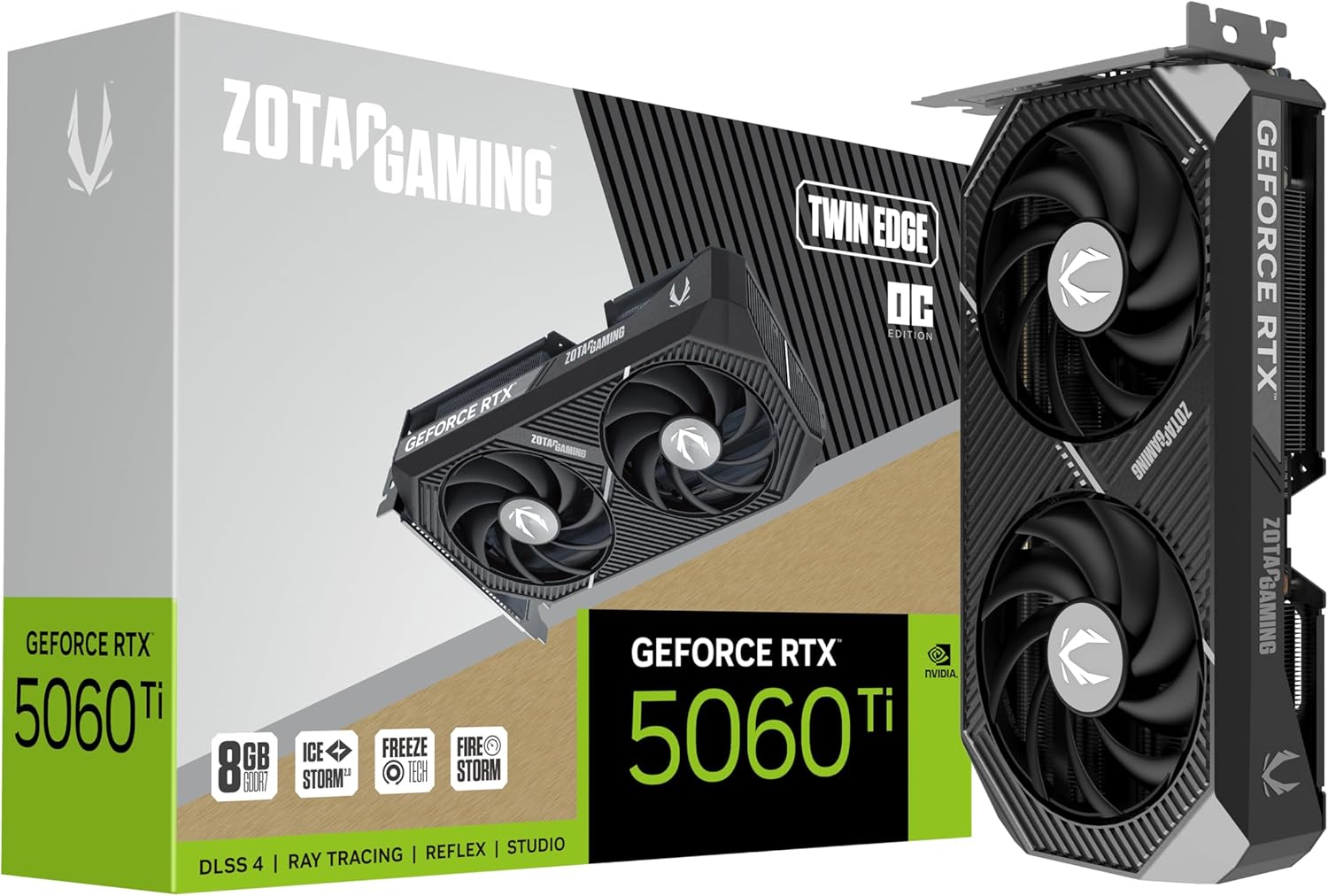
ZOTAC Gaming GeForce RTX 5060 Ti 8GB Twin Edge OC DLSS 4 8GB GDDR7 128-bit 28 Gbps PCIE 5.0 Gaming Graphics Card, IceStorm 2.0 Cooling, SFF-Ready, ZT-B50610H-10A
$300-$599This is a compact, 2-slot RTX 5060 Ti with 8GB GDDR7 and a 2602 MHz clock, built for SFF gaming rigs.