
ASRock AMD Radeon RX 7900 GRE Challenger 16GB OC 18 Gbps 256 Bit Dual Fan Design 0dB Silent Cooling Graphics Card 7680 x 4320 RT AI Accelerators
Want the best price and purchase timing?
Our AI advisor analyzes real-time pricing across all channels to find you the best deal.
AI Verdict
The ASRock RX 7900 GRE Challenger is a compact, dual-fan 1440p powerhouse built for gamers who want high-end AMD performance without paying the triple-fan premium or upgrading their mid-tower case.
This card packs the excellent 7900 GRE chip into a smaller 269mm footprint, making it perfect for older cases. The dual-fan cooler has to spin significantly faster and louder to dissipate the 260W heat load compared to triple-fan models.
If your case has at least 320mm of clearance, spend the extra $20-$40 on a triple-fan model like the Sapphire Pulse or ASRock Steel Legend for drastically lower noise levels.
Regret Score™
Medium RiskLower is better — measures purchase-regret risk from real buyer complaints, review credibility, and product maturity
Issues discovered after purchase
Critically weak dimension
Amazon rating vs actual quality
Chance this product isn't for you
Pros
- Fits easily into most mid-tower cases with its 269mm length and 2.55-slot thickness.
- Fans completely shut off below 55°C for dead-silent web browsing and light desktop use.
- Physical LED switch on the board lets you kill the RGB without installing bloatware.
- Handles 3440x1440 ultrawide gaming easily thanks to 16GB of GDDR6 VRAM and 5120 stream processors.
- Uses standard dual 8-pin PCIe power connectors, avoiding the need for new ATX 3.0 12VHPWR cables.
Cons
- Dual 100mm fans spin up to 1546 RPM under load, hitting 31 dBa which is noticeably louder than triple-fan alternatives.
- Lacks a dual BIOS switch for easy fallback if a firmware flash goes wrong.
- Factory memory bandwidth is artificially limited compared to the 7800 XT, requiring manual memory overclocking to unlock its full potential.
- AMD's Adrenalin drivers occasionally push the boost clock past the official 2293MHz limit, causing system crashes until manually capped.
Dimension Scores
Handles 1440p ultrawide flawlessly with 5120 stream processors, though ray tracing lags behind Nvidia.
The dual 100mm fans keep temperatures safe but hit 31 dBa and 1500+ RPM under load, making it quite audible.
Pulls a reasonable 260W maximum, allowing it to run comfortably on a standard 750W power supply with two 8-pin cables.
16GB of GDDR6 on a 256-bit bus provides excellent headroom for modern unoptimized console ports and high-res texture packs.
Best For
- 1440p ultrawide gaming setups where 12GB of VRAM isn't enough for modern texture packs.
- Upgrading older AM4 systems in compact mid-tower cases that can't fit 300mm+ GPUs.
- Users who prefer physical hardware switches to disable RGB lighting.
Not Recommended For
- Silent PC enthusiasts who want whisper-quiet operation under heavy gaming loads.
- Heavy ray-tracing workloads where Nvidia's 4070 Super significantly outperforms AMD's RDNA 3 architecture.
Watch Out For
- Driver overclocking bug — AMD's Adrenalin software sometimes pushes the boost clock past ASRock's 2293MHz spec, causing black screens until you manually cap the frequency in the tuning menu.
- Loud fan curve — The dual 100mm fans have to work harder than triple-fan models, hitting over 1500 RPM and 31 dBa under load, which is highly audible without headphones.
- Memory bandwidth bottleneck — Despite having more compute units than the 7800 XT, the GRE's memory speed is slower out of the box, meaning you have to manually overclock the VRAM to get the performance you paid for.
Full Specifications
| ASIN | B0CSPJ5DPR |
| Brand | ASRock |
| Item Weight | 2.81 pounds |
| Manufacturer | ASRock |
| Graphics Ram Size | 16 GB |
| Item model number | 90-GA52ZZ-00UANF |
| Product Dimensions | 3.94 x 1.97 x 0.5 inches |
| Graphics Coprocessor | AMD Radeon RX 7900 GRE |
| Video Output Interface | DisplayPort, HDMI |
| Graphics Processor Manufacturer | AMD |
What Buyers Say
The biggest talking point among owners is the driver-level boost clock bug. Many users report black screens and crashes because AMD's Adrenalin software pushes the card past ASRock's 2293MHz spec, forcing buyers to manually undervolt and cap the frequency. Beyond the software quirks, buyers love the compact 269mm size that revives older AM4 builds without requiring a case swap. The physical LED toggle switch is a massive hit for those who hate installing RGB bloatware. Acoustic complaints are common, with users noting the dual 100mm fans get whiny and loud when trying to cool the 260W chip during heavy 1440p gaming.
“Upgraded from a 5700xt and it crushes 1440p ultrawide, but I had to manually cap the boost clock in Adrenalin to stop the random black screens and the fans get pretty loud if you don't tweak the curve.”
Common Praise
- Compact 269mm length fits perfectly in older cases like the Lian Li TU150.
- Physical LED switch on the PCB eliminates the need for ASRock Polychrome software.
- 0dB fan mode works flawlessly, keeping the system dead silent during web browsing.
- Massive 1440p performance jump for users upgrading from older RX 5700 XT or RTX 2070 cards.
Common Complaints
- Fans ramp up past 1500 RPM under load and produce a noticeable 31 dBa hum.
- Adrenalin driver auto-overclocks past the official 2293MHz boost, causing system freezes.
- Out-of-the-box memory bandwidth is artificially restricted by AMD.
- Lacks the dual BIOS switch found on slightly more expensive models like the Steel Legend.
Ownership Tips
- You must manually overclock the VRAM in AMD Adrenalin to unlock the card's true performance, as it ships with artificially slow memory speeds.
- The default fan curve is aggressive; setting a custom curve in the driver software is practically mandatory for acoustic comfort.
- Coil whine is occasionally reported, but often misattributed to the GPU when it's actually coming from the motherboard VRMs on AM5 platforms.
Frequently Asked Questions
Does this card have a dual BIOS switch?
No, the ASRock Challenger model lacks a physical BIOS switch. You only get a single BIOS, though it does have a physical switch to toggle the LED lighting.
Will this fit in a standard mid-tower case?
Yes, it measures exactly 269mm (10.6 inches) long and takes up 2.55 slots. It easily fits into older or more compact ATX cases that struggle with modern 330mm+ cards.
Why is my PC crashing with black screens after installing this?
AMD's Adrenalin drivers have a known bug where they auto-boost the card past ASRock's official 2293MHz limit. You need to go into the Performance Tuning tab and manually cap the max frequency.
Do I need a new power supply cable for this?
No, it uses two standard 8-pin PCIe power connectors. A reliable 750W power supply is recommended by ASRock.
Are the fans loud under full load?
Yes, because it's a dual-fan design cooling a 260W chip, the 100mm fans spin up to around 1546 RPM (31 dBa). It is noticeably louder than triple-fan variants.
Does the 0dB silent cooling actually work?
Yes, the fans completely stop spinning when the GPU temperature drops below 55°C. They only kick back on when you exceed 60°C during gaming.
Buying Guide
When buying a 7900 GRE, you are getting a slightly cut-down version of AMD's flagship silicon. Because this ASRock Challenger is a dual-fan model, it trades acoustic performance for physical compatibility. It fits in almost any case, but it gets louder than a massive three-fan card. You also need to be comfortable opening AMD's driver software to tweak memory speeds and cap boost clocks. This specific chip requires a little manual tuning to run perfectly stable and hit its maximum potential.
269mm Length / 2.55 Slot Width
This is the physical footprint of the card. Think of it like parking a car; this model is a compact sedan that fits in a standard garage, whereas triple-fan cards are long pickup trucks that require a massive PC case.
16GB GDDR6 VRAM
VRAM is the short-term memory your graphics card uses to hold game textures. 16GB is a massive bucket, meaning you can turn texture settings to 'Ultra' in modern games without the game stuttering or crashing.
0dB Silent Cooling
The fans physically stop spinning when the card is below 55°C. When you're just watching YouTube or typing a document, the graphics card makes literally zero noise.
Alternatives
If you have a large PC case and value a whisper-quiet system, search for a triple-fan 7900 GRE model. If you care heavily about ray tracing performance or DLSS upscaling, look for an Nvidia RTX 4070 Super instead.
You Might Also Like

HP NVIDIA GeForce RTX 3070 8GB OEM Graphics Card (Renewed)
$150-$299This is a renewed HP OEM NVIDIA GeForce RTX 3070 with 8GB VRAM, a gamble for budget-conscious 1440p gamers who understand the risks of refurbished hardware.

ZOTAC Gaming GeForce RTX 5070 Twin Edge OC DLSS 4 12GB GDDR7 192-bit 28 Gbps PCIE 5.0 Gaming Graphics Card, IceStorm 2.0 Cooling, SFF-Ready, ZT-B50700H-10A
$600+This is a 2-slot, SFF-ready NVIDIA RTX 5070 with 12GB GDDR7 and a 2542 MHz boost clock, built for compact gaming rigs needing high 1440p performance.

ZOTAC Gaming GeForce RTX 5080 Solid CORE OC DLSS 4 16GB GDDR7 256-bit 30 Gbps PCIE 5.0 Gaming Graphics Card, IceStorm 3.0 Advanced Cooling, Spectra RGB Lighting, ZT-B50800J2-10A
$600+This ZOTAC RTX 5080 with 16GB GDDR7 and a 2640 GHz clock speed is built for high-end 4K gaming and content creation on the NVIDIA Blackwell architecture.
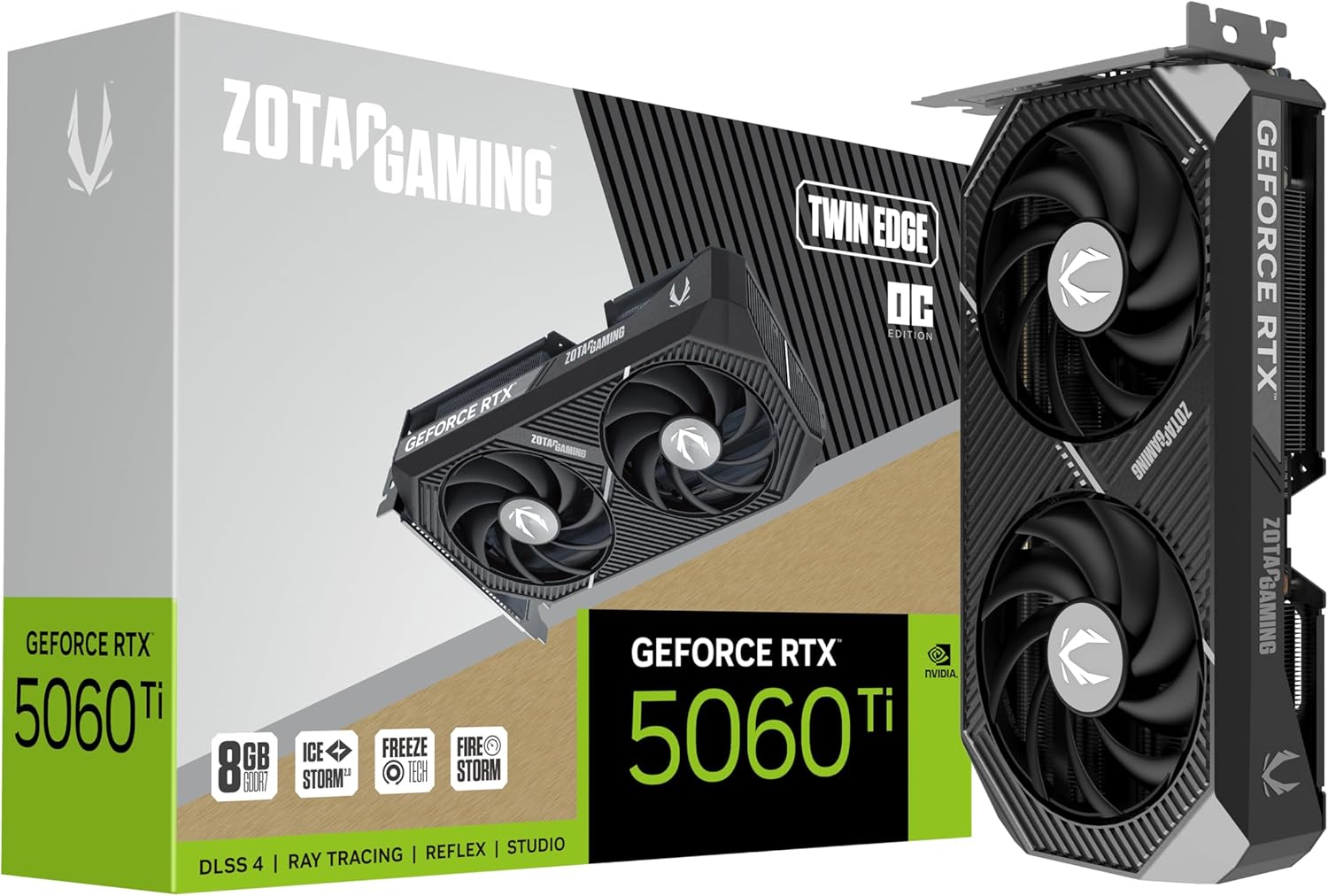
ZOTAC Gaming GeForce RTX 5060 Ti 8GB Twin Edge OC DLSS 4 8GB GDDR7 128-bit 28 Gbps PCIE 5.0 Gaming Graphics Card, IceStorm 2.0 Cooling, SFF-Ready, ZT-B50610H-10A
$300-$599This is a compact, 2-slot RTX 5060 Ti with 8GB GDDR7 and a 2602 MHz clock, built for SFF gaming rigs.