
ASRock Challenger Radeon RX 7800 XT OC RX7800XT CL 16GO 16GB GDDR6-90-GA4SZZ-00UANF
Want the best price and purchase timing?
Our AI advisor analyzes real-time pricing across all channels to find you the best deal.
AI Verdict
This is a barebones, dual-fan 1440p workhorse that trades premium cooling for a compact footprint, perfect for smaller cases if you don't mind tweaking fan curves.
This card crams a massive 16GB of VRAM and a 256-bit memory bus into a smaller dual-fan shroud. It dominates 1440p gaming, but the reduced heatsink mass means it runs hotter and louder than its triple-fan siblings.
If you have the physical case space, look for a triple-fan 7800 XT model to drop hotspot temperatures by 10-15°C.
Regret Score™
Medium RiskLower is better — measures purchase-regret risk from real buyer complaints, review credibility, and product maturity
Issues discovered after purchase
Critically weak dimension
Amazon rating vs actual quality
Chance this product isn't for you
Pros
- Pushes 1440p ultra settings easily thanks to the 2475 MHz boost clock and 60 RDNA 3 compute units.
- 16GB of GDDR6 VRAM prevents texture pop-in on modern memory-hungry titles.
- Dual-fan design fits into compact micro-ATX cases where triple-fan cards physically cannot.
- 0dB silent cooling mode completely stops the fans during desktop browsing and media playback.
- Includes three DisplayPort 2.1 outputs for next-gen high refresh rate monitors.
Cons
- Hotspot temperatures hit 97°C to 104°C under heavy load due to the smaller dual-fan heatsink.
- Noticeable coil whine kicks in during high-fps menus or heavy rendering tasks.
- Virtually zero manual overclocking headroom beyond the factory 2475 MHz boost.
- ASRock's RGB software is clunky and fails to minimize to the system tray properly.
Dimension Scores
Delivers consistent 60+ FPS at 1440p ultra settings across modern AAA titles.
The dual-fan cooler struggles with the 267W board power, leading to hotspot temps over 95°C and noticeable fan noise.
Pulls around 260W under full load, which is standard for this tier but requires two dedicated 8-pin PCIe cables.
16GB of GDDR6 on a 256-bit bus provides massive bandwidth and future-proofs against memory-heavy game engines.
Best For
- 1440p gaming in compact micro-ATX or mini-ITX cases with strict GPU length limits.
- Maxing out texture settings in modern RPGs using the 16GB VRAM buffer.
- Undertaking manual undervolting to drop temperatures and fan noise.
Not Recommended For
- Pushing maximum benchmark scores through manual overclocking.
- Silent PC builds requiring zero coil whine under heavy load.
Watch Out For
- Hotspot delta temperatures are wide — your main GPU temp might say 70°C, but the hotspot can easily cross 100°C during intense gaming.
- Coil whine is a lottery here — expect a distinct buzzing sound when pushing high frame rates or rendering in Blender.
- Driver stability requires work — expect potential green screen crashes until you update your motherboard BIOS and run DDU to install fresh AMD drivers.
- The factory fan curve is too relaxed, letting the card get unnecessarily hot unless you manually set an aggressive curve in Adrenalin.
Full Specifications
| ASIN | B0CHK3929K |
| Brand | ASRock |
| Color | Black |
| Series | RX7800XT CL 16GO |
| Language | English |
| Item Weight | 2.2 pounds |
| Manufacturer | Asrock |
| Memory Speed | 19500 MHz |
| Chipset Brand | AMD |
| Card Description | Exclusive |
| Graphics Ram Size | 16 GB |
| Item model number | RX7800XT CL 16GO |
| Product Dimensions | 19.69 x 19.69 x 0.1 inches |
| Computer Memory Type | DIMM |
| Graphics Coprocessor | AMD Radeon RX 7800 XT |
| Max Screen Resolution | 7680x4320 Pixels |
| Graphics Card Ram Size | 16 GB |
| Item Dimensions LxWxH | 19.69 x 19.69 x 0.1 inches |
| Video Output Interface | DisplayPort, HDMI |
| Graphics Processor Manufacturer | AMD |
What Buyers Say
Forum threads constantly highlight the massive gap between the edge temperature and the hotspot temperature, often showing a 30°C difference under load. You absolutely have to undervolt this card and tweak the fan curve to keep it tame. The compact dual-fan design acts as a lifesaver for small form factor builds, sliding into cases that reject triple-fan monsters. Once dialed in, it chews through 1440p games without breaking a sweat. Just prepare to play the coil whine lottery, as many units buzz audibly during high-framerate menus.
“Hotspot hits 102C in Cyberpunk and the coil whine sounds like a tiny angry bee but honestly it crushes 1440p so I just put my headphones on and ignore it.”
Common Praise
- Fits perfectly into older mid-tower and micro-ATX cases without needing a GPU support bracket.
- Chews through 1440p ultra settings at 100+ FPS in games like Cyberpunk 2077.
- Fans shut off completely during desktop use, keeping the room quiet while working.
- 16GB VRAM completely eliminates the texture loading stutters seen on 8GB and 12GB cards.
Common Complaints
- Hotspot temperatures routinely spike past 95°C during extended gaming sessions.
- Coil whine buzzes loudly when rendering in Blender or sitting in uncapped game menus.
- The plastic shroud feels cheap and flimsy compared to metal-heavy competitor cards.
- Green screen crashes happen frequently until you update your motherboard BIOS.
Ownership Tips
- Undervolting the card by 25mV in the Adrenalin software drops the power draw by 20W and noticeably reduces fan noise.
- The ASRock RGB software conflicts with other motherboard lighting tools, so it's best to set a static color and uninstall it.
- You will need to prop open your case side panel if your front intake fans aren't pushing enough air straight into the GPU.
- The DisplayPort 2.1 connections are great, but you need to buy a certified DP 2.1 cable separately to actually use the bandwidth.
Frequently Asked Questions
Does this card run hot with only two fans?
Yes, the hotspot temperature can reach 100°C under heavy load. You need to set a custom fan curve in the AMD Adrenalin software to keep it in check.
Will this fit in a micro-ATX case?
Absolutely. The dual-fan design is significantly shorter than most 7800 XT models, making it an easy fit for smaller builds.
Is the 16GB of VRAM actually necessary for 1440p?
Yes, modern games are already allocating over 12GB of VRAM at 1440p ultra settings. The 16GB buffer stops texture pop-in and stuttering.
Can I overclock this card?
Barely. The factory overclock already pushes the silicon near its limit, and the dual-fan cooler lacks the thermal headroom for more voltage.
Why am I getting green screen crashes?
This is a known issue with older motherboard firmware. Update your motherboard BIOS to the latest version and use DDU to reinstall the AMD drivers.
Does the 0dB fan mode actually work?
Yes, the fans completely stop spinning when you are just browsing the web or watching YouTube, making the card dead silent.
Buying Guide
You are buying the engine of a sports car crammed into the body of a compact sedan. The silicon inside this card is incredibly powerful for 1440p gaming, but the smaller dual-fan cooler has to work overtime to dissipate the heat. You need to be comfortable opening the AMD software to undervolt the chip and adjust the fan speeds. Make sure your power supply has two separate 8-pin PCIe cables, as daisy-chaining a single cable will cause power delivery crashes.
16GB GDDR6 VRAM
Think of VRAM as the desk space your GPU uses to lay out game textures. 16GB is a massive desk, meaning the game never has to pause to fetch more textures from your hard drive.
64MB Infinity Cache
This is a super-fast VIP lane right next to the GPU core. It holds the most frequently used data so the card doesn't have to wait for the main VRAM, drastically speeding up frame generation.
DisplayPort 2.1
This is the pipe that sends the video to your monitor. Version 2.1 is wide enough to push 4K resolution at 240Hz without compressing the image quality.
Alternatives
If you have the physical space in your case, search for a triple-fan graphics card with the same 16GB VRAM and 256-bit bus to get significantly lower temperatures and quieter operation.
You Might Also Like

HP NVIDIA GeForce RTX 3070 8GB OEM Graphics Card (Renewed)
$150-$299This is a renewed HP OEM NVIDIA GeForce RTX 3070 with 8GB VRAM, a gamble for budget-conscious 1440p gamers who understand the risks of refurbished hardware.

ZOTAC Gaming GeForce RTX 5070 Twin Edge OC DLSS 4 12GB GDDR7 192-bit 28 Gbps PCIE 5.0 Gaming Graphics Card, IceStorm 2.0 Cooling, SFF-Ready, ZT-B50700H-10A
$600+This is a 2-slot, SFF-ready NVIDIA RTX 5070 with 12GB GDDR7 and a 2542 MHz boost clock, built for compact gaming rigs needing high 1440p performance.

ZOTAC Gaming GeForce RTX 5080 Solid CORE OC DLSS 4 16GB GDDR7 256-bit 30 Gbps PCIE 5.0 Gaming Graphics Card, IceStorm 3.0 Advanced Cooling, Spectra RGB Lighting, ZT-B50800J2-10A
$600+This ZOTAC RTX 5080 with 16GB GDDR7 and a 2640 GHz clock speed is built for high-end 4K gaming and content creation on the NVIDIA Blackwell architecture.
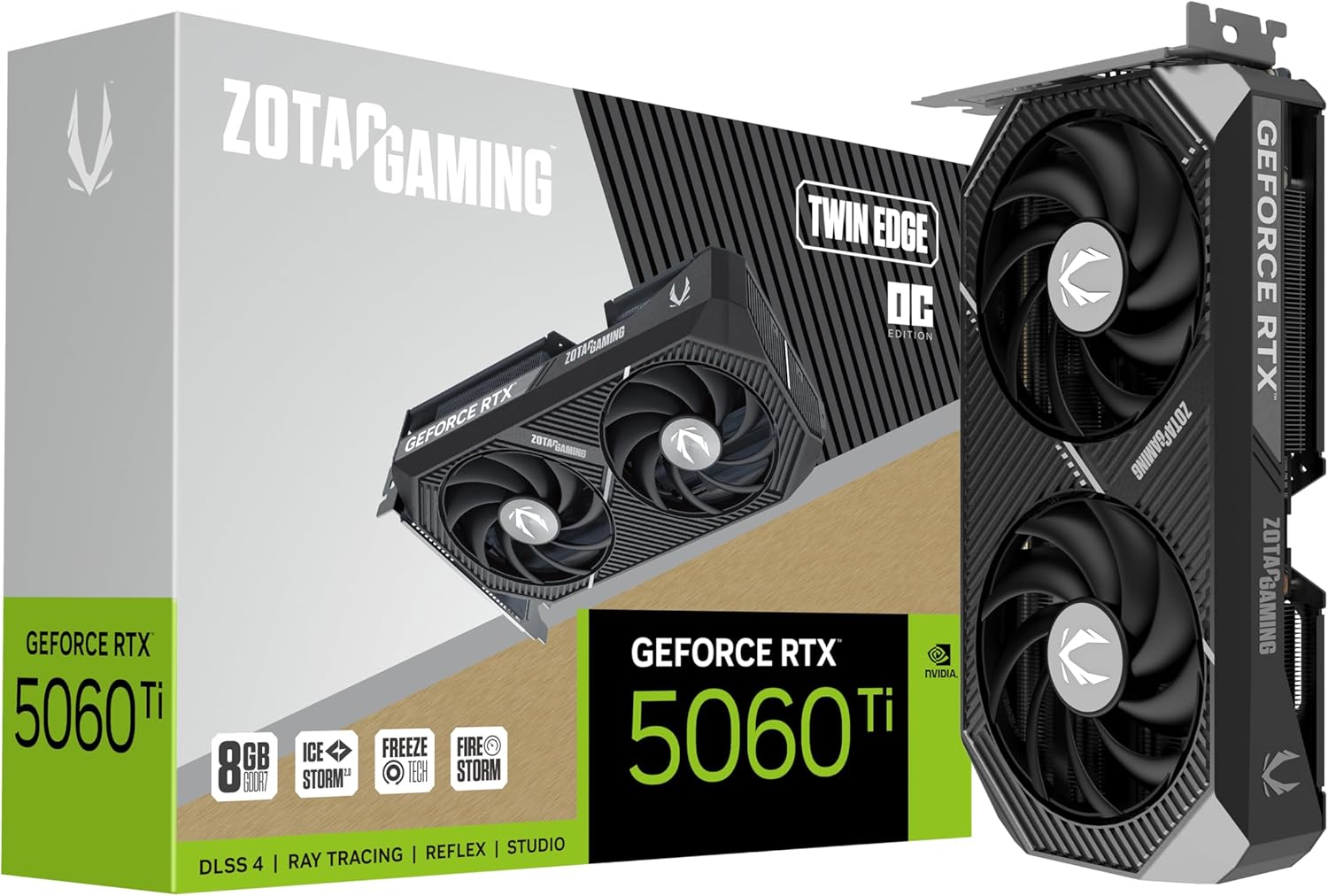
ZOTAC Gaming GeForce RTX 5060 Ti 8GB Twin Edge OC DLSS 4 8GB GDDR7 128-bit 28 Gbps PCIE 5.0 Gaming Graphics Card, IceStorm 2.0 Cooling, SFF-Ready, ZT-B50610H-10A
$300-$599This is a compact, 2-slot RTX 5060 Ti with 8GB GDDR7 and a 2602 MHz clock, built for SFF gaming rigs.