
GIGABYTE Radeon RX 7800 XT Gaming OC 16GB Graphics Card - 16GB GDDR6 256-bit, Windforce Cooling System, Metal Back Plate, DP 2.1, HDMI 2.1, AMD RDNA 3 Architecture, GV-R78XTGAMING OC-16GD
Want the best price and purchase timing?
Our AI advisor analyzes real-time pricing across all channels to find you the best deal.
AI Verdict
This is a massive, 1440p powerhouse that runs dead silent during light tasks, but you'll want to flip it to the Silent BIOS to avoid its noisy fans under heavy load.
The massive heatsink and 16GB of VRAM make this a brute-force solution for 1440p gaming that will last years. You just have to be willing to tweak the fan curve or use the Silent BIOS to bypass Gigabyte's loud stock fan tuning. It physically demands a large ATX case and a sturdy motherboard.
If you care heavily about ray tracing performance or DLSS 3, look for an RTX 4070 Super instead.
Regret Score™
Medium RiskLower is better — measures purchase-regret risk from real buyer complaints, review credibility, and product maturity
Issues discovered after purchase
Critically weak dimension
Amazon rating vs actual quality
Chance this product isn't for you
Pros
- Massive heatsink keeps the card in 0 RPM mode for all non-gaming tasks, staying under 60°C
- Pushes 100+ FPS at 1440p in modern titles like Cyberpunk 2077 without relying on upscaling
- Physical dual BIOS switch lets you instantly toggle to a Silent profile to tame the aggressive 3000 RPM factory fan curve
- 16GB of VRAM on a 256-bit bus provides plenty of texture headroom for unoptimized console ports
Cons
- Sleeve bearing fans produce a distinct, annoying hum when spinning past 1500 RPM
- Coil whine is a frequent lottery issue with this specific Gigabyte board design
- Gigabyte Control Center software often fails to detect the card, leaving you stuck with default cycling RGB
- At 302mm long and 2.7 slots thick, it requires a spacious case and sags heavily without a bracket
Dimension Scores
Easily clears 100+ FPS at 1440p in modern rasterized games without breaking a sweat.
The massive heatsink keeps temps under 60°C, but the sleeve bearing fans are obnoxiously loud past 1500 RPM.
Pulls around 263W under load, which is noticeably higher than competing Nvidia cards in this tier.
16GB of GDDR6 on a 256-bit bus provides massive headroom for unoptimized console ports.
Best For
- 1440p gamers who want to max out rasterization settings without touching upscaling
- Silent PC builders who only want fan noise when actively rendering heavy 3D loads
- Upgraders coming from 8GB cards like the RTX 3060 Ti or RX 5700 XT who are hitting VRAM limits
Not Recommended For
- Small form factor (ITX) builds due to the massive 302mm length and 2.7-slot thickness
- Heavy ray tracing users who want playable framerates in Cyberpunk Overdrive mode
Watch Out For
- The default OC BIOS fan curve is incredibly aggressive — flip the physical switch to Silent BIOS before you even install it.
- Gigabyte's RGB software is notoriously buggy; you might be stuck with the default rainbow cycle if it refuses to detect the GPU.
- It doesn't come with an anti-sag bracket in the box, and at this weight, it will bend your PCIe slot over time without one.
- If you run multiple high-refresh-rate monitors, the RDNA 3 architecture often draws 30W+ at idle, preventing the fans from turning off.
Full Specifications
| ASIN | B0CGRMJF6C |
| Brand | GIGABYTE |
| Color | Black |
| Series | GV-R78XTGAMING OC-16GD |
| Language | English |
| Item Weight | 3.3 pounds |
| Manufacturer | GIGABYTE |
| Memory Speed | 19500 MHz |
| Chipset Brand | AMD |
| Card Description | Dedicated |
| Graphics Ram Size | 16 GB |
| Hardware Platform | Not Machine Specific |
| Item model number | GV-R78XTGAMING OC-16GD |
| Graphics Coprocessor | AMD Radeon RX 7800 XT |
| Max Screen Resolution | 7680x4320 |
| Graphics Card Ram Size | 16 GB |
| Video Output Interface | HDMI |
| Graphics Processor Manufacturer | AMD |
What Buyers Say
The zero RPM mode on this card is practically magic because the massive heatsink passively cools the GPU during web browsing and video playback. Once you launch a game, the stock fan curve ramps up aggressively and the sleeve bearing fans get whiny past 1500 RPM. Owners overwhelmingly recommend flipping the physical dual BIOS switch to 'Silent' before you even slot it into your motherboard. Coil whine is a frequent lottery issue, with many users undervolting via AMD Adrenalin to keep the buzzing in check. Gigabyte's Control Center software is universally despised for failing to detect the card's RGB lighting.
“Upgraded from a 5700xt and the 1440p performance is night and day, but my god these fans sound like a jet engine until you flip the silent bios switch.”
Common Praise
- Zero RPM mode stays active indefinitely during non-gaming tasks due to the oversized heatsink
- Consistently hits 100+ FPS at 1440p Ultra in heavy titles without needing upscaling
- Physical dual BIOS switch makes it easy to drop noise levels without messing with software
- Temperatures rarely exceed 65°C even during sustained benchmark loops
Common Complaints
- Sleeve bearing fans produce a distinct, annoying hum when spinning above 1500 RPM
- Coil whine is very common and audible through mesh PC cases under heavy load
- Gigabyte Control Center software frequently fails to recognize the GPU to change the RGB
- The sheer weight of the card causes noticeable GPU sag if you don't buy a separate support bracket
Ownership Tips
- The default RGB is a cycling rainbow, and if the buggy software doesn't detect your card, you're stuck with it forever.
- Undervolting the card in AMD Adrenalin drops power draw by 30W and almost entirely eliminates the coil whine.
- The card is so heavy that even reinforced PCIe slots will start to bend after a few weeks without a support bracket.
Frequently Asked Questions
Does this card have coil whine?
Yes, many owners report noticeable coil buzz under heavy load. Undervolting the card via AMD Adrenalin or capping your framerate can significantly reduce the noise.
Will this fit in a mid-tower case?
At 302mm long and 2.7 slots thick, it fits most modern mid-towers. You need to measure your front clearance if you have a front-mounted AIO radiator.
Do I need to use the Gigabyte Control Center software?
No, and you probably shouldn't. Most owners use AMD's Adrenalin software for tuning and ignore GCC entirely due to its buggy RGB detection.
What power supply do I need for this?
Gigabyte recommends a 700W PSU. The card draws around 263W under full load, so a high-quality 650W or 700W unit is the safe minimum.
How is the ray tracing performance?
It handles light ray tracing at 1440p fine. It falls significantly behind Nvidia's RTX 4070 in heavy RT titles like Cyberpunk 2077.
Buying Guide
You're buying a brute-force 1440p graphics card that relies on a massive heatsink instead of elegant power efficiency. To get the most out of this specific Gigabyte model, you need to be comfortable tweaking a few things out of the box. Ignore the Gigabyte software entirely and use AMD's Adrenalin app to undervolt the core and set a custom fan curve. Grab a tape measure before ordering — this card is nearly a foot long and will block access to lower motherboard slots.
16GB GDDR6 VRAM
Think of VRAM like a kitchen counter; 16GB gives the game a massive workspace to load ultra-high-resolution textures without stuttering or crashing.
256-bit Memory Bus
This is the highway connecting the VRAM to the GPU core. A 256-bit bus means four lanes of traffic instead of two, preventing bottlenecks at 1440p and 4K.
Dual BIOS Switch
A physical switch on the card that lets you choose between a high-performance, loud fan profile and a quieter, slightly warmer profile without installing any software.
Alternatives
If you want better ray tracing performance, lower power draw, and DLSS upscaling, look for an Nvidia RTX 4070 Super with 12GB of VRAM.
You Might Also Like

HP NVIDIA GeForce RTX 3070 8GB OEM Graphics Card (Renewed)
$150-$299This is a renewed HP OEM NVIDIA GeForce RTX 3070 with 8GB VRAM, a gamble for budget-conscious 1440p gamers who understand the risks of refurbished hardware.

ZOTAC Gaming GeForce RTX 5070 Twin Edge OC DLSS 4 12GB GDDR7 192-bit 28 Gbps PCIE 5.0 Gaming Graphics Card, IceStorm 2.0 Cooling, SFF-Ready, ZT-B50700H-10A
$600+This is a 2-slot, SFF-ready NVIDIA RTX 5070 with 12GB GDDR7 and a 2542 MHz boost clock, built for compact gaming rigs needing high 1440p performance.

ZOTAC Gaming GeForce RTX 5080 Solid CORE OC DLSS 4 16GB GDDR7 256-bit 30 Gbps PCIE 5.0 Gaming Graphics Card, IceStorm 3.0 Advanced Cooling, Spectra RGB Lighting, ZT-B50800J2-10A
$600+This ZOTAC RTX 5080 with 16GB GDDR7 and a 2640 GHz clock speed is built for high-end 4K gaming and content creation on the NVIDIA Blackwell architecture.
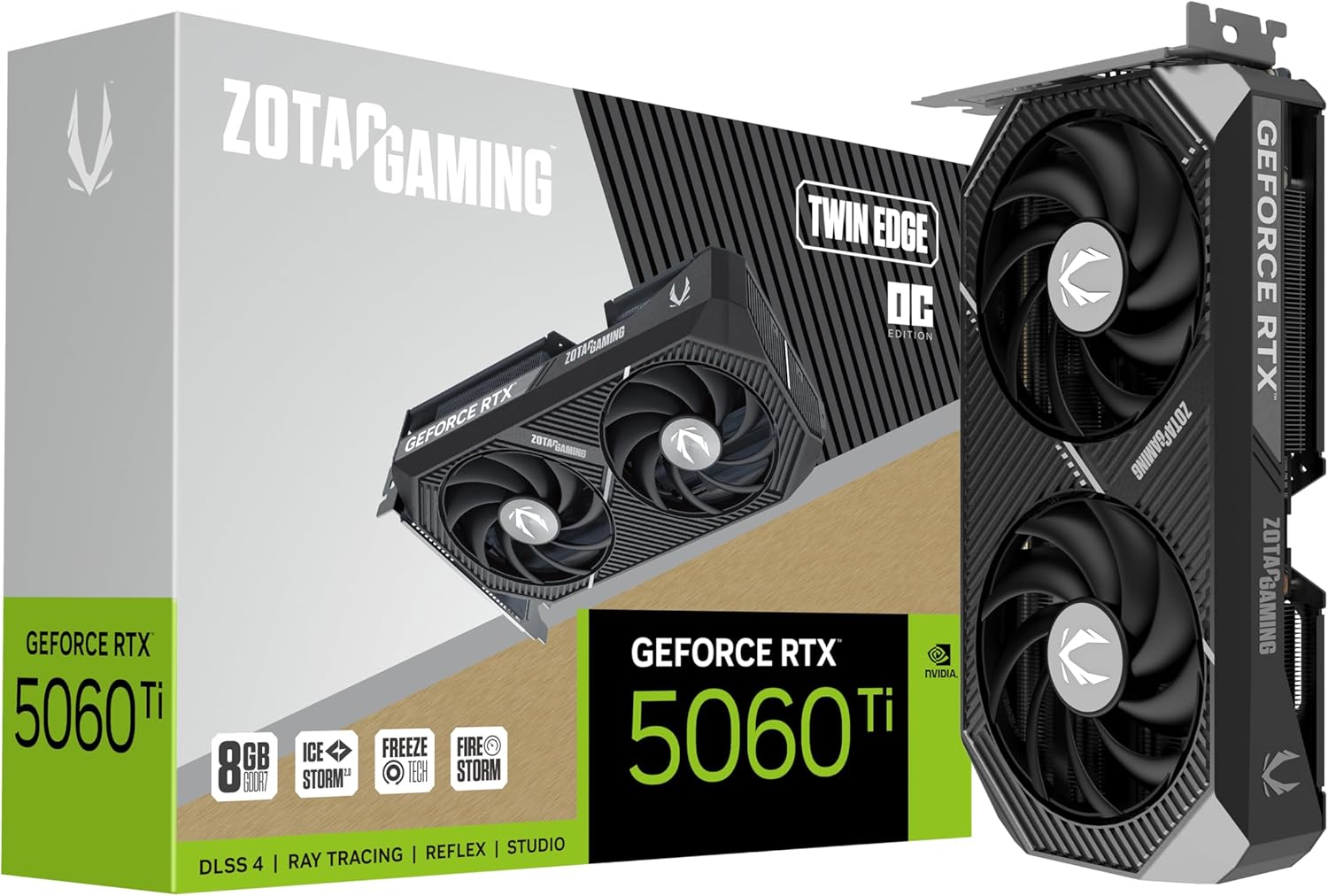
ZOTAC Gaming GeForce RTX 5060 Ti 8GB Twin Edge OC DLSS 4 8GB GDDR7 128-bit 28 Gbps PCIE 5.0 Gaming Graphics Card, IceStorm 2.0 Cooling, SFF-Ready, ZT-B50610H-10A
$300-$599This is a compact, 2-slot RTX 5060 Ti with 8GB GDDR7 and a 2602 MHz clock, built for SFF gaming rigs.