
ASRock AMD Radeon RX 7600 Challenger 8GB OC GDDR6 DisplayPort HDMI 0dB Silent Cooling Graphics Card 128-bit 7680 x 4320 18 Gbps Graphics Card
Want the best price and purchase timing?
Our AI advisor analyzes real-time pricing across all channels to find you the best deal.
AI Verdict
This compact 269mm dual-fan GPU pushes 60+ FPS in modern 1080p titles, but the strict 8GB VRAM limit chokes on 1440p resolutions.
This card drops perfectly into 1080p systems with 550W power supplies. The 8GB memory bus and x8 PCIe lane restrict its lifespan for anyone pushing higher resolutions or ultra textures.
If you plan to upgrade to a 1440p monitor, look for a card with 12GB or 16GB of VRAM and a 192-bit memory bus.
Regret Score™
Medium RiskLower is better — measures purchase-regret risk from real buyer complaints, review credibility, and product maturity
Issues discovered after purchase
Critically weak dimension
Amazon rating vs actual quality
Chance this product isn't for you
Pros
- Averages 60 to 90 FPS in modern AAA titles at 1080p High settings
- Compact 269mm dual-slot design fits easily into older cases and micro-ATX builds
- 0dB silent cooling completely stops the fans during web browsing and light desktop use
- Includes hardware AV1 encoding for high-quality, low-bandwidth Twitch or YouTube streaming
- Only requires a single 8-pin power connector and a 550W power supply
Cons
- 8GB of VRAM causes texture pop-in and stuttering in newer titles at maximum settings
- Wired for PCIe 4.0 x8, which bottlenecks performance by 2-5% on older PCIe 3.0 motherboards
- Under sustained 100% load, the dual fans spin aggressively to keep the hotspot under 80°C
- Uses DisplayPort 1.4a instead of the newer DisplayPort 2.1 found on the XT variant
Dimension Scores
Pushes 89 FPS in Assassin's Creed Valhalla at 1080p but falls off at 1440p due to memory limits.
The dual-fan cooler keeps the die at 65°C, but requires aggressive, audible fan curves to do so.
Maxes out around 165W, running easily on older 550W power supplies.
8GB is the bare minimum for modern gaming and struggles with unoptimized console ports.
Best For
- 1080p gamers upgrading from older 6GB or 8GB cards who want higher frame rates
- Small form factor (SFF) or micro-ATX builds needing a card under 270mm long
- Streamers who want AV1 encoding for Discord or Twitch
Not Recommended For
- 1440p or 4K gaming where 8GB of VRAM is instantly maxed out
- Upgraders with older PCIe 3.0 motherboards who want maximum bandwidth
Watch Out For
- The PCIe connection is physically x16 but electrically x8 — installing this in a PCIe 3.0 board drops a few frames per second due to bandwidth limits.
- The 8GB VRAM buffer fills up fast; you need to manually lower texture settings in modern AAA games to avoid severe stuttering.
- The factory overclock is negligible at 2695 MHz versus the 2655 MHz reference, yielding no meaningful performance bump.
Full Specifications
| ASIN | B0C626FFG2 |
| Brand | ASRock |
| Color | Black |
| Series | RX7600 CL 8GO |
| Item Weight | 2 pounds |
| Manufacturer | ASRock |
| Chipset Brand | AMD |
| Card Description | ASRock RX 7600 CL 8GO OC with 8GB GDDR6X memory, 1770MHz clock rate and HDMI/DisplayPort output |
| Graphics Ram Size | 8 GB |
| Item model number | RX7600 CL 8GO |
| Computer Memory Type | DIMM |
| Graphics Coprocessor | AMD Radeon RX 7600 |
| Max Screen Resolution | 7680x4320 |
| Graphics Card Ram Size | 8 GB |
| Video Output Interface | DisplayPort, HDMI |
| Graphics Processor Manufacturer | AMD |
What Buyers Say
Upgraders coming from aging 10-series and 500-series GPUs report massive frame rate jumps at 1080p. The compact 269mm length makes installation simple in cramped pre-built cases. Desktop work stays dead silent thanks to the 0dB fan mode shutting off the rotors completely. The honeymoon phase ends when cranking textures to 'Ultra' in modern games, quickly hitting the 8GB VRAM wall. Several owners noted the fans get surprisingly whiny when the hotspot crosses 80°C.
“Upgraded from my dying 1060 and it crushes 1080p gaming, but the fans sound like a tiny jet engine when I play Cyberpunk and 8gb vram is already feeling cramped.”
Common Praise
- Massive FPS jump for older 1080p systems without needing a PSU upgrade
- Fits perfectly in cramped micro-ATX and older pre-built cases
- Fans completely shut off while browsing YouTube or working
- AV1 encoder makes a noticeable difference for Discord streaming
Common Complaints
- 8GB VRAM causes stuttering in heavy games unless textures are turned down
- Fans get loud and whiny when the GPU is pushed to 100% utilization
- Performance drops slightly on older PCIe 3.0 motherboards
- No RGB lighting for those who want a flashy case interior
Ownership Tips
- You need to manually tweak the fan curve in AMD Adrenalin to balance the noise-to-temperature ratio.
- Turning on AMD Smart Access Memory (SAM) in your BIOS provides a free 5-10% FPS boost in most games.
- The factory overclock is barely noticeable; undervolting the card actually yields better sustained clock speeds.
Frequently Asked Questions
Does this card need a massive power supply?
No, it pulls about 165W under full load. A standard 550W PSU with a single 8-pin PCIe cable is plenty.
Will this bottleneck on a PCIe 3.0 motherboard?
Yes, slightly. Because it only uses 8 PCIe lanes, running it on Gen 3 costs roughly 2-5% performance in bandwidth-heavy games.
Are the fans loud?
They stay completely off during desktop use. During heavy gaming, they spin up and become audible, keeping the core around 60-65°C and the hotspot near 80°C.
Can I use this for streaming?
Yes. The RDNA 3 architecture includes hardware AV1 encoding, which provides excellent stream quality at lower bitrates.
Does it have RGB lighting?
No, the ASRock Challenger is a stealthy, all-black card with a metal backplate and zero RGB LEDs.
Buying Guide
When buying a graphics card today, you are choosing between raw speed and future-proofing. This card gives you excellent speed for standard HD (1080p) monitors right now. Because it only has 8GB of memory, you will have to lower the visual settings in games released over the next few years. Make sure your motherboard supports PCIe 4.0 to get every drop of performance out of it.
8GB GDDR6 VRAM
Think of VRAM like a desk for your game's textures. 8GB is a small desk; it holds 1080p textures fine, but 1440p or 4K textures spill over and cause the game to stutter.
PCIe 4.0 x8 Interface
This is the highway connecting the GPU to your motherboard. It only uses 8 lanes instead of the usual 16, so if your motherboard has an older, slower highway (PCIe 3.0), traffic jams slightly lower your frame rate.
AV1 Encoding
This is a video compression format. It lets you stream high-quality video to Twitch or YouTube using less internet bandwidth, making your stream look less pixelated to viewers.
Alternatives
If you want to play at 1440p or keep your textures on Ultra for the next five years, search for a GPU with at least 12GB or 16GB of VRAM and a 192-bit memory bus.
You Might Also Like

HP NVIDIA GeForce RTX 3070 8GB OEM Graphics Card (Renewed)
$150-$299This is a renewed HP OEM NVIDIA GeForce RTX 3070 with 8GB VRAM, a gamble for budget-conscious 1440p gamers who understand the risks of refurbished hardware.

ZOTAC Gaming GeForce RTX 5070 Twin Edge OC DLSS 4 12GB GDDR7 192-bit 28 Gbps PCIE 5.0 Gaming Graphics Card, IceStorm 2.0 Cooling, SFF-Ready, ZT-B50700H-10A
$600+This is a 2-slot, SFF-ready NVIDIA RTX 5070 with 12GB GDDR7 and a 2542 MHz boost clock, built for compact gaming rigs needing high 1440p performance.

ZOTAC Gaming GeForce RTX 5080 Solid CORE OC DLSS 4 16GB GDDR7 256-bit 30 Gbps PCIE 5.0 Gaming Graphics Card, IceStorm 3.0 Advanced Cooling, Spectra RGB Lighting, ZT-B50800J2-10A
$600+This ZOTAC RTX 5080 with 16GB GDDR7 and a 2640 GHz clock speed is built for high-end 4K gaming and content creation on the NVIDIA Blackwell architecture.
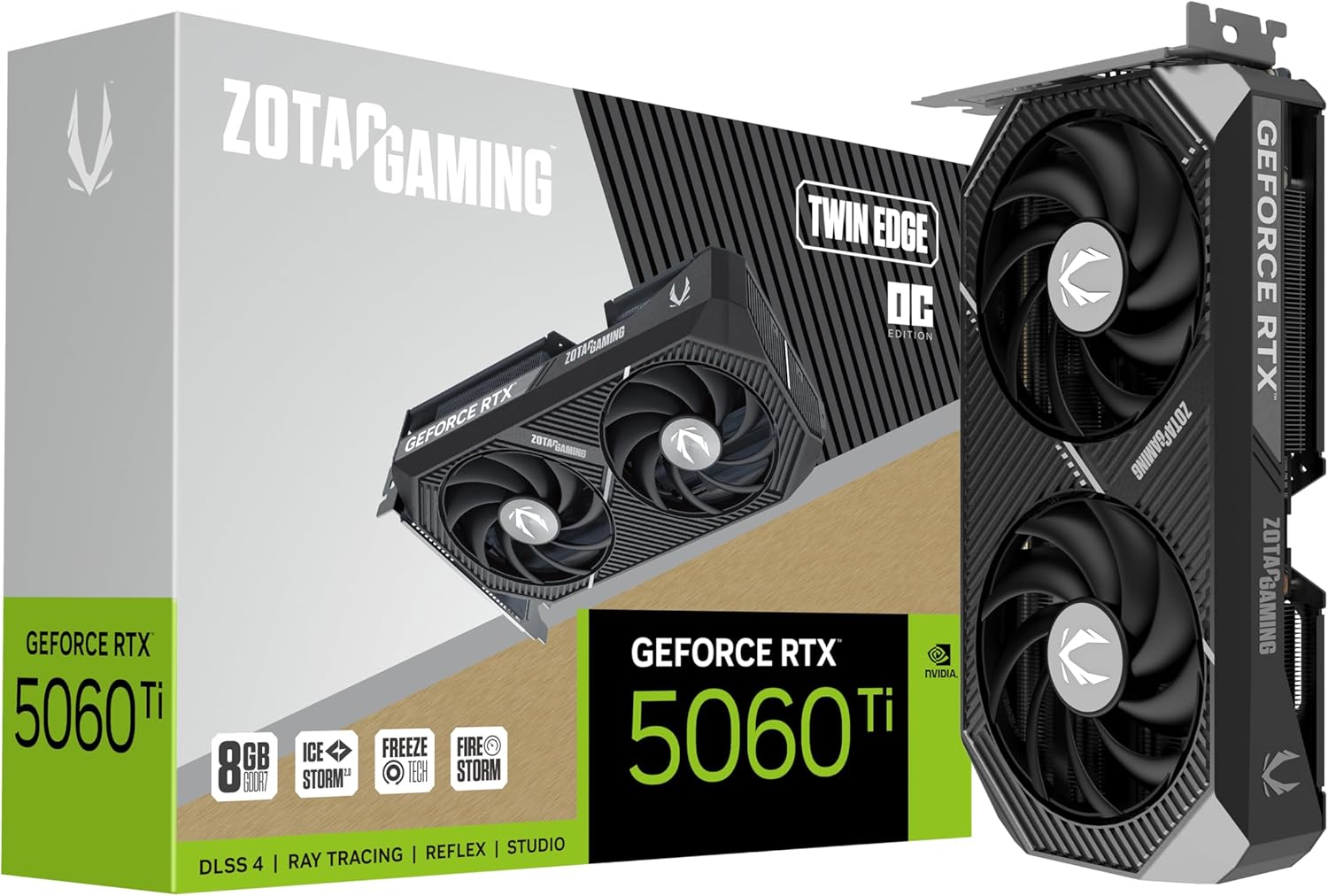
ZOTAC Gaming GeForce RTX 5060 Ti 8GB Twin Edge OC DLSS 4 8GB GDDR7 128-bit 28 Gbps PCIE 5.0 Gaming Graphics Card, IceStorm 2.0 Cooling, SFF-Ready, ZT-B50610H-10A
$300-$599This is a compact, 2-slot RTX 5060 Ti with 8GB GDDR7 and a 2602 MHz clock, built for SFF gaming rigs.