
ASRock AMD Radeon RX 7900 XTX Phantom Gaming 24GB OC GDDR6 Graphics Card DisplayPort HDMI 384-Bit
Want the best price and purchase timing?
Our AI advisor analyzes real-time pricing across all channels to find you the best deal.
AI Verdict
This card delivers massive 24GB VRAM and 4K gaming performance, but you'll have to tolerate screaming coil whine and 100°C hotspot temperatures.
You get top-tier 7900 XTX performance, but the cooling solution cuts corners. It requires manual undervolting to keep hotspot temperatures below 100°C and tame the 400W power draw.
If you want a quiet 7900 XTX out of the box, look for models featuring a vapor chamber cooler.
Regret Score™
Low RiskLower is better — measures purchase-regret risk from real buyer complaints, review credibility, and product maturity
Issues discovered after purchase
Critically weak dimension
Amazon rating vs actual quality
Chance this product isn't for you
Pros
- Pushes 4K resolution easily with its 24GB of GDDR6 VRAM and 2615MHz boost clock.
- Includes three DisplayPort 2.1 connections for next-gen high-refresh monitors.
- Physical LED switch on the PCB lets you disable RGB without installing software.
- Fits in some SFF cases like the Fractal Ridge if you swap to 15mm slim fans.
Cons
- Notorious for severe coil whine when pushing past 144 FPS in games like Apex Legends.
- Hotspot temperatures regularly hit 100°C to 110°C under heavy load due to a weak factory cooler.
- Pulls over 400W at stock settings, requiring at least a high-quality 850W or 1000W power supply.
- Measures 330mm long and takes up 2.8 PCIe slots, blocking lower motherboard connections.
Dimension Scores
Matches top-tier rasterization with 96 RDNA 3 compute units and a 2615MHz boost clock.
The Phantom Gaming 3X cooler struggles, resulting in 100°C+ hotspots and loud coil whine under load.
Consumes over 400W at stock settings and requires three 8-pin connectors.
24GB of GDDR6 on a 384-bit bus is enough for heavy 4K gaming and rendering for years.
Best For
- 4K gamers who play with headphones on to block out coil whine.
- PC builders willing to manually undervolt the core to manage temperatures.
- Creators needing 24GB of VRAM for rendering large 3D scenes.
Not Recommended For
- Silent PC enthusiasts building in mesh cases.
- Plug-and-play users who refuse to mess with custom fan curves and undervolting.
Watch Out For
- The coil whine is aggressive at high framerates — you will hear it buzzing loudly in game menus unless you cap your FPS to your monitor's refresh rate.
- Factory thermal paste application is inconsistent, leading to massive 30°C+ deltas between the GPU edge temperature and the hotspot.
- You need three separate 8-pin PCIe power cables — daisy-chaining cables will cause crashes and make the coil whine even worse.
Full Specifications
| ASIN | B0BTPK5J68 |
| Brand | ASRock |
| Color | Black |
| Series | RX7900XTX PG 24GO |
| Item Weight | 3.42 pounds |
| Manufacturer | ASRock |
| Memory Speed | 20000 MHz |
| Chipset Brand | AMD |
| Card Description | Dedicated |
| Graphics Ram Size | 24 GB |
| Item model number | RX7900XTX PG 24GO |
| Product Dimensions | 12.99 x 5.51 x 0.1 inches |
| Graphics Coprocessor | AMD Radeon RX 7900 XTX |
| Max Screen Resolution | 7680x4320 Pixels |
| Graphics Card Ram Size | 24 GB |
| Item Dimensions LxWxH | 12.99 x 5.51 x 0.1 inches |
| Video Output Interface | DisplayPort, HDMI |
| Graphics Processor Manufacturer | AMD |
What Buyers Say
The thermal performance and acoustic profile dominate user discussions about this card. Buyers consistently report massive coil whine that kicks in the second framerates exceed 144 FPS. The factory thermal paste application seems hit-or-miss, with many owners seeing hotspot temperatures climb straight to 110°C while the edge temperature sits at a cool 70°C. Those who take the time to undervolt the core to 1100mV and set an aggressive fan curve end up happy with the raw 4K framerates. It delivers flagship performance, but you have to do the tuning ASRock skipped at the factory.
“The coil whine sounds like a tiny dentist drill when I play Apex at 240fps, and the hotspot hits 105C out of the box, but I undervolted it and now it crushes 4K.”
Common Praise
- Chews through 4K gaming at max settings without stuttering thanks to the 24GB VRAM buffer.
- Physical LED switch on the board lets you kill the RGB without installing bloatware.
- Fits into some SFF cases like the Fractal Ridge with 15mm slim fans.
- Maintains high boost clocks of 2615MHz when thermal limits are managed.
Common Complaints
- Screaming coil whine in game menus or anytime framerates uncap.
- Hotspot temperatures regularly hit 100°C to 110°C under sustained load.
- Fans get extremely loud when ramping past 2000 RPM to fight the hotspot temps.
- Requires three dedicated 8-pin power cables, making cable management bulky.
Ownership Tips
- Coil whine sometimes lessens after a few weeks of heavy use, but never disappears entirely.
- Undervolting the core to 1100mV and dropping the power limit by 10% drops hotspot temps by 15°C without losing FPS.
- Daisy-chaining the PCIe power cables will cause random black screen crashes under heavy load.
- The center fan spins in reverse to reduce turbulence, but the shroud still exhausts a ton of heat directly against the motherboard.
Frequently Asked Questions
Does this card have coil whine?
Yes, it's a very common complaint. The buzzing gets loud anytime you push past 144 FPS, though undervolting and capping framerates helps reduce it.
What power supply do I need?
ASRock recommends a 1000W PSU. You can run it on a high-tier 850W unit, but you must use three separate 8-pin PCIe cables.
Are the hotspot temperatures safe?
AMD says hotspots up to 110°C are within spec, but users frequently report this card hitting 100°C+ out of the box. Setting a custom fan curve and undervolting to 1100mV drops it to around 85°C.
Will it fit in a Fractal Ridge case?
Yes, but barely. At 330mm long and 57.6mm thick, you have to replace the case fans with 15mm slim fans to close the side panel.
Does it have RGB lighting?
Yes, the center fan and side logo have ARGB LEDs. You can control them using ASRock's Polychrome SYNC software or turn them off completely with a physical switch on the PCB.
Buying Guide
You are buying the raw silicon of a flagship GPU strapped to a basic cooler. Out of the box, it runs hot, pulls over 400 watts, and buzzes loudly at high framerates. You need to be comfortable opening AMD's Adrenalin software to undervolt the card and adjust the fan curve. If you just want to plug a card in and never think about it, the acoustic and thermal behavior will drive you crazy.
24GB GDDR6 VRAM
Think of VRAM as the desk space your GPU uses to hold game textures. 24GB is a massive desk, meaning you can play at 4K resolution with ultra textures without the game stuttering to load new assets.
Hotspot Temperature
This is the reading from the single hottest sensor on the GPU die. While the average temperature might be 70°C, a bad cooler mount can let a tiny section hit 110°C, causing the fans to spin at maximum speed.
DisplayPort 2.1
It's the pipe that sends the video signal to your monitor. DP 2.1 has enough bandwidth to run future 4K monitors at 480Hz or 8K monitors at 165Hz without compressing the image.
Alternatives
Search for a 7900 XTX with a vapor chamber cooler if you want quiet operation, or look for an RTX 4080 Super if you care about ray tracing and lower power draw.
You Might Also Like

HP NVIDIA GeForce RTX 3070 8GB OEM Graphics Card (Renewed)
$150-$299This is a renewed HP OEM NVIDIA GeForce RTX 3070 with 8GB VRAM, a gamble for budget-conscious 1440p gamers who understand the risks of refurbished hardware.

ZOTAC Gaming GeForce RTX 5070 Twin Edge OC DLSS 4 12GB GDDR7 192-bit 28 Gbps PCIE 5.0 Gaming Graphics Card, IceStorm 2.0 Cooling, SFF-Ready, ZT-B50700H-10A
$600+This is a 2-slot, SFF-ready NVIDIA RTX 5070 with 12GB GDDR7 and a 2542 MHz boost clock, built for compact gaming rigs needing high 1440p performance.

ZOTAC Gaming GeForce RTX 5080 Solid CORE OC DLSS 4 16GB GDDR7 256-bit 30 Gbps PCIE 5.0 Gaming Graphics Card, IceStorm 3.0 Advanced Cooling, Spectra RGB Lighting, ZT-B50800J2-10A
$600+This ZOTAC RTX 5080 with 16GB GDDR7 and a 2640 GHz clock speed is built for high-end 4K gaming and content creation on the NVIDIA Blackwell architecture.
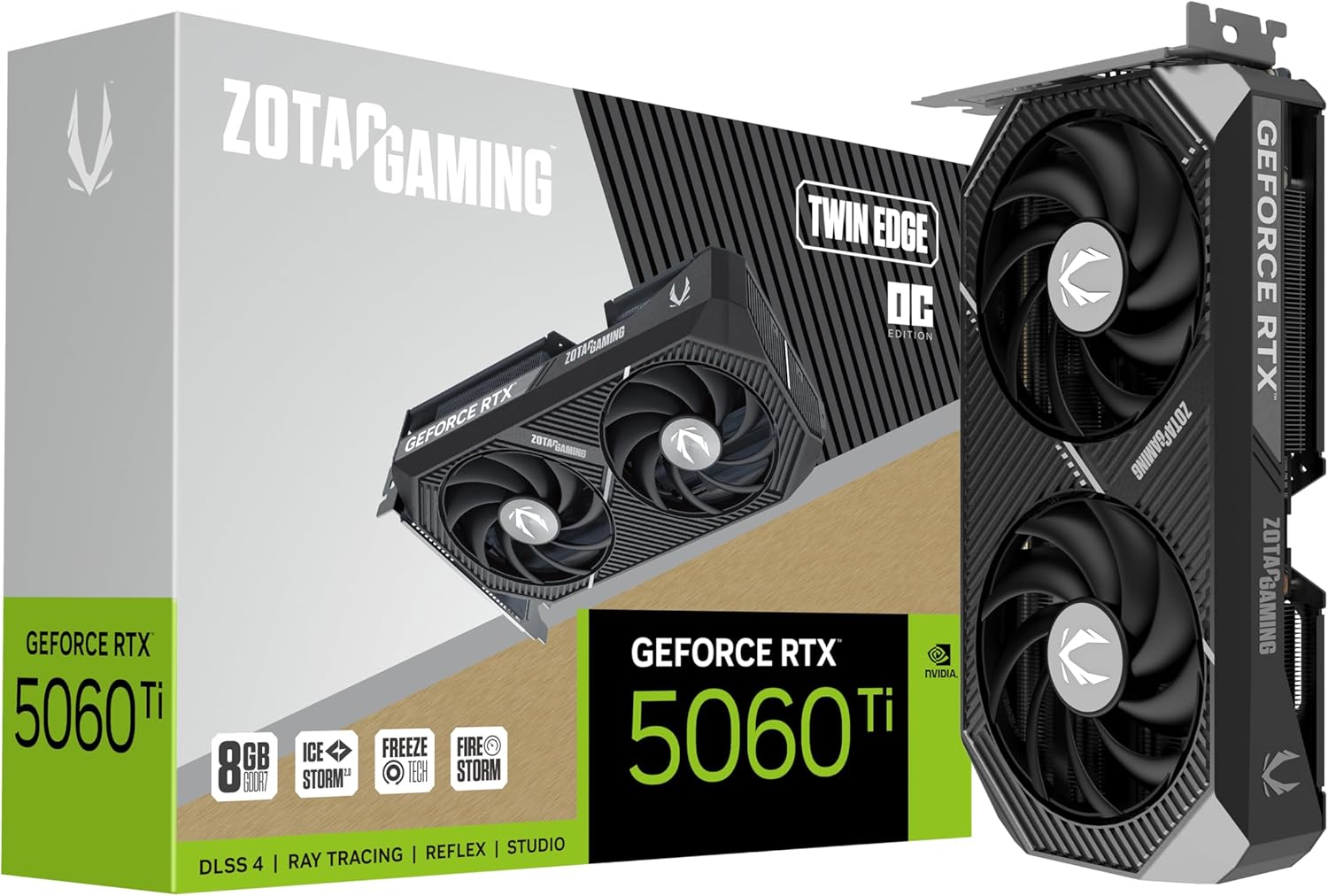
ZOTAC Gaming GeForce RTX 5060 Ti 8GB Twin Edge OC DLSS 4 8GB GDDR7 128-bit 28 Gbps PCIE 5.0 Gaming Graphics Card, IceStorm 2.0 Cooling, SFF-Ready, ZT-B50610H-10A
$300-$599This is a compact, 2-slot RTX 5060 Ti with 8GB GDDR7 and a 2602 MHz clock, built for SFF gaming rigs.