
Sapphire 11315-01-20G Pulse AMD Radeon RX 6400 Low Profile Gaming Graphics Card with 4GB GDDR6, AMD RDNA 2, Black
Want the best price and purchase timing?
Our AI advisor analyzes real-time pricing across all channels to find you the best deal.
AI Verdict
The Sapphire Pulse RX 6400 is a 53W drop-in GPU upgrade built specifically to turn aging, low-wattage office PCs into capable 1080p budget gaming rigs.
This card exists to solve a very specific physics problem: fitting dedicated graphics into a slim PC with a weak power supply. If you have a standard mid-tower case and a 400W+ PSU, you are paying a premium for miniaturization while sacrificing VRAM and encoding features.
If your case supports dual-slot, full-height cards and has a 6-pin power cable, buy an RX 6600 instead for massively better price-to-performance.
Regret Score™
High RiskLower is better — measures purchase-regret risk from real buyer complaints, review credibility, and product maturity
Issues discovered after purchase
Critically weak dimension
Amazon rating vs actual quality
Chance this product isn't for you
Pros
- Draws just 53W from the motherboard, requiring no external PCIe power cables.
- True single-slot, half-height design fits perfectly in ultra-compact cases like the Dell Optiplex 7050 SFF.
- Includes both full-height and low-profile brackets in the box.
- Delivers playable 1080p frame rates in eSports titles, outperforming the GTX 1650 in PCIe 4.0 systems.
Cons
- Loses roughly 14% of its gaming performance when installed in older PCIe 3.0 motherboards due to its x4 lane limit.
- Completely lacks hardware video encoders, making it useless for Twitch streaming or game recording.
- The tiny axial fan gets noticeably whiny when pushing past 70°C under heavy gaming loads.
- Swapping the pre-installed ATX bracket for the low-profile one requires removing four tiny, easily stripped screws.
Dimension Scores
Handles 1080p eSports easily, but struggles with modern AAA games and loses 14% performance on older PCIe 3.0 boards.
The single axial fan keeps it from melting, but it gets whiny under load and idles warm at 50°C in cramped cases.
Pulls a maximum of 53W under full load, allowing it to run flawlessly on ancient 180W office PC power supplies.
4GB of GDDR6 on a 64-bit bus is severely limiting for modern textures, forcing you to drop settings to 'Low' in newer titles.
Best For
- Upgrading refurbished SFF office PCs (like HP ProDesk or Lenovo ThinkCentre) with 180W-240W power supplies.
- Adding 1080p eSports gaming capabilities to a living room home theater PC.
- Systems with PCIe 4.0 motherboards that lack the physical space for a dual-slot GPU.
Not Recommended For
- Content creators who need hardware encoding for OBS streaming or video editing.
- Older PCIe 3.0 systems where the x4 bandwidth bottleneck will severely tank frame rates.
- Gamers looking to play modern AAA titles at 1440p or high settings.
Watch Out For
- PCIe lane bottleneck — this card only uses 4 PCIe lanes, so plugging it into a PCIe 3.0 slot drops performance by up to 14% compared to PCIe 4.0.
- No hardware encoder — AMD stripped the media engine from the Navi 24 silicon, meaning you cannot use ReLive or hardware-accelerated OBS streaming.
- Bracket swap hassle — it ships with the full-height ATX bracket attached, forcing you to manually unscrew and swap to the low-profile bracket yourself.
- Thermal throttling in micro-PCs — users installing this in 1-liter PCs like the Lenovo M720q report idle temps around 55°C and load temps hitting 80°C with the shroud on.
Full Specifications
| ASIN | B09Y2JWMXS |
| Brand | Sapphire |
| Item Weight | 13.7 ounces |
| Manufacturer | Sapphire Technology |
| Graphics Ram Size | 4 GB |
| Item model number | 11315-01-20G |
| Product Dimensions | 9.25 x 6.5 x 2.5 inches |
| Graphics Coprocessor | AMD Radeon RX 6400 |
| Video Output Interface | DisplayPort, HDMI |
| Graphics Processor Manufacturer | AMD |
What Buyers Say
The defining trait of user reviews is relief over physical compatibility. Buyers repeatedly mention slotting this into Dell Optiplex or HP ProDesk SFF cases without triggering the 180W power supply alarms. The lack of a hardware encoder catches several buyers off guard, leading to angry forum posts when OBS streaming fails. Thermal complaints pop up from users trying to cram it into 1-liter 'Tiny/Mini/Micro' PCs, where the plastic shroud chokes the fan against the case lid. Most accept the performance compromises simply because it is the only modern architecture card that physically fits their rig.
“I just wanted to play Fortnite on an old HP ProDesk I got from work, and this little card actually fits the tiny case and doesn't blow up the 200w power supply.”
Common Praise
- Runs perfectly on 180W and 240W proprietary power supplies without crashing.
- Fits flawlessly into the PCIe x16 slot closest to the PSU in Dell Optiplex SFF cases.
- Breathes new life into 6th to 8th-gen Intel office PCs for 1080p gaming.
- Idles silently when doing basic desktop tasks or web browsing.
Common Complaints
- Noticeable frame rate drops when installed in older PCIe 3.0 motherboards.
- The tiny fan gets loud and high-pitched during sustained gaming sessions.
- Cannot record gameplay using AMD ReLive due to the missing media encoder.
- The plastic fan shroud adds just enough thickness to cause clearance issues in 1-liter micro PCs.
Ownership Tips
- Removing the plastic fan shroud drops temperatures by about 5°C in ultra-tight cases like the Lenovo M720q.
- You must manually disable Intel Turbo Boost on older CPUs to keep the total system power draw under 180W.
- The included screws for the bracket swap are extremely soft and easy to strip if you don't use the exact right Phillips head.
Frequently Asked Questions
Does this require a 6-pin power connector?
No. It draws a maximum of 53W directly through the motherboard's PCIe slot, making it safe for 180W-240W proprietary power supplies.
Will this work in a PCIe 3.0 motherboard?
Yes, it is backwards compatible, but you will lose about 14% of your frame rate because the card is physically limited to just 4 PCIe lanes.
Does it come with the low-profile bracket?
Yes, both the full-height and low-profile brackets are included in the box, though the full-height one is installed by default.
Can I use this for streaming on Twitch?
No. The RX 6400 lacks a hardware video encoder, so your CPU will have to handle all the encoding work, which will tank your game performance.
Will this fit in a Dell Optiplex SFF?
Yes. Its single-slot, half-height dimensions (170mm x 56.2mm) are specifically designed to clear the tight PSU tolerances in Dell and HP small form factor cases.
Buying Guide
You are buying this card for its physical dimensions and power efficiency, not its raw frame rates. If you are upgrading a standard desktop PC, stop right now and buy a different card. This GPU is strictly a problem-solver for small form factor (SFF) office PCs that have weak, non-upgradable power supplies. Be aware that if your PC is older than 2020, it likely uses PCIe 3.0, which will bottleneck this card's performance by about 14%.
53W Board Power
It draws all its electricity directly from the motherboard slot. You don't need to dig around for extra power cables, making it safe for weak 200W office PC power supplies.
PCIe 4.0 x4 Interface
The card only uses 4 'lanes' of data traffic instead of the usual 16. If you put it in an older PCIe 3.0 motherboard, the speed limit drops, causing stuttering in heavy games.
Low-Profile Form Factor
It is exactly half the height of a normal graphics card, allowing the side panel to close on slim, briefcase-sized desktop computers.
Alternatives
If your case has room for a full-height, dual-slot card and your power supply has a 6-pin PCIe cable, look for an RX 6600 or GTX 1650 Super for significantly better performance at a similar price.
You Might Also Like

HP NVIDIA GeForce RTX 3070 8GB OEM Graphics Card (Renewed)
$150-$299This is a renewed HP OEM NVIDIA GeForce RTX 3070 with 8GB VRAM, a gamble for budget-conscious 1440p gamers who understand the risks of refurbished hardware.

ZOTAC Gaming GeForce RTX 5070 Twin Edge OC DLSS 4 12GB GDDR7 192-bit 28 Gbps PCIE 5.0 Gaming Graphics Card, IceStorm 2.0 Cooling, SFF-Ready, ZT-B50700H-10A
$600+This is a 2-slot, SFF-ready NVIDIA RTX 5070 with 12GB GDDR7 and a 2542 MHz boost clock, built for compact gaming rigs needing high 1440p performance.

ZOTAC Gaming GeForce RTX 5080 Solid CORE OC DLSS 4 16GB GDDR7 256-bit 30 Gbps PCIE 5.0 Gaming Graphics Card, IceStorm 3.0 Advanced Cooling, Spectra RGB Lighting, ZT-B50800J2-10A
$600+This ZOTAC RTX 5080 with 16GB GDDR7 and a 2640 GHz clock speed is built for high-end 4K gaming and content creation on the NVIDIA Blackwell architecture.
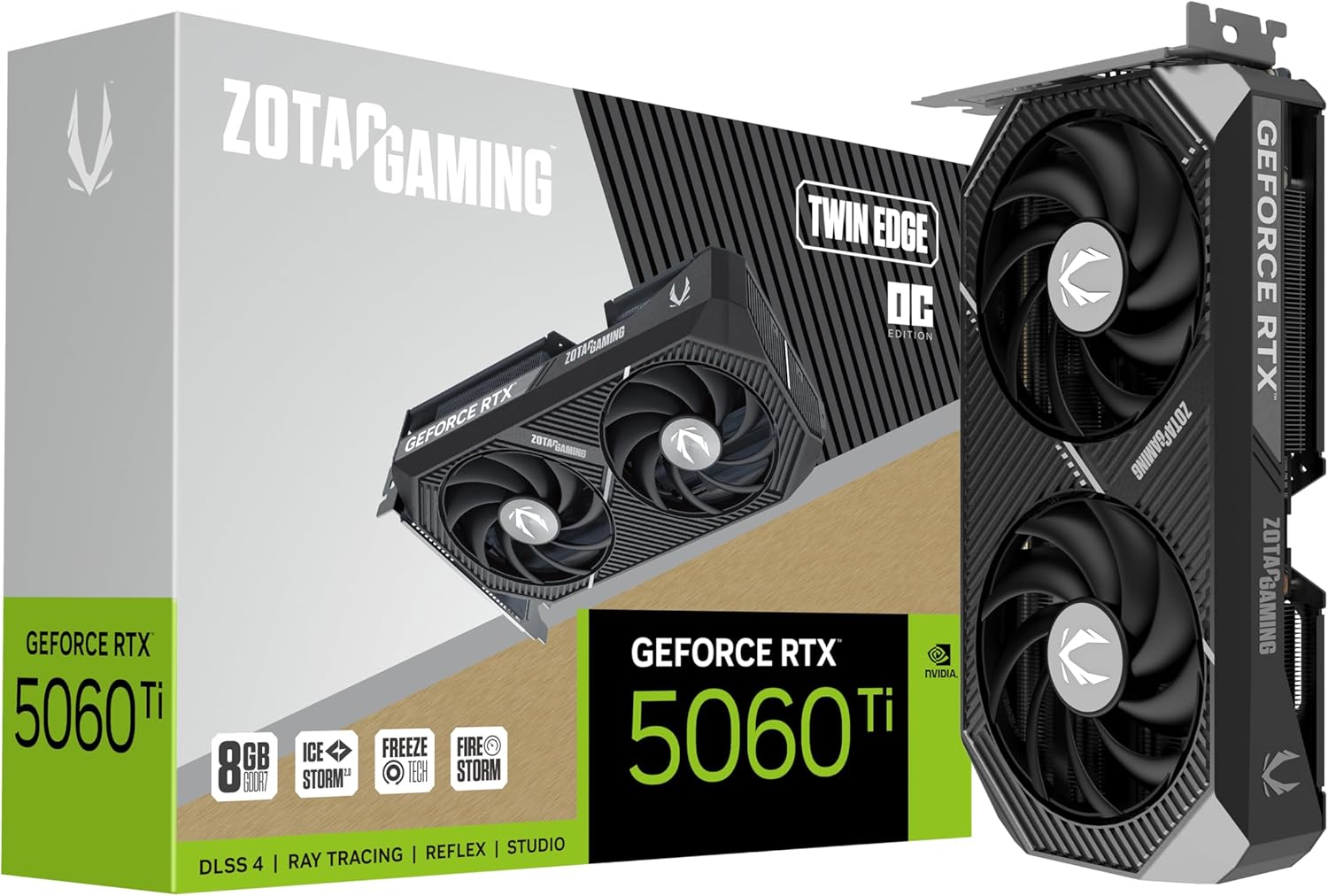
ZOTAC Gaming GeForce RTX 5060 Ti 8GB Twin Edge OC DLSS 4 8GB GDDR7 128-bit 28 Gbps PCIE 5.0 Gaming Graphics Card, IceStorm 2.0 Cooling, SFF-Ready, ZT-B50610H-10A
$300-$599This is a compact, 2-slot RTX 5060 Ti with 8GB GDDR7 and a 2602 MHz clock, built for SFF gaming rigs.