
ASUS ThunderboltEX 4 with Intel® Thunderbolt™ 4 JHL 8540 Controller, 2 USB Type-C Ports, up to 40Gb/s bi-Directional Bandwidth, DisplayPort 1.4 Support, up to 100W Quick Charge, Black
Want the best price and purchase timing?
Our AI advisor analyzes real-time pricing across all channels to find you the best deal.
AI Verdict
This is a strict utility card for ASUS motherboard owners who need 40Gbps Thunderbolt 4 ports for docks or Apple displays, requiring heavy BIOS tweaking to function.
If you have a compatible ASUS motherboard and need to route your discrete GPU to a Thunderbolt monitor or run a massive daisy-chain of external SSDs, this card delivers the 40Gbps bandwidth you need. The strict 14-1 pin header requirement and messy BIOS configuration make it a headache for general users.
Check your motherboard manual for a '14-1 pin Thunderbolt header' before buying; if you don't have it, look for a motherboard with built-in Thunderbolt 4 instead.
Regret Score™
High RiskLower is better — measures purchase-regret risk from real buyer complaints, review credibility, and product maturity
Issues discovered after purchase
Critically weak dimension
Amazon rating vs actual quality
Chance this product isn't for you
Pros
- 40Gbps bi-directional bandwidth maxes out external NVMe SSD speeds
- Port 1 delivers 100W USB-C Power Delivery to charge laptops
- Daisy-chains up to 5 Thunderbolt devices per port
- Redirects VGA and DisplayPort 1.4 input signals for USB-C video output
Cons
- Requires a proprietary 14-1 pin motherboard header
- Eats up a PCIe 3.0 x4 slot on your motherboard
- Port 2 is capped at 27W charging
- Requires routing a bulky 6-pin PCIe power cable for full functionality
Dimension Scores
The listed 4GB VRAM and Intel GPU chipset are catalog errors; this is a pass-through card that relies entirely on your discrete GPU for gaming.
The fanless Intel JHL 8540 controller generates almost no heat and operates completely silently.
It requires a dedicated 6-pin PCIe power cable to deliver the 100W Power Delivery, adding cable clutter to your case.
The 4GB of 2666MHz memory listed in the specs is irrelevant for a Thunderbolt controller and useless for modern workloads.
Best For
- Connecting a CalDigit TS4 dock to a desktop PC with a single cable
- Daisy-chaining multiple UAD Apollo x8 audio interfaces
- Routing discrete GPU video to an Apple Studio Display
Not Recommended For
- Motherboards from MSI, Gigabyte, or ASRock
- ASUS boards missing the 14-1 pin header
- Plug-and-play users who avoid BIOS menus
Watch Out For
- Motherboard lock-in: You absolutely need an ASUS board with a 14-1 pin TB header (like the ROG Strix Z790-E). It will not work on MSI or Gigabyte boards.
- Bandwidth sharing bugs: If you connect a 1080p 144Hz monitor first, it steals the 4xHBR2 bandwidth, leaving your 4K monitor stuck at lower refresh rates.
- BIOS nightmare: You have to manually enable Thunderbolt/USB4 support and PCIe tunneling in the Advanced BIOS menu before Windows even sees the card.
- Cable clutter: You must connect a 14-1 pin header, a USB 2.0 header, a 6-pin PCIe power cable, and a Mini-DP loopback cable just to make it function.
Full Specifications
| ASIN | B08ZS3D6JY |
| Brand | ASUS |
| Color | Black |
| Series | ThunderboltEX 4 |
| Item Weight | 1.21 pounds |
| Manufacturer | ASUS |
| Memory Speed | 2666 MHz |
| Chipset Brand | Intel |
| Card Description | Dedicated |
| Operating System | Windows 10 - 64 bit |
| Graphics Ram Size | 4 GB |
| Item model number | THUNDERBOLTEX 4 |
| Product Dimensions | 15 x 8 x 5 inches |
| Graphics Coprocessor | Intel GPU |
| Max Screen Resolution | 7680x4320 |
| Graphics Card Ram Size | 4 GB |
| Item Dimensions LxWxH | 15 x 8 x 5 inches |
| Video Output Interface | DisplayPort, Mini DisplayPort, VGA |
| Number of USB 2.0 Ports | 2 |
| Graphics Processor Manufacturer | Intel |
What Buyers Say
The biggest shock with the ThunderboltEX 4 is just how much BIOS tweaking it takes to get a single 40Gbps port working. You can't just slot it in; you have to connect a 14-1 pin header, a USB 2.0 header, a 6-pin PCIe power cable, and a Mini-DP loopback cable before diving into the Advanced BIOS to enable PCIe tunneling. Once configured, it flawlessly drives complex setups like a CalDigit TS4 dock or daisy-chained UAD Apollo audio interfaces. Bandwidth allocation is strictly first-come, first-served, meaning plugging in a 1080p monitor before your 4K display will cap the 4K screen's refresh rate. It's a powerful tool for ASUS motherboard owners, but the installation feels like a science project.
“Spent 4 hours fighting BIOS settings and routing 4 different cables just to get my Apple display working on my PC, but it finally works and I'm never touching it again.”
Common Praise
- Successfully routes discrete GPU signals to Thunderbolt-only monitors
- Delivers full 40Gbps bandwidth for external NVMe enclosures once configured
- 100W PD port easily keeps a connected work laptop fully charged
- Daisy-chaining works flawlessly for complex audio production setups
Common Complaints
- Requires a proprietary 14-1 pin header missing from many ASUS boards
- BIOS configuration for PCIe tunneling is undocumented and confusing
- Included Mini DisplayPort loopback cables are too short for some large cases
- Bandwidth allocation bugs cause multi-monitor refresh rate issues
Ownership Tips
- Firmware updates often reset your BIOS Thunderbolt settings, forcing you to reconfigure everything.
- If your PC goes to sleep, connected Thunderbolt audio interfaces sometimes fail to wake up and require a hard reboot.
- The 6-pin PCIe power requirement means you have to run an ugly VGA power cable to the bottom of your motherboard.
Frequently Asked Questions
Will this work on my MSI or Gigabyte motherboard?
No. It requires a proprietary 14-1 pin Thunderbolt header found only on specific ASUS Intel 500-series/Z790 or AMD B550/X670 motherboards.
Can I use this to connect my PC to an Apple Studio Display?
Yes. You run the included Mini DisplayPort cable from your graphics card into the ThunderboltEX 4's input, then run a single Thunderbolt cable to the monitor.
Why is my external SSD only getting 300MB/s instead of 3GB/s?
You likely haven't enabled PCIe tunneling in your BIOS. Without it, the card defaults to slower USB 3.0 fallback speeds instead of the full 40Gbps Thunderbolt bandwidth.
Does it actually provide 100W of power?
Yes, but only on the primary Type-C port (Port 1). The secondary port is limited to 27W quick charging.
Which PCIe slot should I put this in?
It requires a PCIe 3.0 x4 slot. Most users report the best stability when installing it in the bottom-most full-length slot on their motherboard.
Buying Guide
You are not buying a graphics card, despite what some retail listings say. This is an expansion card designed strictly to add Thunderbolt 4 ports to a desktop PC. You must verify that your specific ASUS motherboard has a 14-1 pin Thunderbolt header. Without it, this card is a $100 paperweight. Be prepared to route multiple cables inside your case, including a 6-pin power cable if you want the 100W charging feature.
40Gbps Bi-Directional Bandwidth
Think of it like a massive multi-lane highway. It allows you to run a 4K monitor, gigabit ethernet, and multiple hard drives all through a single cable without a traffic jam.
14-1 Pin Thunderbolt Header
This is the secret handshake cable between the card and your motherboard. If your board doesn't have the matching plug, the card cannot communicate with your CPU.
DisplayPort 1.4 Pass-Through
It acts like a mail forwarder. You plug your real graphics card into this card, and it forwards the video signal out through the USB-C port to your monitor.
Alternatives
If your motherboard lacks the required 14-1 pin header, you need to search for a motherboard with Thunderbolt 4 built directly into the rear I/O panel.
You Might Also Like

HP NVIDIA GeForce RTX 3070 8GB OEM Graphics Card (Renewed)
$150-$299This is a renewed HP OEM NVIDIA GeForce RTX 3070 with 8GB VRAM, a gamble for budget-conscious 1440p gamers who understand the risks of refurbished hardware.

ZOTAC Gaming GeForce RTX 5070 Twin Edge OC DLSS 4 12GB GDDR7 192-bit 28 Gbps PCIE 5.0 Gaming Graphics Card, IceStorm 2.0 Cooling, SFF-Ready, ZT-B50700H-10A
$600+This is a 2-slot, SFF-ready NVIDIA RTX 5070 with 12GB GDDR7 and a 2542 MHz boost clock, built for compact gaming rigs needing high 1440p performance.

ZOTAC Gaming GeForce RTX 5080 Solid CORE OC DLSS 4 16GB GDDR7 256-bit 30 Gbps PCIE 5.0 Gaming Graphics Card, IceStorm 3.0 Advanced Cooling, Spectra RGB Lighting, ZT-B50800J2-10A
$600+This ZOTAC RTX 5080 with 16GB GDDR7 and a 2640 GHz clock speed is built for high-end 4K gaming and content creation on the NVIDIA Blackwell architecture.
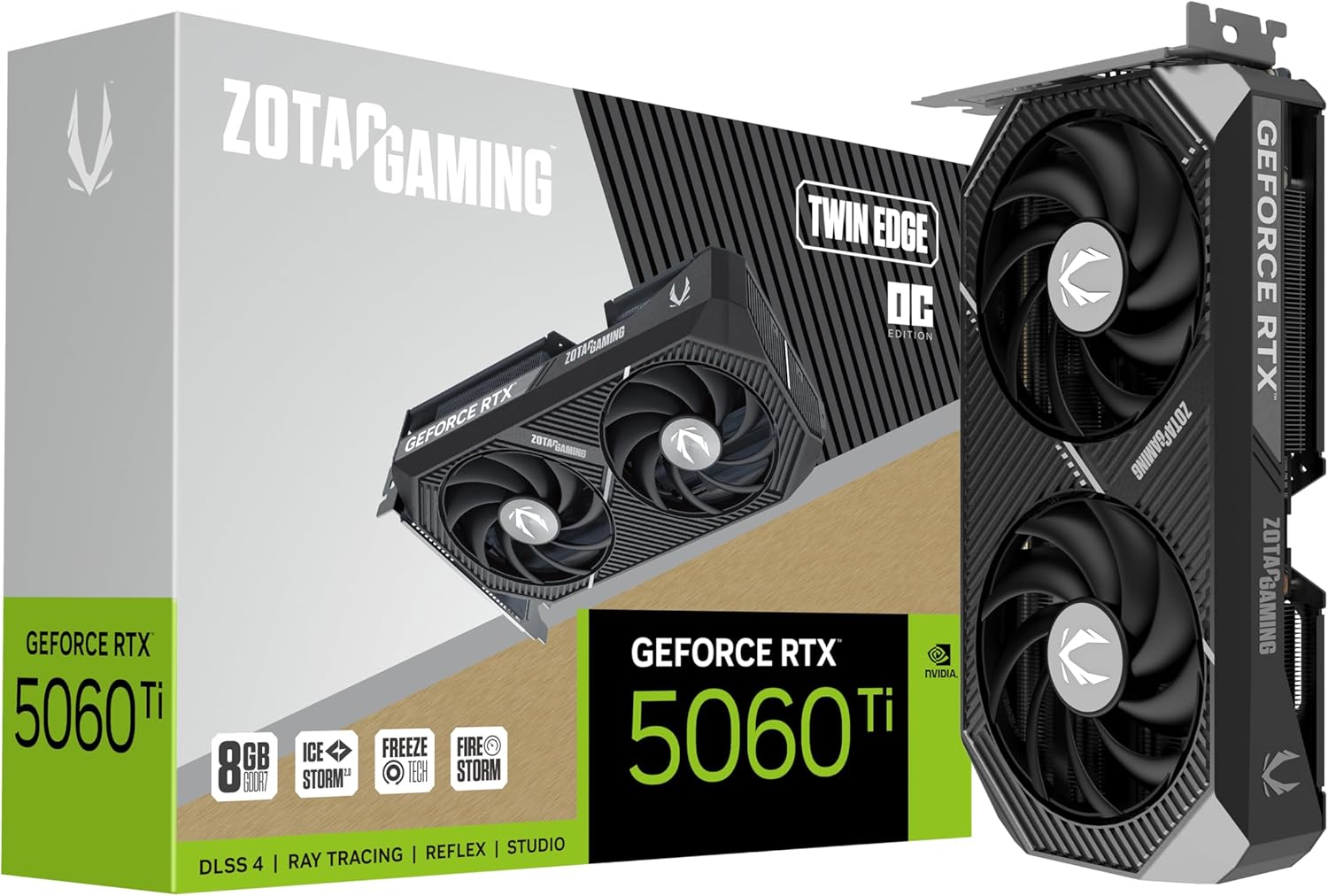
ZOTAC Gaming GeForce RTX 5060 Ti 8GB Twin Edge OC DLSS 4 8GB GDDR7 128-bit 28 Gbps PCIE 5.0 Gaming Graphics Card, IceStorm 2.0 Cooling, SFF-Ready, ZT-B50610H-10A
$300-$599This is a compact, 2-slot RTX 5060 Ti with 8GB GDDR7 and a 2602 MHz clock, built for SFF gaming rigs.