
MSI Gaming GeForce RTX 3060 12GB 15 Gbps GDRR6 192-Bit HDMI/DP PCIe 4 Torx Twin Fan Ampere OC Graphics Card
Want the best price and purchase timing?
Our AI advisor analyzes real-time pricing across all channels to find you the best deal.
AI Verdict
A compact, no-frills 1080p gaming and entry-level AI workhorse that leverages its 12GB VRAM to punch above its weight, provided you don't mind a plastic backplate.
If you need maximum VRAM on a strict budget, this card is a lifesaver. The 12GB buffer makes it uniquely capable for entry-level machine learning and heavy video editing, while the 170W power draw means you won't need a PSU upgrade.
If you only care about pure gaming rasterization and don't need CUDA/12GB VRAM, look for an RX 6700 XT for better raw FPS at a similar price.
Regret Score™
Low RiskLower is better — measures purchase-regret risk from real buyer complaints, review credibility, and product maturity
Issues discovered after purchase
Critically weak dimension
Amazon rating vs actual quality
Chance this product isn't for you
Pros
- 12GB of GDDR6 VRAM handles local LLMs and 4K DaVinci Resolve timelines without crashing
- Compact 235mm dual-fan design fits easily into older pre-builts and ITX cases
- Only requires a single 8-pin PCIe power connector and a 550W power supply
- Runs comfortably at 65-75°C under gaming loads in cases with decent airflow
- NVENC encoder provides massive performance boosts for streaming and video rendering
Cons
- Plastic backplate feels cheap and traps heat compared to metal alternatives
- Fans become noticeably loud and whiny when pushed past 75% speed
- Strict 200W power limit prevents meaningful overclocking headroom
- MSI Center software is notoriously buggy and often overrides custom fan curves
Dimension Scores
Delivers a solid 60+ FPS in modern titles at 1080p, but struggles with native 1440p without relying on DLSS upscaling.
Maintains safe 65-75°C core temperatures under load, but the dual Torx 3.0 fans get noticeably loud past 2000 RPM.
Highly efficient 170W TDP allows it to run perfectly on older 550W power supplies with just one 8-pin cable.
12GB of GDDR6 is massive for this price tier, making it a budget king for AI inference and 4K video timelines.
Best For
- Budget-conscious creators needing 12GB VRAM for Stable Diffusion or local LLM inference
- Upgrading older 1080p gaming rigs (like GTX 1060/1660 systems) without replacing the power supply
- Small form factor (SFF) builds where triple-fan cards physically won't fit
Not Recommended For
- Chasing 144Hz+ frame rates in modern AAA titles at 1440p or 4K
- Silent PC enthusiasts, as the Torx 3.0 fans get vocal under heavy load
Watch Out For
- MSI Dragon Center/MSI Center bloatware — users report it hijacking fan controls and RGB settings, so uninstall it and use MSI Afterburner instead.
- Aggressive default fan stop — the fans stay at 0 RPM until the card hits 60°C, which can cause sudden, loud fan spikes when launching a game.
- Hotspot temperature variance — if your case has poor intake airflow, the hotspot temp can easily spike to 85°C+, causing the fans to ramp up to 2300 RPM.
Full Specifications
| ASIN | B08WPRMVWB |
| Brand | msi |
| Series | GeForce RTX 3060 |
| Item Weight | 12 ounces |
| Manufacturer | MSI |
| Memory Speed | 1807 MHz |
| Chipset Brand | NVIDIA |
| Card Description | Dedicated |
| Graphics Ram Size | 12 GB |
| Item model number | RTX 3060 Ventus 2X 12G OC |
| Product Dimensions | 9.3 x 1.7 x 4.9 inches |
| Computer Memory Type | GDDR6 |
| Graphics Coprocessor | NVIDIA GeForce RTX 3060 |
| Max Screen Resolution | 7680x4320 |
| Graphics Card Ram Size | 12 GB |
| Item Dimensions LxWxH | 9.3 x 1.7 x 4.9 inches |
| Video Output Interface | HDMI |
| Graphics Processor Manufacturer | NVIDIA |
| Is Discontinued By Manufacturer | No |
What Buyers Say
The most surprising takeaway from long-term owners is how many people buy this specifically for AI and productivity rather than gaming. The 12GB of VRAM is the star of the show, allowing users to run local LLMs and heavy DaVinci Resolve projects that would crash an 8GB card. On the gaming front, it delivers a massive leap for anyone upgrading from a GTX 1060 or 1660. The Ventus cooler is definitely budget-tier; users frequently complain about the plastic backplate and the loud, whiny fans when the card is pushed to its 170W limit. Software is another sore spot, with many advising to completely avoid MSI Center.
“Upgraded from my dying 1060 and it runs everything at 1080p flawlessly, but good lord the fans sound like a hair dryer when I play Cyberpunk and the plastic backplate feels super cheap.”
Common Praise
- 12GB VRAM prevents out-of-memory errors in Stable Diffusion and DaVinci Resolve
- Massive performance leap for users upgrading from GTX 10-series or 16-series cards
- Compact 235mm length fits perfectly in older pre-built Dell and HP cases
- Low 170W power draw keeps electricity bills down and avoids PSU upgrades
Common Complaints
- Fans sound like a jet engine when they ramp up past 2000 RPM
- Plastic backplate feels cheap and doesn't help dissipate heat
- MSI Center software is buggy and overrides custom Afterburner fan curves
- Strict 200W hard power limit prevents any serious overclocking
Ownership Tips
- The factory thermal paste tends to dry out after a year, causing hotspot temps to spike to 85°C+.
- Uninstalling MSI Dragon Center and using MSI Afterburner for a custom fan curve is practically mandatory for noise control.
- The card often boosts well past its advertised 1807 MHz out of the box, hitting 2000 MHz+ if the case is cool.
Frequently Asked Questions
Why is my card boosting to 2000+ MHz when the spec says 1807 MHz?
Nvidia's GPU Boost algorithm automatically pushes the clock speed past the advertised boost clock if there is thermal and power headroom. As long as temps are under 80°C, this is completely normal and safe.
Do I need to upgrade my power supply for this?
Probably not. It only draws 170W and requires a single 8-pin connector. A quality 550W power supply is plenty for most systems.
Is the backplate metal or plastic?
It is a brushed plastic backplate. It looks like metal from a distance but lacks the structural rigidity or passive cooling benefits of an aluminum backplate.
Why are my fans not spinning at idle?
The Ventus 2X features 'Zero Frozr' technology. The fans completely stop when temperatures are below 60°C to keep your system dead silent during web browsing.
Can this card handle 1440p gaming?
Yes, but with compromises. You need to rely heavily on DLSS and lower in-game settings to medium/high to maintain 60 FPS in newer AAA titles.
Buying Guide
When buying a budget GPU, you are choosing between raw gaming speed and feature sets. This card's superpower is its 12GB of VRAM and Nvidia's CUDA architecture, making it a cheat code for budget video editors and AI hobbyists. If you just want to play games, you are paying a premium for that Nvidia badge and VRAM you might not even use. Pay close attention to your case airflow, as this budget 'Ventus' cooler will get loud if it has to fight for fresh air.
12GB GDDR6 VRAM
Think of VRAM like a desk for your graphics card. A bigger desk (12GB) lets you lay out massive 4K video files or complex AI models without the system freezing up to fetch more data.
192-Bit Memory Interface
This is the highway connecting the GPU to its memory. 192-bit is a mid-sized highway—plenty fast for 1080p gaming, but it can cause traffic jams if you try to push 4K gaming textures.
CUDA Cores
These are the tiny workers inside the chip. While they render game graphics, they are also the industry standard for running creative apps like Adobe Premiere and Blender.
Alternatives
If you only care about gaming frame rates and don't need Nvidia's streaming/AI features, look for an AMD card with 12GB of VRAM for significantly better raw performance at a similar price.
You Might Also Like

HP NVIDIA GeForce RTX 3070 8GB OEM Graphics Card (Renewed)
$150-$299This is a renewed HP OEM NVIDIA GeForce RTX 3070 with 8GB VRAM, a gamble for budget-conscious 1440p gamers who understand the risks of refurbished hardware.

ZOTAC Gaming GeForce RTX 5070 Twin Edge OC DLSS 4 12GB GDDR7 192-bit 28 Gbps PCIE 5.0 Gaming Graphics Card, IceStorm 2.0 Cooling, SFF-Ready, ZT-B50700H-10A
$600+This is a 2-slot, SFF-ready NVIDIA RTX 5070 with 12GB GDDR7 and a 2542 MHz boost clock, built for compact gaming rigs needing high 1440p performance.

ZOTAC Gaming GeForce RTX 5080 Solid CORE OC DLSS 4 16GB GDDR7 256-bit 30 Gbps PCIE 5.0 Gaming Graphics Card, IceStorm 3.0 Advanced Cooling, Spectra RGB Lighting, ZT-B50800J2-10A
$600+This ZOTAC RTX 5080 with 16GB GDDR7 and a 2640 GHz clock speed is built for high-end 4K gaming and content creation on the NVIDIA Blackwell architecture.
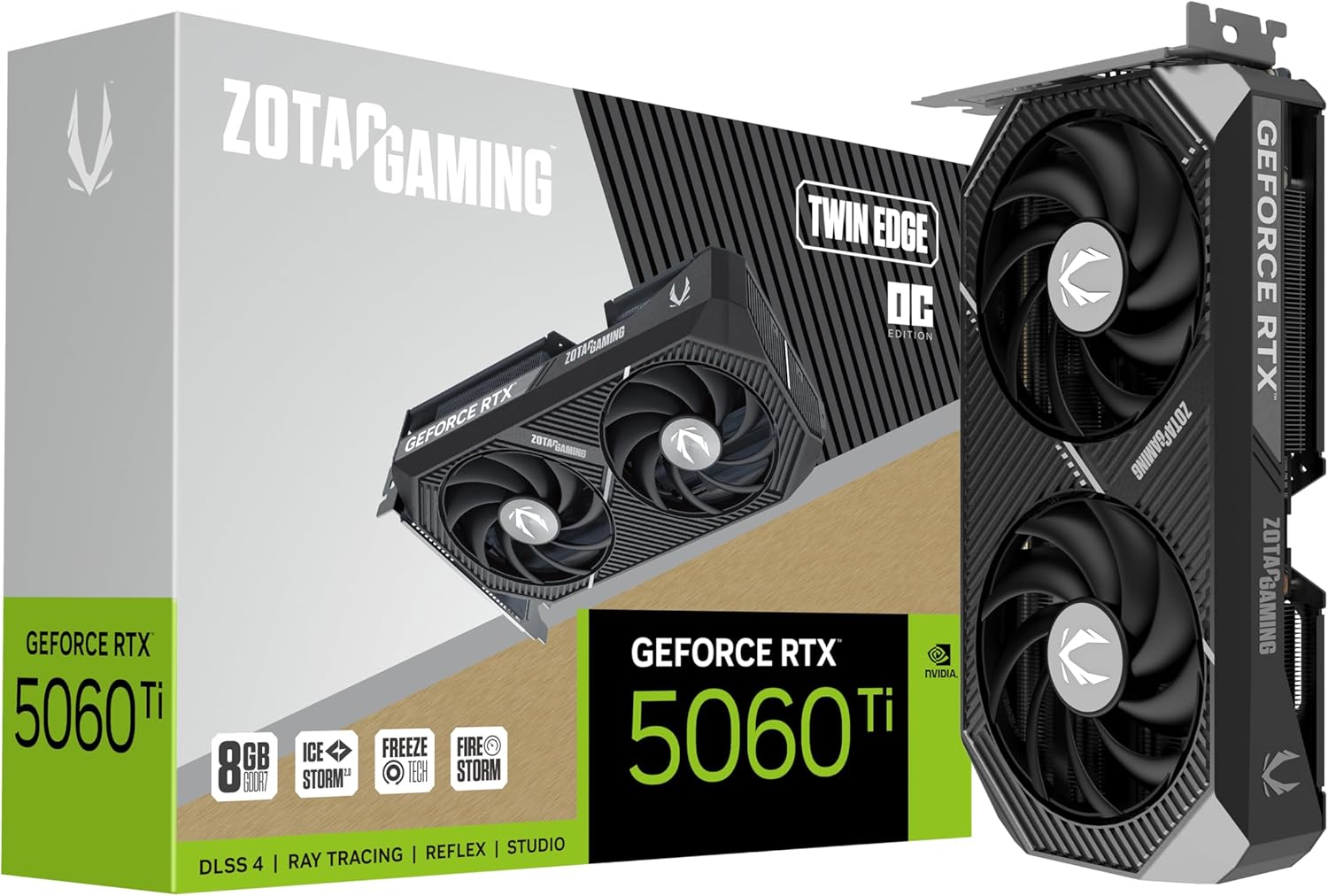
ZOTAC Gaming GeForce RTX 5060 Ti 8GB Twin Edge OC DLSS 4 8GB GDDR7 128-bit 28 Gbps PCIE 5.0 Gaming Graphics Card, IceStorm 2.0 Cooling, SFF-Ready, ZT-B50610H-10A
$300-$599This is a compact, 2-slot RTX 5060 Ti with 8GB GDDR7 and a 2602 MHz clock, built for SFF gaming rigs.