
5Pcs 360 Degree Rotary Encoder Code Switch Digital Potentiometer with Push Button 5 Pins and Knob Cap for Arduino (Pack of 5) CYT1100
Want the best price and purchase timing?
Our AI advisor analyzes real-time pricing across all channels to find you the best deal.
AI Verdict
This is a dirt-cheap five-pack of bare mechanical rotary encoders perfect for fixing an Ender 3 screen or building a custom macro pad, despite Amazon bizarrely classifying it as an NVIDIA GPU.
These are bare mechanical components requiring soldering and software debouncing to function properly. They fit perfectly for direct PCB mounting in custom keyboards or 3D printer repairs, but fail miserably for quick solderless breadboarding.
If you want plug-and-play Arduino testing, buy a KY-040 rotary encoder module that includes the breakout board and pull-up resistors.
Regret Score™
High RiskLower is better — measures purchase-regret risk from real buyer complaints, review credibility, and product maturity
Issues discovered after purchase
Critically weak dimension
Amazon rating vs actual quality
Chance this product isn't for you
Pros
- Includes five matching plastic knob caps so you don't have to hunt for compatible accessories
- Integrated push-button switch uses two dedicated pins, saving space on your custom keyboard PCB
- 20mm shaft length provides plenty of clearance for thick 3D printed enclosures
- Direct drop-in replacement for the notoriously fragile Ender 3 V2 display knob
Cons
- Bare 5-pin design lacks a breakout board, making breadboard prototyping annoying without soldering
- Zero hardware debounce circuitry means you must handle signal noise in your Arduino code
- Spinning the knob too fast causes the mechanical contacts to skip steps
Dimension Scores
Despite Amazon's 'Computer Graphics Cards' category and NVIDIA chipset tag, this 5-pin mechanical switch will not improve your framerates.
Generates zero heat and only produces a satisfying mechanical click when rotated.
Draws absolutely no power on its own, relying entirely on your microcontroller's 5V or 3.3V logic.
Contains exactly 0 bytes of memory, falling slightly short of modern NVIDIA chipset standards.
Best For
- Repairing a broken Ender 3 V2 LCD screen knob
- Adding volume controls to custom QMK mechanical keyboards like the BDN9
- Budget Arduino or ESP32 projects requiring menu navigation
Not Recommended For
- High-speed motor tracking where optical encoders are required
- Solderless breadboard prototyping out of the box
Watch Out For
- No pull-up resistors included — you must enable INPUT_PULLUP on your Arduino pins or wire your own 10k resistors.
- The pins are thin and easily bent if you try to force them directly into a breadboard.
- Amazon lists this as an NVIDIA graphics card — it obviously cannot run Crysis or output video.
Full Specifications
| ASIN | B07DM2YMT4 |
| Brand | Cylewet |
| Item Weight | 1.76 ounces |
| Manufacturer | Qianxin |
| Graphics RAM Type | DDR DRAM |
| Item model number | CYT1100 |
| Package Dimensions | 3.31 x 1.97 x 0.79 inches |
| Graphics Coprocessor | NVIDIA |
| Recommended Uses For Product | Gaming, Professional |
| Graphics Processor Manufacturer | NVIDIA |
| Is Discontinued By Manufacturer | No |
What Buyers Say
The most entertaining part of buying these encoders is ignoring the fact that Amazon categorizes them as NVIDIA GPUs. 3D printing forums are full of people using these to rescue Ender 3 V2 printers with seized screen knobs, swapping them out in under ten minutes. Custom keyboard builders solder these into macro pads, but the bare pins bend instantly on solderless breadboards. You will need to write software debounce into your code, as spinning the knob too fast causes the mechanical contacts to miss steps.
“Bought these because my Ender 3 knob locked up completely, soldered it on in 5 mins and it works perfectly, just don't expect to play PC games on it despite the GPU category lol.”
Common Praise
- Exact fit for repairing Ender 3 V2 LCD screens
- Integrated push-button eliminates the need for a separate switch
- Included knob caps fit snugly and look professional
- Incredibly cheap per-unit cost compared to buying singles
Common Complaints
- Skips inputs if rotated rapidly
- Thin pins bend easily during installation
- Requires software debouncing to prevent double-triggering
- Lacks a breakout board for easy breadboard use
Ownership Tips
- The tactile clicks soften slightly after a few weeks of heavy use.
- You will likely need to tweak your debounce delay in code to find the sweet spot between responsiveness and accuracy.
- The plastic knob caps attract finger oils but wipe clean easily.
Frequently Asked Questions
Does this have an analog output?
No. It uses mechanical switches to output digital quadrature signals (A and B) and a simple open/close circuit for the push button.
Will this fix my Ender 3 V2 screen?
Yes. This is an exact drop-in replacement for the factory Ender 3 V2 display potentiometer that frequently seizes up.
Do I need resistors to wire this to an Arduino?
You don't need external resistors if you enable the internal pull-up resistors in your code using `pinMode(pin, INPUT_PULLUP)`.
How many detents per revolution?
These have 20 tactile clicks (detents) per full 360-degree rotation.
Can I use this on a Keychron V1?
No. The Keychron V1 requires a completely different PCB design to support the 5-pin layout of a rotary encoder.
Buying Guide
You are buying raw, bare-bones electronic components, not a finished consumer product. These encoders rely entirely on your microcontroller to interpret their physical clicks into digital signals. Because they lack built-in hardware debouncing, your code must filter out the electrical noise, or every click will register multiple times. They are ideal for permanent soldered projects, but if you just want to play around on a breadboard, you will bend the flimsy pins.
5-Pin Layout
Three pins handle the left/right rotation tracking, while the other two are strictly for the push-button click. It is like having a steering wheel and a horn wired into the same column.
20mm Shaft Length
This dictates how far the metal rod sticks out. 20mm gives you enough room to mount the encoder behind a thick plastic panel and still attach the knob.
Quadrature Output
Instead of sending a simple left or right signal, it sends two overlapping pulses. Your Arduino reads which pulse hits first to figure out the direction.
Alternatives
If you want an easier time prototyping without soldering, search for a KY-040 rotary encoder module which pre-mounts the encoder on a board with header pins and resistors.
You Might Also Like

HP NVIDIA GeForce RTX 3070 8GB OEM Graphics Card (Renewed)
$150-$299This is a renewed HP OEM NVIDIA GeForce RTX 3070 with 8GB VRAM, a gamble for budget-conscious 1440p gamers who understand the risks of refurbished hardware.

ZOTAC Gaming GeForce RTX 5070 Twin Edge OC DLSS 4 12GB GDDR7 192-bit 28 Gbps PCIE 5.0 Gaming Graphics Card, IceStorm 2.0 Cooling, SFF-Ready, ZT-B50700H-10A
$600+This is a 2-slot, SFF-ready NVIDIA RTX 5070 with 12GB GDDR7 and a 2542 MHz boost clock, built for compact gaming rigs needing high 1440p performance.

ZOTAC Gaming GeForce RTX 5080 Solid CORE OC DLSS 4 16GB GDDR7 256-bit 30 Gbps PCIE 5.0 Gaming Graphics Card, IceStorm 3.0 Advanced Cooling, Spectra RGB Lighting, ZT-B50800J2-10A
$600+This ZOTAC RTX 5080 with 16GB GDDR7 and a 2640 GHz clock speed is built for high-end 4K gaming and content creation on the NVIDIA Blackwell architecture.
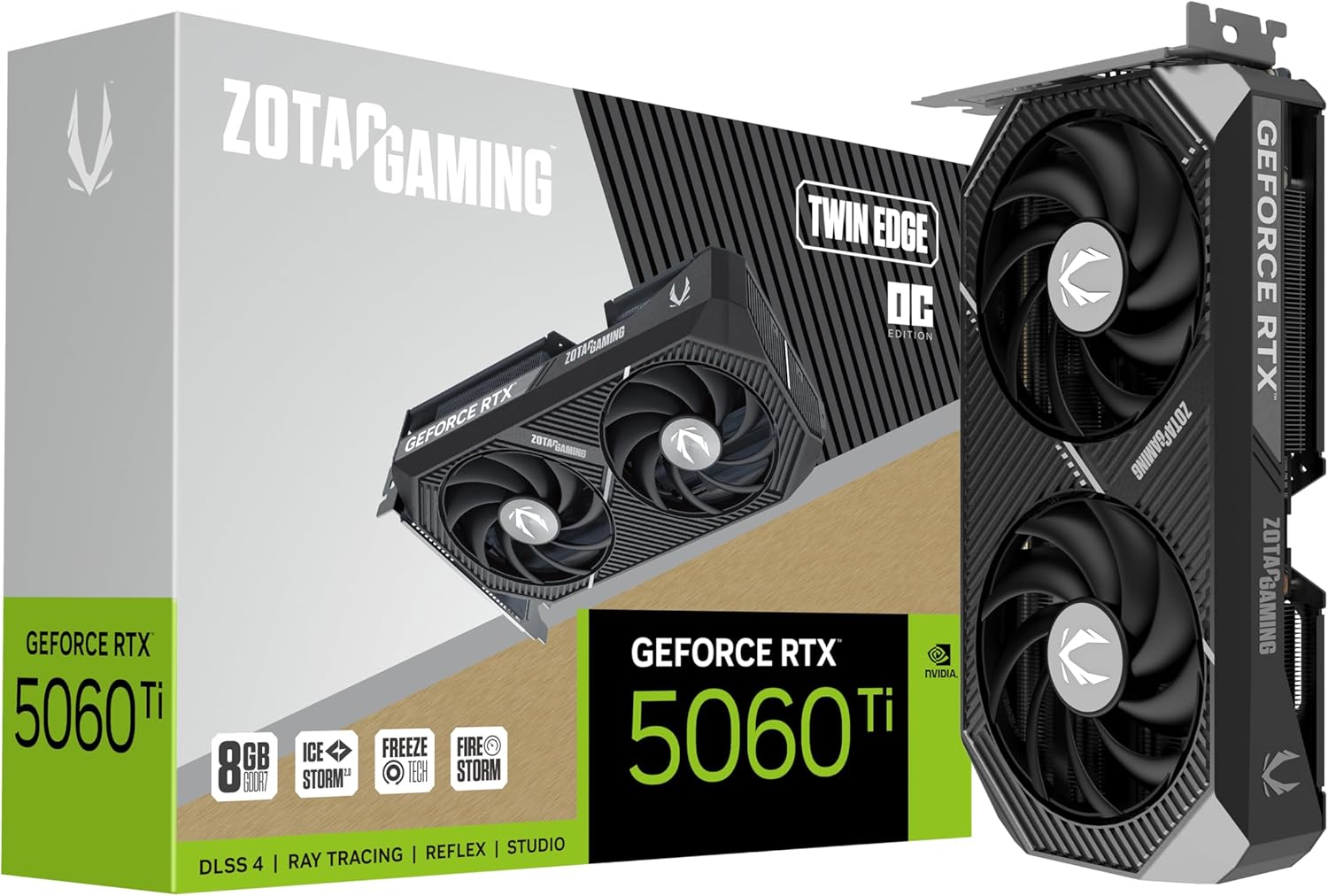
ZOTAC Gaming GeForce RTX 5060 Ti 8GB Twin Edge OC DLSS 4 8GB GDDR7 128-bit 28 Gbps PCIE 5.0 Gaming Graphics Card, IceStorm 2.0 Cooling, SFF-Ready, ZT-B50610H-10A
$300-$599This is a compact, 2-slot RTX 5060 Ti with 8GB GDDR7 and a 2602 MHz clock, built for SFF gaming rigs.