
msi Gaming GeForce GT 710 2GB GDRR3 64-bit HDCP Support DirectX 12 OpenGL 4.5 Single Fan Low Profile Graphics Card (GT 710 2GD3 LP)
Want the best price and purchase timing?
Our AI advisor analyzes real-time pricing across all channels to find you the best deal.
AI Verdict
This is a glorified display adapter for adding HDMI or DVI ports to a decade-old office PC, not a gaming card.
This card exists solely to provide video outputs for systems that lack them. The 2GB of DDR3 and 64-bit bus will struggle to hit 30fps in modern 3D titles, but it perfectly handles 1080p desktop tasks on a 300W power supply.
If you want to play eSports titles at 1080p, look for a used GTX 1650 or a GT 1030 with GDDR5 memory instead.
Regret Score™
Medium RiskLower is better — measures purchase-regret risk from real buyer complaints, review credibility, and product maturity
Issues discovered after purchase
Critically weak dimension
Amazon rating vs actual quality
Chance this product isn't for you
Pros
- Draws all its power directly from the PCIe x8 slot, requiring zero external power cables.
- Fits inside small form factor cases like the Dell Optiplex 3020 thanks to the low-profile PCB.
- Provides hardware acceleration for basic 1080p video playback on headless servers or old CPUs.
- Includes legacy VGA and DVI-D ports for connecting to older 60Hz office monitors.
Cons
- HDMI port caps out at a miserable 24Hz when running at 4K resolution, making mouse movement incredibly choppy.
- The 2GB DDR3 memory on a 64-bit bus chokes on anything more demanding than 720p low settings in 2013-era games.
- Modern integrated graphics like Intel UHD 630 or AMD Vega 3 benchmark 30% to 50% faster.
- The single tiny fan whines at high RPMs under load compared to passive heatsink versions.
Dimension Scores
The 64-bit DDR3 memory interface limits playable framerates to games released before 2014 at 720p resolution.
The 19-watt TDP keeps temperatures under 75C, but the tiny single fan emits a high-pitched whine under load.
It pulls less than 20 watts at peak load, running perfectly on proprietary 240W Dell or HP power supplies.
2GB is enough for dual 1080p desktop displays, but instantly fills up if you try loading modern game textures.
Best For
- Reviving a 2nd or 3rd-gen Intel Core desktop that has a dead integrated GPU.
- Adding a second 1080p monitor to a small form factor office PC.
- Home server builds that just need a basic video output for initial BIOS setup.
Not Recommended For
- Playing any 3D game released after 2015.
- 4K media center PCs, since the 24Hz refresh rate ruins video playback.
Watch Out For
- 4K refresh rate limit — the HDMI port only supports 4K at 24Hz, which causes massive input lag and stuttering just dragging windows around.
- Bracket swapping hassle — you have to manually unscrew the VGA port standoffs with pliers to swap the full-size bracket for the low-profile one.
- Worse than free graphics — if your CPU was made in the last five years, its built-in integrated graphics will actually run games faster than this dedicated card.
- DDR3 bottleneck — this specific model uses 1600 MHz DDR3 instead of GDDR5, cutting memory bandwidth in half and tanking frame rates in games like GTA V.
Full Specifications
| ASIN | B01DOFD0G8 |
| Brand | msi |
| Series | GT 710 2GB GDRR3 |
| Item Weight | 5.1 ounces |
| Manufacturer | MSI Computer |
| Memory Speed | 1600 MHz |
| Chipset Brand | NVIDIA |
| GPU Clock Speed | 1600 MHz |
| Card Description | MSI Gaming NVIDIA GeForce GT 710 with 2GB GDDR3 memory, PCIe 2.0 x16 interface (using x8), supporting HDMI, DVI, and VGA connections |
| Graphics Ram Size | 2.0 |
| Item model number | GT 710 2GD3 LP |
| Product Dimensions | 5.75 x 0.75 x 2.72 inches |
| Graphics Coprocessor | NVIDIA |
| Max Screen Resolution | 2560x1600 |
| Graphics Card Ram Size | 2.0 |
| Item Dimensions LxWxH | 5.75 x 0.75 x 2.72 inches |
| Video Output Interface | DVI |
| Is Discontinued By Manufacturer | No |
What Buyers Say
Buyers strictly use this card as a cheap life-support system for ancient office PCs. The most frequent complaint involves the HDMI port's 24Hz limit at 4K, which catches many home-theater builders off guard with unbearable screen stutter. People upgrading old Dell Optiplexes praise the sub-20W power draw that avoids tripping proprietary power supplies. Gamers who buy this expecting an upgrade over modern integrated graphics end up returning it immediately. The bracket swap process also frustrates users who don't own the tiny pliers needed to remove the VGA standoffs.
“Bought this to play fortnite on my old hp desktop and it runs at like 20 fps on the lowest settings, complete waste of money just use your integrated graphics.”
Common Praise
- Revives 10-year-old motherboards that lack built-in HDMI ports
- Fits perfectly into Dell Optiplex SFF cases without hitting the hard drive cage
- Pulls so little power that 240W OEM power supplies handle it easily
- Runs older titles like Left 4 Dead 2 and Assassin's Creed 2 at a locked 60fps
Common Complaints
- 4K output is locked to 24Hz over HDMI, making desktop navigation nauseating
- The tiny cooling fan develops a rattling noise after a few months of continuous use
- Swapping to the low-profile bracket requires disconnecting the VGA port entirely
- Performs worse than a modern $100 CPU's integrated graphics
Ownership Tips
- The thermal paste applied at the factory dries out after a year, causing the fan to spin much louder.
- Windows 10 will automatically install a basic driver, but you need the official Nvidia package to fix screen scaling issues over HDMI.
- If you use the low-profile bracket, you lose the VGA port completely because there's no physical room for it.
Frequently Asked Questions
Will this run GTA V?
Yes, but barely. You have to drop the resolution to 720p and set all textures to low to maintain around 40-50 fps.
Does it come with the short bracket for small cases?
The card includes a low-profile bracket in the box, but you have to unscrew the default full-size bracket and disconnect the VGA ribbon cable yourself.
Can I use this for a 4K monitor?
Technically yes, but the HDMI port limits 4K resolution to 24Hz. Your mouse cursor will skip across the screen and videos will look choppy.
Does this need a 6-pin power cable from my power supply?
No. It pulls all the electricity it needs straight from the motherboard's PCIe slot.
Is this better than Intel HD graphics?
Only if your Intel CPU is older than a 6th-generation Core series. Anything newer like UHD 630 will easily beat this card's performance.
Buying Guide
You are buying a display adapter, not a gaming GPU. This card uses a chip designed in 2013 and pairs it with slow DDR3 memory. It exists to give you HDMI and DVI ports when your motherboard doesn't have them, or when your CPU lacks integrated graphics. Do not buy this expecting to play modern games, edit 4K video, or run a high-refresh-rate monitor.
2GB DDR3 Memory
DDR3 is the same slow memory used in PCs from 2010. It acts like a one-lane dirt road for graphics data, causing massive stuttering in 3D games compared to the paved highway of GDDR5 memory.
Low Profile Form Factor
The circuit board is cut in half vertically so it can fit inside skinny, book-sized office computers instead of requiring a massive gaming tower.
HDMI 4K @ 24Hz
The HDMI port uses an ancient standard that can't send 4K data fast enough. A 24Hz refresh rate means your screen only updates 24 times a second, making your mouse cursor look like it's teleporting.
Alternatives
Search for a GT 1030 GDDR5 or RX 6400 if you need a low-profile card that can actually play modern eSports titles at 1080p.
You Might Also Like

HP NVIDIA GeForce RTX 3070 8GB OEM Graphics Card (Renewed)
$150-$299This is a renewed HP OEM NVIDIA GeForce RTX 3070 with 8GB VRAM, a gamble for budget-conscious 1440p gamers who understand the risks of refurbished hardware.

ZOTAC Gaming GeForce RTX 5070 Twin Edge OC DLSS 4 12GB GDDR7 192-bit 28 Gbps PCIE 5.0 Gaming Graphics Card, IceStorm 2.0 Cooling, SFF-Ready, ZT-B50700H-10A
$600+This is a 2-slot, SFF-ready NVIDIA RTX 5070 with 12GB GDDR7 and a 2542 MHz boost clock, built for compact gaming rigs needing high 1440p performance.

ZOTAC Gaming GeForce RTX 5080 Solid CORE OC DLSS 4 16GB GDDR7 256-bit 30 Gbps PCIE 5.0 Gaming Graphics Card, IceStorm 3.0 Advanced Cooling, Spectra RGB Lighting, ZT-B50800J2-10A
$600+This ZOTAC RTX 5080 with 16GB GDDR7 and a 2640 GHz clock speed is built for high-end 4K gaming and content creation on the NVIDIA Blackwell architecture.
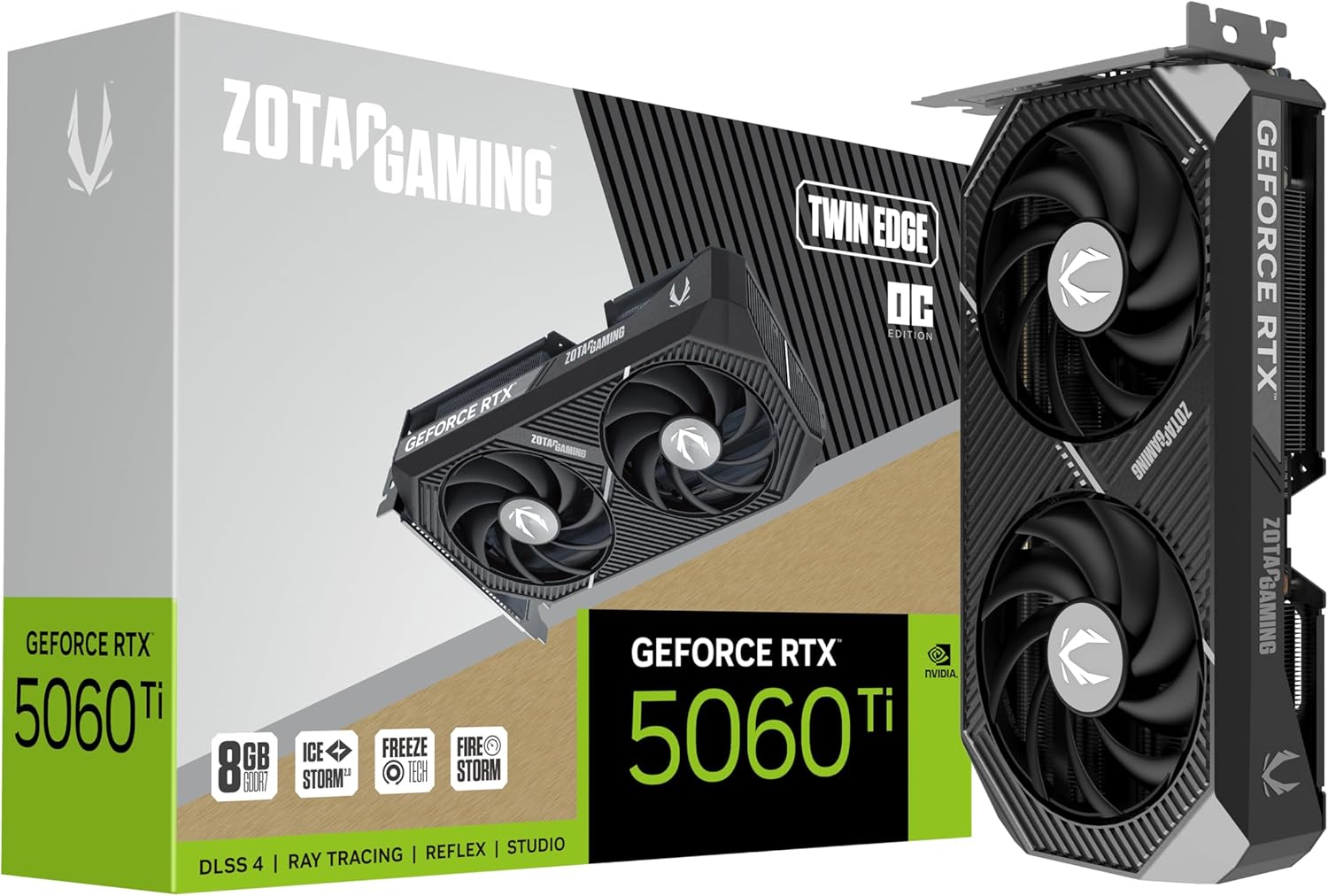
ZOTAC Gaming GeForce RTX 5060 Ti 8GB Twin Edge OC DLSS 4 8GB GDDR7 128-bit 28 Gbps PCIE 5.0 Gaming Graphics Card, IceStorm 2.0 Cooling, SFF-Ready, ZT-B50610H-10A
$300-$599This is a compact, 2-slot RTX 5060 Ti with 8GB GDDR7 and a 2602 MHz clock, built for SFF gaming rigs.