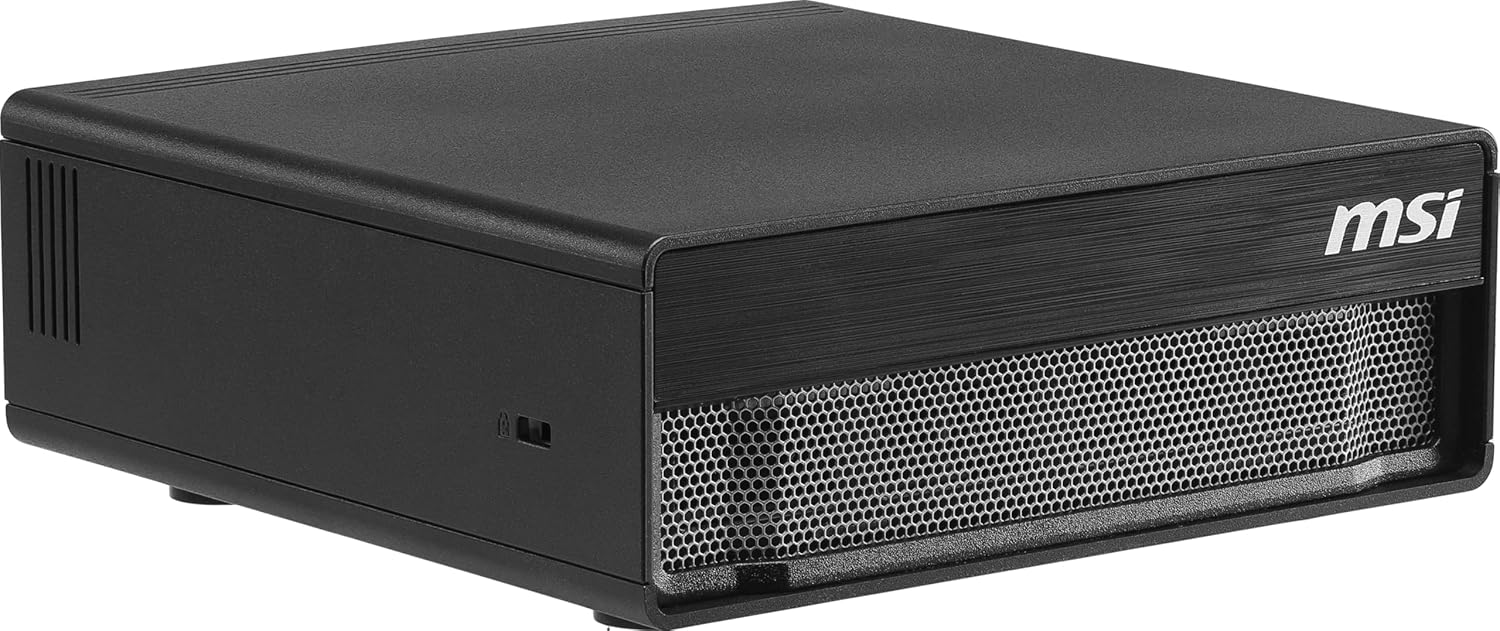
msi EdgeXpert AI Supercomputer Desktop, ARM CPU, NVIDIA GB10 Grace Blackwell Architecture, 128GB LPDDR5 Unified Memory, 4TB NVMe Gen5 SSD, WiFi 7, BT 5.3, NVIDIA DGX OS
Want the best price and purchase timing?
Our AI advisor analyzes real-time pricing across all channels to find you the best deal.
AI Verdict
This is a compact AI supercomputer with a 20-core Arm CPU, NVIDIA Blackwell GPU, and 128GB LPDDR5X unified memory, built for local AI development and high-performance computing.
This is a highly specialized machine, purpose-built for AI development with its NVIDIA GB10 Grace Blackwell Superchip, 128GB LPDDR5X unified memory, and NVIDIA DGX OS. It's a strong fit for professionals and researchers who need to run and scale large AI models locally, leveraging its high-performance ARM CPU and Blackwell GPU architecture.
If your primary need is raw inference speed for smaller models rather than large model development, consider systems with a dedicated, high-end consumer GPU like an RTX 5090.
Regret Score™
High RiskLower is better — measures purchase-regret risk from real buyer complaints, review credibility, and product maturity
Issues discovered after purchase
Critically weak dimension
Amazon rating vs actual quality
Chance this product isn't for you
Pros
- Features a 20-core Arm CPU with 10 Cortex-X925 cores at 3.8GHz and 10 Cortex-A725 cores at 3.25GHz for balanced power and efficiency.
- Equipped with NVIDIA Blackwell Architecture Graphic, delivering 1 petaFLOP of AI Tensor Performance for demanding AI workloads.
- Includes 128GB LPDDR5X unified system memory with 273 GB/s bandwidth, allowing for large model development and high-efficiency inference.
- Offers 4TB NVMe M.2 Gen5 self-encrypting storage for fast and secure data access.
- Provides advanced connectivity with WiFi 7, Bluetooth 5.3, 4x USB 3.2 Type C ports, a 10 GbE RJ-45 connector, and an NVIDIA ConnectX-7 Smart NIC.
- Comes pre-installed with NVIDIA DGX OS, an Ubuntu-based operating system optimized for AI development and machine learning.
Cons
- The Mini PC form factor and unified memory architecture limit traditional component upgrades for CPU, GPU, and RAM.
- The NVIDIA DGX OS, while optimized for AI, may present a learning curve for users accustomed to mainstream operating systems.
- Despite its 'supercomputer' designation, its raw inference speed is noted by some users as being less than a dedicated RTX 5090 GPU.
- Availability and widespread user adoption appear limited, with some users describing it as a 'mythical creature'.
Dimension Scores
The 20-core Arm CPU and NVIDIA Blackwell GPU deliver 1 petaFLOP of AI Tensor Performance, enabling complex AI workloads and large language model processing.
As a Mini PC with unified LPDDR5X memory and integrated GPU, user upgrades for core components like CPU, GPU, and RAM are not possible, though storage is a 4TB NVMe Gen5 M.2.
User feedback indicates the system runs 'cool to the touch and completely silent' even under load, thanks to its all-metal chassis and smart fan design.
The device features a durable all-metal chassis, suggesting a premium and robust construction for its compact form factor.
Best For
- AI developers and researchers needing a local platform for training and fine-tuning large language models up to 200 billion parameters.
- Data scientists requiring high-bandwidth memory and fast storage for massive datasets and complex computational tasks.
- Enterprises and startups prototyping and deploying edge AI applications in robotics, smart cities, or computer vision.
- Educational and research institutions seeking a cost-effective platform for large-scale model development without cloud reliance.
Not Recommended For
- Casual users or those primarily needing a desktop for general productivity tasks, web browsing, or gaming.
- Users expecting to upgrade CPU, GPU, or RAM components as they would in a traditional desktop PC.
Watch Out For
- The system's raw AI TOPS performance is estimated by one user to be about half that of an RTX 5090, which could disappoint those prioritizing peak inference speed over memory capacity.
- Despite its 'supercomputer' branding, some users find its price point doesn't offer significant savings compared to building a custom system, questioning its value proposition for certain use cases.
- The product's niche nature means it's not widely available or commonly seen, with one user calling it a 'mythical creature,' potentially leading to procurement challenges or limited community support.
Full Specifications
| RAM | 128 GB DDR5 |
| ASIN | B0G2P8WTL4 |
| Brand | msi |
| Color | Black |
| Series | EdgeXpert-13SUS |
| CPU Model | ARM Cortex A5 |
| CPU Speed | 3.25 GHz |
| Processor | 3.25 GHz ARM_Cortex_A5 |
| Hard Drive | 4 TB SSD |
| Item Weight | 2.65 pounds |
| Chipset Brand | NVIDIA |
| Wireless Type | 802.11ax, Bluetooth |
| Processor Brand | 20 core ARM |
| Card Description | Integrated |
| Operating System | NVIDIA DGX OS |
| Flash Memory Size | 4 TB |
| Item model number | EdgeXpert13S |
| Screen Resolution | 1920 x 1080 |
| Product Dimensions | 5.94 x 5.94 x 2.05 inches |
| Computer Memory Type | DDR5 RAM |
| Graphics Coprocessor | NVIDIA Blackwell Architecture |
| Hard Drive Interface | Solid State |
| Number of Processors | 1 |
| Max Screen Resolution | 1920x1080 |
| Graphics Card Ram Size | 128 GB |
| Item Dimensions LxWxH | 5.94 x 5.94 x 2.05 inches |
| Memory Storage Capacity | 4 TB |
| Number of USB 3.0 Ports | 4 |
| Graphics Card Description | Integrated |
| Ram Memory Installed Size | 128 GB |
| Specific Uses For Product | Business, Everyday Use, Multimedia |
| Personal computer design type | Mini PC |
What Buyers Say
The MSI EdgeXpert is a specialized AI supercomputer that users find particularly effective for developing and tuning large AI models due to its substantial 128GB unified memory, which is a significant advantage over consumer GPUs like the RTX 5090. While it might not match the raw inference speed of some dedicated gaming GPUs, it handles newer LLMs like gpt-oss:120b at 40 tps and Qwen3-coder:30B at over 80 tps, proving its capability for local AI tasks. Users appreciate its compact, all-metal chassis and quiet operation, even during intense workloads. The pre-installed NVIDIA DGX OS and ecosystem support for frameworks like CUDA, PyTorch, and TensorFlow streamline the AI development workflow.
“Dude, this thing is awesome for my LLM projects! It's not the fastest for pure inference, but that 128GB unified memory means I can actually load and mess with huge models without my system choking. Plus, it's dead quiet, which is a huge win for my home office setup.”
Common Praise
- The 128GB of unified RAM is tremendous for developing, tweaking, and tuning large AI models.
- Runs 'cool to the touch and completely silent' even when processing demanding AI tasks.
- Handles newer LLMs like gpt-oss:120b at 40 tps and Qwen3-coder:30B at over 80 tps locally.
- Features a durable all-metal chassis with effective airflow and thermal management.
- Integrates seamlessly with existing AI development frameworks like TensorFlow, PyTorch, and CUDA.
Common Complaints
- Perceived as less powerful for raw inference compared to a dedicated RTX 5090 GPU.
- The 'DGX Spark' platform is considered niche and not widely available or seen by many users.
- Some users question the cost-effectiveness compared to alternative setups for specific AI tasks.
Ownership Tips
- The NVIDIA DGX OS, being Ubuntu-based, provides a robust environment but requires familiarity with Linux for optimal use.
- The ConnectX-7 Smart NIC allows for seamless dual-system configuration to scale AI models up to 405 billion parameters, which is a game-changer for larger projects.
- The compact size (1.2 kg, 1.19L) makes it surprisingly portable for an AI supercomputer.
- The 4x USB 3.2 Type C ports offer versatile connectivity, including video output, which is handy for multi-display setups.
Frequently Asked Questions
What operating system does the MSI EdgeXpert use?
It comes pre-installed with NVIDIA DGX OS, which is based on Ubuntu and optimized for AI development, machine learning, and high-performance computing applications.
Can I upgrade the RAM or GPU in this desktop?
No, the system features 128GB LPDDR5X unified system memory and an integrated NVIDIA Blackwell Architecture Graphic, meaning these components are not user-upgradable.
What kind of AI workloads is this system designed for?
It's designed for running and scaling large language models (LLMs) locally up to 200 billion parameters, accelerating model tuning, real-time inference, and developing edge AI applications.
How does its performance compare to a high-end consumer GPU like an RTX 5090?
While it offers 1 petaFLOP of AI Tensor Performance and massive unified memory for model development, one user noted its raw AI TOPS for inference is about half that of an RTX 5090.
What are the physical dimensions of the MSI EdgeXpert?
It has a compact Mini PC form factor, measuring 151mm x 151mm x 52mm and weighing 1.2 kg.
Does it support multi-monitor setups?
Yes, it includes one HDMI 2.1a port and supports up to three DisplayPort outputs via its USB-C ports.
Buying Guide
When you're looking at an AI supercomputer like this, you're not buying a typical desktop. You're investing in specialized hardware designed to accelerate complex AI and machine learning tasks locally. The key here is the 'unified memory' and 'Blackwell architecture' – it means the CPU and GPU share a massive pool of fast memory, which is crucial for handling large AI models that wouldn't fit on a standard GPU's VRAM. Don't expect to game on this, or upgrade parts like you would a gaming PC.
NVIDIA GB10 Grace Blackwell Architecture
This isn't just a GPU; it's a superchip combining an Arm CPU and Blackwell GPU. It's engineered for AI, offering immense parallel processing power and specialized tensor cores to crunch through AI calculations much faster than general-purpose processors, like a dedicated calculator for AI math.
128GB LPDDR5X Unified Memory
Think of this as a massive, super-fast workspace shared by both the CPU and GPU. For AI, especially large language models, having this much memory directly accessible by the GPU prevents bottlenecks and allows you to load and manipulate models that would otherwise be too big for typical GPU VRAM, like having a huge whiteboard for complex equations.
NVIDIA DGX OS
This isn't Windows; it's a Linux-based operating system specifically tuned by NVIDIA for AI development. It comes with pre-installed frameworks and tools (like CUDA, PyTorch, TensorFlow) that are essential for AI work, meaning less setup time and more time coding, like getting a workshop with all the right tools already laid out.
ConnectX-7 Smart NIC
This is a high-speed network interface that allows you to link multiple EdgeXpert units together for even greater AI processing power. It's like having a super-fast data highway between your supercomputers, enabling them to work together on even larger problems.
Alternatives
If this doesn't fit, look for systems with a high-end consumer GPU (like an RTX 5090) for raw inference speed, or cloud-based AI platforms if you prefer a subscription model over local hardware.
You Might Also Like

HP ProOne 600 G4 All-in-One Desktop Computer 21.5" FHD PC, Intel Core i5-8500T, 8GB RAM, 256GB SSD, Keyboard & Mouse, USB WiFi & BT, Windows 11 Pro (Renewed)
$150-$299This is a renewed 21.5-inch FHD All-in-One with an 8th Gen Intel Core i5-8500T, 8GB RAM, and 256GB SSD, best for basic office tasks and web browsing.

GEEKOM A9 Max AI Mini PC, with AMD Ryzen AI 9 HX 370 (80 Tops), Copilot+ PC, Radeon 890M, 32GB DDR5 (Not LPDDR), 1TB SSD, Win 11 Pro, WiFi 7, BT 5.4, USB4, HDMI 2.1, Dual 2.5GbE, 8K, 3-Year Warranty
$600+A mini PC with an AMD Ryzen AI 9 HX 370 processor and Radeon 890M graphics, designed for AI workloads and 1080p gaming.

Bmax Mini PC B1 Pro Intel Gemini Lake N4000 (Up to 2.6GHz), 8GB LPDDR4 128GB eMMC Support M.2 SSD Expansion (512GB/2TB), 4K Dual Display 2.4G/5G WiFi & BT4.2 Mini Desktop Computer for Home/Office
$150-$299This is a fanless mini PC with an Intel N4000 processor, 8GB LPDDR4, and 128GB eMMC, designed for basic office tasks and web browsing.

Lenovo 24" ThinkCentre All-in-One Desktop Computer • 6-core AMD Ryzen 5 Processor • 16GB DDR5 • 512GB SSD • Wi-Fi 6 • HDMI in&Out • Wired KB&Mouse • Windows 11 Pro
$600+This is a 24-inch FHD IPS AIO with an AMD Ryzen 5 220 processor, 16GB DDR5 RAM, and a 512GB SSD, built for everyday productivity and light creative tasks.