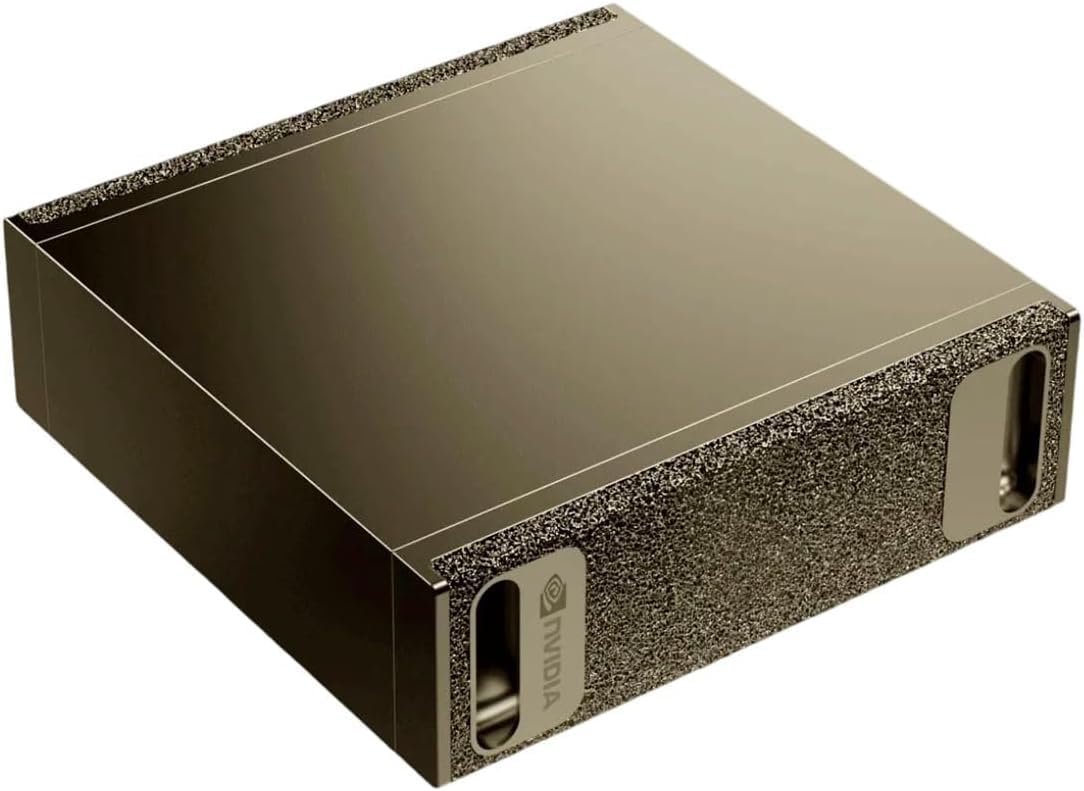
NVIDIA DGX Spark™ - Personal AI Desktop Supercomputer – Desktop GB10 Grace Blackwell Chip
Want the best price and purchase timing?
Our AI advisor analyzes real-time pricing across all channels to find you the best deal.
AI Verdict
A compact Mini PC with 128GB unified memory and 1 petaFLOP AI performance, built for local AI model fine-tuning and inference.
This is a highly specialized tool for AI development, offering a massive 128GB unified memory pool and NVIDIA's comprehensive software ecosystem in a compact form factor. Its strength lies in handling large AI models locally, but its LPDDR5X memory bandwidth and premium price point make it less suitable for general computing or tasks not optimized for FP4 precision.
If unified memory isn't the absolute priority, look for systems with higher memory bandwidth (e.g., GDDR7 VRAM) for faster inference decode or general GPU compute.
Regret Score™
High RiskLower is better — measures purchase-regret risk from real buyer complaints, review credibility, and product maturity
Issues discovered after purchase
Critically weak dimension
Amazon rating vs actual quality
Chance this product isn't for you
Pros
- Features 128GB of unified LPDDR5X memory, enabling local processing of large AI models up to 200 billion parameters.
- Delivers up to 1 petaFLOP of AI performance at FP4 precision for accelerated AI tasks.
- Comes with the full NVIDIA AI software stack pre-installed, allowing out-of-the-box AI development.
- Operates with quiet cooling and exhibits stable performance.
- Includes 200GbE networking via ConnectX-7, facilitating high-speed data transfer.
- Compact form factor (150 x 150 x 50.5 mm) brings AI supercomputing to the desktop.
Cons
- Memory bandwidth of 273 GB/s LPDDR5X is lower compared to systems with dedicated GDDR7 VRAM, impacting certain inference tasks.
- High price point, with the Founders Edition increasing to $4,699 as of February 2026.
- Not designed for general productivity, content creation, or gaming.
- Exhibits slower generation throughput (decode stage) for inference compared to multi-GPU rigs.
- Users have reported immature display drivers and early software limitations.
Dimension Scores
Delivers 1 petaFLOP of AI performance at FP4 precision and features a 20-core ARM CPU, but LPDDR5X memory bandwidth is 273 GB/s.
As a Mini PC with an integrated GB10 Grace Blackwell Superchip, internal expansion options are minimal.
User feedback indicates quiet operation and efficient cooling, even under load.
Reviewers describe it as a 'gorgeous piece of engineering' in a compact 150 x 150 x 50.5 mm form factor.
Best For
- AI model fine-tuning and experimentation with large language models (up to 200 billion parameters).
- Local inference of complex AI models, reducing reliance on cloud infrastructure.
- Developers deeply integrated into the NVIDIA AI software ecosystem.
- Edge AI applications requiring compact, energy-efficient AI compute.
Not Recommended For
- Users seeking a general-purpose workstation for tasks like gaming or video editing.
- Budget-conscious buyers looking for cost-effective AI compute solutions.
- Users prioritizing raw memory bandwidth for all GPU-intensive tasks.
Watch Out For
- The memory bandwidth of 273 GB/s LPDDR5X can be a bottleneck for some inference tasks, making it slower than systems with higher GDDR7 bandwidth.
- The price increased to $4,699 in February 2026, making it significantly more expensive than some alternatives for comparable performance in certain benchmarks.
- It is not a replacement for a full workstation PC, and its performance for non-AI tasks is not a primary focus.
- Early adopters noted immature display drivers and software limitations, which could affect initial user experience.
Full Specifications
| RAM | 128 GB DDR5 |
| ASIN | B0FWJ16CCH |
| Brand | NVIDIA |
| Color | Gold |
| Series | NVIDIA DGX Spark |
| CPU Model | Cortex |
| CPU Speed | 3.8 GHz |
| Processor | 3.8 GHz cortex |
| Cache Size | 24 |
| Hard Drive | 4 TB SSD |
| Item Weight | 6.67 pounds |
| Processor Brand | ARM |
| Card Description | Dedicated |
| Operating System | NVIDIA DGX OS |
| Flash Memory Size | 128 GB |
| Item model number | DGX Spark |
| Screen Resolution | 3840 x 2160 |
| Product Dimensions | 9.5 x 9.5 x 6 inches |
| Computer Memory Type | DDR5 RAM |
| Graphics Coprocessor | Integrated Graphics |
| Hard Drive Interface | Solid State |
| Number of Processors | 20 |
| Max Screen Resolution | 3840x2160 |
| Graphics Card Ram Size | 128 GB |
| Item Dimensions LxWxH | 9.5 x 9.5 x 6 inches |
| Memory Storage Capacity | 4 TB |
| Number of USB 3.0 Ports | 4 |
| Graphics Card Description | Dedicated |
| Specific Uses For Product | Business, Education |
| Personal computer design type | Mini PC |
What Buyers Say
The most surprising finding is the strong praise for its ability to run large models locally due to 128GB unified memory, despite its lower memory bandwidth compared to discrete GPUs. Users appreciate the out-of-the-box NVIDIA AI software stack and its quiet operation. However, the high price point and limitations in raw memory bandwidth for certain inference tasks are recurring complaints. Some users also noted early software limitations and immature display drivers.
“I bought this thing thinking it would be a beast for everything, but honestly, for the price, the memory bandwidth is a real letdown for some of my inference stuff. Still, being able to run those huge models locally without cloud costs is kinda wild.”
Common Praise
- Runs large models like Llama 3.1 70B and Gemma 3 27B directly from unified memory.
- Out-of-the-box NVIDIA AI software stack saves development time.
- Quiet cooling and stable operation.
- Compact form factor (150 x 150 x 50.5 mm).
- Excellent batching efficiency and strong throughput consistency for smaller models.
Common Complaints
- Lower memory bandwidth (273 GB/s LPDDR5X) is a bottleneck compared to discrete GPUs.
- High price point, especially after a price increase to $4,699.
- Not suitable for general productivity, content creation, or gaming.
- Slower generation throughput (decode stage) for inference compared to multi-GPU rigs.
- Immature display drivers and early software limitations.
Ownership Tips
- The 128GB unified memory genuinely allows for local experimentation with models that would otherwise require cloud resources.
- The pre-installed NVIDIA AI software stack makes setup straightforward for AI development.
- It's not a replacement for a high-end gaming PC or general workstation.
- The 200GbE networking is a significant feature for connecting to other DGX systems or high-speed storage.
- The quiet operation is a real plus for a desktop unit.
Frequently Asked Questions
What kind of AI performance can I expect?
You can expect up to 1 petaFLOP of AI performance at FP4 precision, enabling the system to run AI models with up to 200 billion parameters locally.
Is the NVIDIA DGX Spark suitable for gaming?
No, it is not designed for gaming or general productivity tasks. Its architecture and software stack are optimized specifically for AI development.
What is the memory bandwidth of the DGX Spark?
It features 128GB of unified LPDDR5X memory with a bandwidth of 273 GB/s.
Can I use it for training large AI models?
It excels at inference and fine-tuning large models that fit its 128GB unified memory, especially with FP4 precision. For brute-force training, systems with higher GDDR7 bandwidth might offer faster performance.
What operating system does the DGX Spark run?
It runs on NVIDIA DGX OS, which is pre-configured with the full NVIDIA AI software stack for seamless development.
Buying Guide
This isn't a typical desktop computer. It's a specialized tool for AI development, designed to bring serious AI compute to your desk. You're paying for the ability to run large AI models locally with a massive amount of unified memory, and access to NVIDIA's full AI software ecosystem. Don't expect it to replace your gaming rig or everyday workstation.
128 GB DDR5 RAM (Unified Memory)
This isn't just regular system RAM; it's shared between the CPU and GPU, allowing the system to load and process extremely large AI models (up to 200 billion parameters) that would overwhelm typical GPUs with limited VRAM. Think of it like a massive shared workspace for your AI projects.
1 petaFLOP AI performance (FP4)
This number indicates its raw AI processing power, specifically when using 4-bit precision. It means it can perform a quadrillion (1,000,000,000,000,000) floating-point operations per second for AI tasks, making it very fast for inference and fine-tuning.
NVIDIA DGX OS & AI Software Stack
This isn't Windows or macOS; it's a specialized operating system pre-configured with all the NVIDIA tools and libraries you need for AI development. It's like buying a car with a custom-tuned engine and all the racing software pre-installed, ready to go.
Alternatives
If you need higher raw memory bandwidth for general GPU compute or faster inference decode on smaller models, look for systems with dedicated GPUs featuring GDDR7 VRAM. If you're on a tighter budget and don't need the NVIDIA ecosystem, consider systems with high-end AMD or Apple silicon.
You Might Also Like

HP ProOne 600 G4 All-in-One Desktop Computer 21.5" FHD PC, Intel Core i5-8500T, 8GB RAM, 256GB SSD, Keyboard & Mouse, USB WiFi & BT, Windows 11 Pro (Renewed)
$150-$299This is a renewed 21.5-inch FHD All-in-One with an 8th Gen Intel Core i5-8500T, 8GB RAM, and 256GB SSD, best for basic office tasks and web browsing.

GEEKOM A9 Max AI Mini PC, with AMD Ryzen AI 9 HX 370 (80 Tops), Copilot+ PC, Radeon 890M, 32GB DDR5 (Not LPDDR), 1TB SSD, Win 11 Pro, WiFi 7, BT 5.4, USB4, HDMI 2.1, Dual 2.5GbE, 8K, 3-Year Warranty
$600+A mini PC with an AMD Ryzen AI 9 HX 370 processor and Radeon 890M graphics, designed for AI workloads and 1080p gaming.

Bmax Mini PC B1 Pro Intel Gemini Lake N4000 (Up to 2.6GHz), 8GB LPDDR4 128GB eMMC Support M.2 SSD Expansion (512GB/2TB), 4K Dual Display 2.4G/5G WiFi & BT4.2 Mini Desktop Computer for Home/Office
$150-$299This is a fanless mini PC with an Intel N4000 processor, 8GB LPDDR4, and 128GB eMMC, designed for basic office tasks and web browsing.

Lenovo 24" ThinkCentre All-in-One Desktop Computer • 6-core AMD Ryzen 5 Processor • 16GB DDR5 • 512GB SSD • Wi-Fi 6 • HDMI in&Out • Wired KB&Mouse • Windows 11 Pro
$600+This is a 24-inch FHD IPS AIO with an AMD Ryzen 5 220 processor, 16GB DDR5 RAM, and a 512GB SSD, built for everyday productivity and light creative tasks.