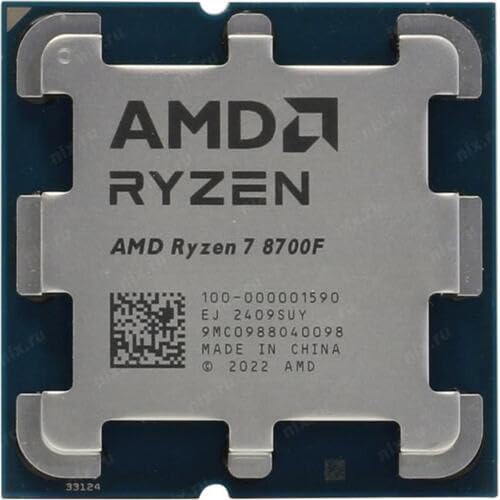
Empowered PC AMD Ryzen 7 8700F 8-Core Desktop Processor: 16 Threads, 65W TDP with 125W TDP CPU Cooler, 16MB L3 Cache, PCIe 4.0, up to 5.0 GHz Boost, AM5, Zen 4, DDR4, Precision Boost 2, OEM Tray
Want the best price and purchase timing?
Our AI advisor analyzes real-time pricing across all channels to find you the best deal.
AI Verdict
This is an 8-core, 16-thread Zen 4 processor with a 4.1 GHz base clock and 5.0 GHz boost, designed for AM5 systems requiring a dedicated GPU.
This 8-core, 16-thread Zen 4 processor with a 65W TDP is a solid foundation for a gaming or productivity PC, especially if you already have a discrete GPU. Its AM5 socket ensures platform longevity, but the comparatively low 16MB L3 cache might make it a less optimal choice for specific gaming scenarios compared to other Ryzen options.
If gaming performance, particularly 0.1% lows, is a top priority, consider CPUs with larger L3 cache configurations, even if they have fewer cores, or those specifically designed for gaming like X3D variants.
Regret Score™
Low RiskLower is better — measures purchase-regret risk from real buyer complaints, review credibility, and product maturity
Issues discovered after purchase
Critically weak dimension
Amazon rating vs actual quality
Chance this product isn't for you
Pros
- Features 8 cores and 16 threads, suitable for demanding tasks and multitasking.
- Achieves a maximum boost clock of up to 5.0 GHz, providing substantial processing power.
- Built on the Zen 4 architecture with a 4nm FinFET process, indicating modern efficiency.
- Includes a 125W TDP CPU cooler, which is more than adequate for its 65W TDP.
- Supports PCIe 4.0 for high-speed data transfer with compatible components.
- Integrates NPU technology for AI acceleration, enhancing specific software performance.
Cons
- L3 cache is 16MB, which some early analyses suggest is comparatively low for an 8-core Zen 4 CPU, potentially impacting gaming performance in some scenarios.
- Requires a discrete GPU as it does not include integrated graphics.
- The product is an OEM Tray version, meaning no retail packaging is included, which might be less appealing for some buyers.
- The provided product data incorrectly lists DDR4 memory support; the AM5 platform and this CPU actually support DDR5-5200.
Dimension Scores
The 5.0 GHz boost clock on the Zen 4 architecture provides strong single-thread performance for most applications.
With 8 cores and 16 threads, this CPU offers above-average multi-threaded capabilities for productivity and content creation tasks.
A 65W TDP for an 8-core Zen 4 processor is highly efficient, especially considering its performance capabilities.
Utilizing the AM5 socket and Zen 4 architecture, this CPU is on AMD's newest platform, offering good future upgrade potential.
Best For
- Users building a new AM5 system for gaming with a dedicated graphics card.
- Content creators needing 8 cores and 16 threads for multi-threaded applications.
- Individuals looking for a power-efficient 65W TDP processor for sustained workloads.
- Early adopters interested in AI acceleration features provided by the NPU.
Not Recommended For
- Users expecting integrated graphics for a system without a discrete GPU.
- Budget-conscious builders seeking the absolute best value per dollar, as early reviews question its positioning against other Ryzen CPUs.
- Users prioritizing maximum L3 cache for specific gaming titles that benefit heavily from it.
Watch Out For
- The CPU's 16MB L3 cache is considered 'anemic' by some early reviewers compared to other Ryzen 5 CPUs like the 8400F or 7500F, which have double the L3 cache, potentially leading to 'odd 0.1% lows' in gaming benchmarks.
- This is an OEM Tray processor, meaning it lacks the standard retail box and potentially some documentation or accessories typically found with boxed versions.
- The product data incorrectly states DDR4 memory support; the AM5 platform exclusively uses DDR5, specifically DDR5-5200 for this CPU, which could confuse buyers.
Full Specifications
| ASIN | B0FG4DZH4Y |
| Brand | Empowered PC |
| Series | Ryzen 7 8700F |
| CPU Model | AMD R Series |
| CPU Speed | 4.1 GHz |
| Processor | 4.1 GHz amd_r_series |
| Model Name | Ryzen 7 8700F |
| Item Weight | 1 pounds |
| Processor Brand | AMD |
| CPU Manufacturer | AMD |
| Card Description | Integrated |
| Operating System | Windows |
| Hardware Platform | PC |
| Item model number | 8700F |
| Screen Resolution | 1920 x 1080 |
| Package Dimensions | 6 x 6 x 3 inches |
| Included Components | CPU Cooler |
| Computer Memory Type | DDR4 SDRAM |
| Graphics Coprocessor | Integrated Graphics |
| Number of Processors | 8 |
| Max Screen Resolution | 1920x1080 |
| Graphics Card Description | Integrated |
| Personal computer design type | Computer Tower |
What Buyers Say
As of March 29, 2026, general consumer reviews for the Empowered PC AMD Ryzen 7 8700F are not available due to its future release date of June 30, 2025. However, early analyses and reviewer videos from late 2024 provide some insights. These suggest the CPU offers very good gaming performance but highlight a potential concern regarding its 16MB L3 cache, which is considered less generous than some other Ryzen CPUs and might lead to 'odd 0.1% lows' in certain games. The inclusion of NPU technology for AI acceleration is also noted.
“Man, I'm kinda torn on this 8700F. It's got the cores and threads, but that L3 cache thing for gaming has me wondering if I should just wait or grab something else with more cache, even if it costs a bit more.”
Common Praise
- Very good gaming performance reported in early tests.
- Efficient 65W TDP for an 8-core, 16-thread processor.
- AI acceleration capabilities through integrated NPU technology.
- Modern Zen 4 architecture on the AM5 platform.
Common Complaints
- The 16MB L3 cache is considered 'anemic' compared to other Ryzen CPUs, potentially affecting gaming performance.
- Not considered a 'great value proposition' by some early reviewers when compared to existing alternatives.
- Lack of integrated graphics requires a separate GPU.
Ownership Tips
- No general consumer ownership notes are available as the product is not yet released.
Frequently Asked Questions
Does the AMD Ryzen 7 8700F come with a CPU cooler?
Yes, the Empowered PC version of the AMD Ryzen 7 8700F includes a 125W TDP Wraith Stealth CPU Cooler [Product Data].
Does the Ryzen 7 8700F have integrated graphics?
No, the Ryzen 7 8700F does not have integrated graphics; its iGPU is disabled, so a dedicated graphics card is required for display output.
What motherboard socket does the Ryzen 7 8700F use?
The AMD Ryzen 7 8700F uses the AM5 socket, which is AMD's current-generation desktop platform.
What type of RAM does the Ryzen 7 8700F support?
The Ryzen 7 8700F, being an AM5 processor, supports DDR5 memory, specifically up to DDR5-5200. The product listing's mention of DDR4 is incorrect.
Is the Ryzen 7 8700F suitable for gaming?
With 8 cores and 16 threads and a boost clock up to 5.0 GHz, the 8700F is capable of very good gaming performance, though some early analyses suggest its L3 cache might be a bottleneck in certain games.
Buying Guide
When you're looking at a CPU like the Ryzen 7 8700F, you need to think about what you're actually going to do with your computer. This isn't just about the fastest clock speed; it's about how many tasks it can handle at once (cores/threads), how quickly it can access data (cache), and how much power it uses. Since this one doesn't have built-in graphics, you'll definitely need a separate graphics card, so factor that into your budget.
Cores / Threads (8 Cores / 16 Threads)
Think of cores as individual workers and threads as their ability to multitask. More cores and threads mean the CPU can handle more programs or complex tasks simultaneously, like running a game while streaming or editing video, without slowing down.
Boost Clock (up to 5.0 GHz)
This is the maximum speed a single core can reach when a demanding task needs extra oomph. It's like a car's turbo boost – it kicks in for short bursts to make things feel snappier, especially in games or single-threaded applications.
TDP (65W)
TDP, or Thermal Design Power, tells you how much heat the CPU can generate under typical workloads. A lower TDP means it's more power-efficient and generally easier to cool, which can save you money on electricity and allow for quieter cooling solutions.
L3 Cache (16MB)
Cache is super-fast memory right on the CPU that stores frequently used data, so the processor doesn't have to fetch it from slower system RAM. A larger L3 cache can significantly improve performance in certain applications and games by reducing data access latency.
Alternatives
If you need integrated graphics, look for CPUs with 'G' in their model name. If you prioritize maximum gaming performance, especially for competitive titles, consider CPUs with larger L3 cache amounts or those specifically designed for gaming performance.
You Might Also Like

INTEL INTEL XEON Gold 6246R Processor (35.75M Cache, 3.40 GHZ)
$600+This is a 1-core, 3.40 GHz Xeon Gold processor designed for highly specialized server tasks, not general computing.

INTEL INTEL XEON Gold 6250 Processor (35.75M Cache, 3.90 GHZ)
$600+This is a 1-core, 3.9 GHz Intel Xeon Gold processor with 35.75MB cache, making it an unusual fit for demanding data center workloads.

AMD Ryzen 5 3600 6-Core, 12-Thread Unlocked Desktop Processor with Wraith Stealth Cooler
This 6-core, 12-thread AM4 processor with a 4.2 GHz max boost is for budget PC builders needing 100+ FPS in 1080p games and basic multitasking.

AMD Ryzen 7 3700X 8-Core, 16-Thread Unlocked Desktop Processor with Wraith Prism LED Cooler
An 8-core, 16-thread AM4 processor with a 4.4 GHz max boost, bundled with an RGB cooler, suitable for multi-threaded tasks.